Inspiration
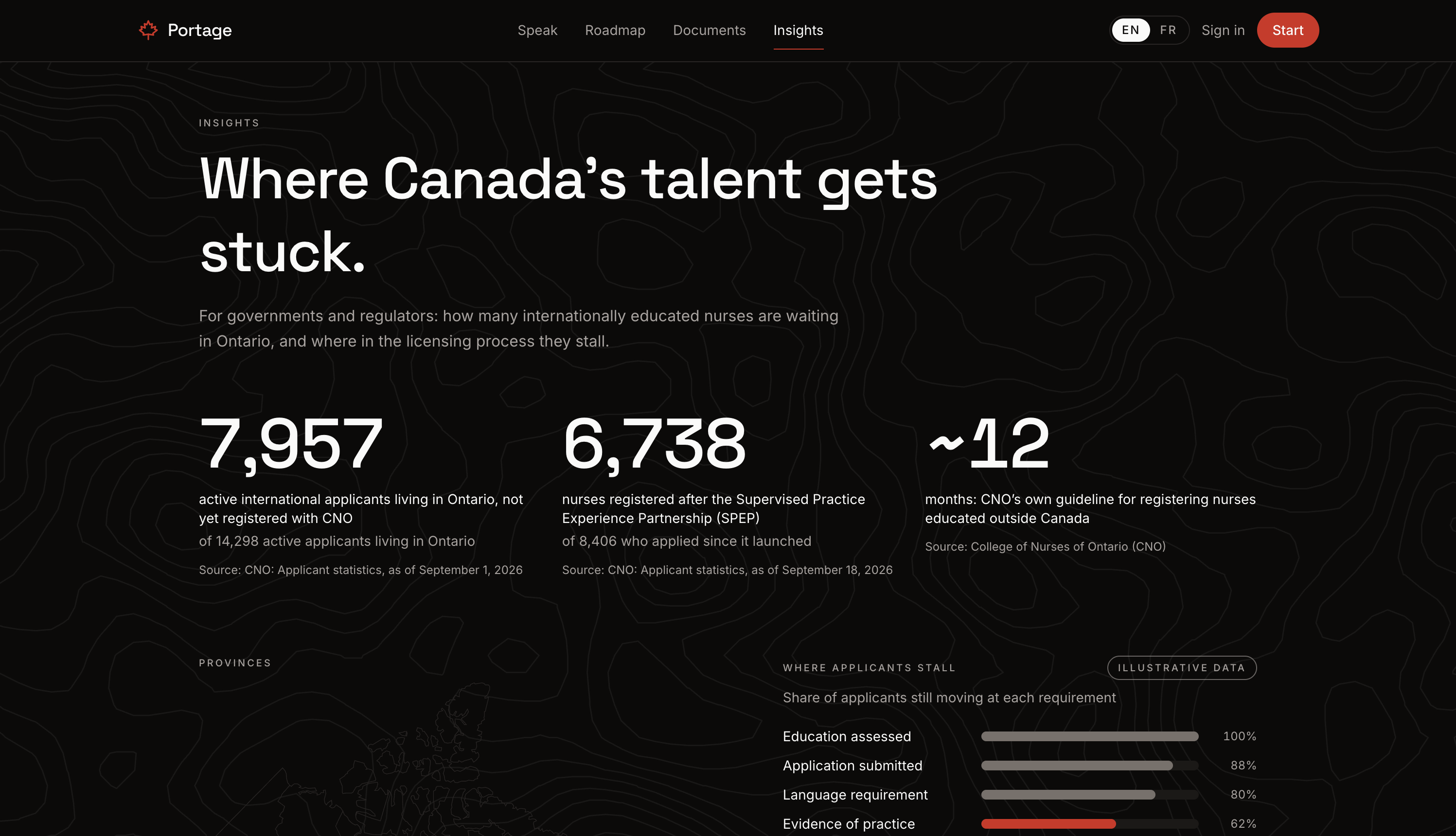
Canada needs nurses, and thousands of internationally educated nurses already live here. As of September 1, 2026, 7,957 internationally educated applicants living in Ontario were still waiting to register with the College of Nurses of Ontario (CNO). To get licensed, a nurse educated abroad has to meet nine separate requirements across several organizations, and CNO's own guideline is about 12 months. Nobody shows you your path: which steps apply to you, what order to do them in, and which deadlines can quietly derail you.
This summer, federal, provincial and territorial labour ministers committed to building a digital platform to simplify credential recognition, with recommendations due this fall. We built the prototype this weekend.
What it does
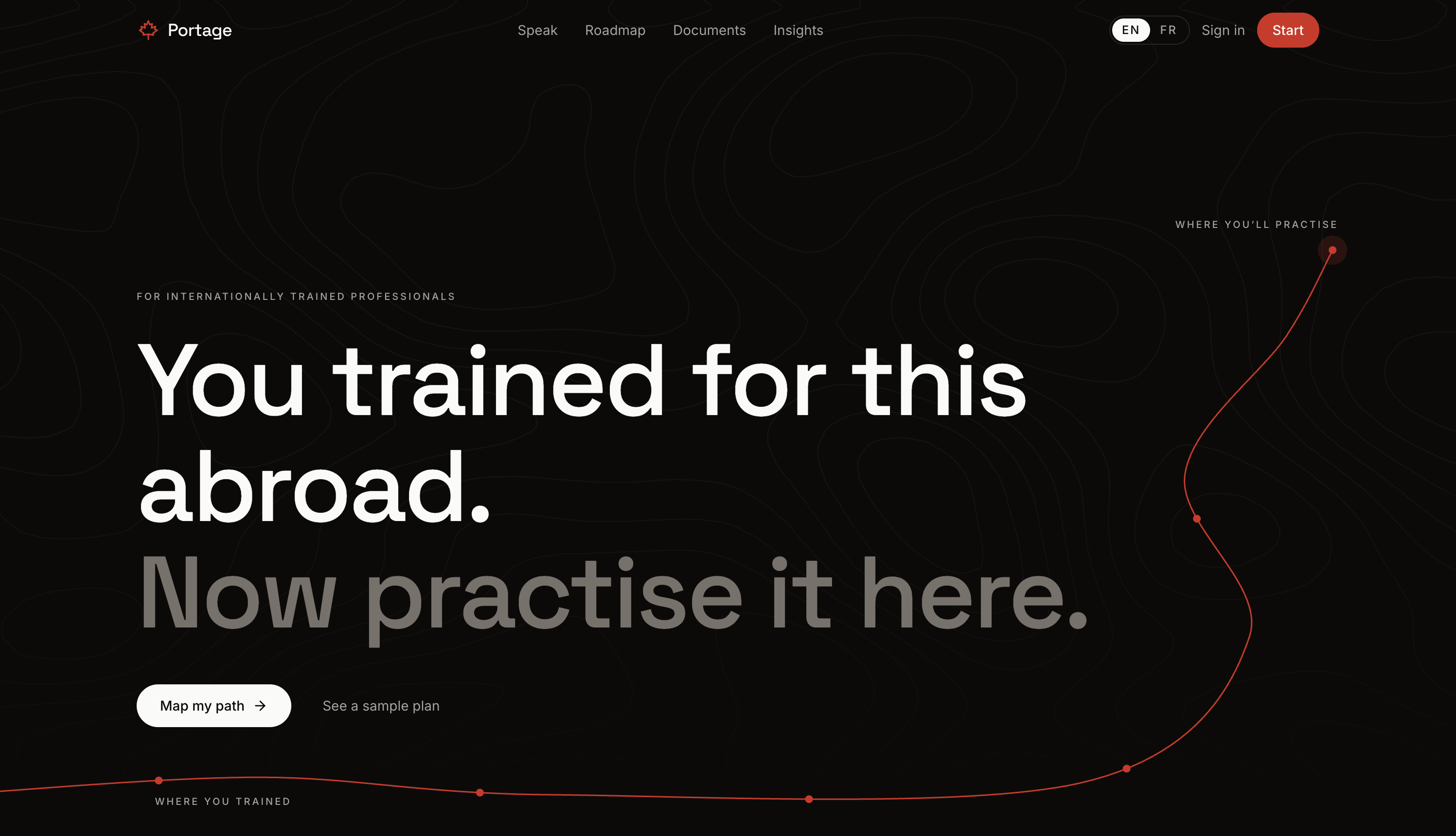
Portage turns the licensing maze into a personal, cited, deadline-aware roadmap, starting with internationally educated nurses becoming Registered Nurses in Ontario.
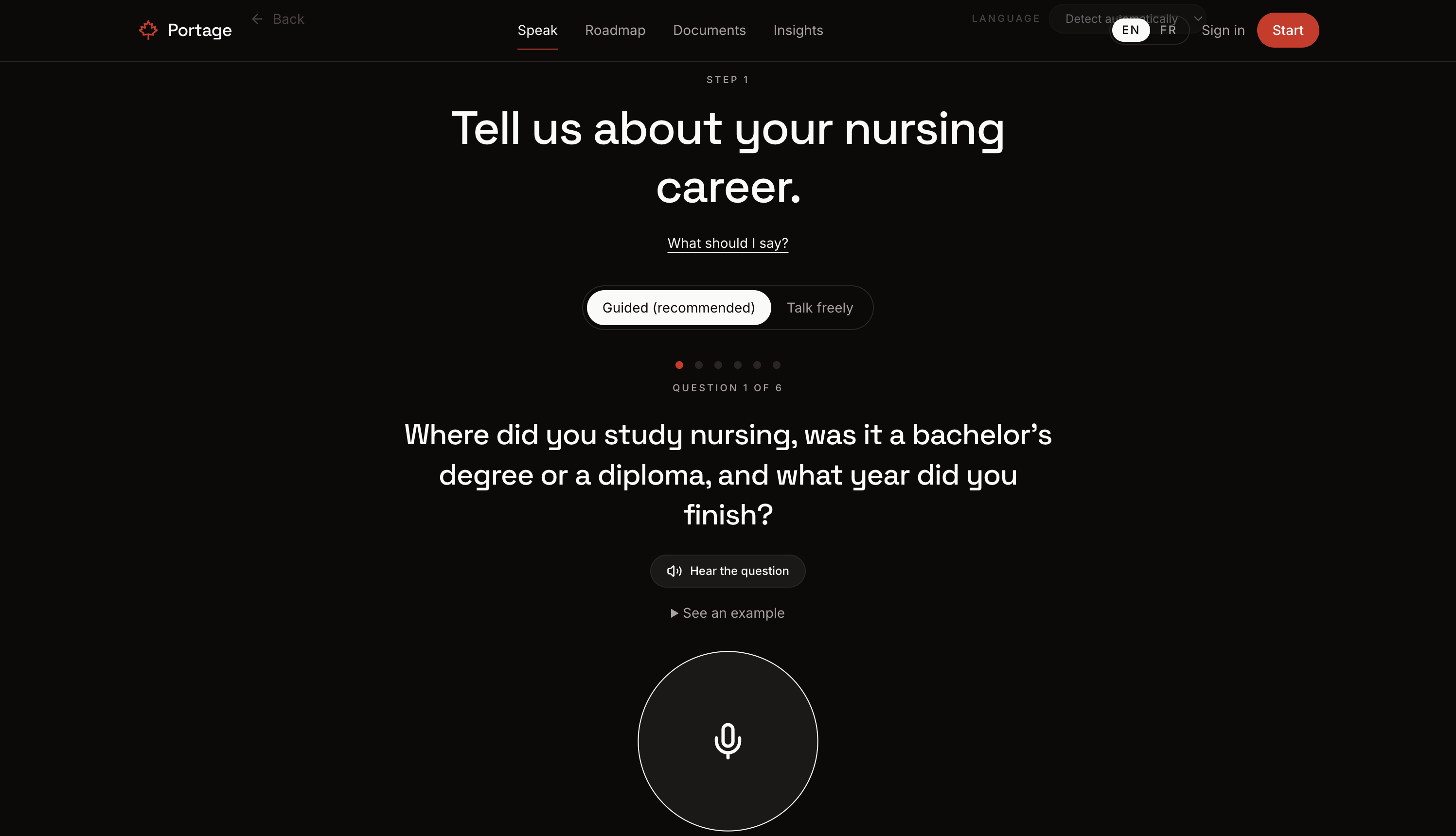
- Guided voice interview: Portage asks six short questions, one at a time, spoken in your language (English, French, Hindi, Punjabi, Urdu, Tagalog, Arabic, Spanish or Mandarin). You answer in your own words, and AI turns your answers into a structured profile.
- Profile: everything Portage knows about you in one place, from your voice and your documents. Every field shows where it came from, and you can edit any of it. When a document disagrees with what you said (for example, your legal name), Portage asks you instead of guessing.
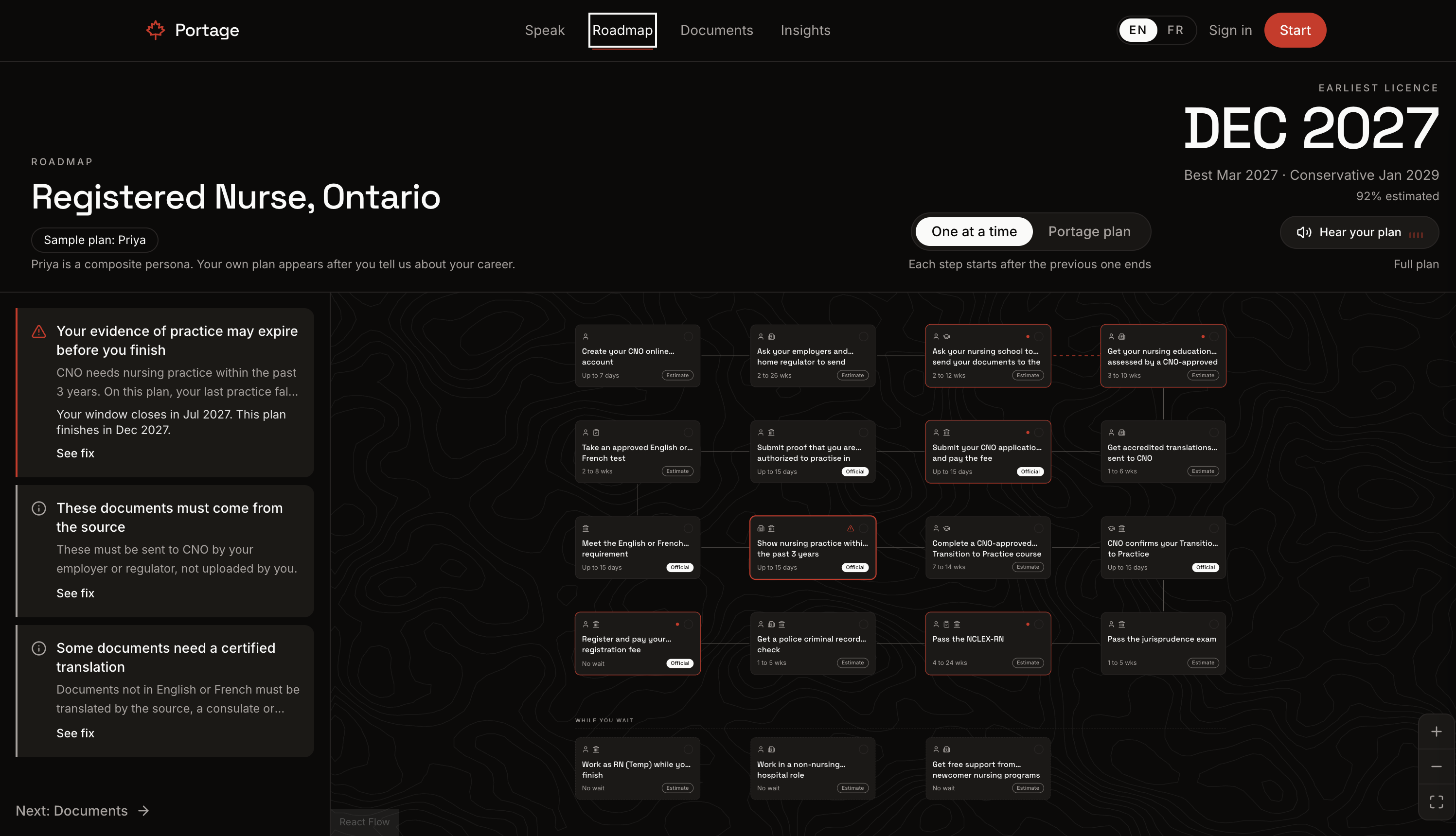
- Roadmap: every CNO requirement as steps on an interactive map, each linked to its official source, with official processing times and estimates clearly labelled. Compare "one step at a time" with the "Portage plan", which runs independent steps in parallel along the critical path.
- Deadline intelligence: Portage tracks rules like CNO's 3-year evidence-of-practice window, the 6-month police check validity and the 2-year application window. For our demo persona, one step at a time finishes in December 2027, after her evidence of practice expires in July 2027. The Portage plan reaches April 2027, and Portage honestly marks it "tight": it only works if each step goes to plan, and it shows exactly which steps protect her window.
- Hear your plan: your plan read aloud in your language.
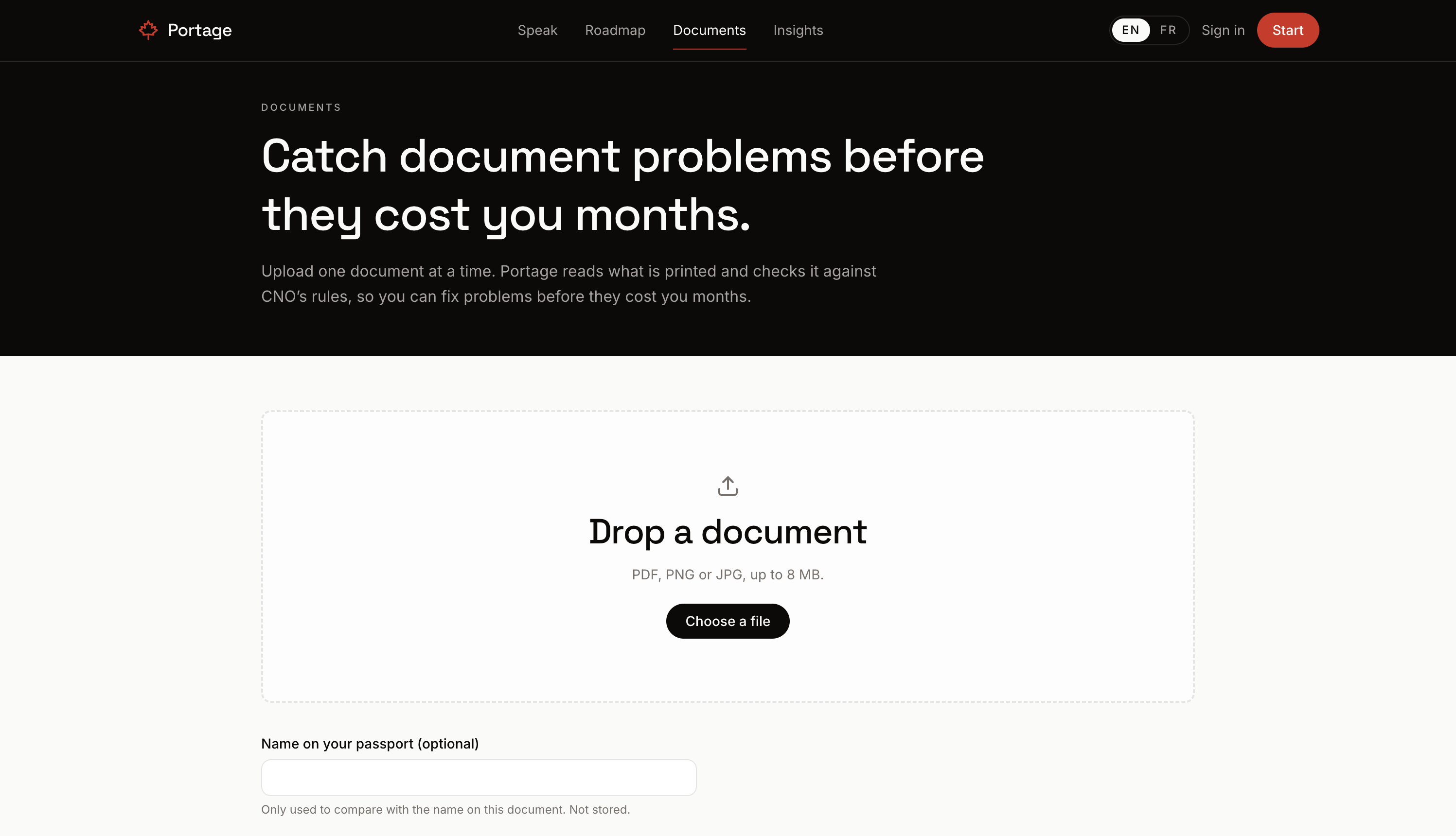
- Document pre-check: upload a document and Portage flags problems before you send it, such as a police check from the wrong provider, one that will expire before you register, or a letter that must come directly from your employer.
- Insights for government: real CNO applicant statistics and a view of where people get stuck, the evidence a national credential-recognition platform needs.
- Fully bilingual: English and French, one language at a time.
How we built it
- Next.js, React and TypeScript, deployed on Vercel, with Tailwind CSS, GSAP for motion and React Flow for the roadmap canvas.
- A deterministic pathway engine that computes applicability, a one-at-a-time schedule, a critical-path (parallel) schedule with best, typical and conservative ranges, and deadline warnings per schedule. It is pure TypeScript, covered by golden tests for three personas and a property test over 200 random profiles.
- Sourced pathway data: every step, fee and processing time was verified against official CNO pages and linked in the data. Every duration is tagged "official" or "estimate".
- AI only where it adds value: ElevenLabs Scribe transcribes speech in any language, and Claude extracts structured facts from what people say and from uploaded documents through forced tool use validated with Zod. The AI never invents requirements or dates; the engine and the data decide those.
- ElevenLabs text-to-speech for the spoken interview questions and "Hear your plan". The facts are built by code, and the model only translates them, with instructions not to change any date, number or name.
- Privacy by design: no database and no server-side storage. The profile lives only in your browser as structured facts; audio, transcripts and document files are never stored. Portage never asks for a regulator login and never submits anything on your behalf.
- Two people, two independent tracks (UI and engine/AI) coordinated through typed contracts, status files and GitHub issues, with CI checks on every change and 196 automated tests.
Challenges we ran into
- The rules keep changing. CNO replaced its credential assessment process in April 2025, and volunteer practice stopped counting as evidence of practice on January 12, 2026. Many guides online are out of date, so we verified everything against official pages.
- Staying honest. CNO publishes only its own processing times; most of the timeline depends on schools, employers and applicants. Instead of hiding that, we show ranges and label every estimate. When our demo persona's plan came out "tight" instead of "resolved", we kept it, because that's the truth.
- Stable extraction. An answer like "the summer of 2024" gave different months on different runs, and a single month changes the deadline math. So the guided interview asks for the month and the year.
- Latency. Live extraction took several seconds, so we show real progress steps tied to each request, and we compared models for speed and accuracy.
- Multilingual audio quality. We transcribed every generated question back to check its language, which caught one voice model producing unusable Punjabi.
Accomplishments that we're proud of
- A plan that is cited, not generated: every requirement comes from official sources, and every number on screen is computed from data.
- A deadline-aware roadmap that can show someone they are about to lose their evidence of practice, and what to do about it.
- Speaking to Portage in Hindi and hearing your plan back in Hindi, with every date intact.
- A polished, bilingual, fully deployed product built in about 24 hours by two people.
What we learned
- The hardest part of a form is knowing what to say. Asking one clear question at a time works better than a blank recording button.
- Honesty is a feature. Labelling estimates and "tight" plans builds more trust than a clean but misleading number.
- Deterministic code plus narrow AI beats asking a model to "make a plan".
What's next for Portage
- Validate with internationally educated nurses and a settlement agency.
- Add engineers, a Red Seal skilled trade and a second province. The engine takes new professions as data.
- Replace the illustrative funnel with real stage-by-stage data in partnership with regulators and provinces.
- Keep it free for newcomers, always. Regulators and provinces license the insights, employers hiring internationally educated nurses use it to bring people in faster, and settlement agencies use it with their clients.
Built With
- elevenlabs
- gsap
- javascript
- next.js
- node.js
- pnpm
- react
- react-flow
- tailwindcss
- typescript
- vercel
- vitest
- zod
- zustand

Log in or sign up for Devpost to join the conversation.