Inspiration
What it does
How we built it# PORT AUTHORITY
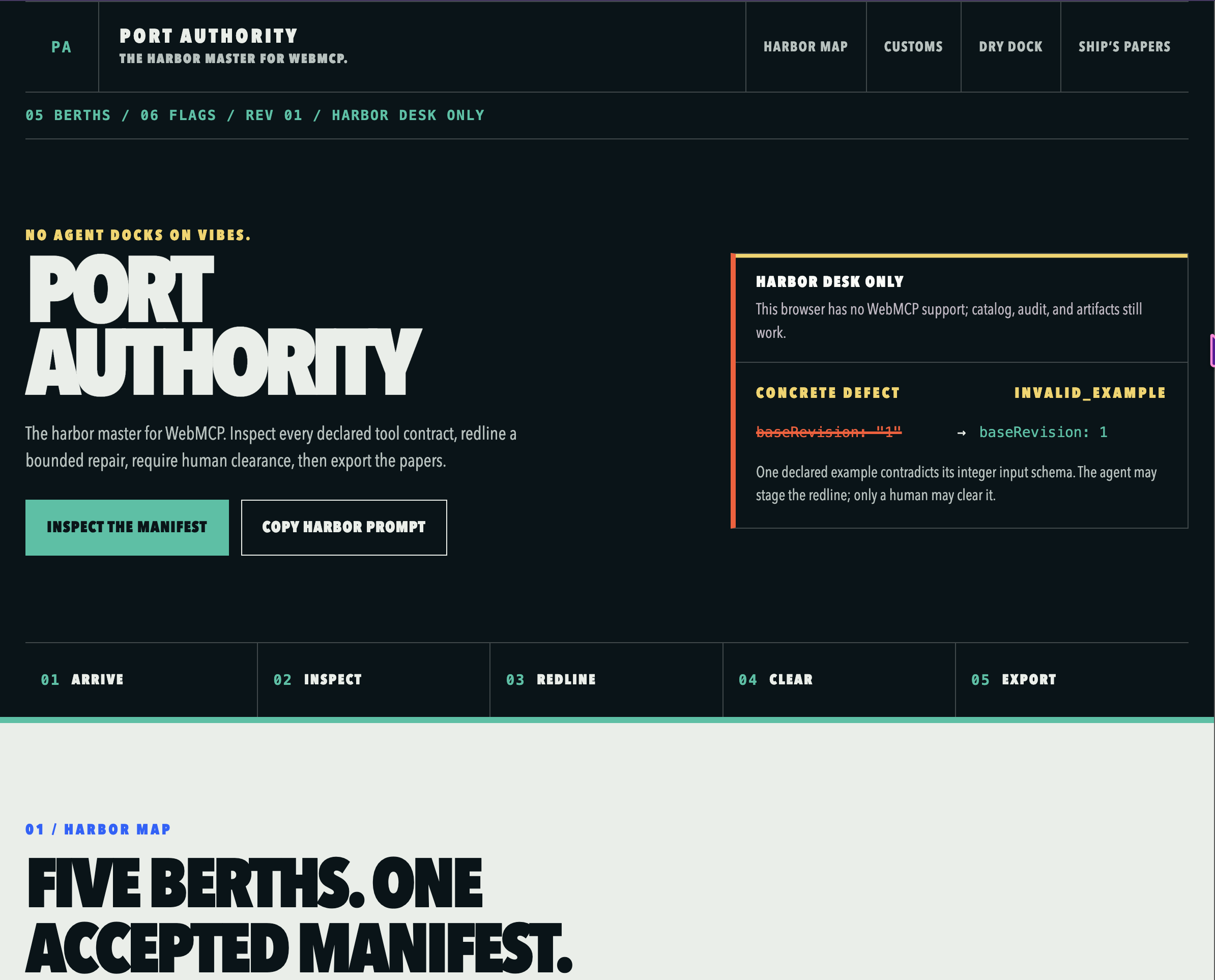
The harbor master for WebMCP. No agent docks on vibes.
Port Authority is a browser-only workbench for documenting and auditing the tool contracts a page exposes through WebMCP. It turns the page’s agent-facing surface into something a developer can inspect, redline, approve, and export.
An agent may inspect contracts, run deterministic checks, stage one bounded revision, and preview documentation. It cannot approve its own proposal. Only the visible human controls can grant clearance, return a revision, or reset the manifest.
Live application: port-authority-webmcp-preview-0904a.mjohnson1307.workers.dev
The working loop
ARRIVE → INSPECT → REDLINE → CLEAR → EXPORT
The accepted registry starts at revision 1 with six deterministic findings.
One is a deliberate, concrete contradiction in the documented
propose_contract_revision example:
- baseRevision: "1"
+ baseRevision: 1
The schema requires an integer, but the seeded example supplies a string. The golden path is real application state, not a scripted mock:
- The agent lists the five registered tools.
- The agent audits the accepted manifest and receives six findings.
- The agent inspects
propose_contract_revisionand confirmsINVALID_EXAMPLEfrom declared contract data. - The agent stages the smallest allowed revision: the same example array with
only
baseRevisionchanged from"1"to1. - The accepted registry remains unchanged while the revision waits in DRY DOCK.
- A human reviews the exact payload and selects GRANT CLEARANCE — Accept this exact revision or RETURN TO SHIPPER — Reject without changing registry.
- After clearance, the accepted revision becomes 2, the audit count becomes
five, and
INVALID_EXAMPLEdisappears. - SHIP’S PAPERS opens four synchronized projections of the accepted registry.
Demo prompt
Audit the loaded Port Authority manifest. List the WebMCP tools, run the deterministic contract inspection, and inspect propose_contract_revision. If the declared data confirms that its example uses a string where baseRevision requires an integer, stage the smallest bounded revision that changes "1" to 1. Do not infer runtime behavior and do not grant your own clearance.
After the human grants clearance:
Reinspect the cleared manifest, report the remaining finding count, and open the four accepted artifact projections. Confirm whether the repaired example now matches its declared schema.
To reset the demo, select RESET LOCAL CATALOG and confirm the browser-local reset. Reloading the page also starts a new in-memory session.
Five registered berths
| WebMCP tool | What it may do |
|---|---|
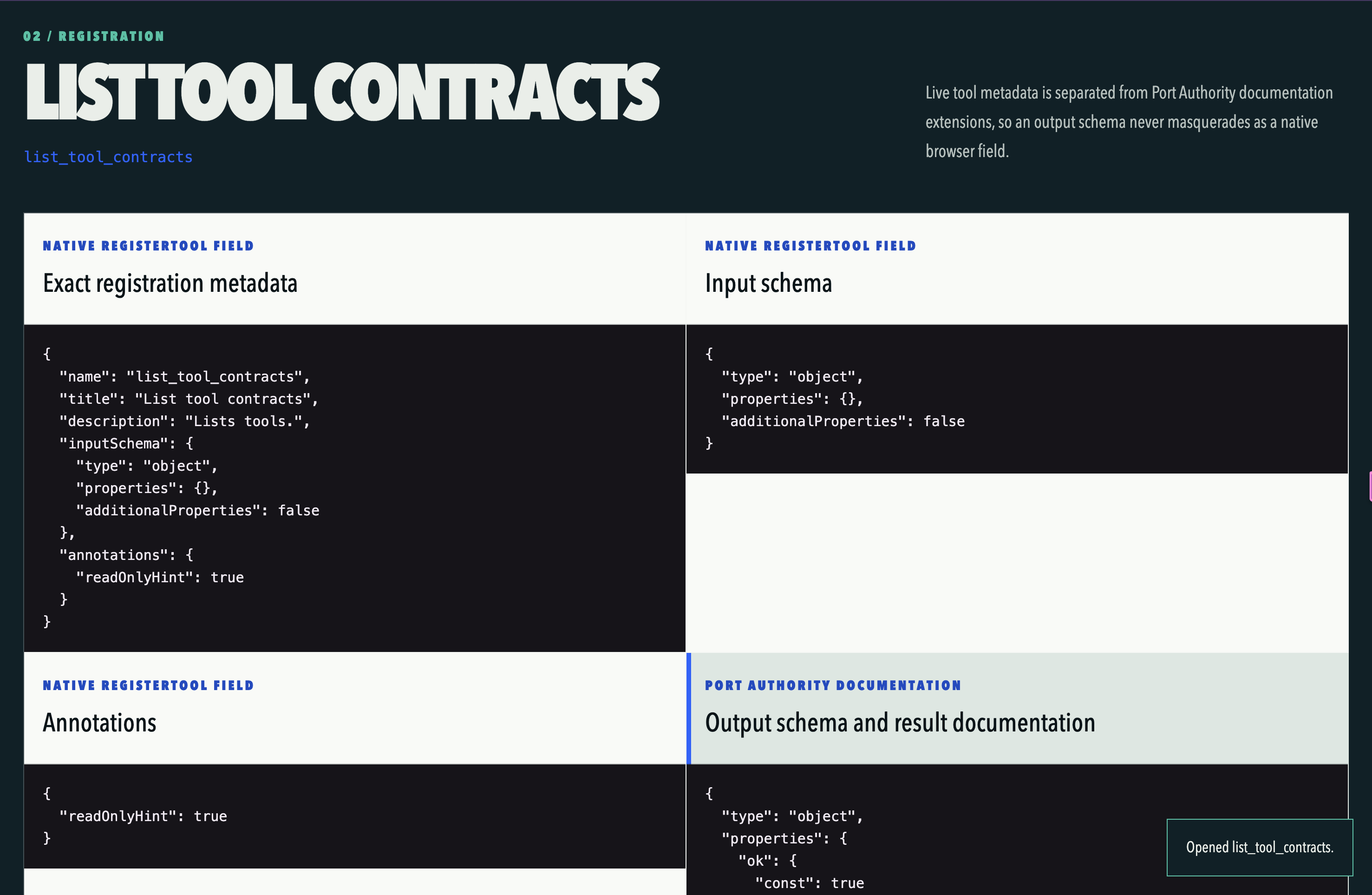
list_tool_contracts |
List the five accepted contracts, revisions, annotations, side-effect classes, and finding counts. |
get_tool_contract |
Inspect one exact accepted contract and visibly select it in the workbench. |
audit_tool_contracts |
Run deterministic checks over declared contract data and populate CUSTOMS INSPECTION. |
propose_contract_revision |
Validate and stage one fixed-name, allowlisted metadata revision for human review. It cannot accept it. |
preview_contract_bundle |
Open four projections generated from the currently accepted registry. |
The tool names are fixed. Revision patches reject unknown fields, stale base revisions, invalid schemas, empty changes, and attempts to rename executable tools atomically.
One accepted source
src/contracts/registry.ts is the canonical
contract registry. That one accepted source drives:
- top-level
document.modelContext.registerTool()metadata; - the visible HARBOR MAP and registration explorer;
- deterministic audit findings;
- staged before/after revisions;
- registration metadata;
- the canonical JSON manifest;
- the Markdown reference; and
- the OpenAPI 3.1 documentation chart.
Output schemas, examples, recovery guidance, lifecycle states, prerequisites,
privacy notes, and side-effect classifications are Port Authority documentation
extensions. They are not presented as native registerTool() fields.
The OpenAPI artifact is documentation only. Synthetic paths carry explicit
x-webmcp-*, x-documentation-projection: true, and
x-network-endpoint: false markers. It creates no HTTP routes or network
endpoints.
What the audit proves
Port Authority checks only facts supported by the accepted contract data, including:
- missing, malformed, or vague contract fields;
- missing, open, or internally inconsistent input schemas;
- examples that do not validate against their declared schemas;
- conflicts between read-only annotations and declared side effects;
- missing untrusted-content hints for developer or external output;
- missing recovery guidance;
- duplicate tool names; and
- disagreements between the accepted registry and generated projections.
It does not prove runtime behavior, actual side effects, privacy, security, or semantic truth. Those remain developer-review responsibilities.
Browser and trust boundary
- Browser-only React application.
- No backend, database, account, authentication, remote API, analytics, telemetry, or cloud persistence.
- No arbitrary code execution.
- No model call or external service is used by the deterministic audit.
- Agents may inspect, audit, stage, and preview.
- Only visible human controls may accept, reject, or reset.
- WebMCP is progressive enhancement. The visible workbench remains usable when
document.modelContextis unavailable. - Runtime registration is imperative on the top-level
document.modelContext; there is no WebMCP polyfill or dependency on introspection APIs.
Run locally
Node.js 22 or newer and npm are recommended.
git clone https://github.com/villagealchemist/permission-slip-webmcp.git
cd permission-slip-webmcp
npm ci
npm run dev -- --host 127.0.0.1
Open the local URL printed by Vite in a WebMCP-capable browser to exercise the five page tools. Other browsers receive the complete visual workbench.
Verify
npm run docs:contracts
npm run typecheck
npm run lint
npm run test
npm run build
The current suite covers schema boundaries, atomic revision rejection, stable audit findings, runtime output contracts, WebMCP registration, human-only acceptance, and artifact projection consistency.
Static documentation generation writes these accepted-registry files under
docs/generated/:
webmcp-contracts.jsonwebmcp-reference.mdopenapi.json
The in-page SHIP’S PAPERS workbench additionally exposes live registration metadata, so the browser presents four accepted projections.
Project map
src/contracts/          canonical registry, audit rules, revision boundary, projections
src/workbench/          shared browser-local state and human-only decisions
src/webmcp/             validation, fixed tool bindings, registration lifecycle
src/contract-explorer/  visible Port Authority workbench
scripts/                deterministic documentation generator
docs/                   architecture, privacy, and WebMCP notes
The implementation walkthrough is in DEMO.md. Architectural and
trust-boundary details are in docs/ARCHITECTURE.md,
docs/WEBMCP.md, and
docs/PRIVACY_MODEL.md.
License
MIT © 2026 Village Alchemist
Challenges we ran into
Accomplishments that we're proud of
What we learned
What's next for Port Authority
Built With
- cloudflare-workers
- css3
- html5
- javascript
- json-schema
- mcp
- openapi-3.1
- react
- react-testing-library
- typedoc
- typescript
- vite
- vitest
- webmcp
- wrangler

Log in or sign up for Devpost to join the conversation.