-
-
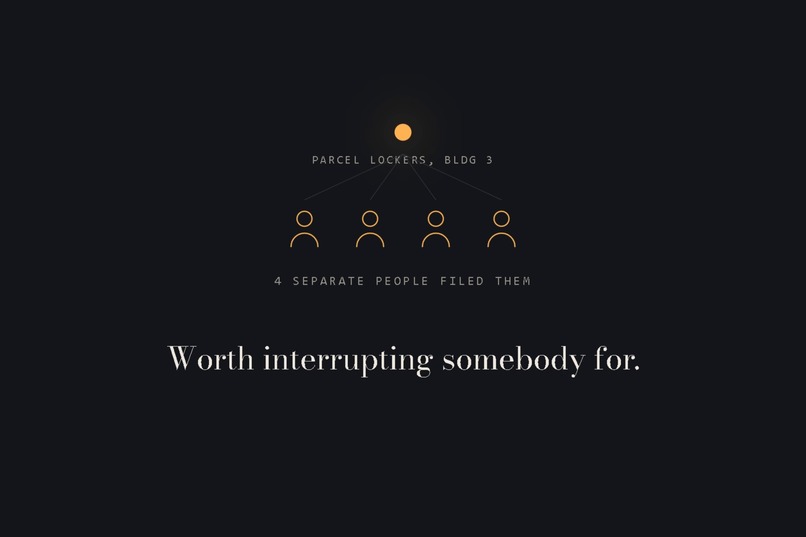
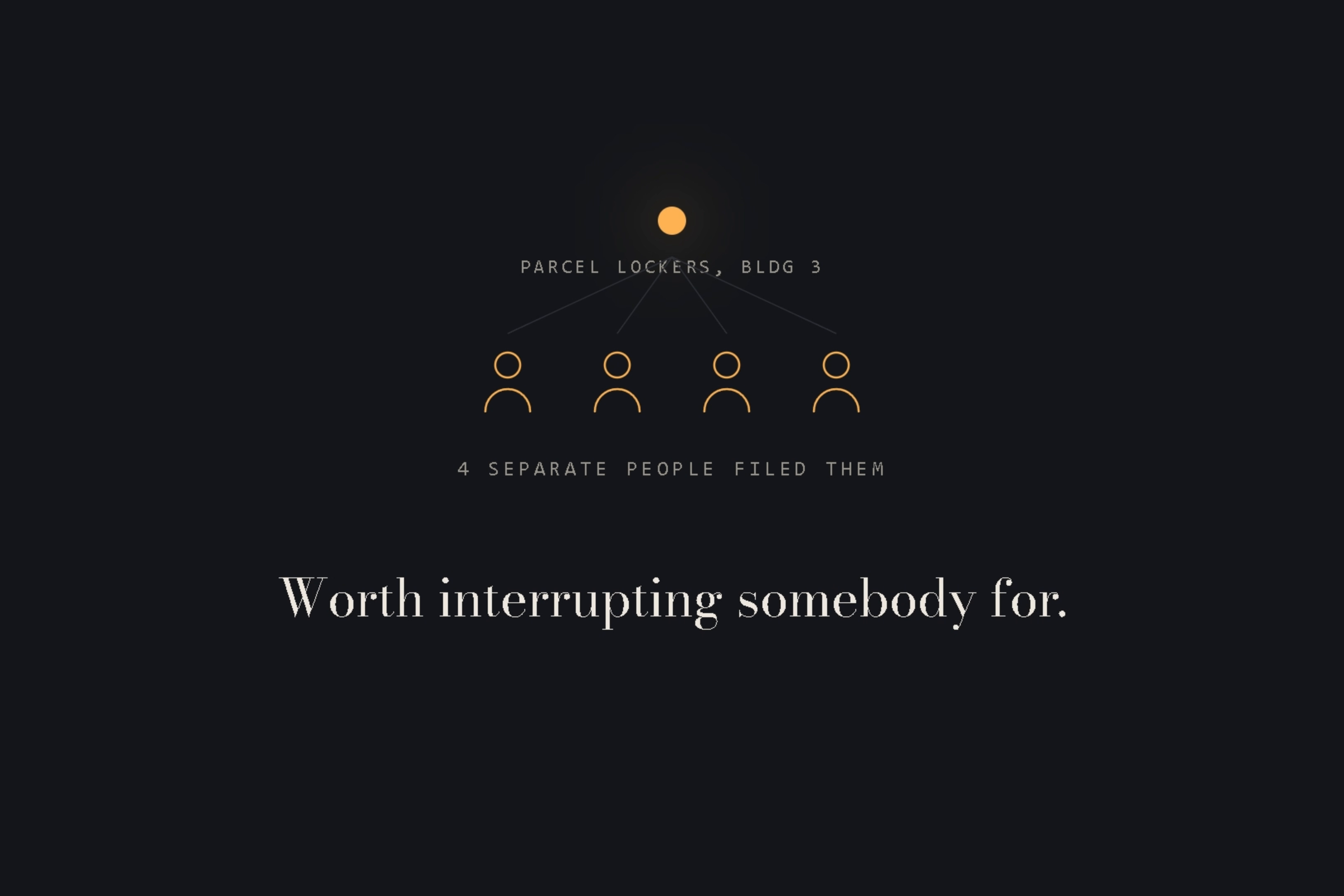
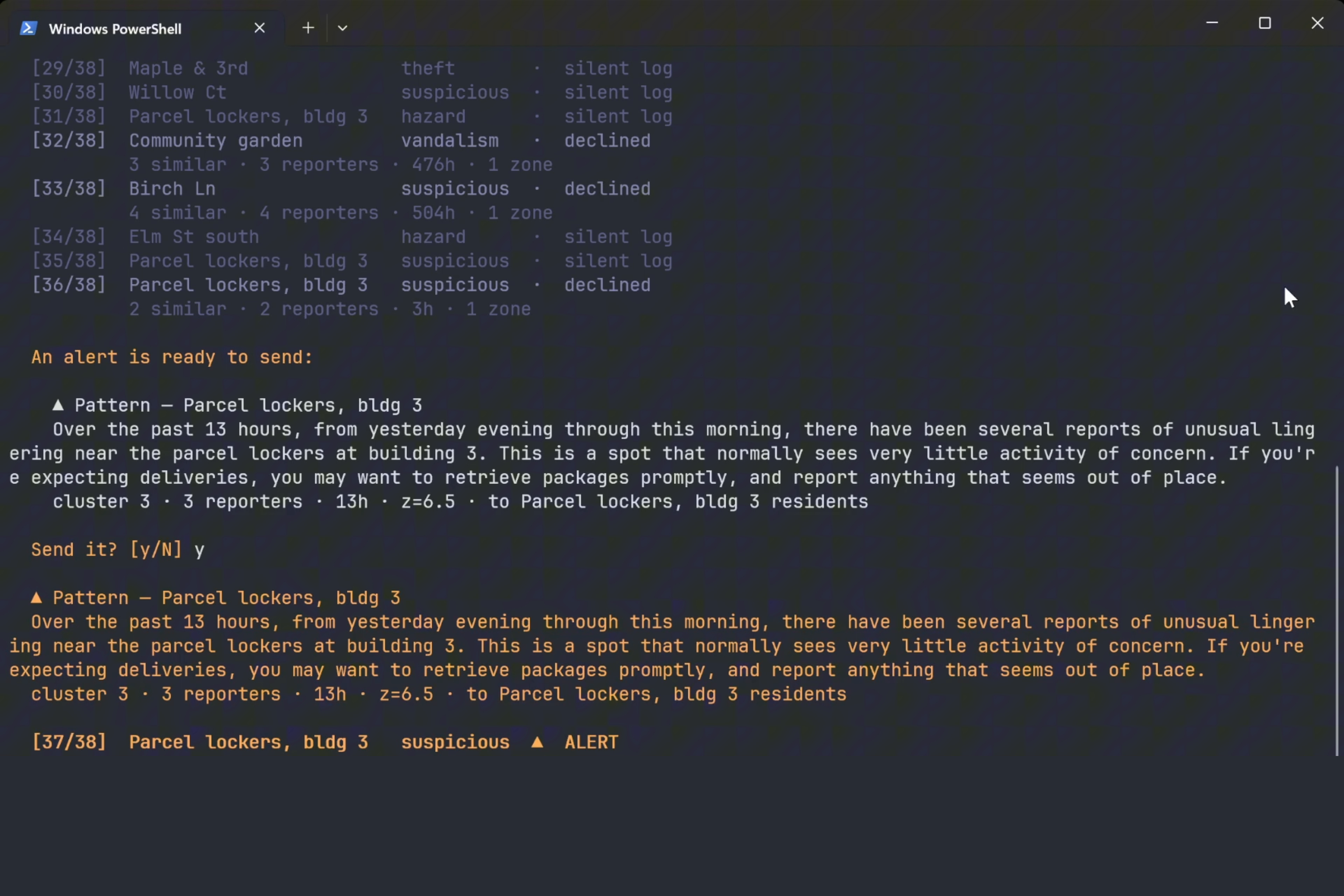
Three separate people, thirteen hours, one place.
-
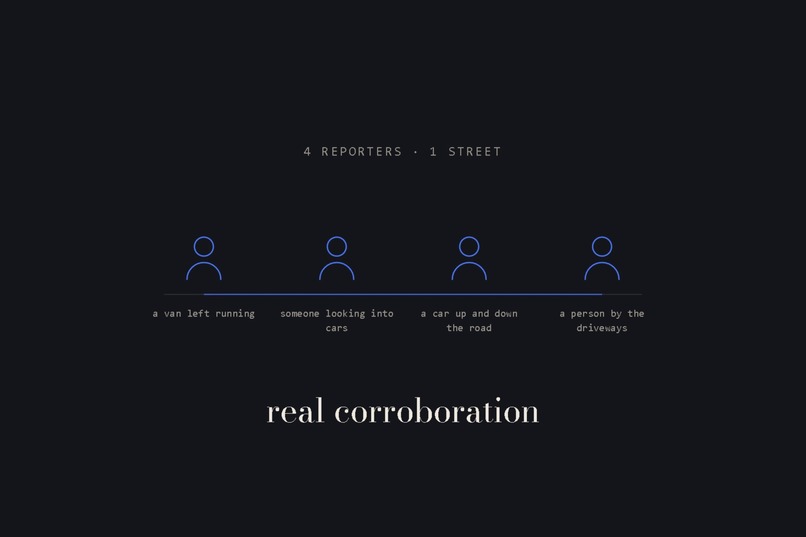
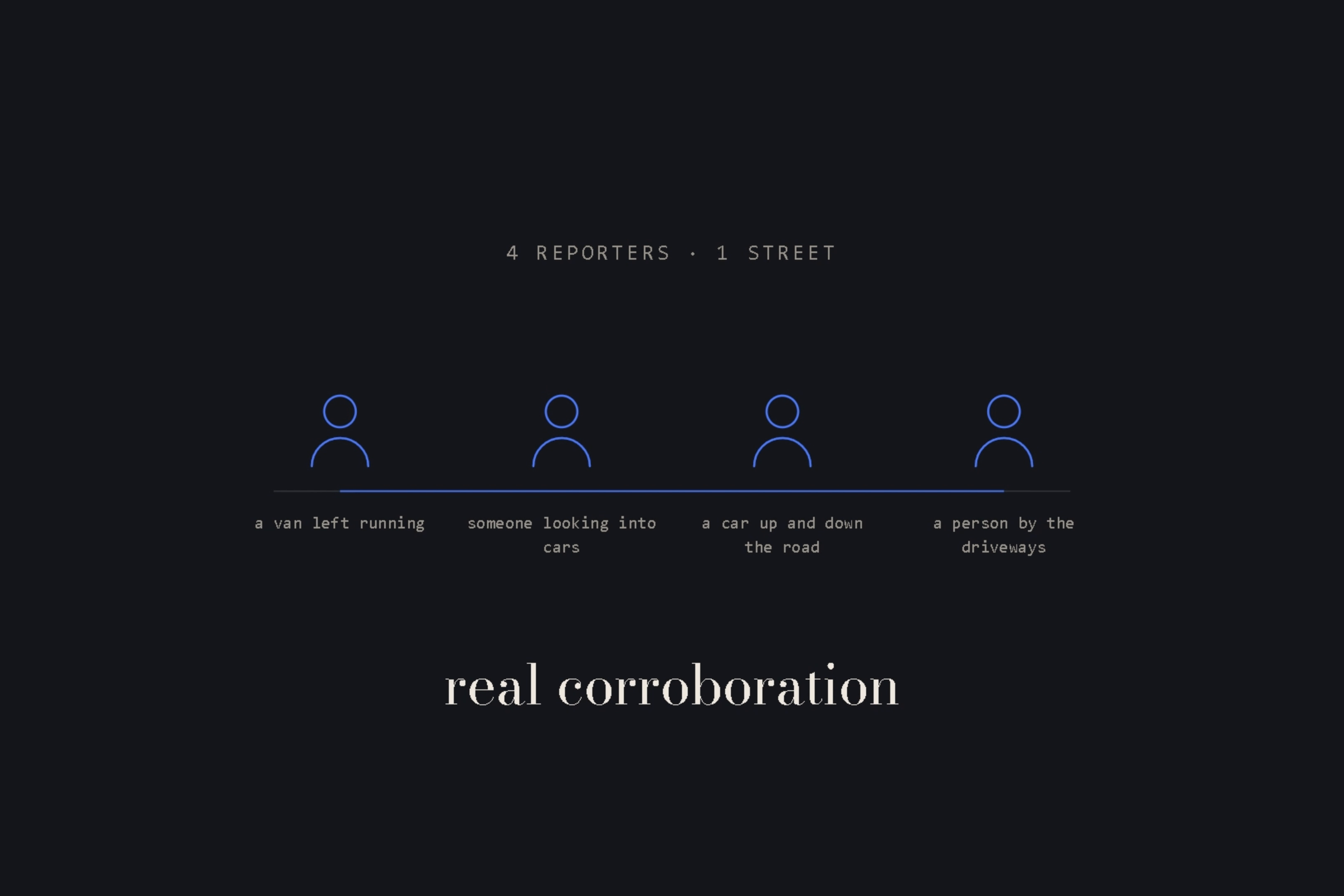
Four reporters, one street: any threshold would have fired.
-
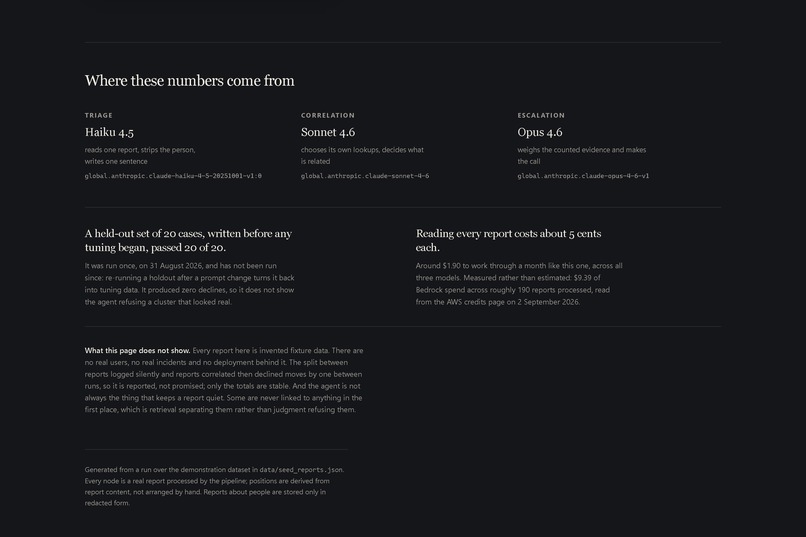
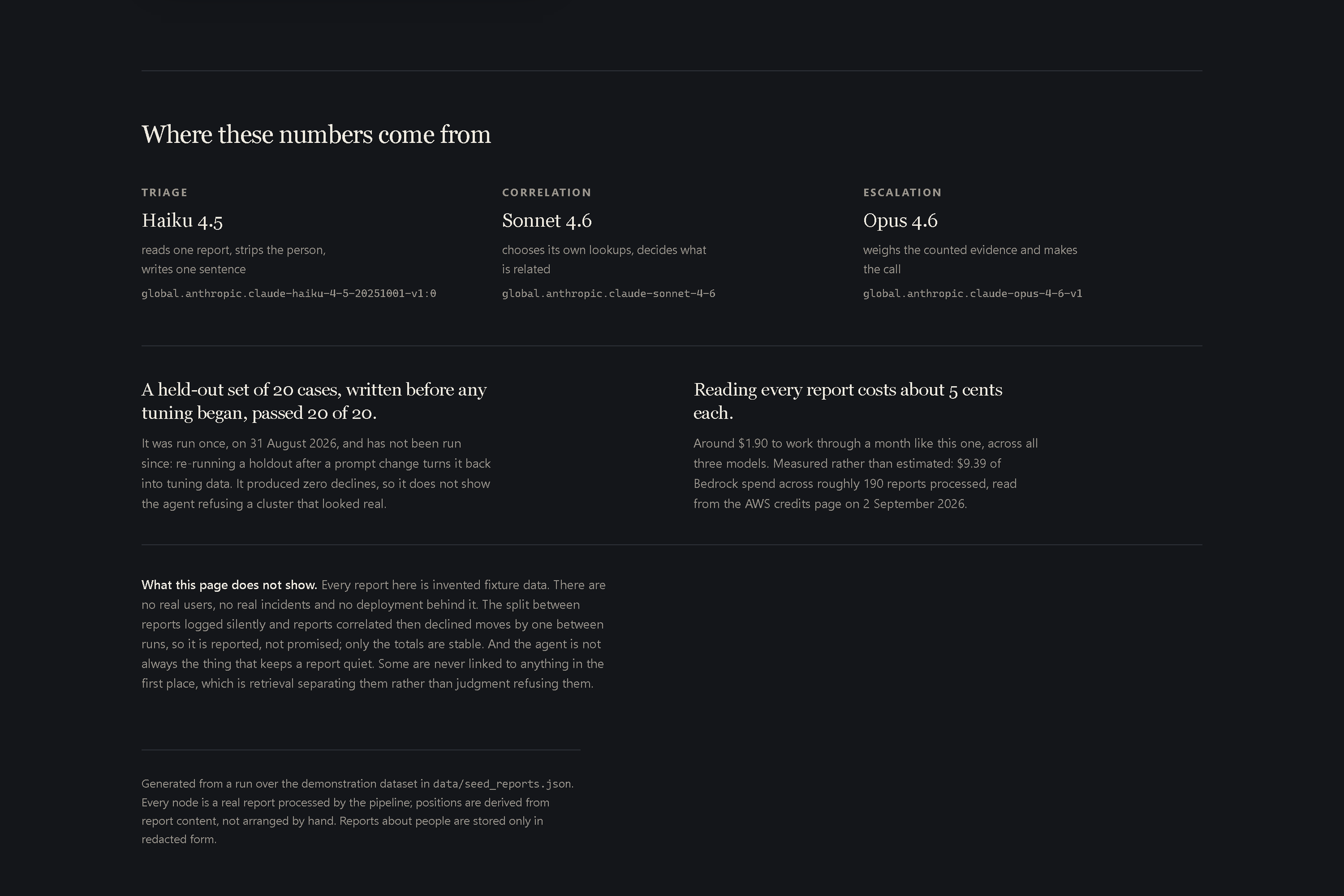
Models used, the 20-of-20 holdout, and what one report costs to read.
-
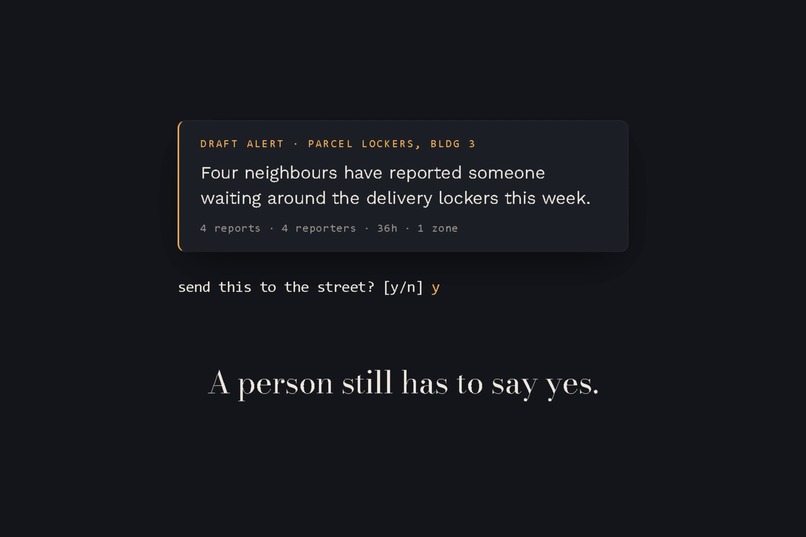
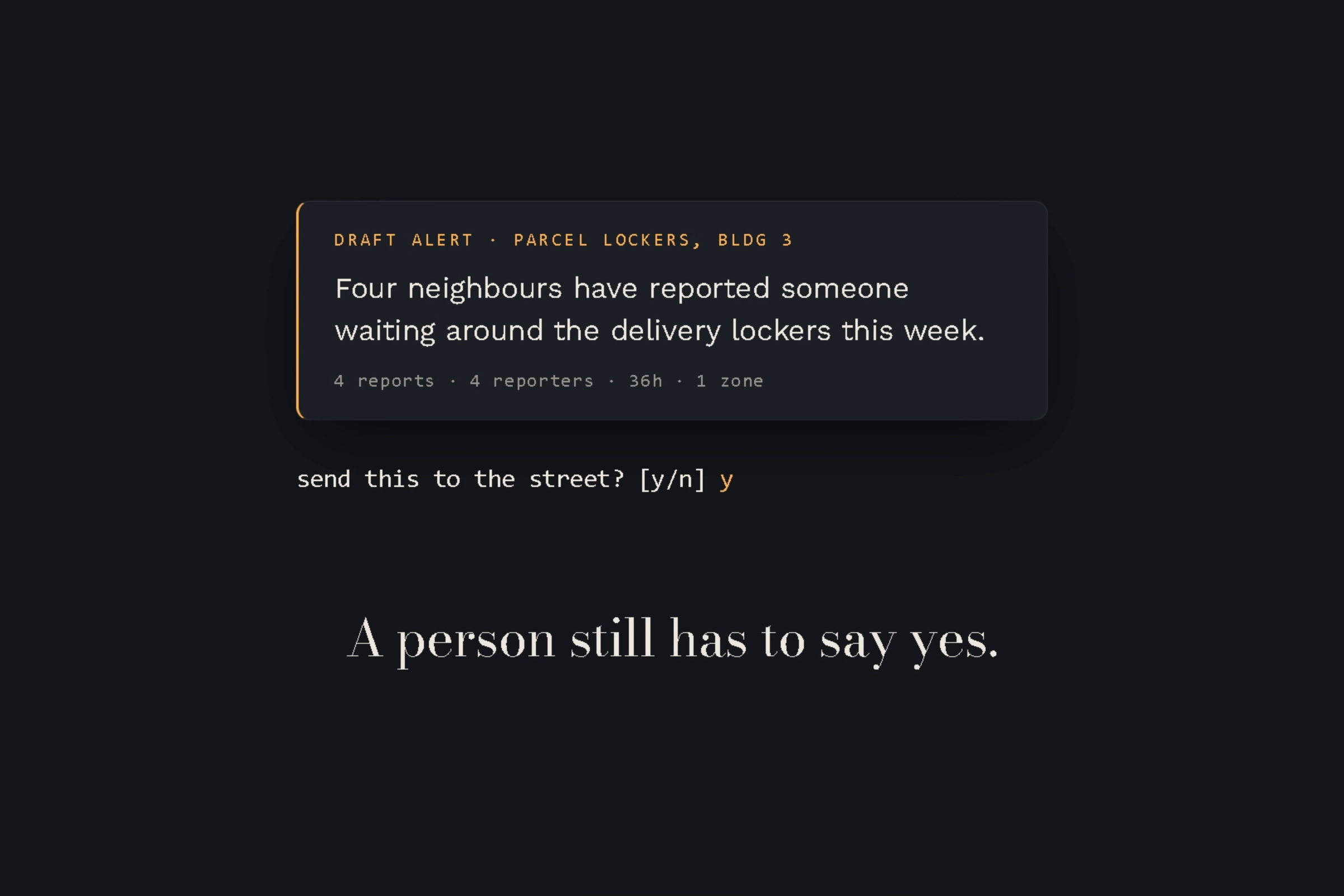
The agent drafts the alert. A person still has to say yes.
-
Open source, MIT licensed, with a live report. Every report in the demo is invented.
-

The run report: the one message the street received.
-
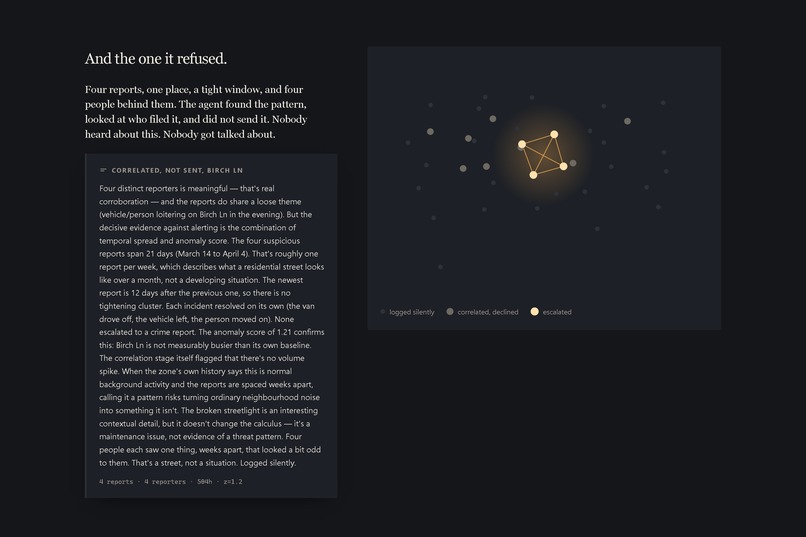
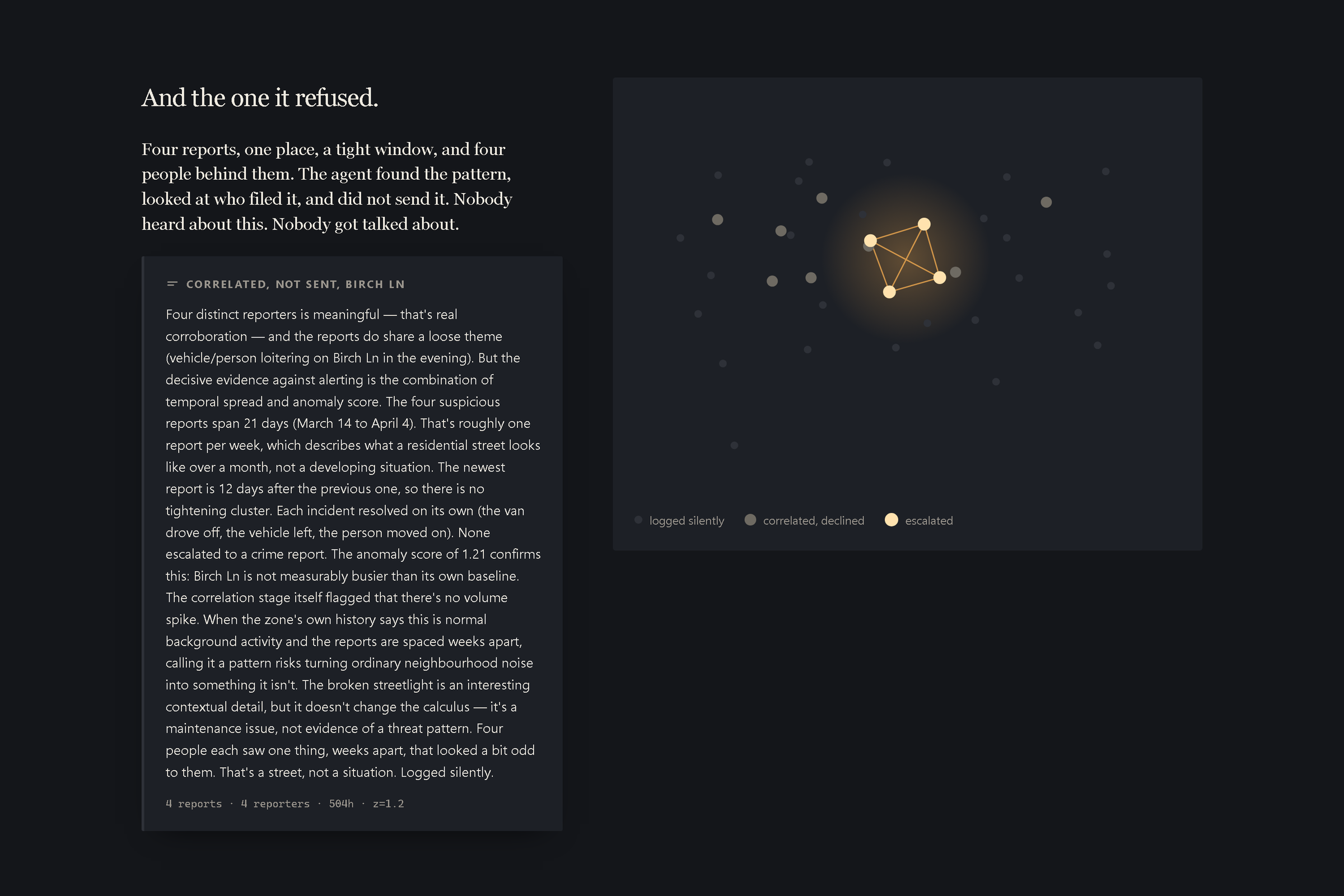
The situation it found and chose not to send.
-
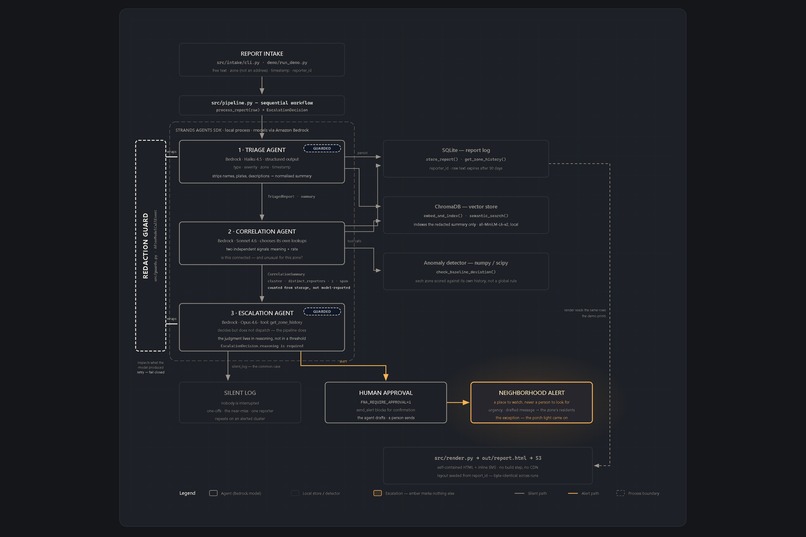
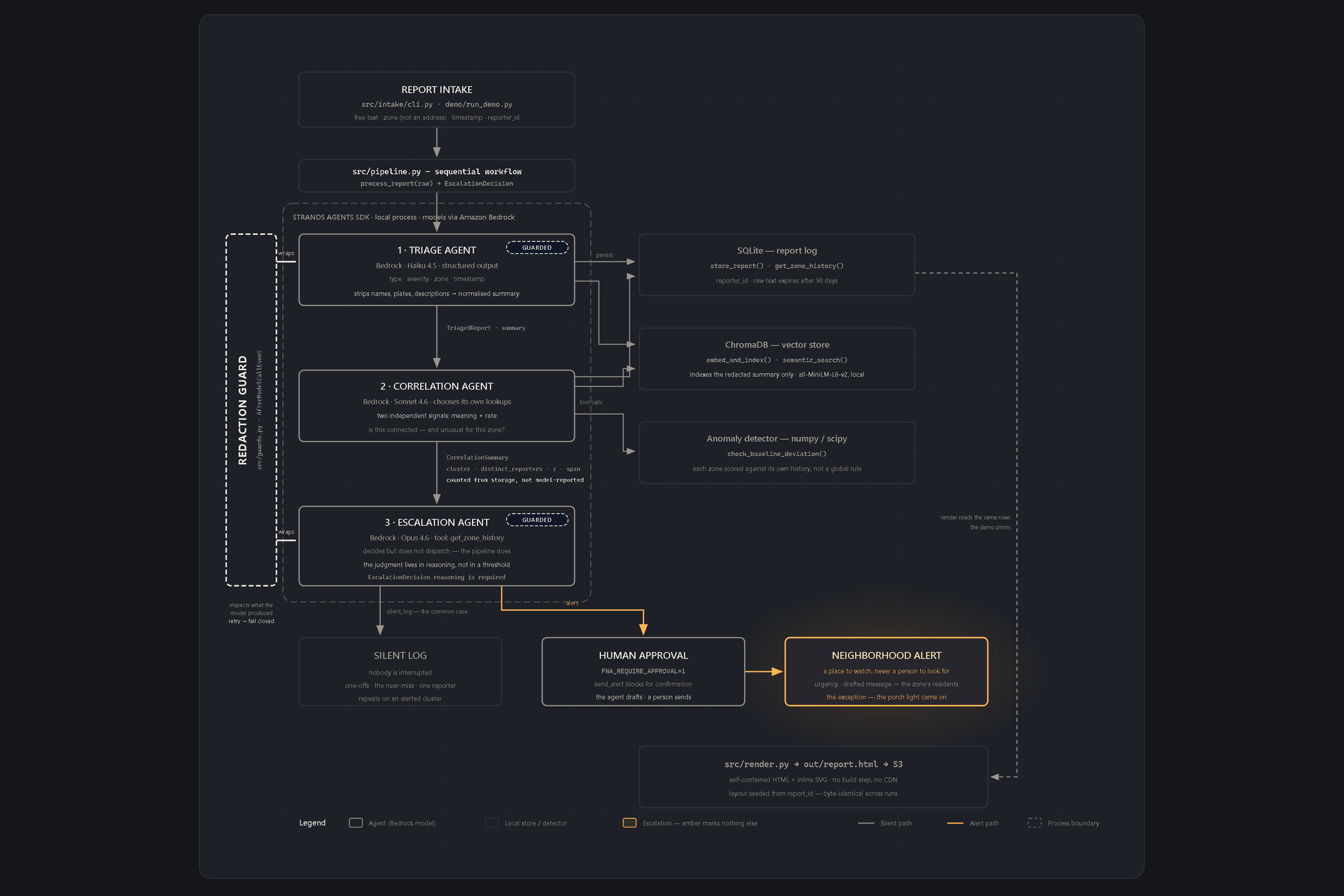
Three Strands agents on Bedrock, with a redaction guard around triage and escalation.
-
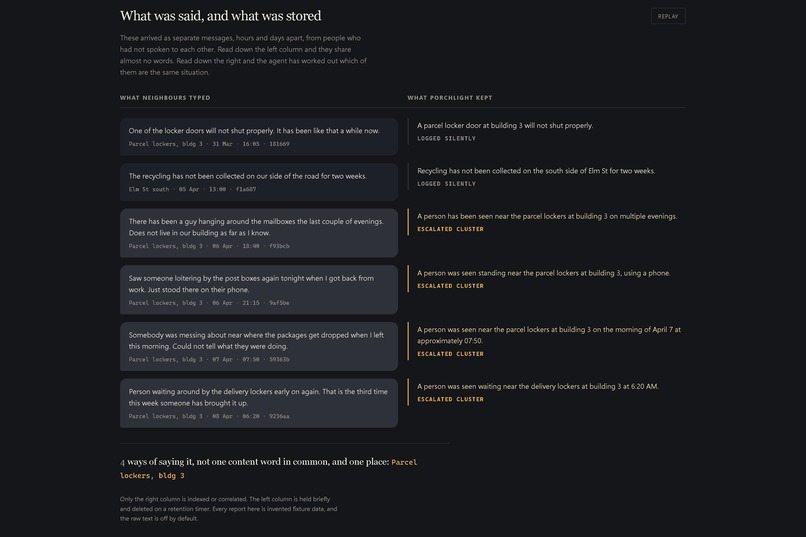
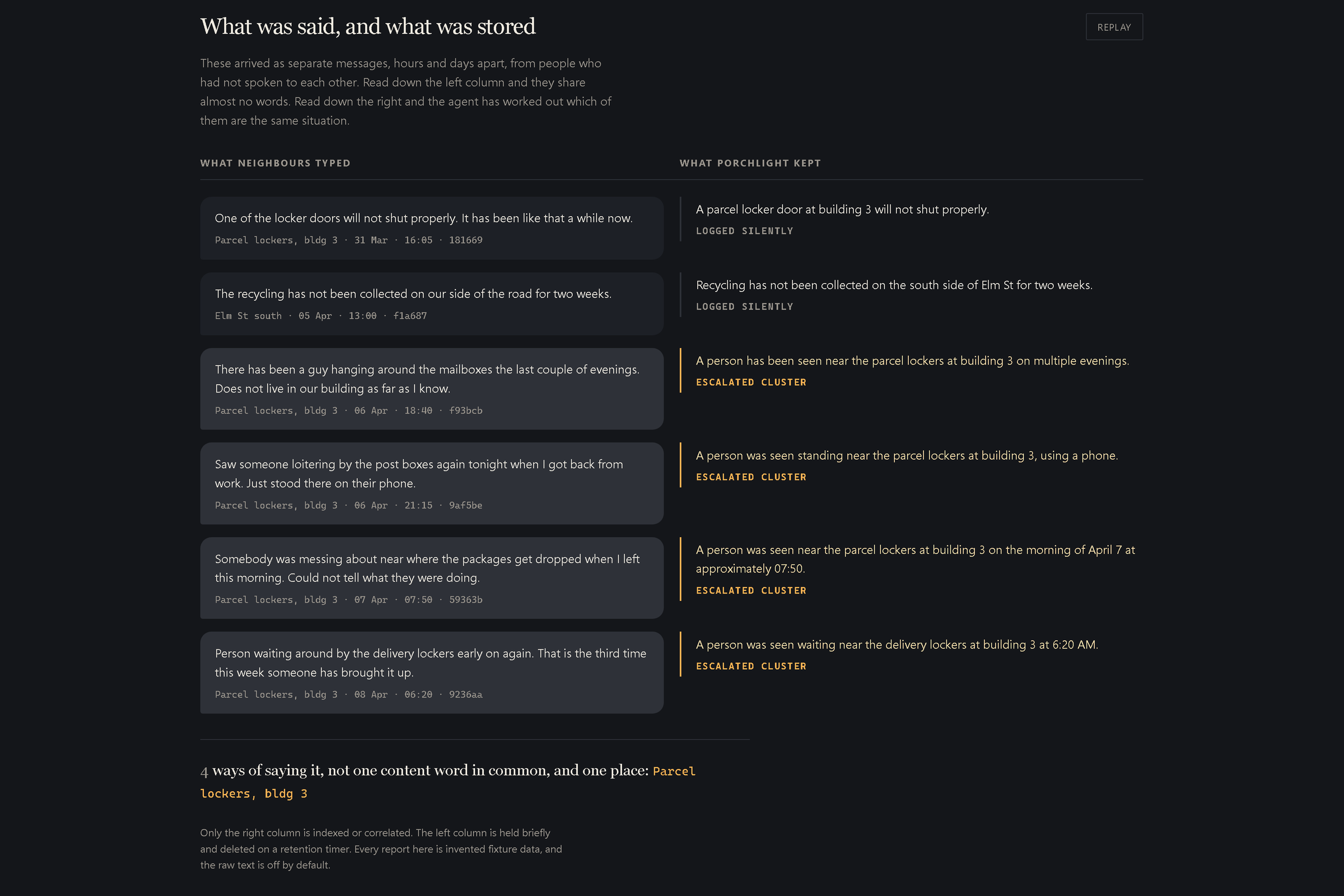
Left, what neighbors typed. Right, what Porchlight kept, with every person description removed.
-
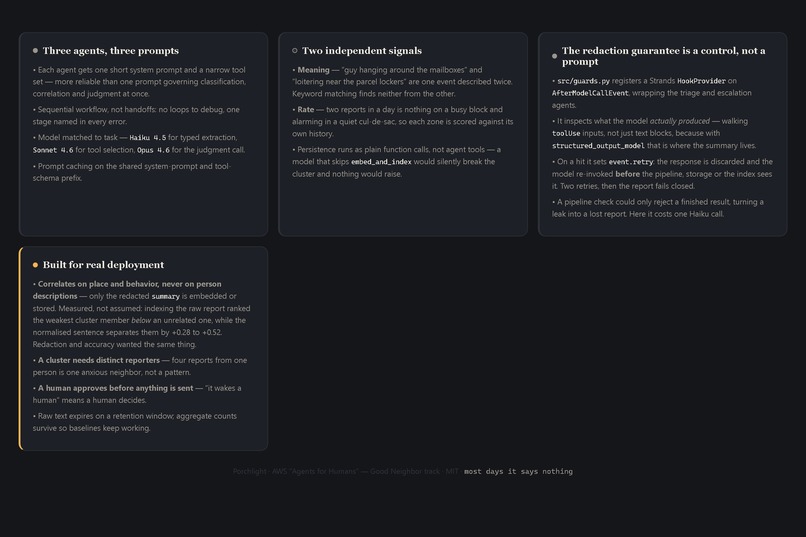
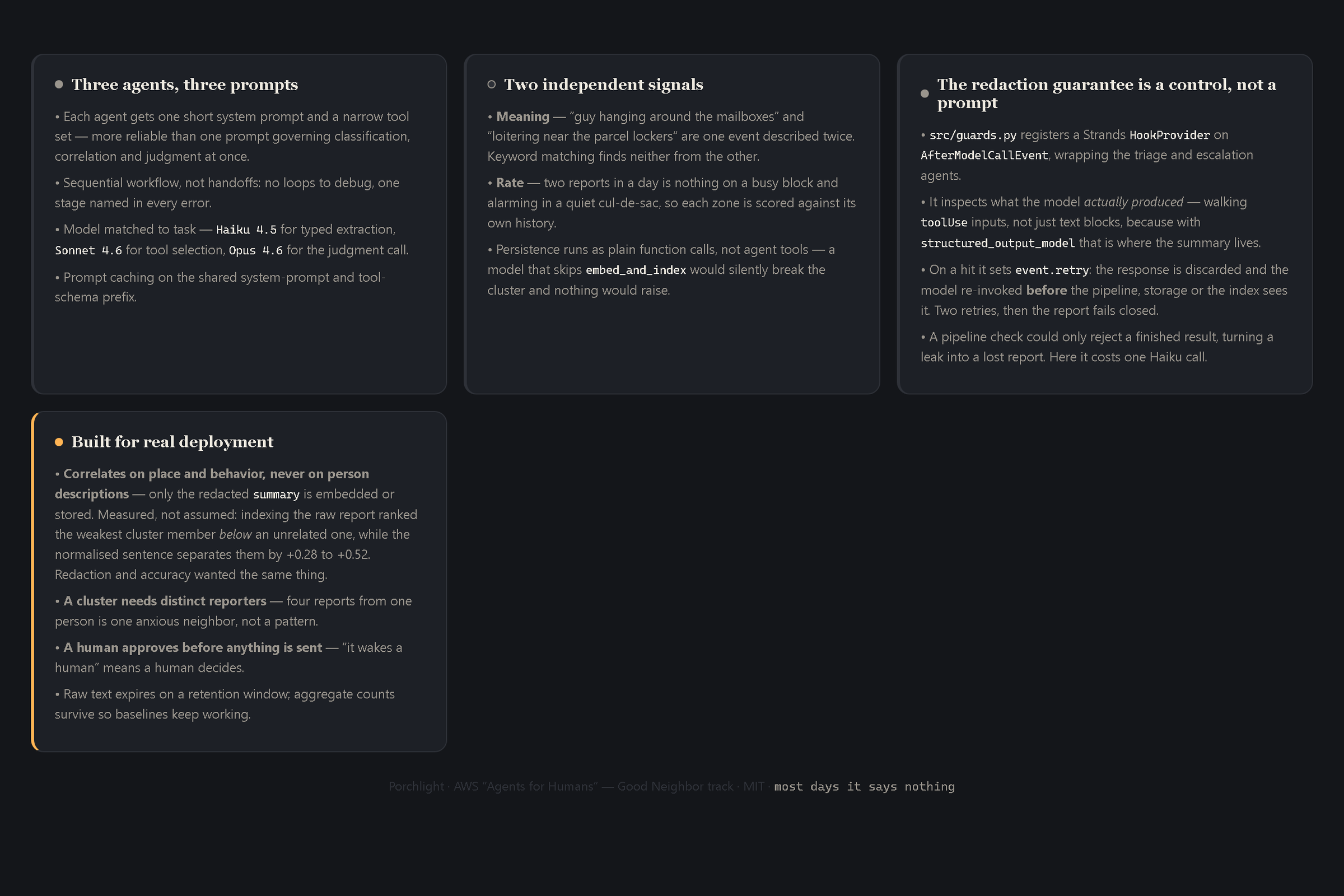
Two independent signals, and redaction enforced in code rather than asked for in a prompt.
-
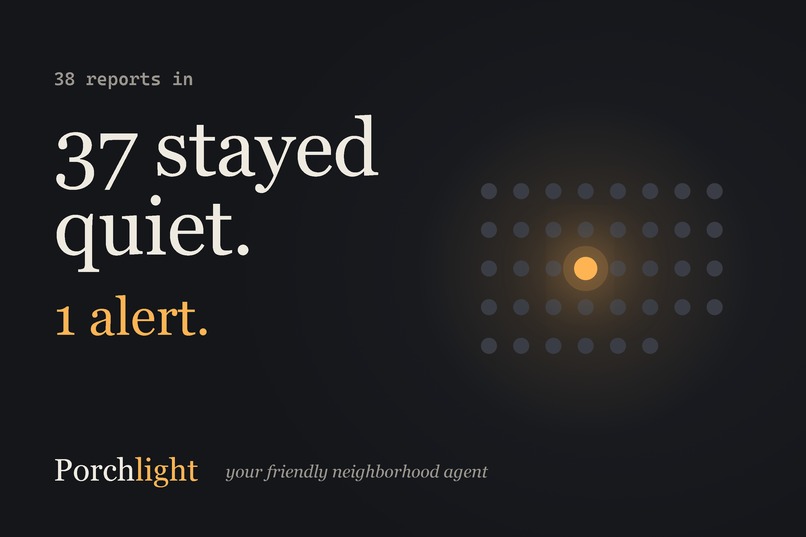
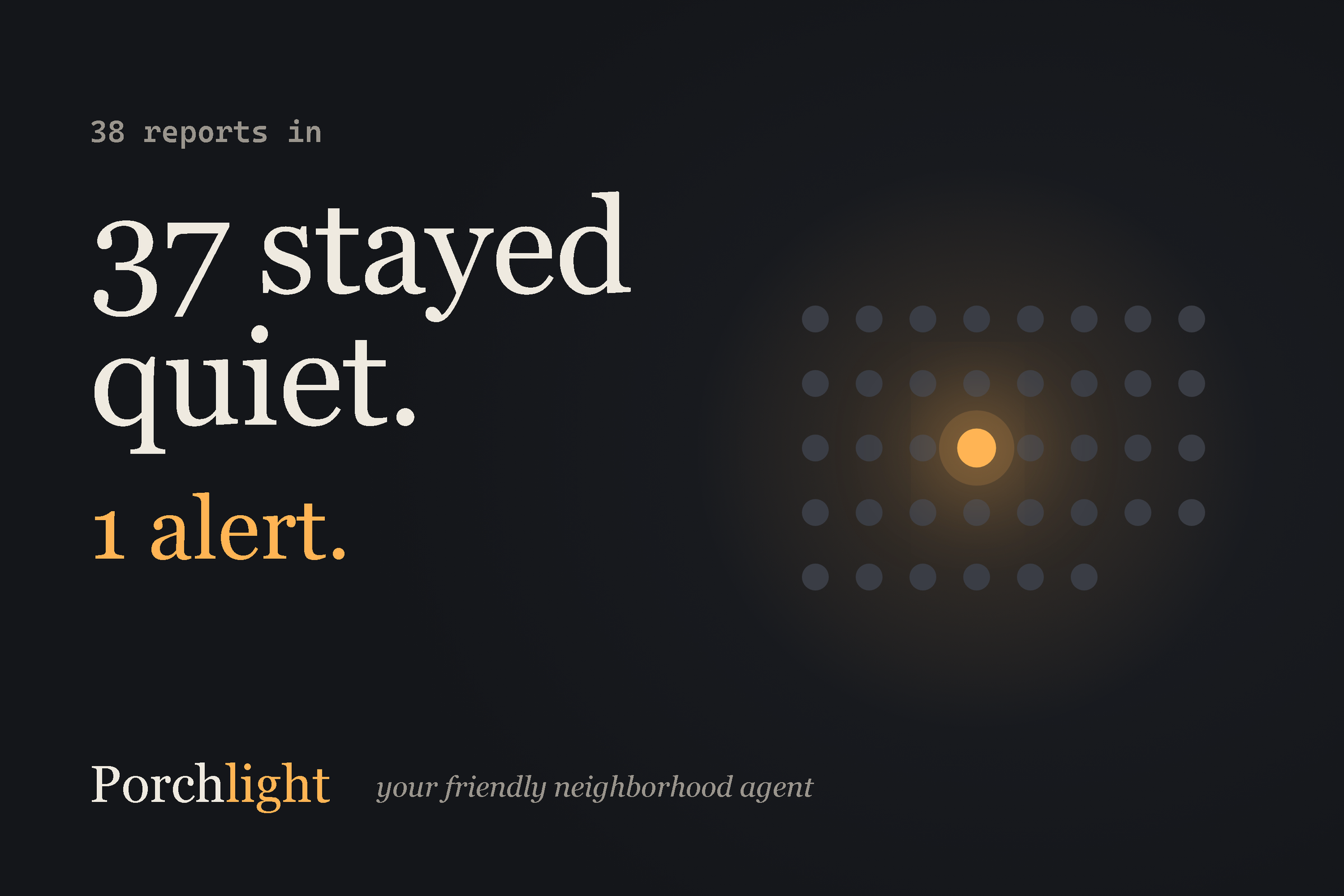
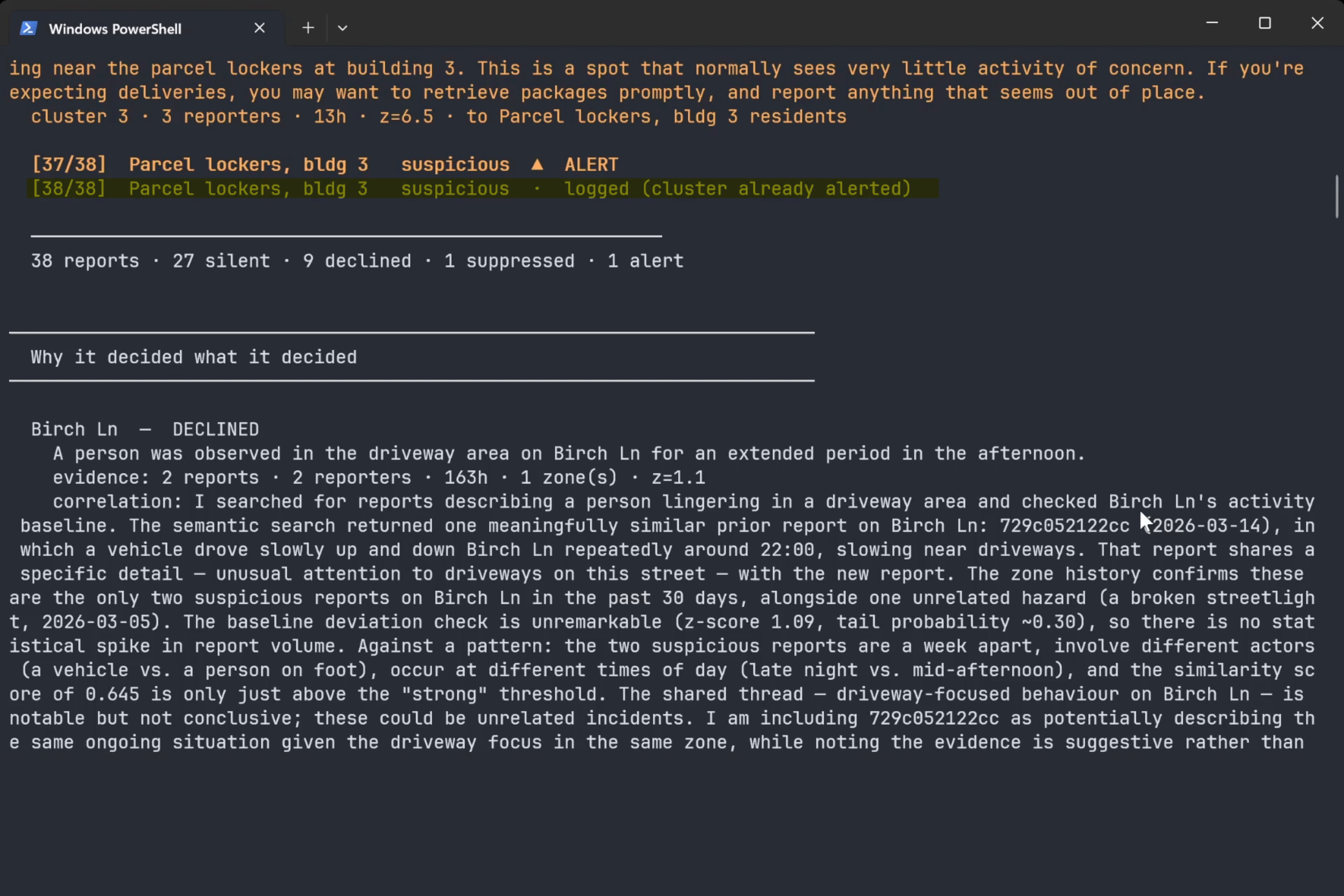
38 reports in. 37 stayed quiet. 1 alert.
-
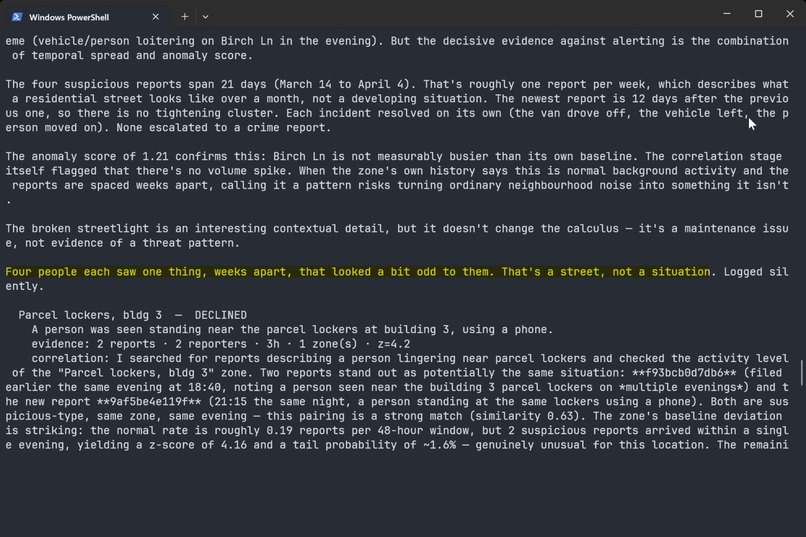
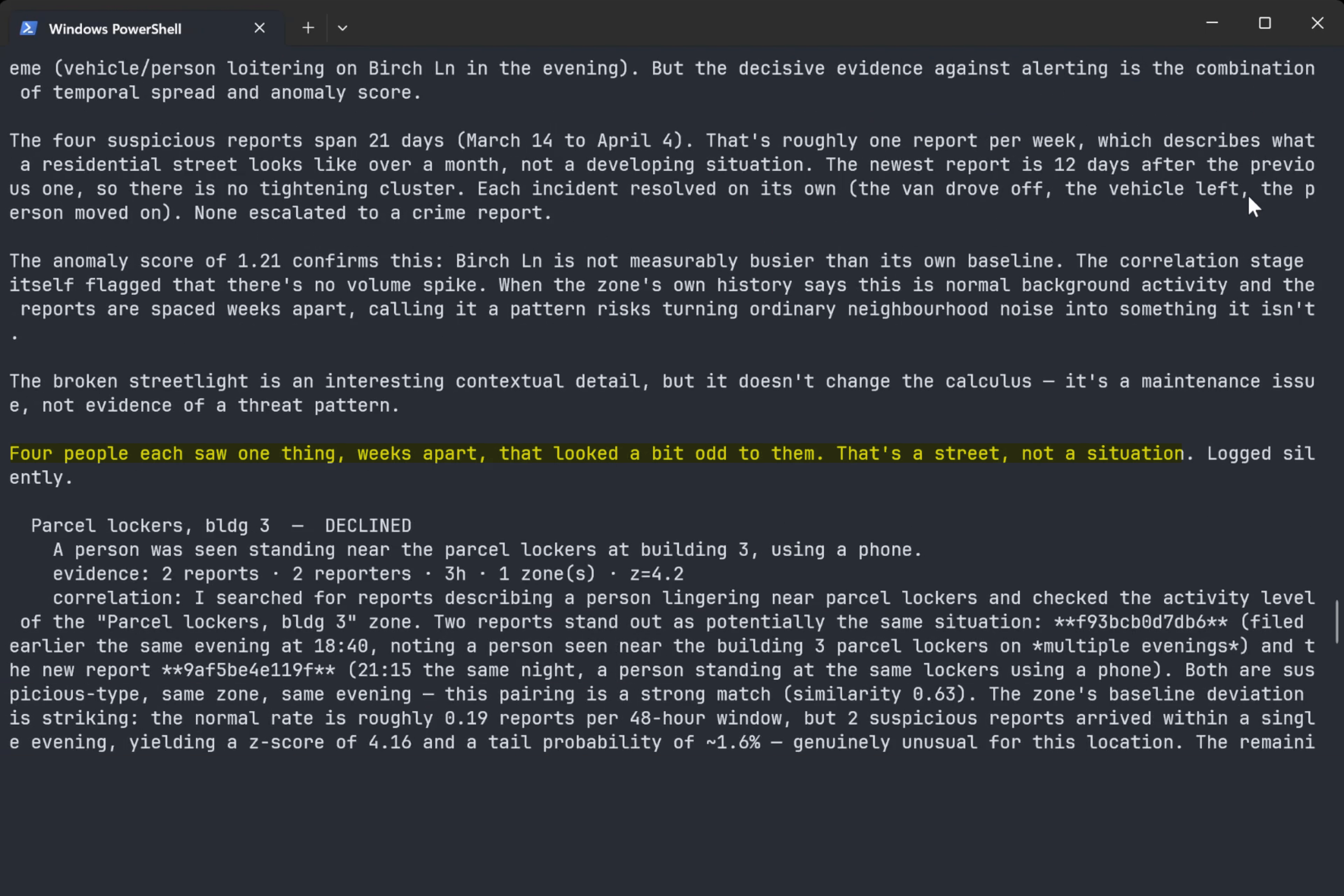
The agent declines Birch Ln: "That's a street, not a situation."
-
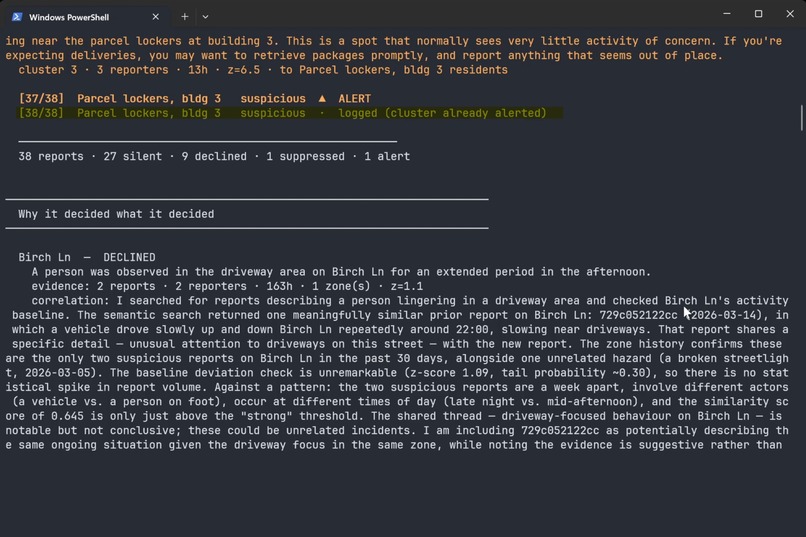
38 reports · 27 silent · 9 declined · 1 suppressed · 1 alert.
-
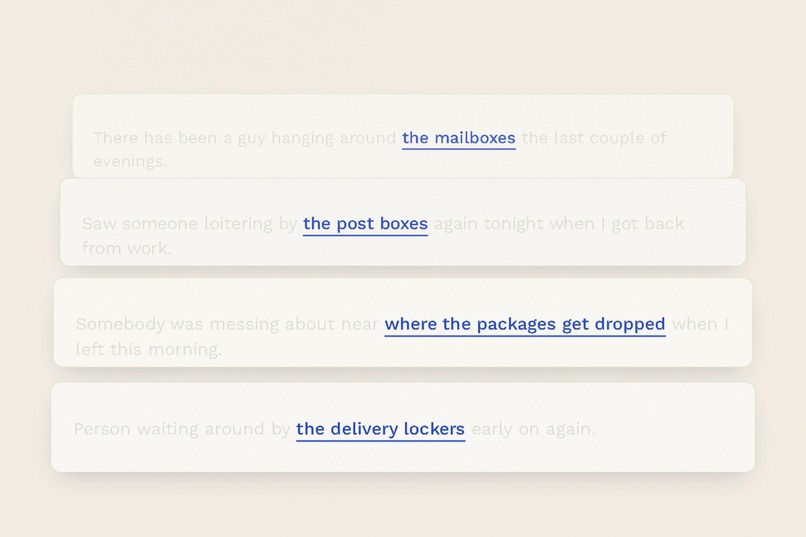
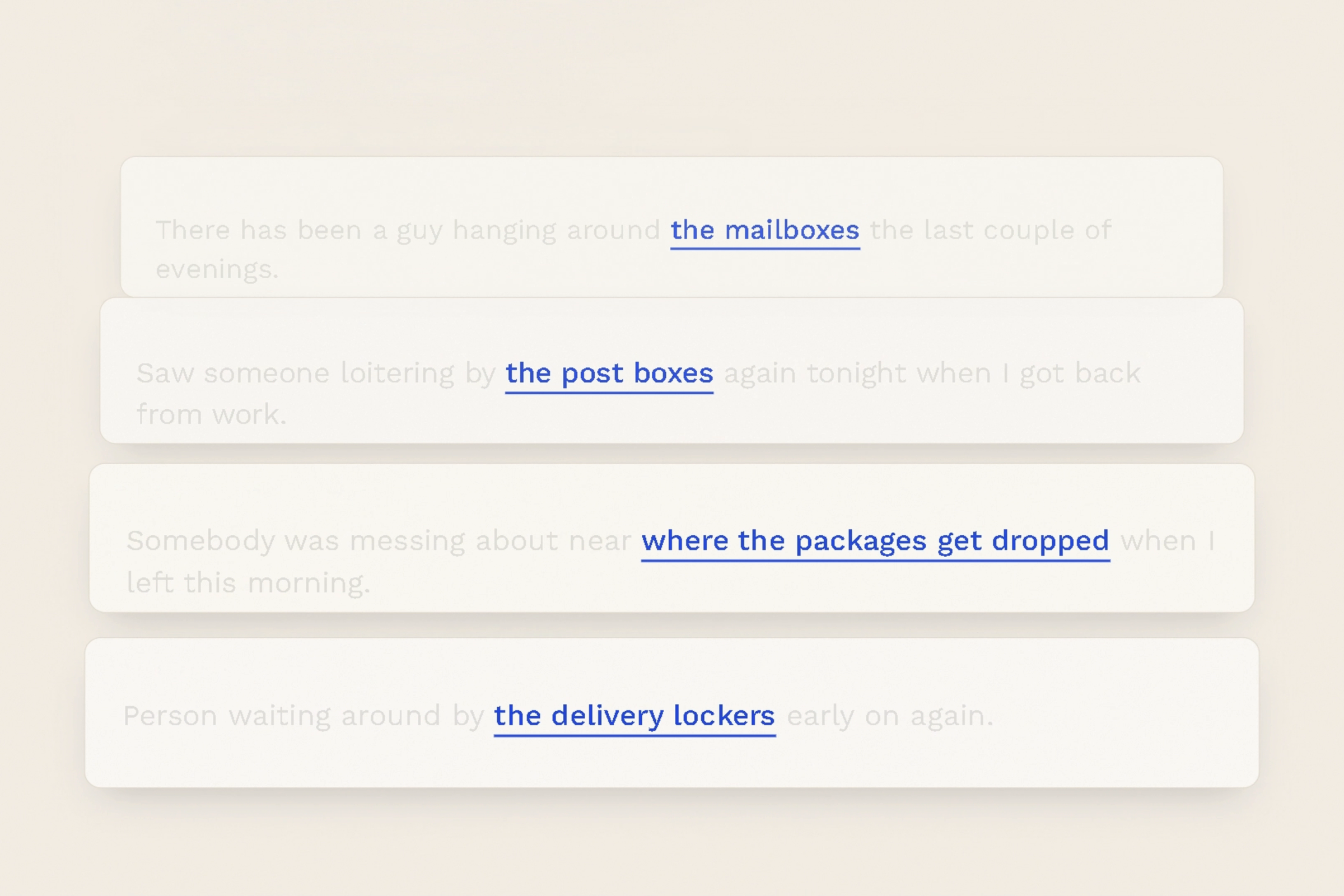
Four neighbors, four ways of describing one place, and not one word in common.
-
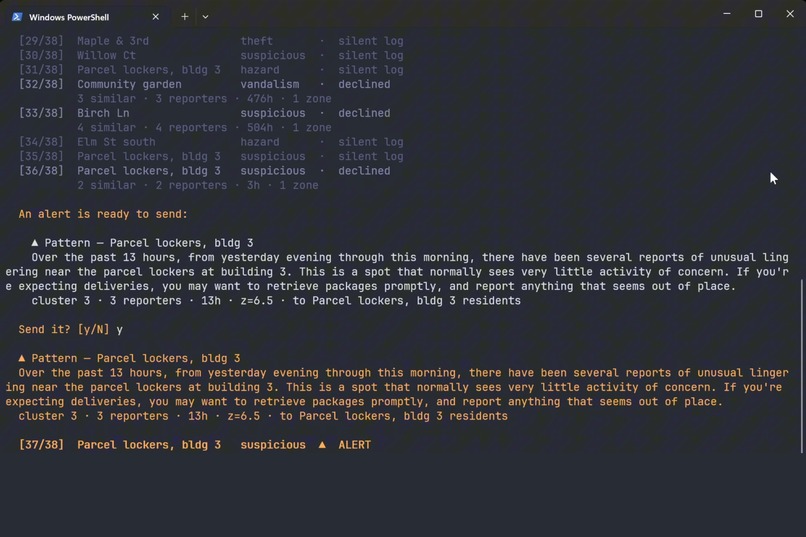
The live alert, approved, sent to the zone's residents.

Inspiration
Neighborhoods already report things to each other — a missing package, someone loitering near the mailboxes, a car circling the block. It lands in a Discord server, a WhatsApp group, an HOA email chain.
Three things go wrong. Every report is treated identically, so a one-off and the third theft on the same street this week produce the same notification. Nobody correlates, because the pattern is only visible if one person reads every message and remembers them all — and that person doesn't exist, or burns out. And the wording varies wildly, so keyword matching misses the cases that matter most.
The starting question was: what does an agent look like if its value is measured by how often it doesn't interrupt you?
What it does
Porchlight reads every report a neighborhood submits, works out which ones describe the same ongoing situation, and wakes a human only when the evidence supports it. On the demonstration dataset, thirty-seven of thirty-eight reports never surface to anyone. One alert fires.
The problem it's built around looks like this. Four neighbors notice the same person near the same parcel lockers over a day and a half, and report it as:
- "a guy hanging around the mailboxes"
- "someone loitering by the post boxes"
- "somebody was messing about near where the packages get dropped"
- "Person waiting around by the delivery lockers"
Those four reports share no content word. Any keyword filter sees four unrelated notes. A moderator reading them a day apart sees four unrelated notes.
Three behaviors are worth watching:
| Evidence | Outcome | |
|---|---|---|
| The real cluster | 3 reports · 3 different reporters · one zone · 13 hours · z = 6.5 | Alert (4th suppressed) |
| The near-miss | 3 similar reports · 3 reporters · three zones · 21 days | No alert — never correlated |
| The spread | 4 reports · 4 different reporters · one zone · 21 days · z = 1.2 | Declined |
| The single reporter | 3 similar reports · one zone · 3.5 days · 1 reporter | Declined |
The bottom three rows are the point. A system that only ever fires isn't exercising judgment — the declines are what make the alert worth reading.
The spread is the strongest of them. Four different people reported four different things on one street. That is real corroboration by any count a threshold would apply, and the agent declined anyway, because the reports are spread over twenty-one days and the newest is twelve days after the one before it. In its own words: "Four people each saw one thing, weeks apart, that looked a bit odd to them. That's a street, not a situation."
The last row is also a safety control: three reports from one person isn't corroboration, and treating it as a neighborhood pattern is how a service like this gets used against somebody.
The near-miss is the row that didn't go how we designed it, and it's worth being precise about. We wrote those three reports — "walking slowly up the street looking at the houses", "wandering about near the driveways", "loitering at the end of the road" — as three people, three zones, twenty-one days. The intent was that the agent would assemble them and then decline on the spread.
It never assembles them. Retrieval doesn't link the three to each other: they sit at 0.436–0.456 cosine similarity, lower than one of them scores against an unrelated report about a car passing driveways (0.576). Two are logged silently with nothing correlated at all. The third links to three unrelated reports on its own street — a van idling, someone looking into parked cars, a car driving up and down — and is declined there, as the spread row above.
None of the three ever reaches anyone, which is the outcome we wanted — but it happens for a different reason than we intended. That is the same measurement below that makes the case for an agent, pointed back at us.
Who it's for
Everyone on the street. Alerts go to the residents of the affected zone, so the people the product is for are the neighbours who currently get pinged for every raccoon and every strange car, and who have quietly muted the channel because of it. The thing Porchlight gives them is the silence — thirty-seven of thirty-eight reports never reach them at all, which is what makes the thirty-eighth worth opening.
The volunteer who runs the channel — a block captain, an HOA coordinator, a moderator for a local server — is still in this, but not as the customer. They are the human in the loop: the agent reads everything and drafts, and a person approves before anything is broadcast. Unpaid and already stretched, which is exactly why the reading is the part worth automating.
Small-scale community safety is almost entirely volunteer-run and unsupported by tooling. The realistic alternative to "someone reads every message" is nothing at all.
How we built it
Three Strands agents run as a sequential workflow, each on the smallest model that can do its job.
Triage (Claude Haiku 4.5) classifies one report and rewrites it as a single neutral sentence with every person-identifying detail removed. That sentence is the only long-lived copy — the reporter's original words are held briefly, never indexed, and deleted on a retention timer.
Correlation (Claude Sonnet 4.6) has three tools: semantic search over past reports, a per-zone anomaly check, and zone history. It decides which reports describe the same situation and explains its reading of the evidence. It returns IDs and prose — never counts.
The pipeline counts the evidence from storage: how many reports, how many distinct reporters, over what time span, across how many zones, and how unusual that rate is for that particular place.
Escalation (Claude Opus 4.6) weighs that and decides. The decision lives in the
agent's reasoning under its system prompt, never in an if count > 3 branch, and
every decision carries a required reasoning field shown on screen.
Retrieval is ChromaDB with local ONNX embeddings — no API key, no per-embedding cost, deterministic across runs. The report log is SQLite. Anomaly detection models each zone's arrival rate against its own history as a Poisson process, so a busy through-road and a quiet courtyard are held to different baselines.
Built with: Strands Agents SDK · Amazon Bedrock · Claude Haiku 4.5 / Sonnet 4.6 / Opus 4.6 · ChromaDB · SQLite · numpy · scipy · Pydantic · Python 3.12
Challenges we ran into
Indexing the raw report text does not work, and finding that out changed the design. On the first run of the premise check, the weakest cluster report ranked below an unrelated one — separation of −0.03 to −0.16 across every query strategy we tried. Incidental narration ("when I got back from work", "again tonight") dominates the embedding of a short text. Indexing the normalized triage sentence instead separates the same groups by +0.28 to +0.52.
That turned the privacy decision and the accuracy decision into the same decision. Redaction isn't a tax paid against retrieval quality — it's what makes retrieval work.
Most of the real defects came from looking, not from testing. A four-report cluster rendering as three nodes. The terminal printing ALERT next to a tally counting it as suppressed. Nothing suppressing repeat alerts, so every later report joining an escalated cluster would alert again. The suite is what stops them coming back; it isn't what found them.
Accomplishments that we're proud of
We measured whether a cheaper design would work, and published the answer. The obvious alternative is to embed everything and call it a cluster above some similarity threshold. On our data it fails:
| cosine similarity | |
|---|---|
| Within the genuine cluster | 0.708 – 0.814 |
| Within the near-miss | 0.436 – 0.456 |
| Near-miss report → an unrelated report | 0.576 |
The near-miss reports resemble each other less than one of them resembles a completely unrelated report about a car driving past some driveways. Sweeping the threshold doesn't rescue it — at 0.45 it finds two correct links and twenty incorrect ones; at 0.50 and above, none at all. Separating "three people described loitering in three zones over three weeks" from "these two sentences both mention driveways" requires reading them. That is the argument for putting an agent here, and it's measured rather than asserted.
The honest coda: retrieval doesn't clear this bar either. On a live run the three near-miss reports are never linked to one another at all, for exactly the reason the table gives, so the agent declines them locally rather than weighing them as one three-zone situation. The threshold fails, retrieval also fails, and the outcome is still correct — we'd rather say which of those we get to take credit for than round it up.
Redaction is enforced, not requested. A Strands AfterModelCallEvent hook
inspects what the model actually produced — including the structured-output
fields — and if a summary still describes a person, sets the event's retry
flag: the response is discarded and regenerated before the pipeline, storage, or
the index ever sees it. A prompt is an instruction; this is a control.
A holdout set, written before any tuning — and it passed. Twenty reports authored on 2026-08-14 and never looked at while tuning prompts, run once on 2026-08-31 against the prompts as committed: 17 silent, 2 suppressed, 1 alert, and all twenty match the behaviour the file specified.
It carries two adversarial cases that are mirror images, so any threshold that rescues one fails the other. The first is a real 4-report bike-stripping cluster whose reporters share almost no words — "back wheel gone", "saddle and seatpost off", "brake cables cut", "stripped for parts". Found, alerted once, the rest suppressed. The second is four reports that all contain the phrase "parked car on Sycamore Row" and describe four unrelated incidents — a flat tyre, a hit-and-run, a blocked kerb, an open window. All four stayed silent.
Two honest notes. The alert fired on the second report rather than the third, at an anomaly score of 2.1 — because that zone had no recorded history, which the escalation agent said out loud and then set aside: "built on a completely empty baseline, so it carries almost no statistical weight; I'm not relying on it." It alerted on method, independence and tightness instead. And the run does not exercise the decline path at all: the Sycamore Row four never grouped, so retrieval separated them rather than judgment refusing them. The holdout shows the agent finds a hard cluster and resists a lexical trap. It does not show it declining a plausible group, and we would rather say so.
What we learned
That the interesting engineering in an agent product is often in the declining. Getting Porchlight to find the cluster took an afternoon. Getting it to reliably not fire on the near-miss — and to explain why in a way a volunteer coordinator would find reasonable — was the real work.
Also that safety architecture and product quality kept turning out to be the same thing. Correlating on place and behavior instead of person descriptions is a bias mitigation and what makes retrieval work. Requiring distinct reporters is a harassment defense and a correctness fix.
What's next
Consent flow for reporters. A moderation queue. Real alert dispatch over SMS or Discord. Per-reporter rate limiting and a false-report path. Deployment to AgentCore Runtime. The structural safety work is already in, so these are additive rather than a rewrite.
Before real residents use it, the README says plainly that we'd need advice on liability if an alert precedes a confrontation, and on whether the operator becomes a data controller under the applicable privacy regime. That's not a footnote we want to discover after launch.
Build posts on builder.aws.com
- Redaction made my retrieval work: https://builder.aws.com/content/3IH3FtgK3xtZL4ft7oUrPtvLPpu/redaction-made-my-retrieval-work-a-measurement-from-an-agents-for-humans-build
- The wrong pair ranks higher than the right pair: https://builder.aws.com/content/3IH3gxMX7EiBVvcj8LNeOrinhXc/the-wrong-pair-ranks-higher-than-the-right-pair-why-my-agents-for-humans-build-needed-an-agent
- A prompt is not a control: https://builder.aws.com/content/3IH4JGX8muNHBXdCNGDDRgpAbeu/a-prompt-is-not-a-control-enforcing-a-safety-guarantee-with-a-strands-hook-in-an-agents-for-humans-build

Log in or sign up for Devpost to join the conversation.