POPULI TV
Don't Just Watch TV. Make It Happen.
A participatory television experience where fictional AI characters inhabit shared broadcasts, and audience imagination can become entertainment for everyone.
Inspiration
For seventy years, television has largely been a one-way medium.
Streaming changed how we access entertainment, but not fundamentally who creates it.
What if viewers could introduce something entirely new into a broadcast, rather than simply choosing from predetermined options?
POPULI explores television as a generative medium: one where fictional AI personalities inhabit ongoing broadcasts, and audience requests can create performances that become part of a shared experience.
For the Amazon Developer Hackathon, we wanted to bring that experience into the living room.
What it does
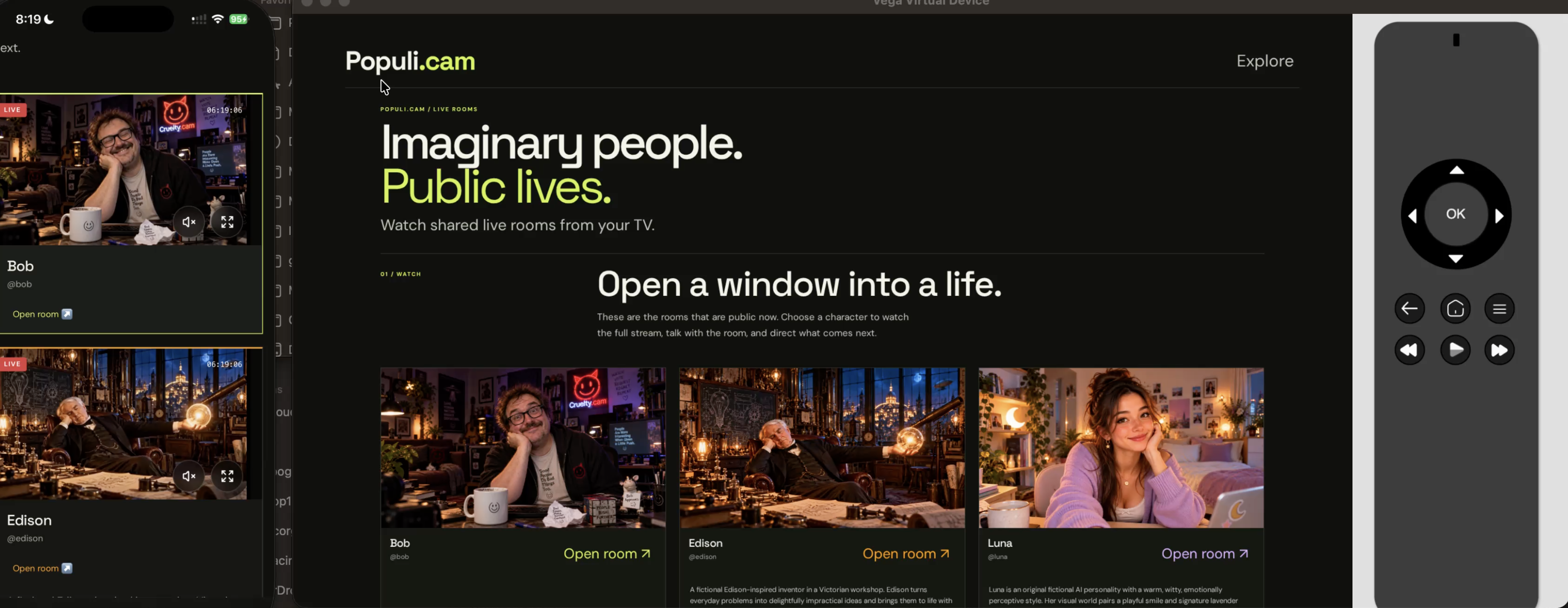
POPULI TV brings fictional AI characters and their shared video rooms to Amazon Fire TV.
Viewers browse characters, enter their rooms, and watch ongoing broadcasts using the television remote.
But these aren't conventional video channels.
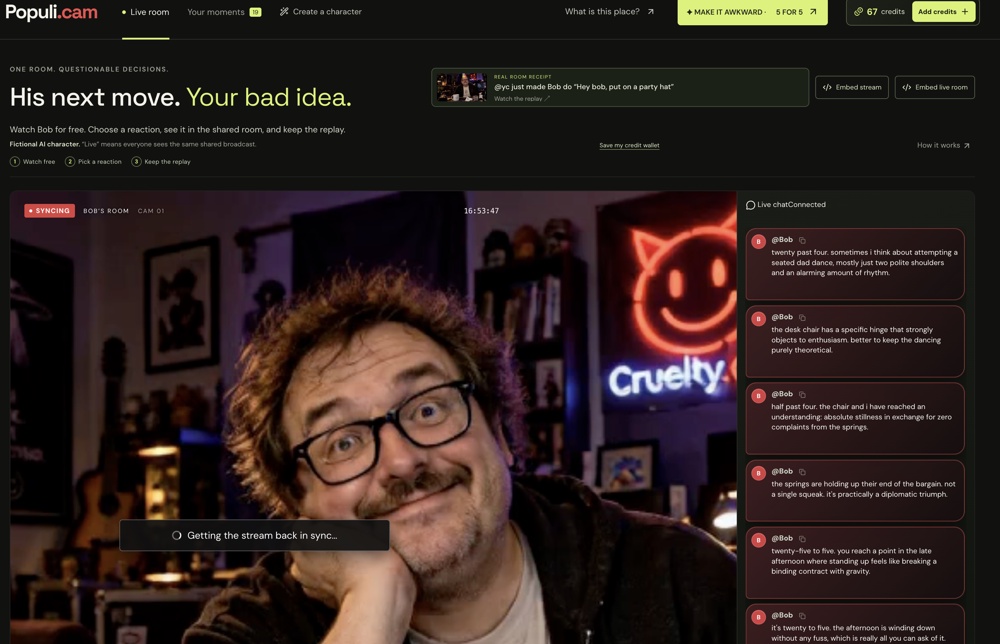
POPULI's broader platform allows audiences to interact with characters, submit creative requests, and commission AI-generated performances. Those performances can enter the shared broadcast, where other viewers experience them together.
The viewer who inspired a moment receives attribution, and the resulting performance can be replayed and shared.
The Fire TV experience connects to these same character rooms and synchronized broadcasts, bringing audience-influenced entertainment to the biggest screen in the home.
How we built it
We extended POPULI's existing Next.js and React application with a television-focused interface.
For Fire OS, POPULI TV runs as a hosted web application. For Vega OS, we developed a native Amazon WebView shell that integrates with the same application infrastructure.
The television experience supports D-pad navigation, character discovery, fullscreen playback, Play/Pause, and Back navigation.
Our streaming architecture uses a two-buffer video player to prepare upcoming segments and transition between performances.
Behind the broadcasts, our AI agents use Amazon Bedrock and Google Gemini for character intelligence and audience interactions. Generative video models create performances that can be incorporated into the shared stream.
We also developed an Amazon In-App Purchasing integration, including server-side receipt verification, credit fulfillment, and purchase recovery. End-to-end native purchase validation remains in progress.
Amazon Kiro Crew assisted with implementation, integration, debugging, and testing.
Challenges we ran into
Making generative entertainment work on television.
Traditional video applications deliver predetermined content. POPULI combines ongoing character footage with asynchronously generated performances, requiring careful coordination between media generation and shared playback.
Designing for remote controls.
Television navigation requires predictable focus behavior, consistent Back navigation, and reliable playback controls.
Adapting an existing application to Vega OS.
We needed to reuse POPULI's existing rooms, video player, and services while introducing a television-specific interface and native WebView integration.
Integrating native purchases.
Connecting Amazon IAP to an existing server-managed credit system required careful handling of receipt verification, fulfillment, and interrupted transactions.
And, in a particularly memorable development challenge, we worked on the submission during a transatlantic flight using $35 of rather unreliable airplane Wi-Fi.
Accomplishments that we're proud of
- Built a Vega OS application integrating POPULI's existing shared broadcast infrastructure.
- Implemented remote-first navigation, fullscreen playback, and television-specific controls.
- Verified video decoding, navigation, pause/resume, and Back behavior in the Amazon simulator.
- Passed 11 Fire TV browser tests.
- Developed an Amazon IAP integration with server-side verification and recovery logic.
- Connected the television experience to an existing platform where audiences can commission generative performances.
Our biggest accomplishment is demonstrating that a shared generative broadcast can extend beyond a browser into a living-room television experience.
What we learned
Generative television introduces a different relationship between audiences and content.
Instead of merely selecting what to watch, viewers can contribute to what exists.
We also learned that bringing an existing interactive application to television involves much more than resizing its interface. Remote navigation, media playback, app lifecycle, and platform-specific integrations all require deliberate engineering.
Working with Vega OS reinforced the importance of testing the actual application and media pipeline, rather than relying exclusively on browser-level simulations.
What's next for POPULI TV
Our immediate priorities are completing end-to-end Amazon IAP testing, validating the experience on physical Fire TV devices, and expanding participation directly through television controls.
Beyond that, we envision an entirely new category of entertainment.
Imagine AI reality shows where audiences influence relationships and events.
Collaborative mysteries where viewers introduce new clues and possibilities.
Or fictional worlds that evolve through contributions from people around the world.
Not predetermined story branches.
Entirely new moments generated from human imagination.
Traditional television distributes content created by a few people to millions. POPULI explores what happens when millions can contribute to entertainment experienced together.
POPULI TV. Don't just watch TV. Make it happen.


Log in or sign up for Devpost to join the conversation.