

PopPulse — Turning City Data into Retail Decisions
Inspiration
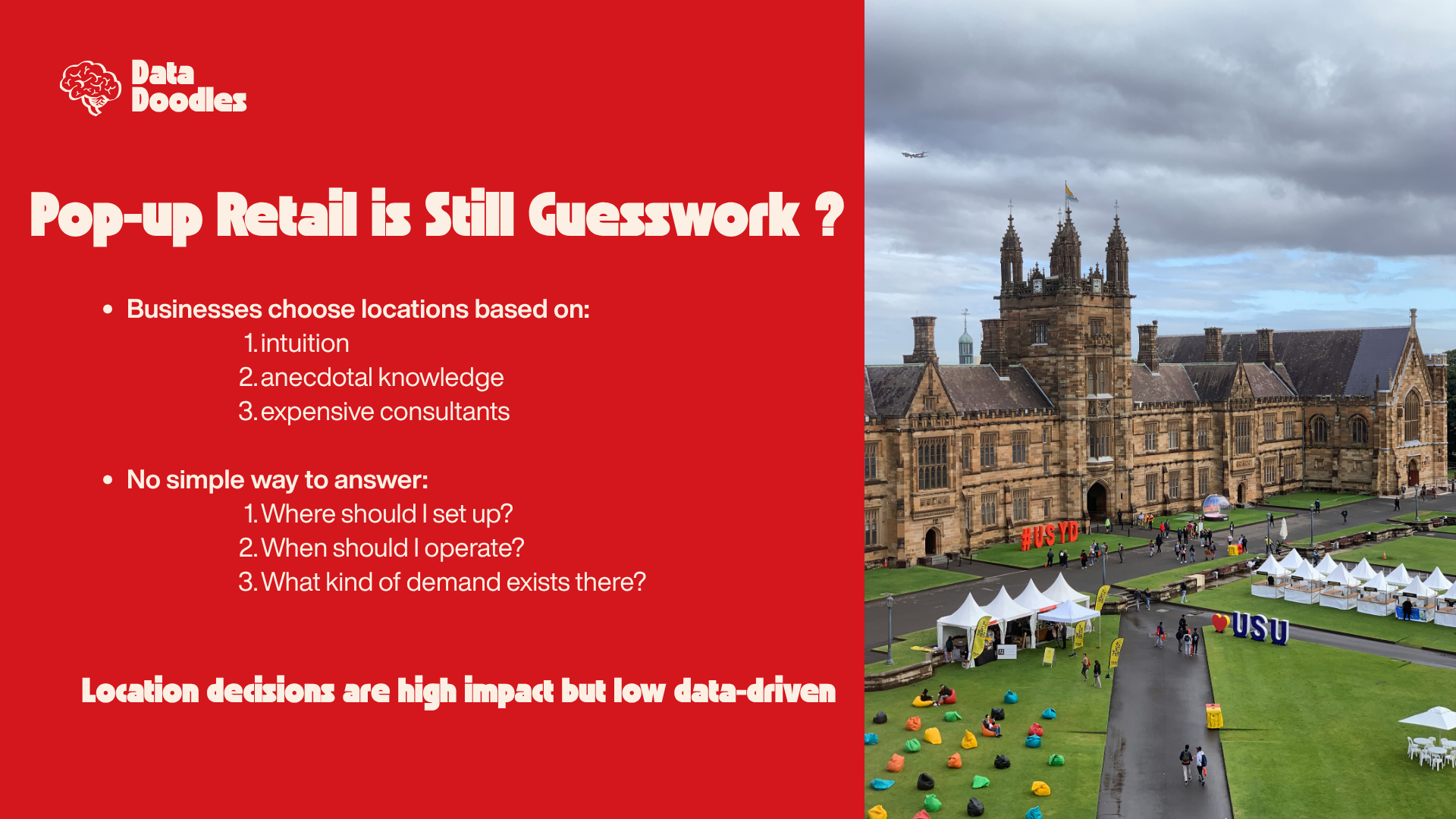
Pop-up retail and small vendors often rely on intuition or trial-and-error when choosing locations. While large organizations can afford detailed market research, smaller operators typically lack access to actionable insights.
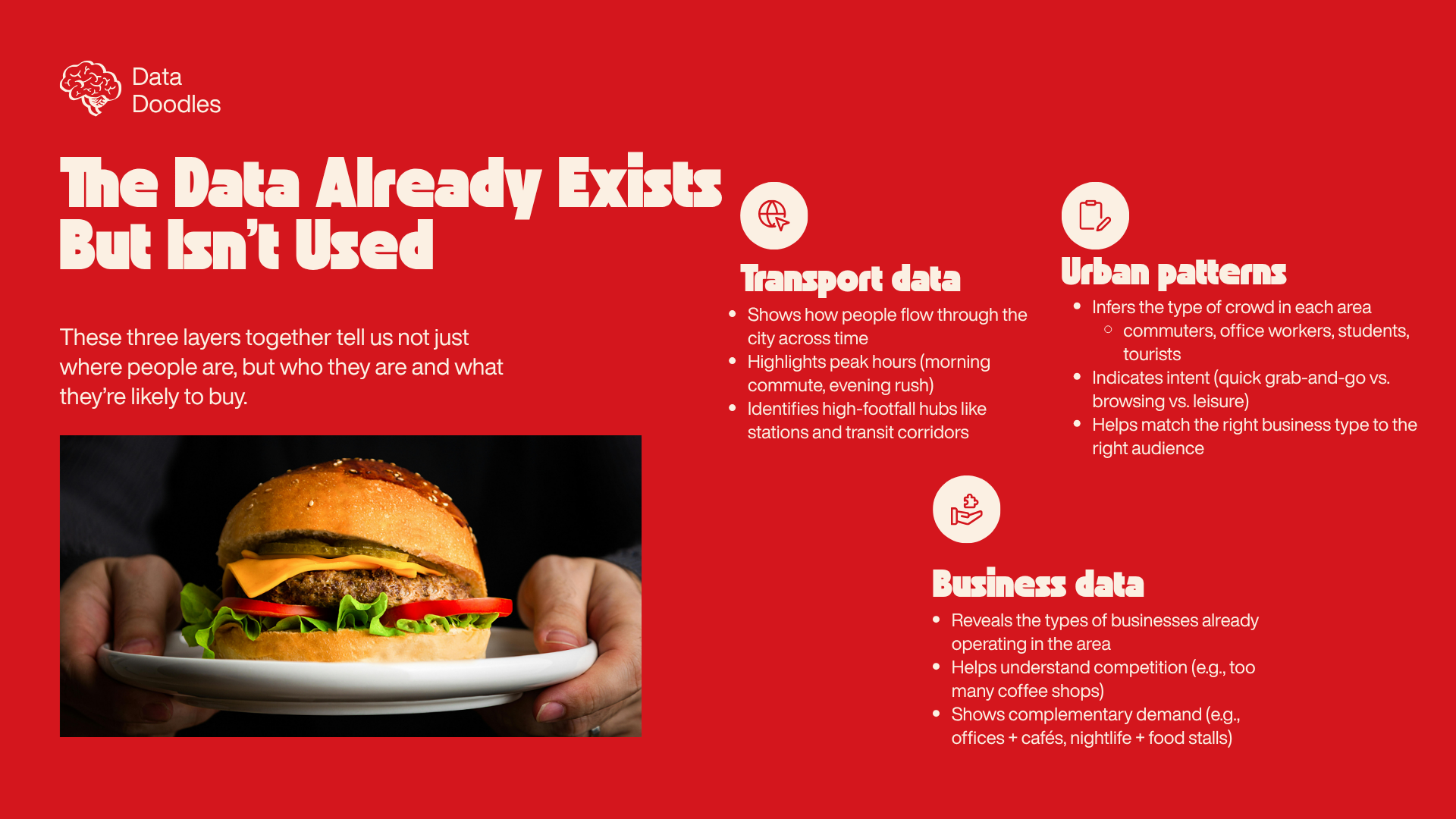
At the same time, cities generate large volumes of data — transport movement, business presence, and urban activity — but this data is rarely translated into something directly usable for decision-making.
This gap inspired PopPulse:
A system that converts urban data into simple, actionable recommendations about where and when to operate.
What it does
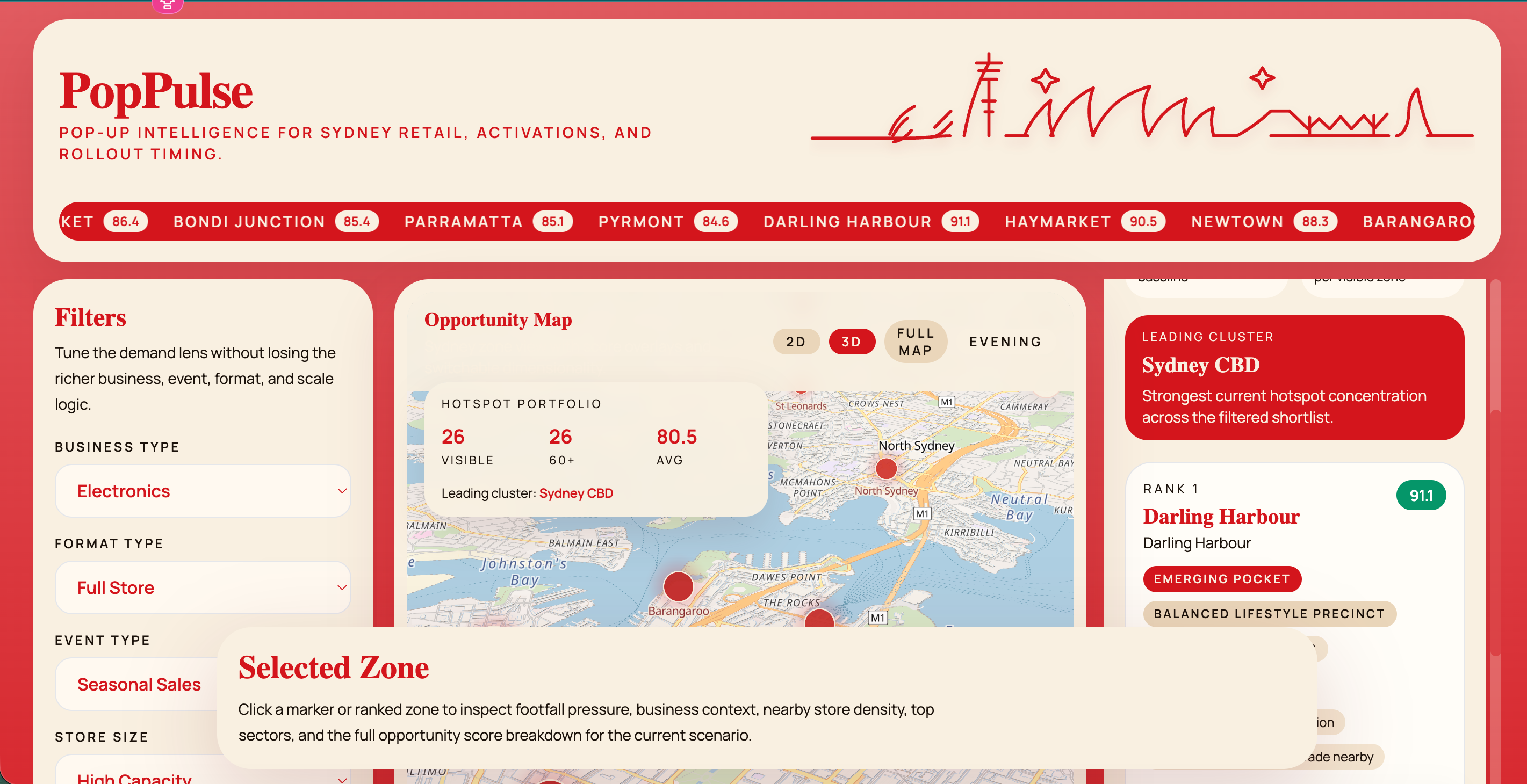
PopPulse is an interactive web application that helps users identify the best locations for pop-up businesses.
Users can:
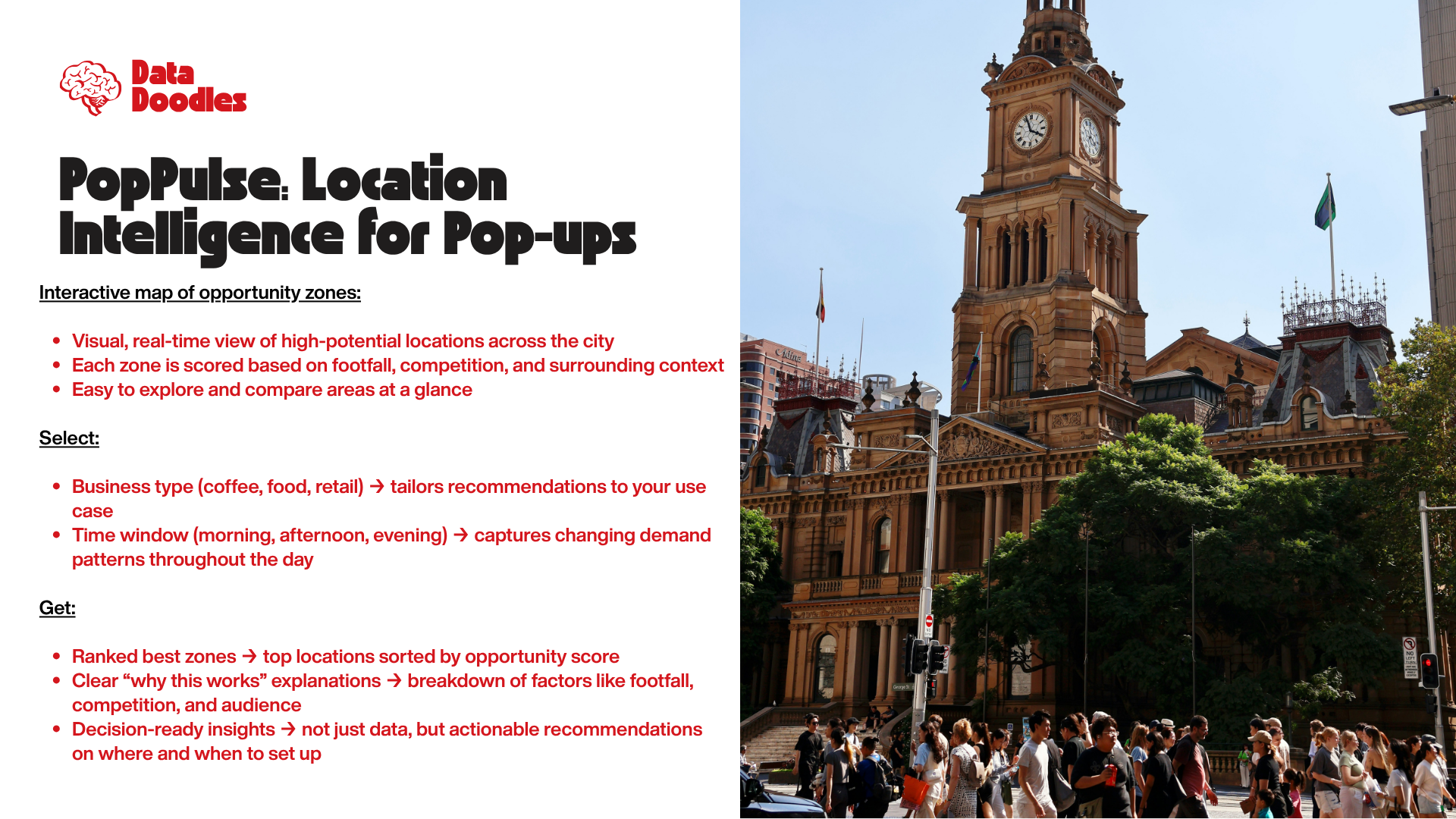
- Select a business type (coffee, food, retail)
- Choose a time window (morning, afternoon, evening)
The system then provides:
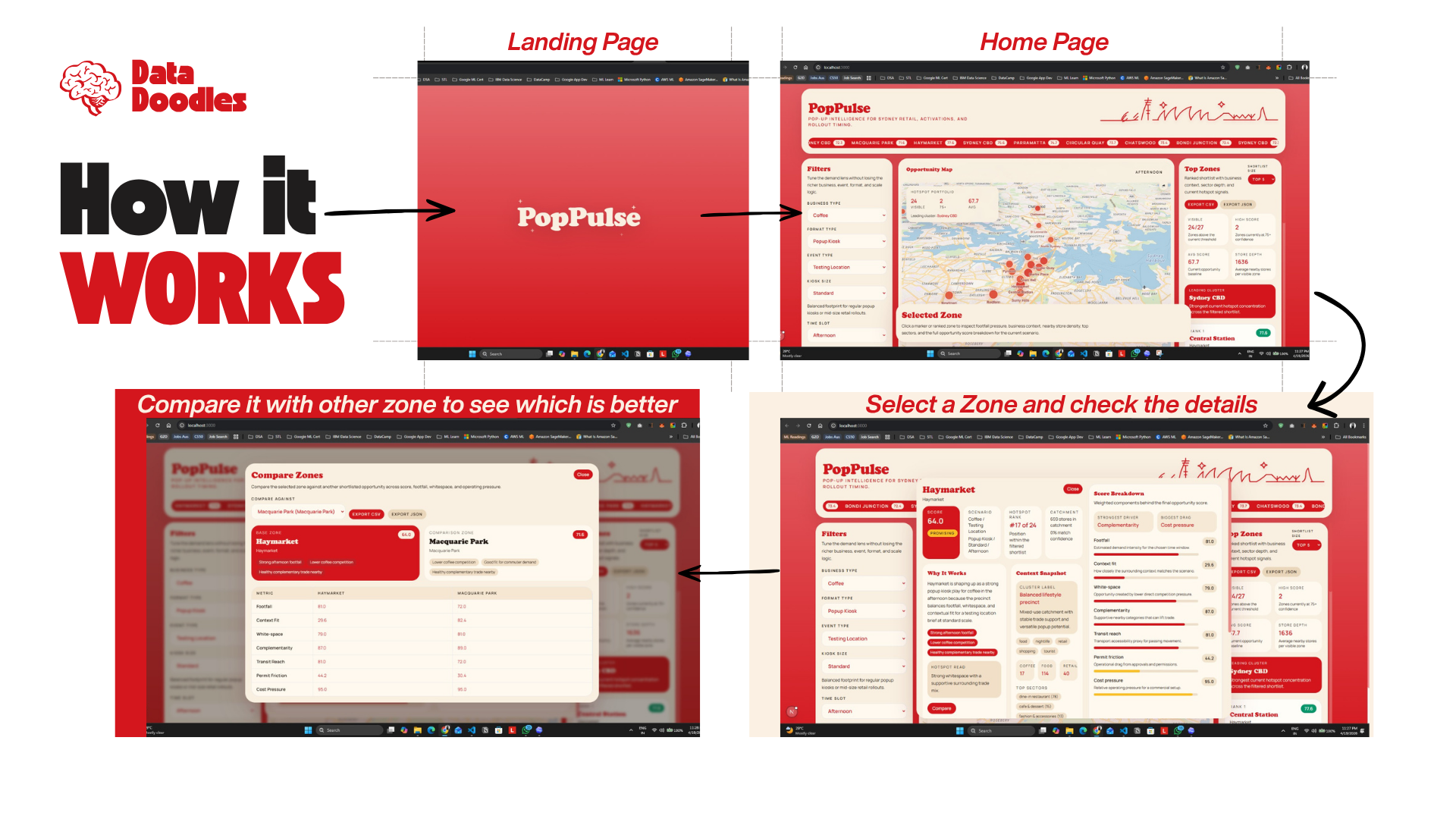
- A map of opportunity zones
- A ranked list of top locations
- Clear explanations of why each location is suitable
This allows users to move from exploration to decision-making quickly and effectively.
How we built it
The project was built in two main stages:
1. Data Preparation
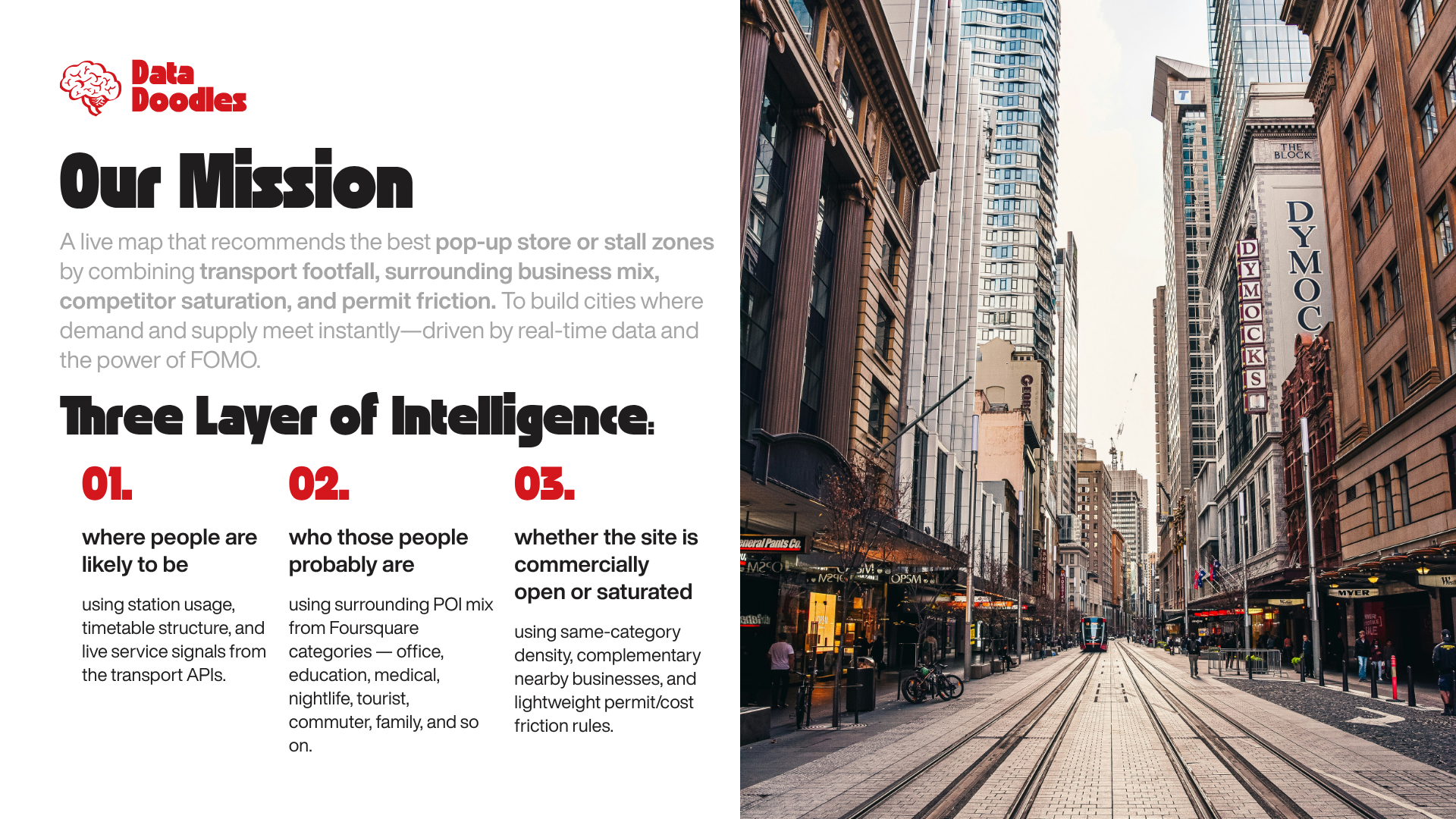
- Raw location and contextual data were cleaned and transformed into structured geographic units called zones
- Each zone contains features such as footfall, competition, complementarity, and operational constraints
- Features were normalized to ensure comparability across zones
2. Scoring and Application Layer
We designed an interpretable scoring function:
$$ \text{Score} = 0.35 \cdot \text{Footfall} + 0.20 \cdot \text{Context Fit} + 0.15 \cdot \text{White Space} + 0.15 \cdot \text{Complementarity} + 0.10 \cdot \text{Transit Reach}
- 0.03 \cdot \text{Permit Friction}
- 0.02 \cdot \text{Cost Pressure} $$
The web application was built using:
- Next.js for structure
- TypeScript and React for modular components
- A map-based interface for visualization
Challenges we ran into
- Data quality and availability: Real-world datasets were incomplete and inconsistent, requiring simplification
- Time constraints: Balancing a functional product with limited time for data processing
- Scoring design: Creating a model that is simple, interpretable, and meaningful
- Avoiding overengineering: Resisting unnecessary complexity such as advanced machine learning
Accomplishments that we're proud of
- Built a fully functional end-to-end system within a limited timeframe
- Designed an explainable scoring mechanism instead of a black-box model
- Created a user-friendly interface that supports real decision-making
- Combined multiple data dimensions into a coherent and usable product
What we learned
- The importance of explainability in data-driven systems
- How to convert raw data into actionable insights
- The value of prioritizing simplicity and usability over complexity
- Practical trade-offs between data accuracy and development speed
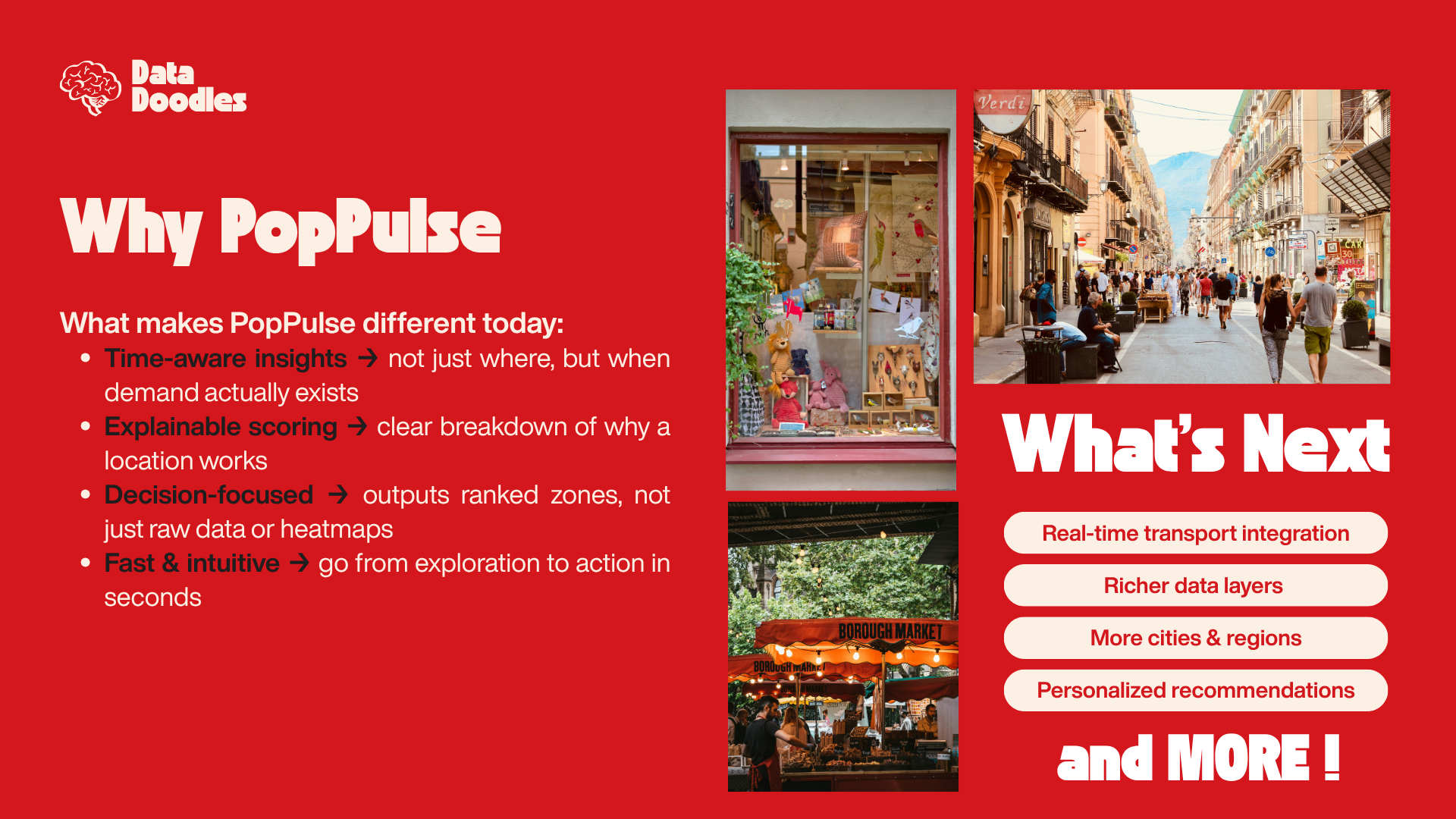
What's next for PopPulse
Future improvements include:
- Integration of real-time transport and mobility data
- Expansion to more cities beyond Sydney
- Inclusion of cost, rent, and permit-related datasets
- Personalized recommendations based on user behavior
PopPulse aims to evolve into a scalable platform for data-driven retail and urban decision-making.
Built With
- git
- github
- javascript
- nextjs
- python
- vercel
