Inspiration
Romania scores lowest in the EU on financial knowledge and highest on confidence: only 13% score high on financial knowledge (Flash Eurobarometer 525, 2023). We ran a small survey of our own (97 people, our network, not representative): almost 1 in 5 can't put any money aside, and among under-25s, 47% keep their savings only in a current account or cash.
Money rarely leaks in the big decisions. It leaks at checkout, one "I deserve this" at a time. Budgeting apps look back at what already happened. We wanted something that shows up in the moment before you pay, with the exact amount, and makes the better choice feel just as satisfying.
What it does
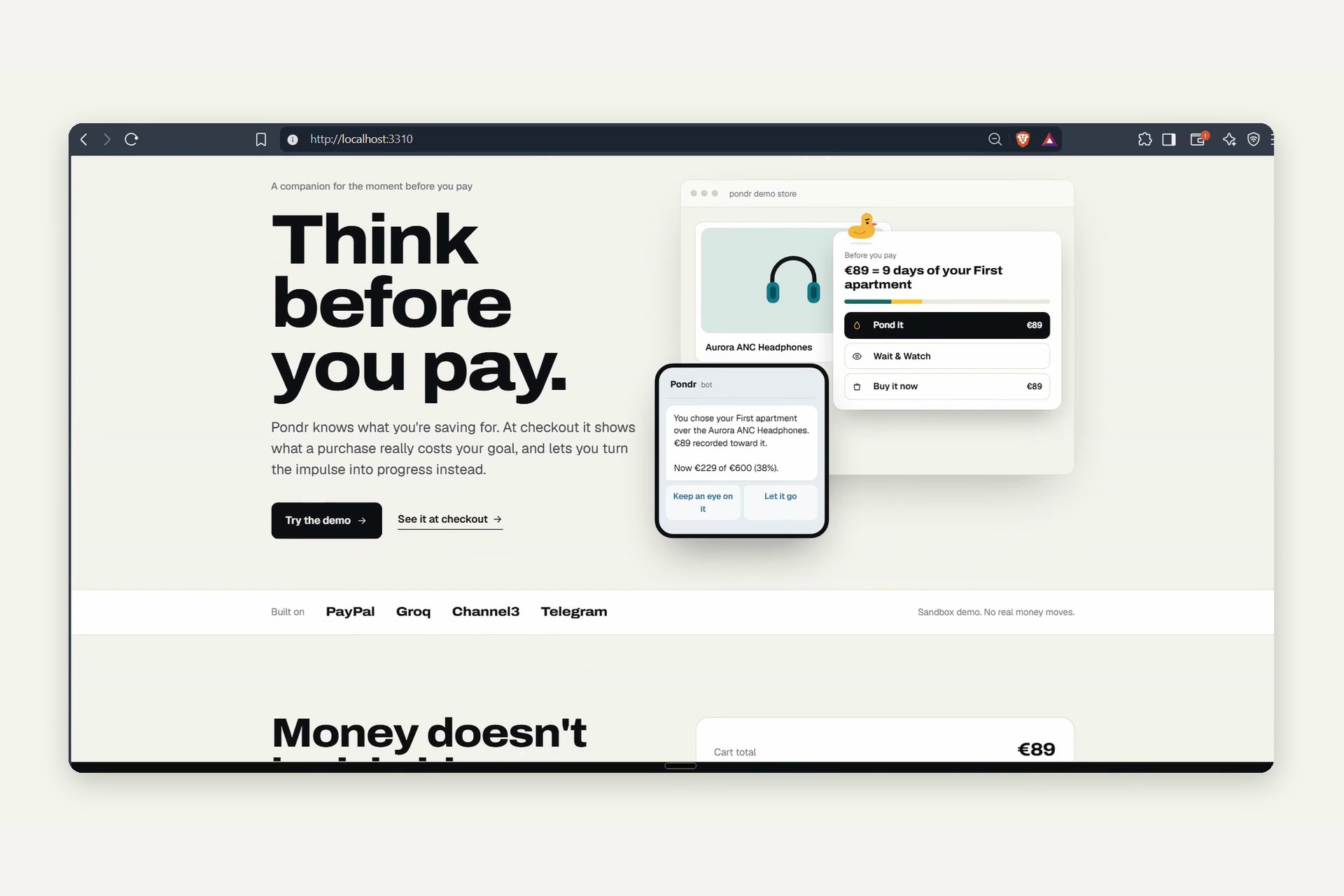
Pondr is a checkout companion that knows what you are saving for.
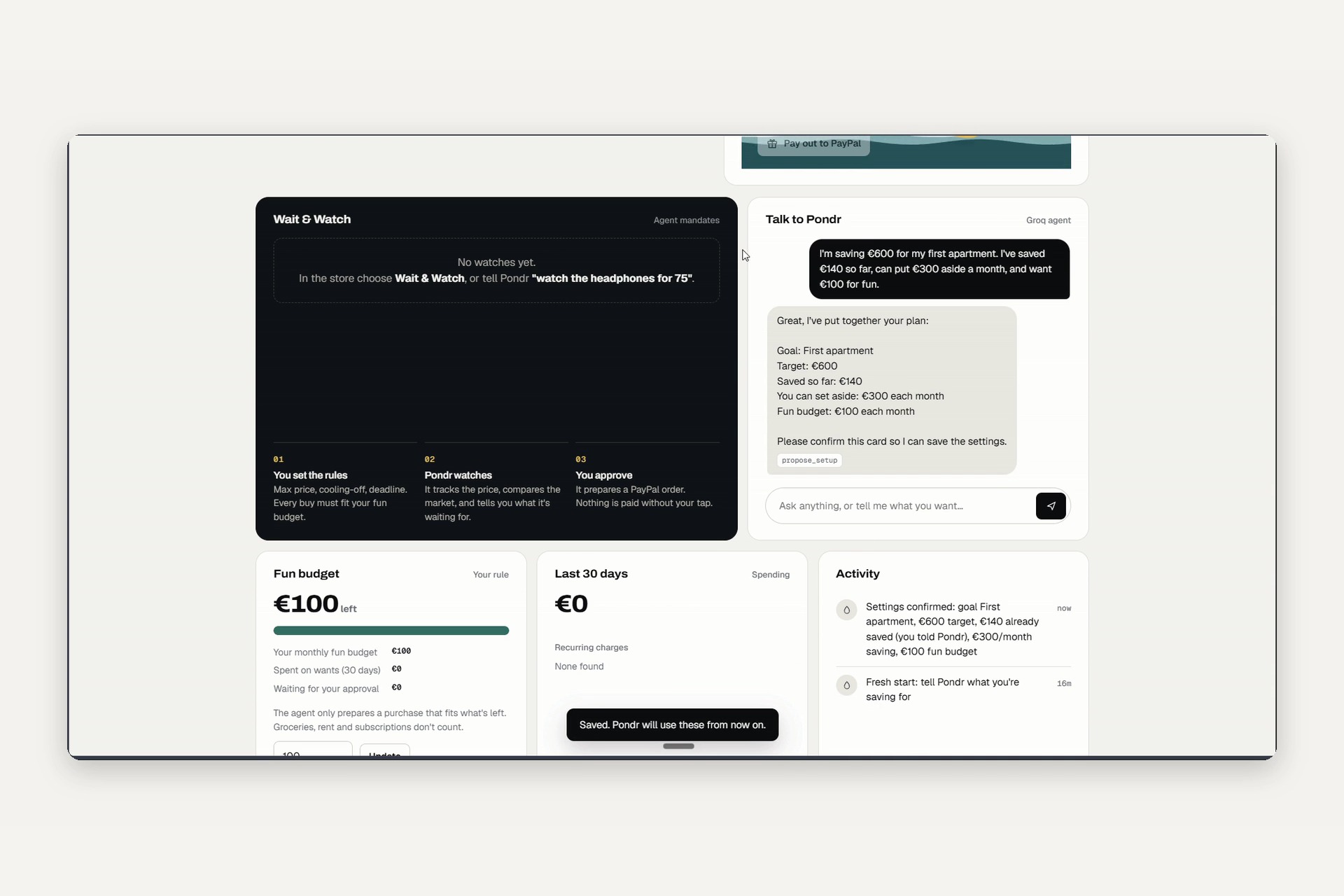
- Gets to know you. You type, in your own words: "I'm saving €600 for my first apartment, I've saved €140, can put €300 aside a month and want €100 for fun." The AI turns it into settings, and nothing is saved until you confirm.
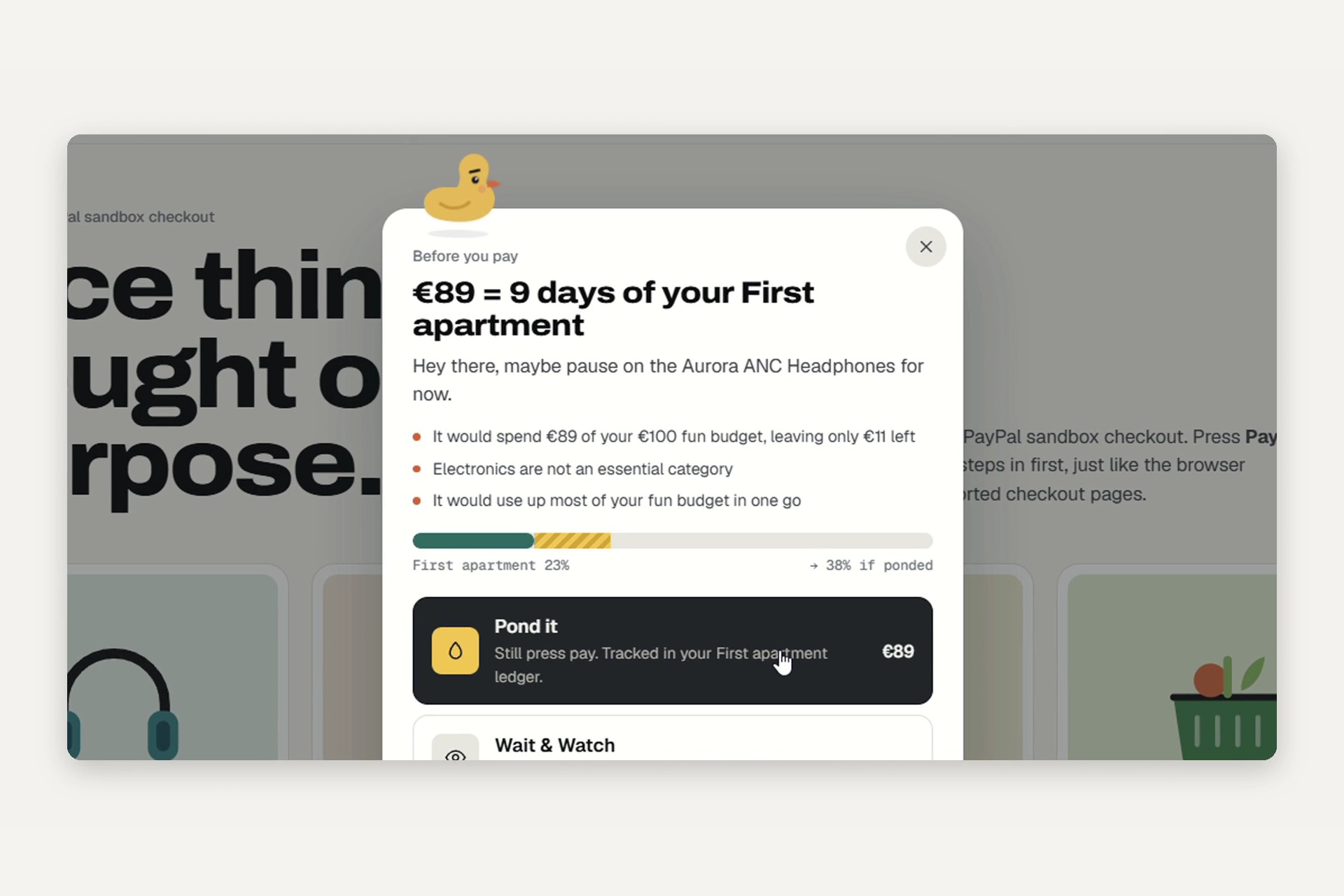
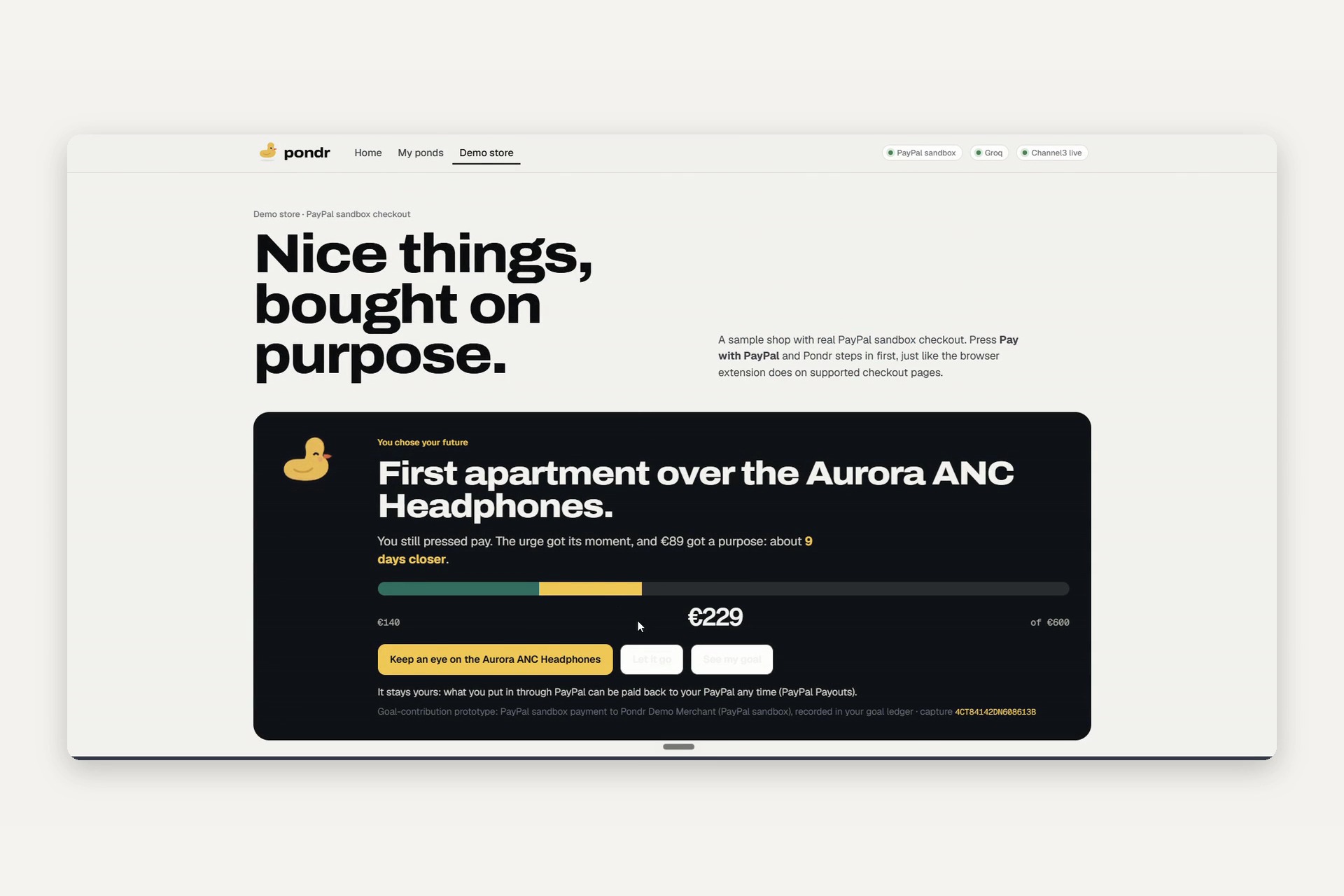
- Steps in at checkout. When you press Pay with PayPal, the duck shows what this purchase means for your goal. Code does the maths:
$$\text{days of saving} = \frac{\text{price}}{\text{monthly saving pace} / 30} = \frac{89}{300 / 30} \approx 9 \text{ days}$$
The AI decides whether an interruption is worth it, and writes the words. For groceries or rent it stays quiet.
- Three ways out of every checkout:
- Pond it (the default): you still press Pay in PayPal, but the amount goes toward your goal instead of into the cart. The urge gets its moment; the money gets a purpose. The goal only moves after a confirmed PayPal capture.
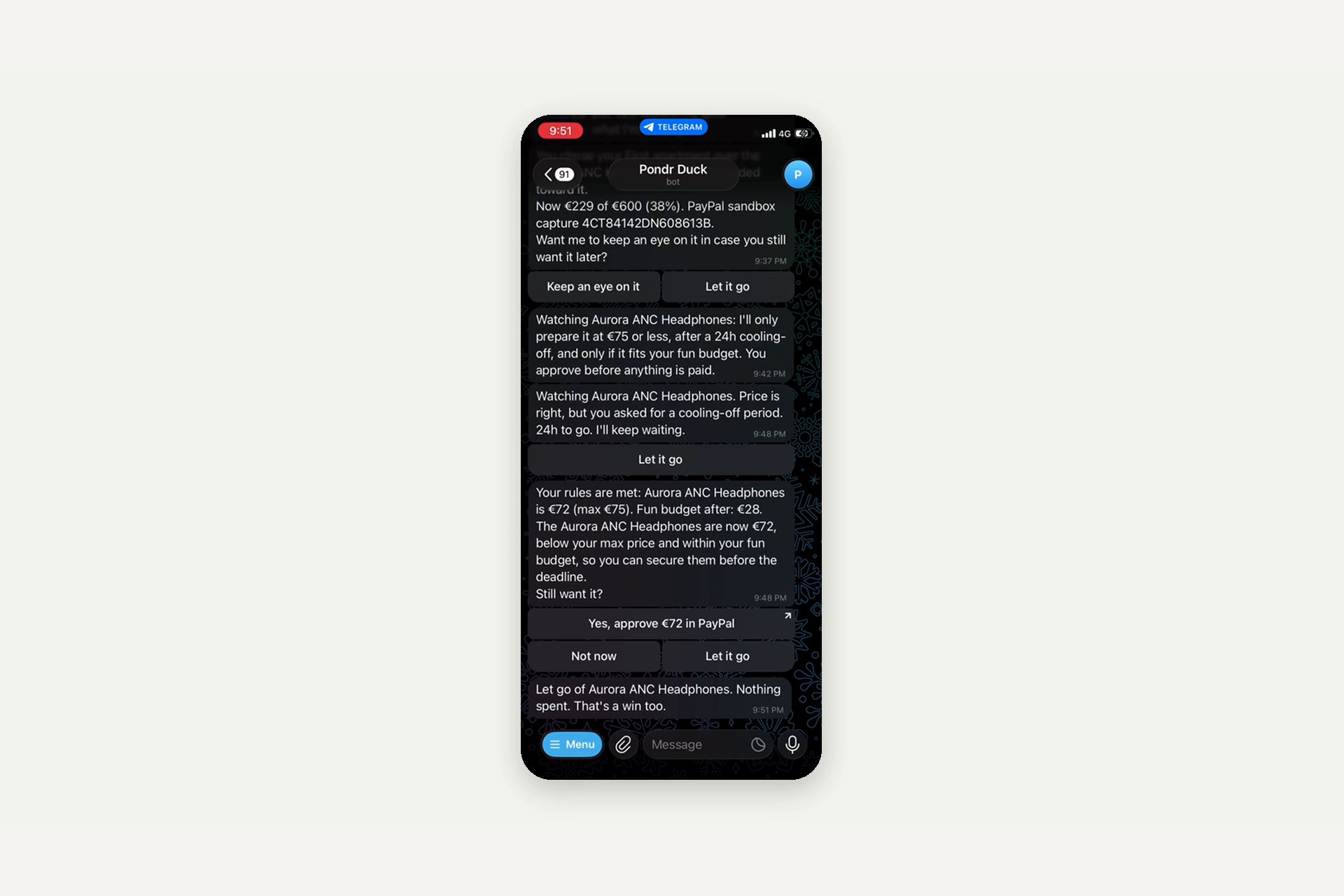
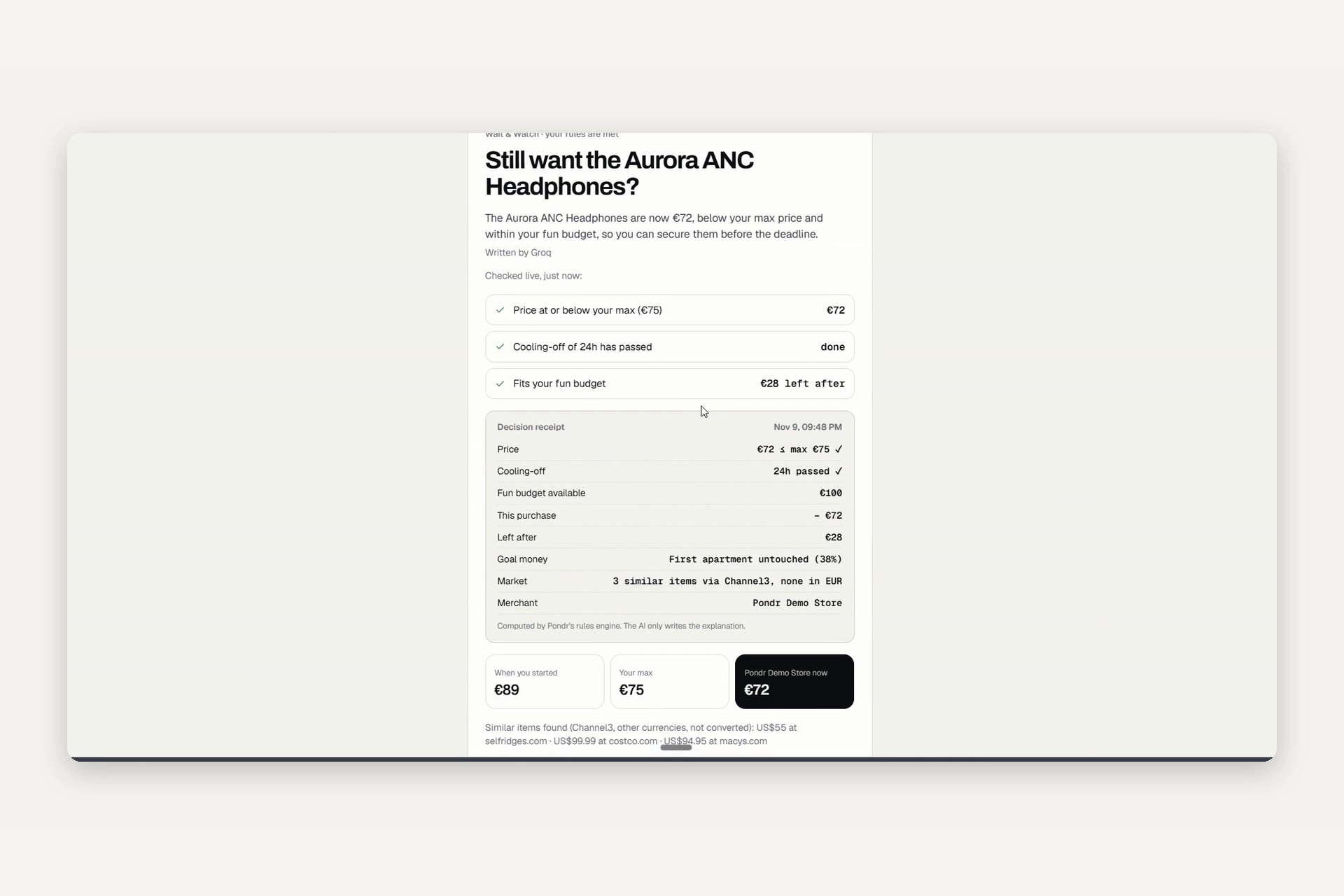
- Wait & Watch: "I want it, but not at this price." You set a max price, a cooling-off period and a fun budget. Pondr's agent watches the price (with live market comparisons from Channel3), and only when every rule holds does it prepare a PayPal order and ask you. It can never capture a payment on its own. Every decision comes with a receipt: price ≤ max, cooling-off passed, fun budget left after.
- Buy it now: your call, no lecture.
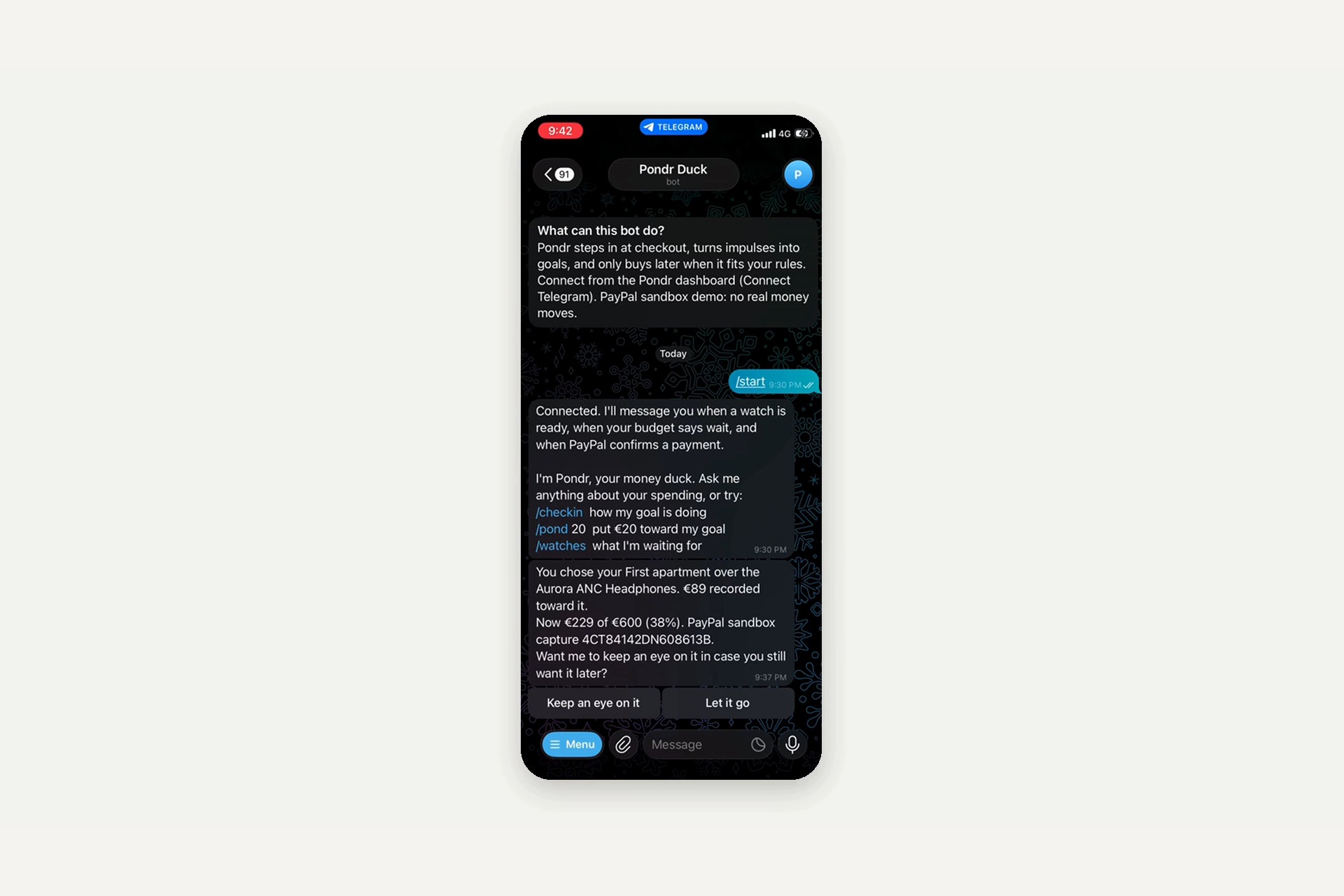
- Lives on your phone. A Telegram companion, linked with a one-time code, remembers what you chose ("You chose your First apartment over the headphones… keep an eye on them?") and pings you when your rules are met.
- It stays yours. Money put in through PayPal can be paid back to your PayPal account at any time with PayPal Payouts. A monthly auto-pond uses PayPal Subscriptions.
How we built it
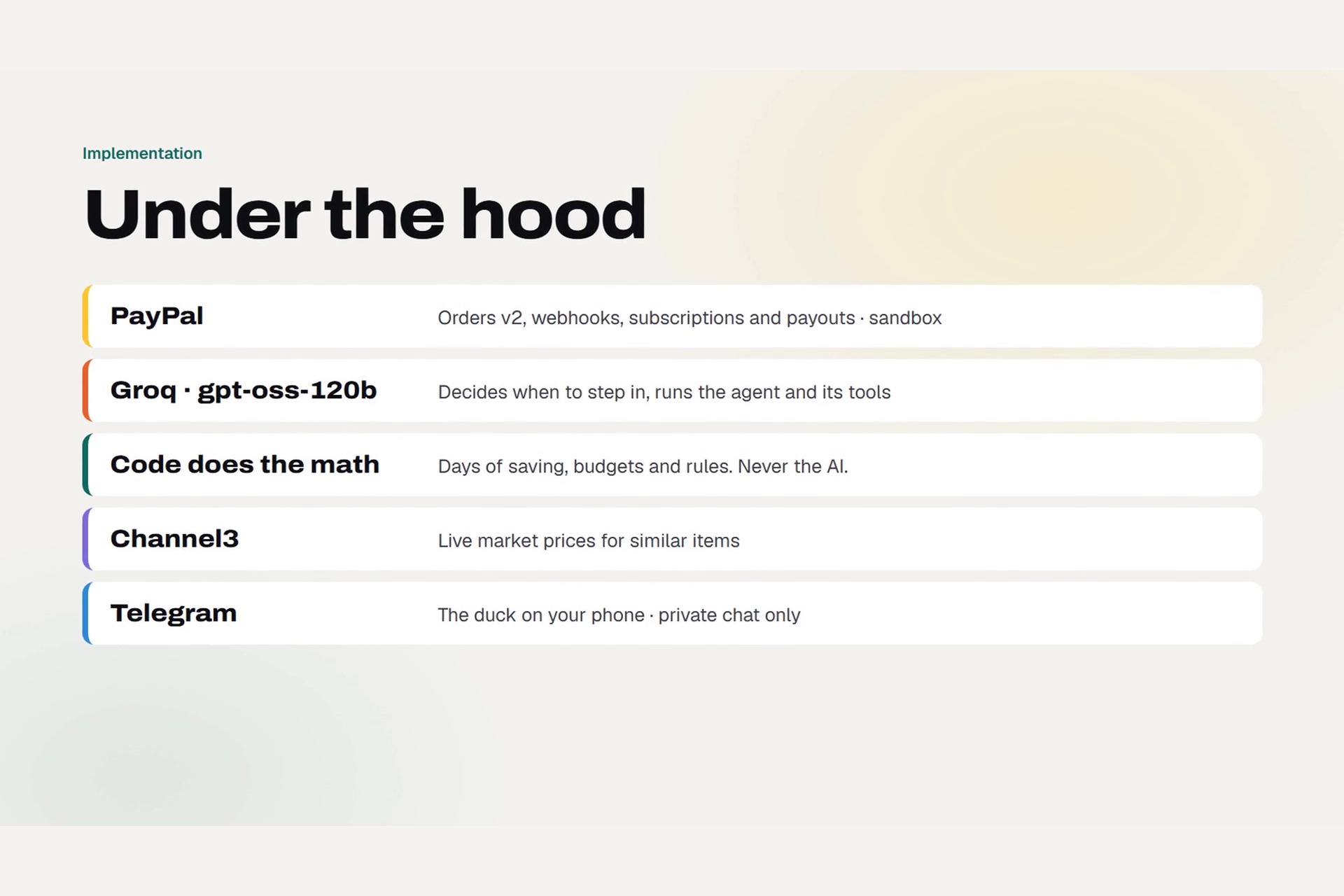
- Backend: Node.js + Express, per-visitor sessions, a background loop for watches and check-ins.
- PayPal (sandbox):
- Orders v2: create → approve → capture, with
PayPal-Request-Ididempotency. Rules are re-checked right before every capture. - Webhooks: signature-verified, duplicates ignored.
- Subscriptions: product → plan → subscription.
- Payouts: status polling and a stable batch id, so a retry can't pay twice.
- Orders v2: create → approve → capture, with
- AI: Groq
openai/gpt-oss-120bbehind a provider-neutral layer (Claude is optional). The agent uses server-side tools: reading your finances, searching the market, creating a watch, proposing your setup. The model never does the maths. The server hands it computed facts, and it decides and explains. - Channel3 for live prices of similar products, kept currency-aware (other currencies are shown, never silently compared).
- Telegram Bot API for the phone companion: private chats only, owner-checked.
- Frontend: hand-built HTML, CSS and vanilla JS, with an original duck mascot drawn in SVG.
- Hosting: Render.
Challenges we ran into
- The AI got the maths wrong. Early on, the model said buying the headphones would "drop your goal to €51", which isn't how goals work. We moved every number into code (
if you buy now/if you pond itfacts) and the model only explains them. - Keeping declared savings separate from real money. Your €140 "saved so far" is what you told Pondr; it must never be withdrawable. Withdrawable money is derived only from PayPal payment records.
- Losing the session on PayPal's redirect. The cookie can drop on the cross-site return, so the server finds the session by the PayPal order and restores it.
- Payouts stuck ON HOLD because the receiving sandbox account couldn't hold EUR. We switched to a EUR-capable sandbox account.
- Making an agent safe with money. It can prepare an order but never capture one; rules are checked again at approval; it ignores instructions inside product pages and never acts in group chats.
Accomplishments that we're proud of
- A complete loop that really runs on PayPal sandbox: goal → checkout → Pond it → captured payment → goal moves → phone follows up → agent waits → order prepared → you decide.
- An AI that knows when to stay quiet. Not every purchase gets a lecture.
- A clear line of trust: code does the maths, the AI explains, you approve.
What we learned
- The best moment to help with money is the second before you pay, not the end of the month.
- LLMs are great at judgement and wording, and unreliable at arithmetic. Splitting those roles made the product both smarter and more honest.
- PayPal's building blocks (Orders, Webhooks, Subscriptions, Payouts) are enough to build a real savings experience in a short time.
What's next for Pondr
- Partner with a regulated savings provider so ponded money moves into a real savings account.
- Ship the browser extension (prototype in the repo) beyond our demo store, so the duck appears on real checkout pages.
- A pilot with students, then improve the "when to step in" decisions from real feedback.
Built With
- ai-agents
- channel3
- css3
- express.js
- gpt-oss-120b
- groq
- html5
- javascript
- llm
- node.js
- paypal
- paypal-orders-api
- paypal-payouts
- paypal-subscriptions
- paypal-webhooks
- render
- telegram-bot-api
