-
-
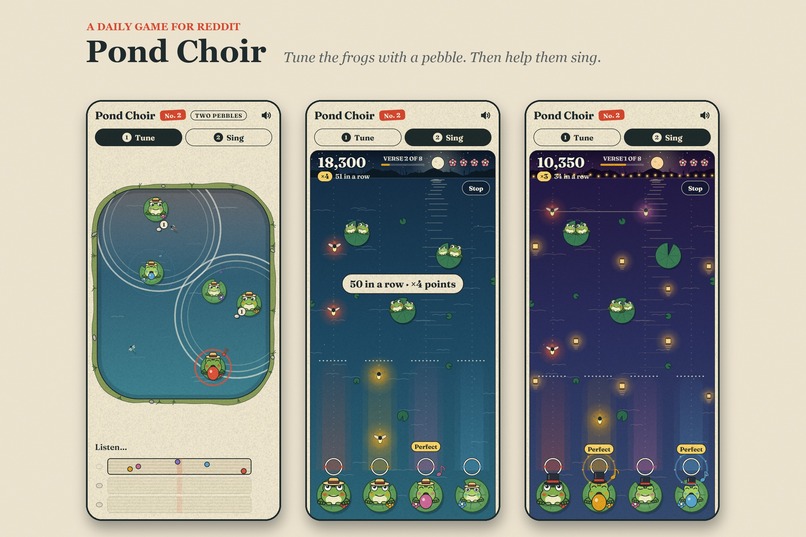
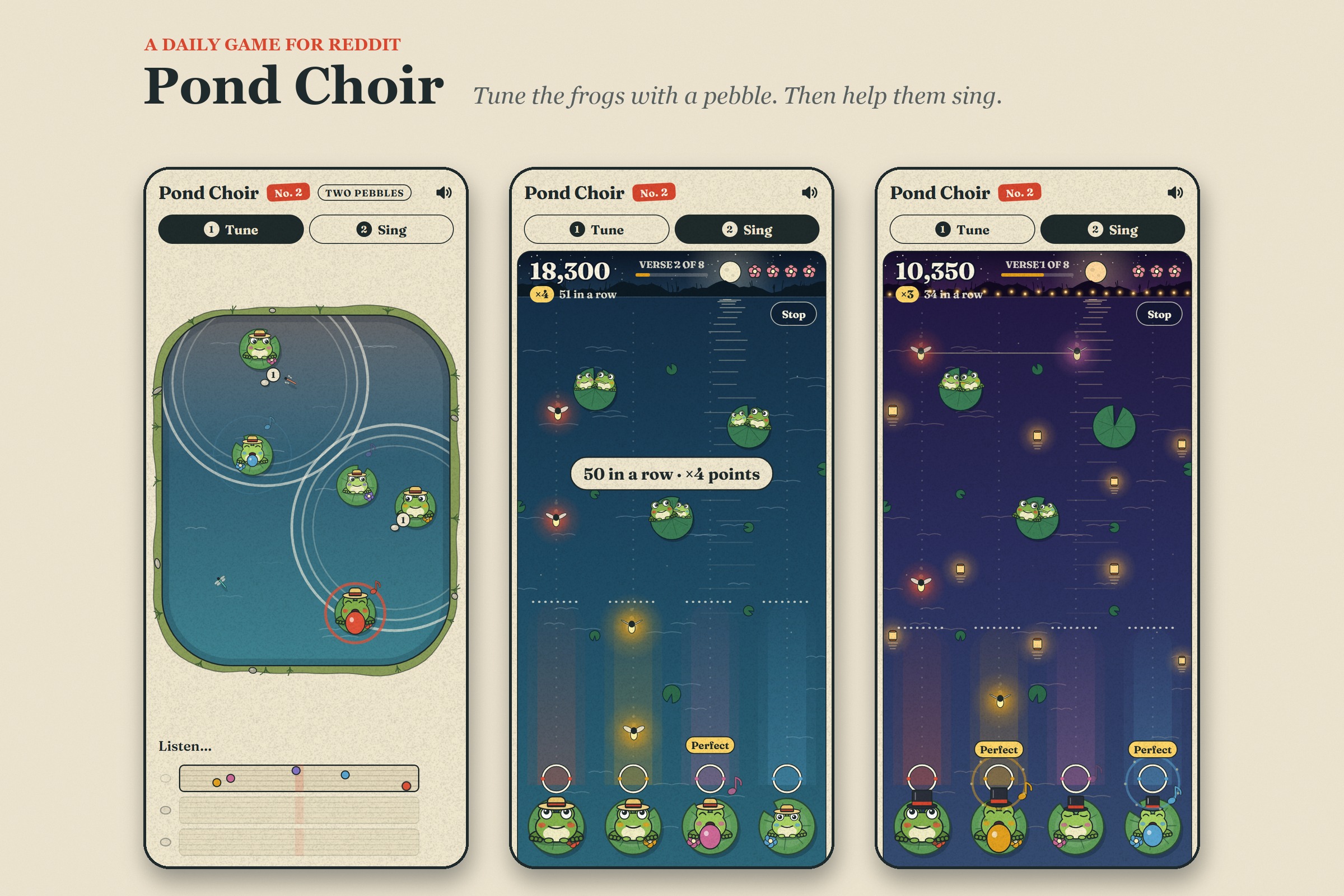
Pond Choir: tune the frogs with a pebble, then help them sing.
-
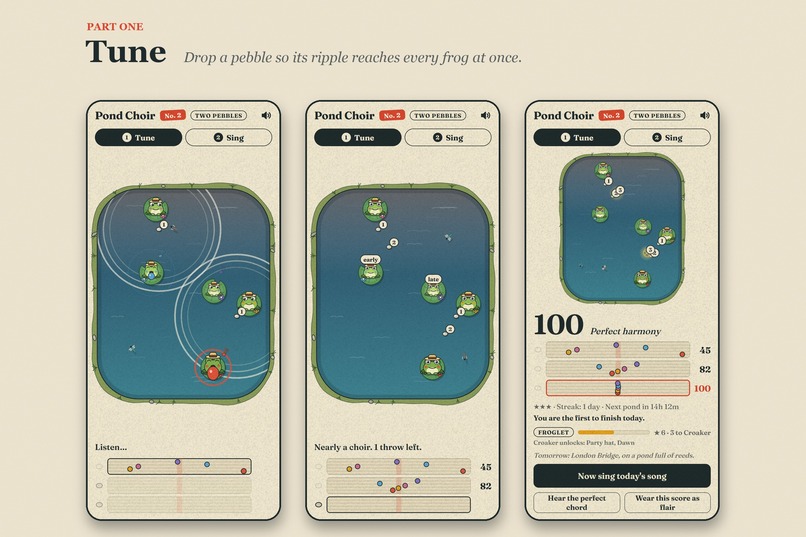
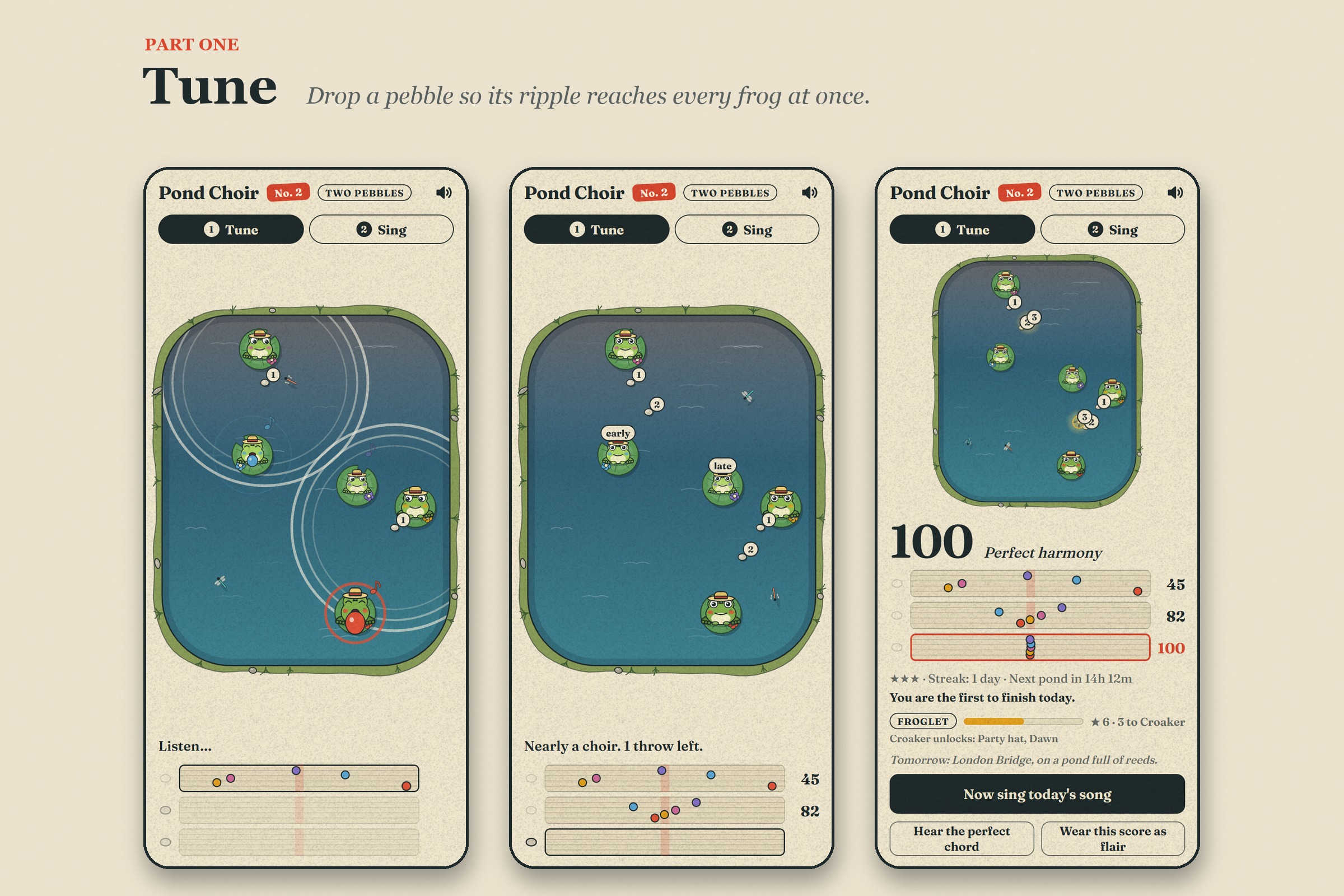
Tune: a throw with ripples spreading, the early and late hints, and a perfect 100.
-
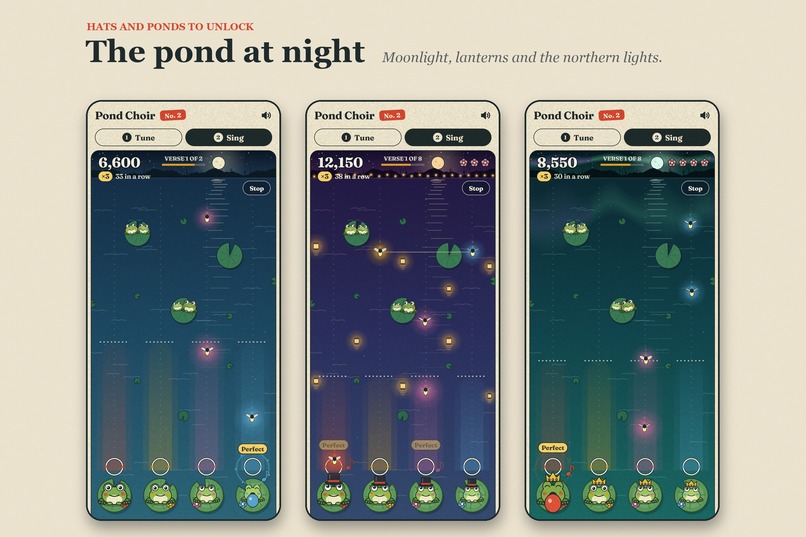
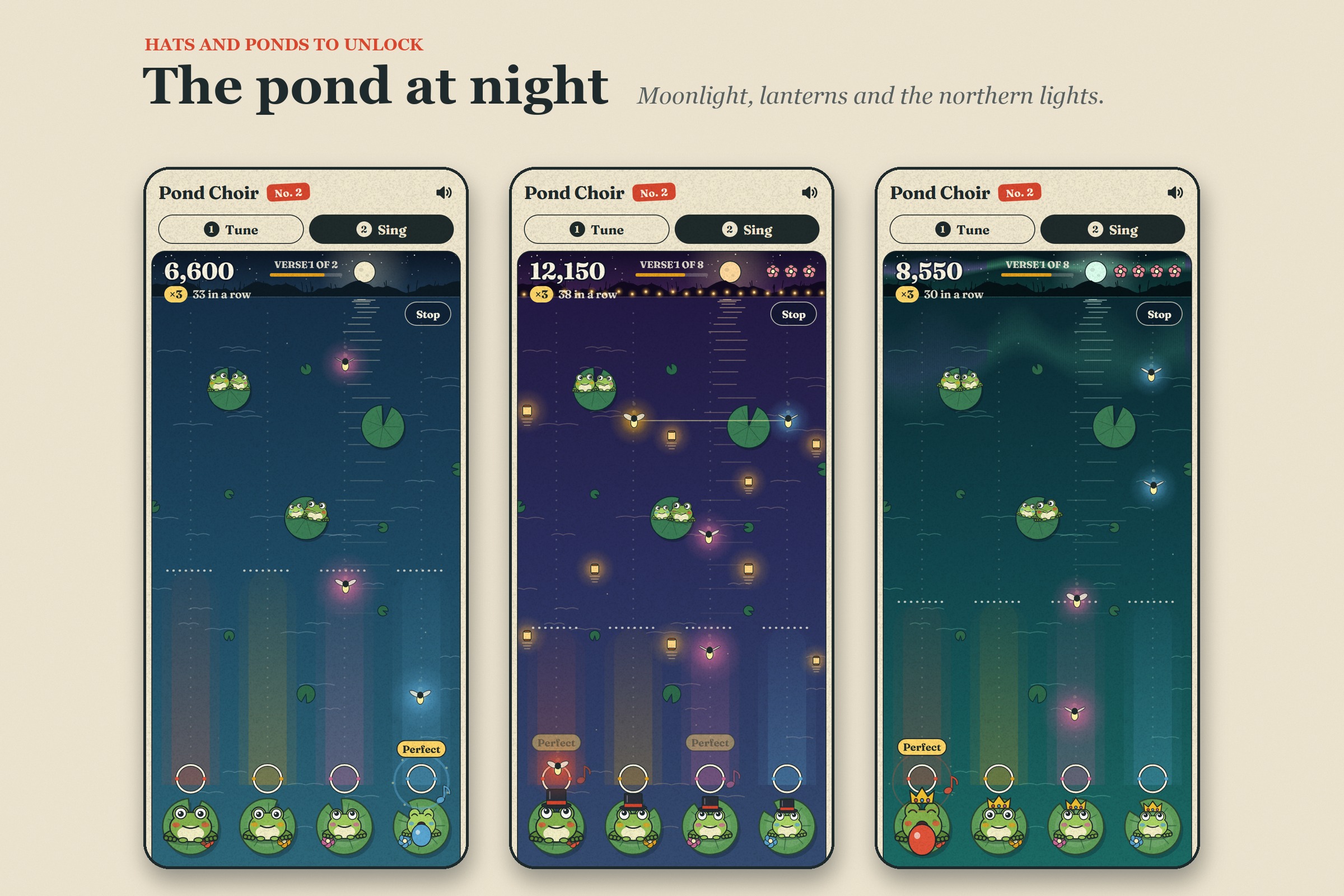
Three of the four ways the pond can look at night, with hats unlocked by stars.
-
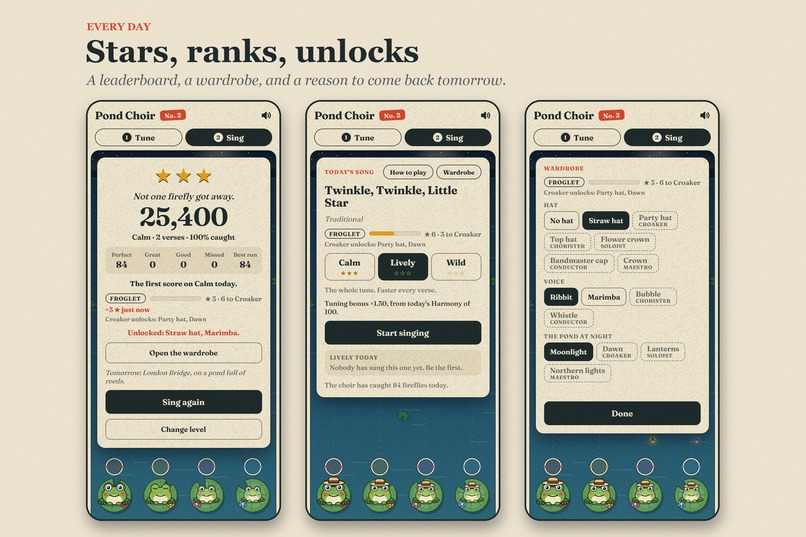
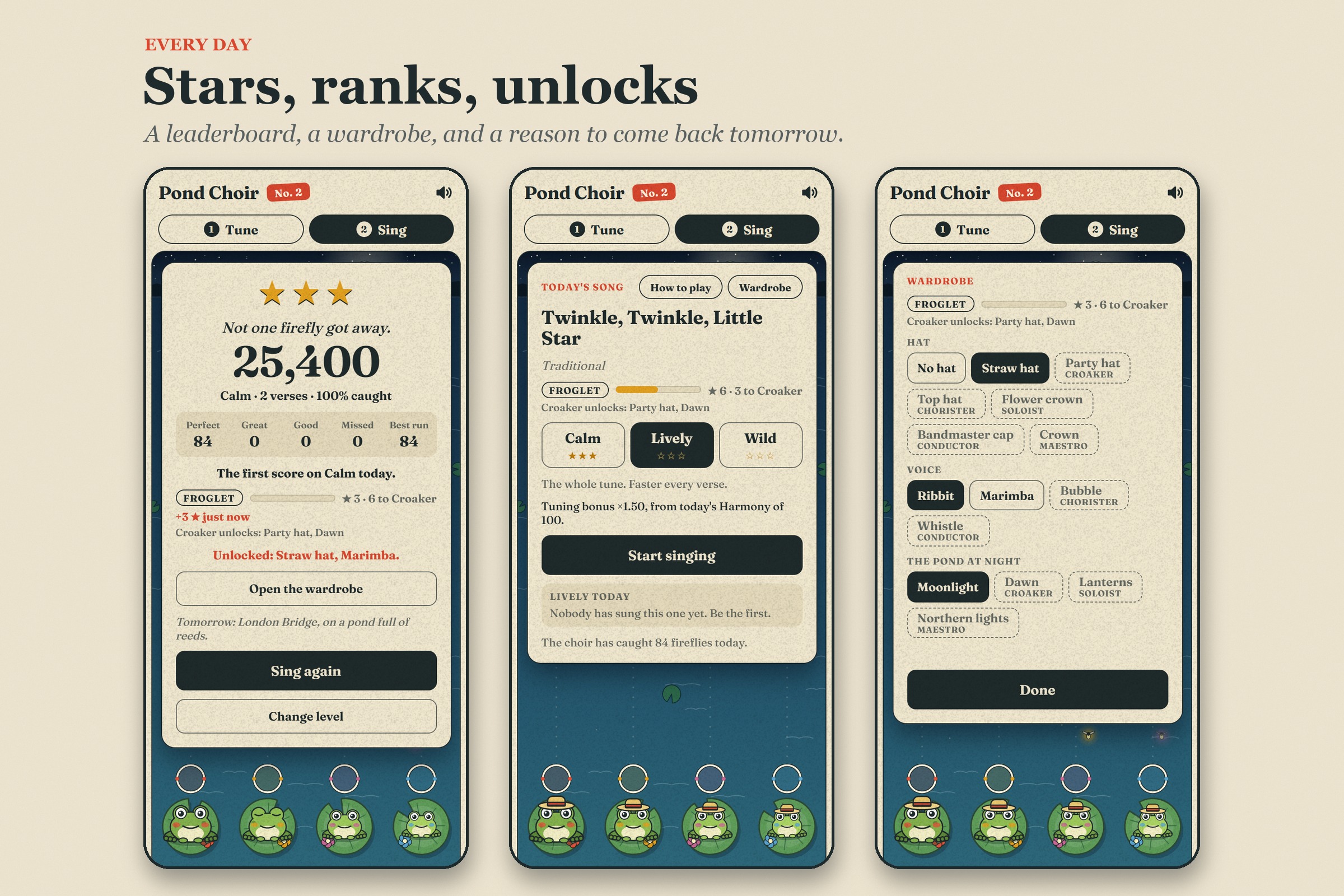
A result with stars and an unlock, the song lobby, and the wardrobe.
-
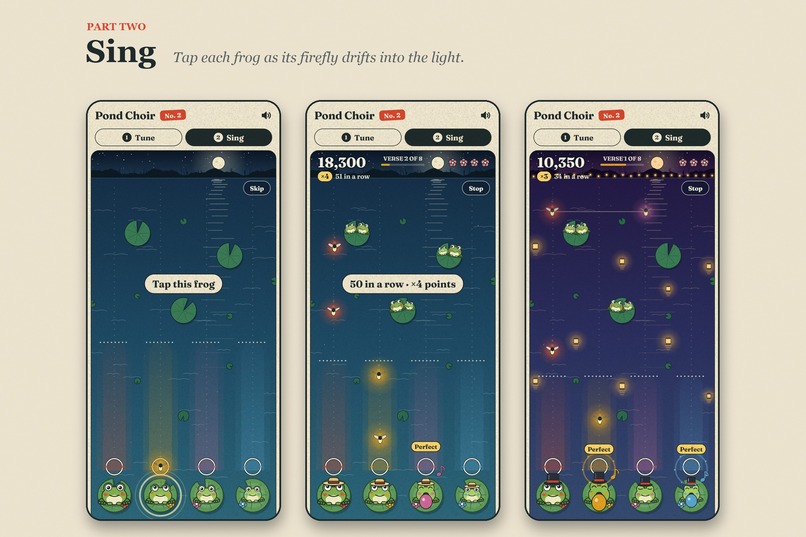
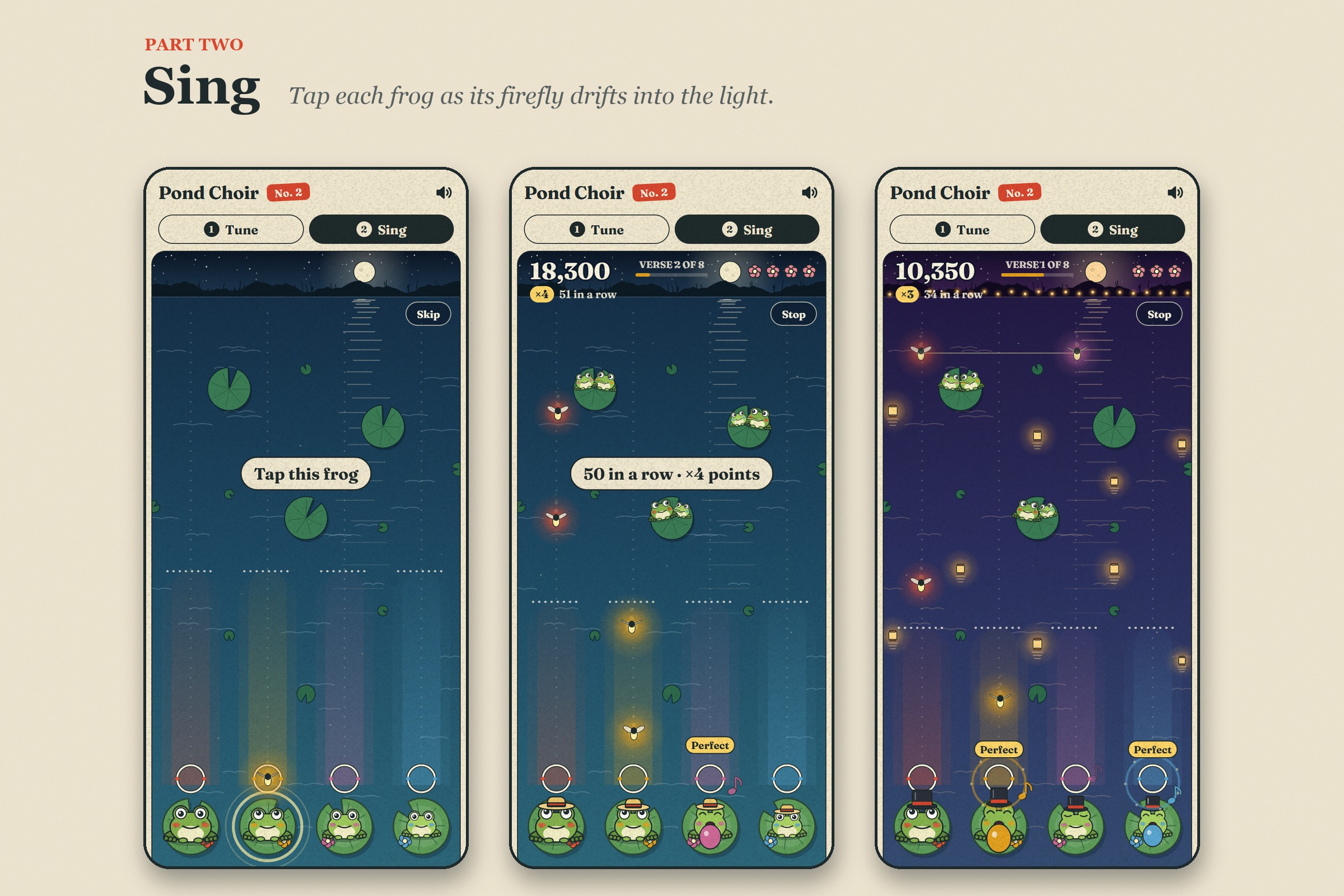
Sing: the first-time lesson, a 50-catch run on Lively, and two frogs at once on Wild.
What it is
Pond Choir is a daily game that runs inside a Reddit post. Every day has one pond and one song, and the day has two parts.
Tune. Frogs sit on lily pads. You drop a pebble, the ripple spreads, and each frog sings at the moment the ripple reaches it. The goal is to find the one spot where the ripple reaches every frog at once, so they sing a single chord. You get three throws, and a Harmony score from 0 to 100.
Sing. The frogs then sing the song of the day. Fireflies drift down the pond at night, one for every note. Tap a frog while its firefly is within reach and it catches it and sings the note at that instant, so you are playing the tune yourself. It comes round again faster each verse, for as long as you can keep up.
The two parts are tied together: the better you tuned the choir, the more every note is worth, by up to half as much again.
How a day plays
- The post in the feed shows today's pond, names the song, and has a Play button.
- Tune takes about a minute. The first frog to sing is marked "early" and the last one "late", which tells you where to aim next. After three throws the sweet spot is revealed.
- Sing has three levels: Calm cannot be failed, Lively speeds up every verse, and Wild adds two frogs at once. Each frog has a patch of light in front of it showing how far it can reach. A catch right on the beat scores most, but any catch inside the light counts, so it is easy to start and hard to master.
- The first time, a ten-second lesson teaches it with two fireflies that wait at the ring until they are caught, so nobody can fail it.
- Catches in a row multiply your points, and couples of frogs come out to dance on the spare lily pads as your run grows.
- The result screen shows your stars, your place on the day's leaderboard, your progress to the next rank and what it unlocks, and a line about tomorrow's pond and song.
The game reads with the sound off. In Tune, each throw has a bar drawn like a line of sheet music, with one dot per frog placed at the moment it sang. In Sing, every catch is graded in words.
Fresh every day
- A new pond. Each pond is generated from the date. Every week has two plain days and one day of each of five twists: a sleepy frog that sings a beat late, reeds that slow the ripple, a log it has to go around, two pebbles at once, and a lily pad that drifts.
- A new song. There are 18 tunes, all in the public domain, from Ode to Joy to the Can-Can, in arrangements made for the game. Carols take over on alternate days in December, and New Year gets Auld Lang Syne.
- A new light. Each day's pond is drawn at noon, at dusk, in mist or at night.
Reasons to come back
- Stars. Each day offers twelve: three for Tune and three for each level of Sing.
- Choir rank. Stars add up, from Tadpole to Maestro. Every rank unlocks two things.
- Wardrobe. Six hats for the frogs, three more voices for them to sing in, and three more ways for the pond to look at night: dawn, floating lanterns, and the northern lights. None of it changes the score.
- Daily leaderboards, one for each level, with your own place always shown.
- Streaks, judged by the server's clock.
- Tomorrow. Every result screen ends with tomorrow's song and pond.
Built to be fair
A daily puzzle is only fun if every day is solvable and nobody gets a free win. Before a pond is used, a checker plays it and rejects it unless:
- a perfect throw exists and scores 100;
- there is only one sweet spot;
- the obvious first guesses (the middle of the frogs, the middle of the pond) score 80 or less;
- on a twist day, solving it as if it were a plain day scores 85 or less, so the twist always matters.
Ripples are worked out with exact geometry, not a simulation, so scoring is instant and identical for everyone. The server re-scores every throw itself and never trusts a score sent by a browser.
Sing is played in the browser, so the server cannot replay it. It checks instead that a run is possible: the counts must fit the day's song, and a score can never be more than those catches are worth. Songs are laid out so that no frog is ever asked for two notes closer together than a thumb can manage, and the speed stops rising before that limit.
The test suite has 70 tests. It runs the pond checker over 150 ponds of each kind and over 400 consecutive days of the real schedule, and builds every song at every level.
Made for a community
- Everyone's first pebble. When you finish Tune, a faint scatter on the pond shows where the rest of the community dropped their first pebble. It stays hidden until you have used all three throws, so it can never be used as a hint.
- How you compare. You see how many players have finished, what share of them you beat, and how many reached 100.
- Leaderboards and a shared total. The Sing screen shows the day's best scores on each level and how many fireflies the whole community has caught.
- A pinned comment on every post invites players to share scores without giving away the sweet spot.
- Flair. One tap shows your score next to your name in the community. It is never set without being asked.
- Logged-out visitors can play. Their throws and scores are kept in the browser, and their throws carry over if they log in.
How it was built
- Devvit Web, with a plain TypeScript client and server and no framework.
- Everything on screen is drawn in code on a canvas: the ponds, the frogs, their hats, the fireflies, the dancers and the night skies. There are no image files.
- All sound is synthesised in the browser: the frogs' voices, and a small band of bass, chords and percussion that builds up verse by verse. There are no audio files. Sound is scheduled on the audio clock, and the screen follows that clock, so the music stays in time even if the screen drops frames.
- Reddit's Redis holds each player's throws, streak, scores, stars and wardrobe, the daily leaderboards as sorted sets, and anonymous community totals. Everything tied to a player deletes itself after 30 days.
- A scheduler task creates the day's post at 00:01 UTC, and it is safe to run twice.
- Devvit Journeys events mark the start, progress and end of each round of Tune.
- The rules of the game live in code shared by the browser and the server, so they always agree.
Challenges
- A round rock did nothing. The first obstacle was a round rock. The checker showed that at this pond size a ripple gets around a rock with almost no delay, so the twist never mattered. A long log forces a real detour and is easier to read at a glance.
- Second sweet spots. Some ponds with reeds turned out to have a second, accidental sweet spot far from the intended one. The checker caught it, and the generator now rejects those layouts.
- Fingers cover the target. On a phone your finger hides the exact spot you are aiming at, so dragging shows a magnifier above it.
- The first Sing was unplayable. It asked for a tap at one exact instant, and the first person to try it could not play it at all. Now each frog has a visible reach, any catch inside it counts, and timing only decides how many points a catch is worth.
- Then the tune played itself. To keep the music tidy, a frog that caught its firefly early held the note and sang it on the beat. The same tester noticed at once that the sound no longer followed the taps: catch three fireflies early and the tune carried on alone. Now every note sounds the instant it is tapped. The player is playing the tune, and a catch on the beat is rewarded twice: it scores more, and it sounds right.
What is next
- A result image players can save and share.
- More twists, such as wind that pushes ripples faster in one direction.
- More songs, and songs chosen by the community.
Built With
- canvas
- devvit
- redis
- typescript
- web-audio