-
-
-
-
-
-
-
-
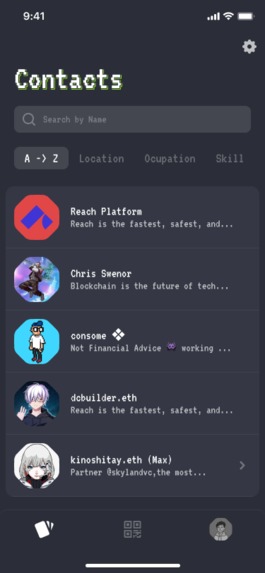
Contact List
🤝 PoN: Polygon BUIDL IT : Summer 2022


Try out the demo, which is hosted live here! Try to see the our README, which is hosted live here!
🚀 Statement
We are eager to continue the project after the hackathon in order to actually launch it in the world.
🔥 Our Challenge for Hackathon
- Web3 Integration in Web2 - Build the Web3 version of your favorite Web2 product.
- Nfts - Combine creativity with Engineering to build awesome NFT dApps.
- Designathon
🎬 Pitch & Live Demo (Video)
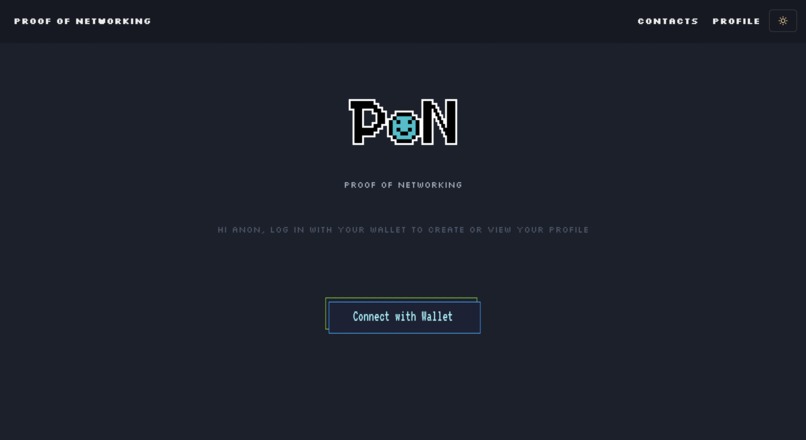
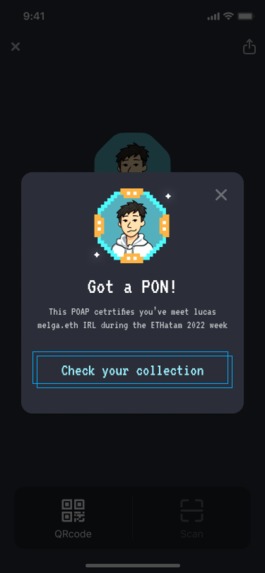
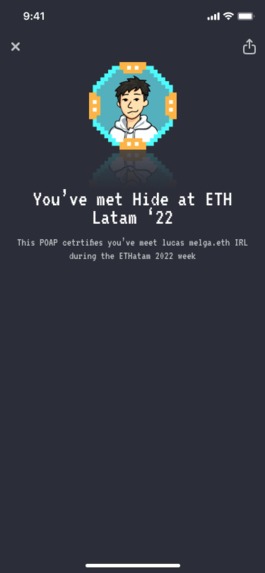
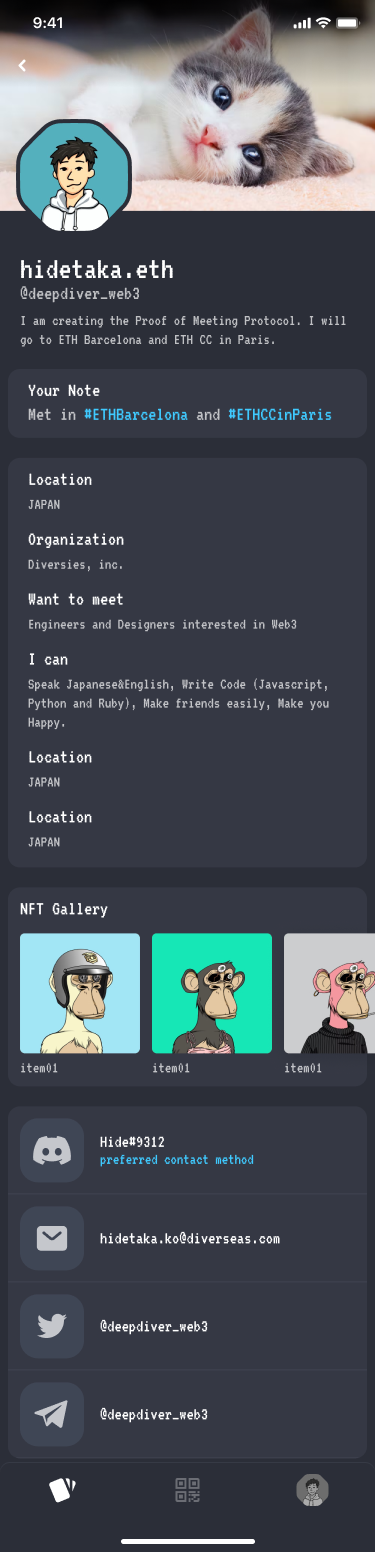
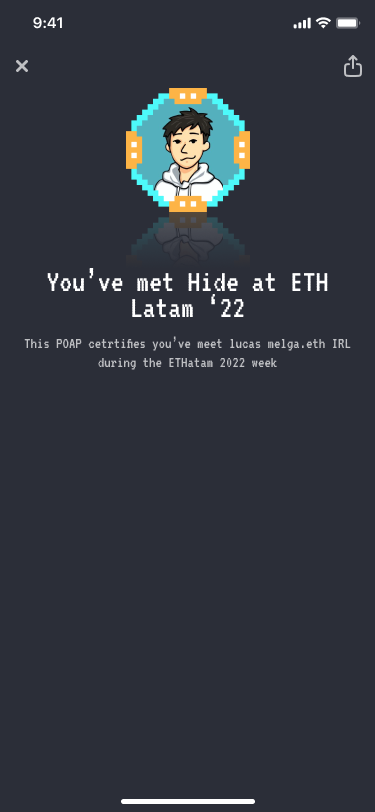
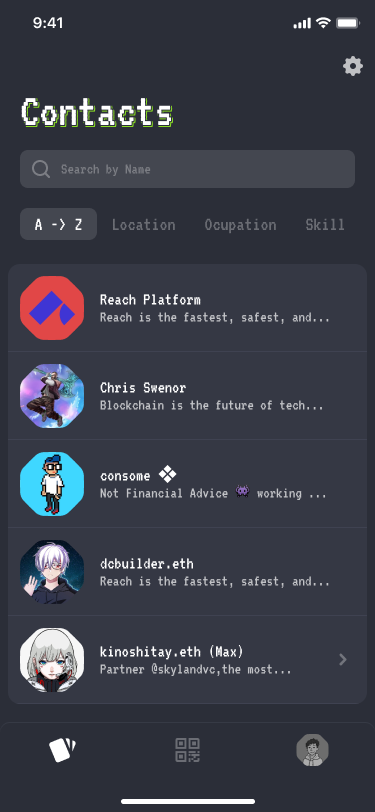
PoN is a Dapp used by people in the web3 industry attending the conference to exchange contact information with people they meet in a more efficient and enjoyable way. PON's profile can aggregate on- and off-chain data into a holistic identity that enables reliable networking and meaningful connections among users and organizations.
💬 Problem
It’s hard for Web3 People to remember everyone they meet at events and re-connect later.
- As current Alternatives, some of them are documenting everything on Memo app or Spreadsheet.
- But due to the lack of effective identity gating, one usually ends up getting not connected at all or waking up every day to an inbox flooded by random DMs and spam.
Web2 Social Media is Broken
- Networks Sell your Data
- You pay with your personal information to utilize their services. There is no digital Privacy.
- User Data is Centralized
- Data is controlled by one party largely behind closed doors, making it susceptible to attacks.
- User Data is Not Portable
- In Web2 implementation of platforms like Linkedin and Facebook User’s data is owned and gated by the app.
- Networks Sell your Data
💡 Solution
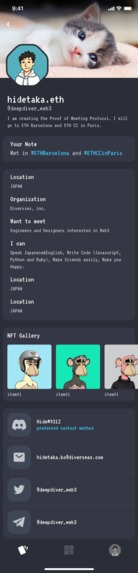
By sharing your profile in a specially designed business card format in Web3 industry, you can quickly showcase who you are and why your connections are valuable.
- You can combine all of your contact information into one profile.
- You can also include other profile information in term of your identity and career.
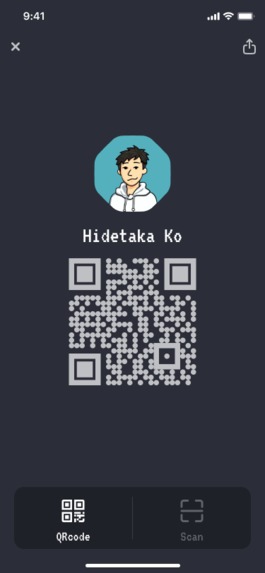
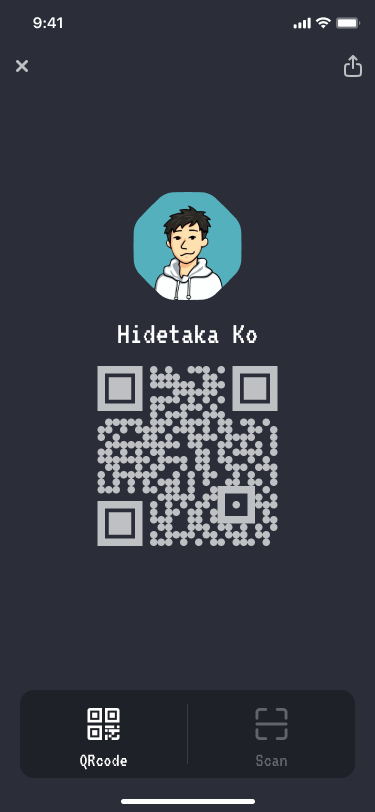
- Profile data is exchanged and stored with each other using QR codes.
- Searchable Profile data.
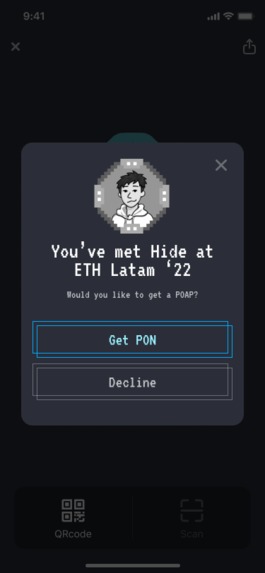
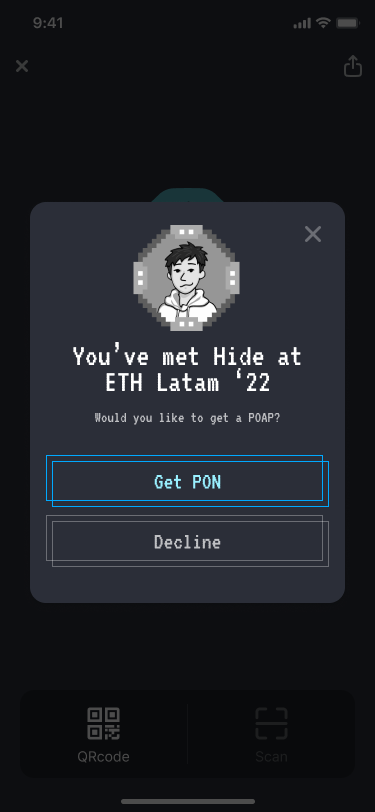
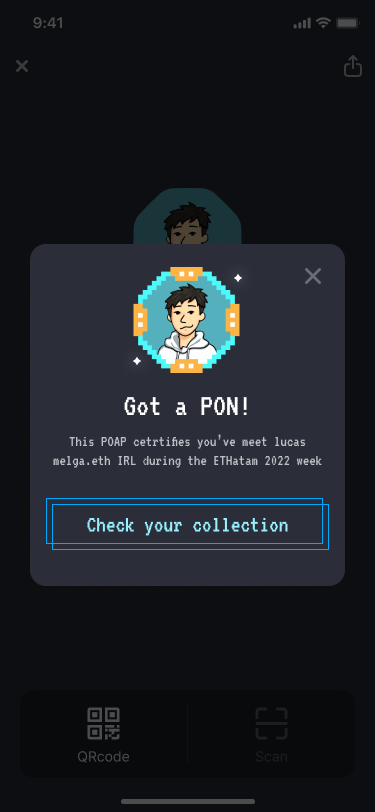
- The issuance of SBTs to prove that they have met will make the connection between users stronger and more memorable and composable.
User can own social graph relationship’s data
🤔 Judges & Criteria
1. Technological Implementation
Tech Stack
- Front-End: NextJS, React, Typescript, Rainbowkit/Wagmi, Pixelated style
- Contracts: Solidity
- Back-End: Ceramic, Orbis, IPFS
- Technologies: We are deployed on Polygon. We have ERC for test.
📄 Smart Contract Architecture
Contracts were written with
- Why SBT?:Proof of whom one has met can be a credential that enhances the credibility of the Wallet. And because for a credential to actually represent a person's characteristics, the credential must be non-transferable. Otherwise, it would be possible for a hedge fund to collect thousands of credentials and create a huge populace with a single click
- Detail Implementation:Try to see the our README!
Use of Polygon:Deployed to Polygon to issue SBTs to prove that users have met each other
- Why Polygon?:The Web3 social experience must be as fast and cheap as Web2. Also, identity is about privacy. We thought Polygon, where ZK technology and other technologies are used, would be a good match for this as well.
- Detail Implementation:Try to see the our README!
Use of IPFS:We used IPFS to store the user's Avatar data and metadata
- Why IPFS?:IPFS is stable and secure because of it's distributed structure
- Detail Implementation:Try to see the our README!
Use of AWS:Route53 was used to make the domain easy to understand
- What is AWS, Route53?:Amazon Route 53 is a highly available and scalable Domain Name System (DNS) web service.
- Why Route53?:This is because it is the easiest to register.
- Detail Implementation:Try to see the our README!
Use of Orbis.SDK on Ceramic:For both fast and cheap UX and data portability
- What is Orbis.SDK on Ceramic:Ceramic is a mutable datastore tied to a DID, a wrapper for the Ceramic/Lit protocol that complements Ceramic and allows developers to focus on UI/UX.
- Why Orbis.SDK on Ceramic?:The indexing experience is optimized to provide a faster experience than using Ceramic alone. And because it has data portability and can interface with multiple chains. It also saves time in implementation.
- Detail Implementation:Try to see the our [README!]https://github.com/Hackerthonweb3/proof-of-networking#use-of-orbissdk-on-ceramicfor-both-fast-and-cheap-ux-and-data-portability)
2. Design
① High Fidelity working prototype
- Try out the demo about the design and flow of the project at Figma.
② Presentation of Case Study
As the founder, I have attended over seven Web3 conferences around the world this year. There, I noticed the following problems The baffling dichotomy between Telegram and Twitter when exchanging contact information, and DM notes to remember who you have met. Taking selfies. Also, some of the people I met were not satisfied with the above means and were writing everything down in spreadsheets and note-taking apps. This was taken as proof of the challenge. Moreover, due to the lack of effective identity gating, one usually ends up getting not connected at all or waking up every day to an inbox flooded by random DMs and spam.
In the United States, losses from identity theft and related fraud grew from $1.8 billion in 2019 to $3.3 billion in 2020 and $5.8 billion in 2021 (FTC, 2022). As more and more of our lives shift to digital following the global pandemic, this problem continues to grow at a rapid pace.
A qualitative survey revealed that more than 90% of the respondents were not satisfied with existing social networking sites such as Telegram and Twitter.
③ Problem-solving
Our product should provide the best UX to solve the above issues by sharing your profile in a specially designed business card format in Web3 industry, you can quickly showcase who you are and why your connections are valuable.
- You can combine all of your contact information into one profile.
- You can also include other profile information in term of your identity and career.
- Profile data is exchanged and stored with each other using QR codes.
- Searchable Profile data.
- The issuance of SBTs to prove that they have met will make the connection between users stronger and more memorable and composable.
- User can own social graph relationship’s data
④ User flow and thought process
⑤ Branding and Design
Part 2: UX Problem Statement for an audience with little to no web3 awareness
Be faster and cheaper than other Web3 products while maintaining elements of data ownership and decentralization.
- We are able to optimize the data indexing experience.
- It's a choice for users whether or not to issue an SBT.
Users have authority over our own disclosure whether or not to make the data publicly available.
- In the conventional Dapp, many products are obligated to issue NFTs. However, we suggest that this be made optional. This way, users can choose to publish their data, and even if they choose not to issue NFTs or SBTs, the UX is good because it increases speed.
3. Potential Impact
① Accelerating better encounters between people involved in Web3 can accelerate innovation in the ecosystem
This is Because PON offers a better way for users in the web3 industry to network in a reliable and meaningful way. With more verifiable dimensions aggregated in the user's profile, you can now truly speak about who you are and present yourself in a complete and credible way, you have an overall identity.
This is because context-rich identities and more meaningful connections are built, and networks are easier to discover. You can expect to be contacted by more people who better understand your strengths, career aspirations, role in the community, and personal preferences. You will also be able to quickly find the people you want to contact, and your requests can be well communicated in support of your profile.
② It will be a digital representation of an individual that does not rely on personally identifiable information (PII) such as name, gender, nationality, passport number, etc
Proof of whom one has met can be a credential that enhances the credibility of the Wallet. And because for a credential to actually represent a person's characteristics, the credential must be non-transferable. Otherwise, it would be possible for a hedge fund to collect thousands of credentials and create a huge populace with a single click.
I think one of the things we need to do is to strike a major blow to the dictatorial issues and imbalances in the cryptocurrency world. If we do that, you will be amazed at what will happen. Ideally, we need a system that works both to avoid economic elitism and to select people who are working on a particular topic with competence and passion. A good use of identity and reputation primitives could solve this problem.
③ Reinventing Web2Social puts the power back in the hands of the user
- We could solve the following problems that traditional social has had by starting with its value as a business card exchange. In the current Web2 social network implementation, data is owned and gated by the app you are using to share it. This means it cannot be accessed by the rest of the Internet.
Apps can force users to access content with specific algorithms, read user messages for more targeted advertising, or block access to their audience or followers.
We believe that online social networks should not function this way. Users should own their data and be able to access it from a variety of user interfaces, while at the same time being able to take advantage of privacy when they want to. We aim to be the leading project in this regard.
4. Quality of the Idea
How Creative
- We develop this idea based on real customer problems.
How Unique
- There are no products that specialize in business-card-like use cases, such as actually meeting people face to face and recording the meeting for Web3 people. We describe here the differences between us and other projects we have researched.
- POAP is optimized for conference attendance verification, others are optimized for profile functions only, Gitcoin Passport is optimized for Gitcoin, Telegram and Twitter are optimized for Web2 messaging and social networking experiences.
Very fast and inexpensive social experience compared to simlar did project.
- This is because we are building without relying on the only blockchain using the Ceramic protocol while ensuring de-centralization. And. It's well optimized to query specific data in a very efficient way (we are optimizing it for the entire protocol)by using OrbisSDK compared to similar project by using only Ceramic itself.
More Data potability
- This design decision would keep interoperability with all products built on top of Ceramic, Orbis.sdk, orbis.club included, while extending the usecase for our digital business card product (it is kind of personal POAPS + decentralized business card), we call it Proof of Networking.
Must be able to interface with a multi-chain.
- For example, if you don't like or don't want to use a certain theory, I don't think you should be forced to use it in order to be part of the identity web of the future. you are free to use Solana, or if you are David Gerard, you don't have to stick to the blockchain, you can use Open You are free to have your own identity, Google, Facebook, etc. with your ID, PoN can provide a UX that doesn't depend only on a particular chain.
Minting SBT instead of NFT is to prove that users have actually met compared to personal POAP.
- POAP's NFT is currently available for sale.
📓 Appendix
5. Our Product Roadmap
① In conjunction with the POAP API, visualize the list of users who participated in a particular event to support networking
How creative and unique:
- Many people are not satisfied with the encounters they have at the event. We can increase the likelihood of more enjoyable encounters if we can easily learn more about the attendees in advance; POAP's on-chain data and public APIs make this possible.
② Adding more composable and sophisticated direct message functionality
How creative and unique
- Telegram, Discord, Twitter, Messenger, Linkedin, What's app, Slack, LINE, WeChat, etc... Web2 has too many messaging tools that run on completely different protocols.There are some contexts for which data-portability will have more value than others, for example let's take DMs, the great benefit of composability is that you can bring your direct messages from one app to another and pick the user experience you like the most. For a platform dedicated 100% to video like youtube the data-portability would be useful to allow your followers to watch your content from any video app they want to (they aren't locked into one application)
③ Launch on Mobile App like iOS and Android
How creative and unique:
- To make Web3Social's products a product market fit for consumers, it is necessary to achieve a better UX, and a mobile experience is essential to this. There are only a few projects in the industry that are able to combine data portability and mobile.
④ The current trade-offs in terms of attack vectors, potential future integration of ZK proofs to enhance privacy
How creative and unique:
- Because SBT has issues with security and the risk of being sent around.
⑤ Adding Timeline feature for users
How creative and unique:
- To ensure portability of user submitted data.
⑥ Implement UI/UX for the organization or project on PON
How creative and unique:
- Our organizational profiles in PON will be verified and trusted. To protect users from scams & fake links prevalent on Twitter and Discord, PON verifies organizations by their existing official accounts such as Twitter. Organizations can also connect with other reputable entities and showcase it in the backers/partners/team sections. Issuing verifiable credentials or SBTs will also later be enabled for organizations to recognize key community contributors. A fabric of trust composed of such connections and records holds PON profiles trustworthy. So users will be sure that the links they’re clicking on and all updates received are official.
6. What We Learned
During the hackathon, a bug occurred with the functionality released on the Ceramic side and its consistency with Orbis, which caused a bit of a jam. I should have communicated with them sooner.
Learned how to send and retrieve data to the IPFS API through the UI side.
How to implement SBT.
7. Frequently questions
- Q1. Why this solution should work as a replacement for personal POAPs
- A1.We are more specialized in the experience of meeting people and exchanging contact information, such as profile functions and other features, such as the optionality of issuing SBTs, and the portability of data is guaranteed, making it easier to obtain network effects.
8. Team Members:Efforts were made from South America, Europe, the United States, and Japan. All are scheduled for ongoing development
- Hidetaka Ko | Product Manager | We have been developing and operating Japan’s largest homestay matching service for 4 years as CEO/Co-Founder.
- Asiya | Full Stack Software Engineer | I’m a SWE based between LA/NY, good with front end, like to build things.
- O_t | Full Stack Software Engineer | In blockchain space since 2013, full stack+solidity developer and investor, co-organizer Ethereum Meetup Spain.
- Taiki Ikeda | UI Designer | Fluent in English and Japanese.


Log in or sign up for Devpost to join the conversation.