
POME Guardian Agent
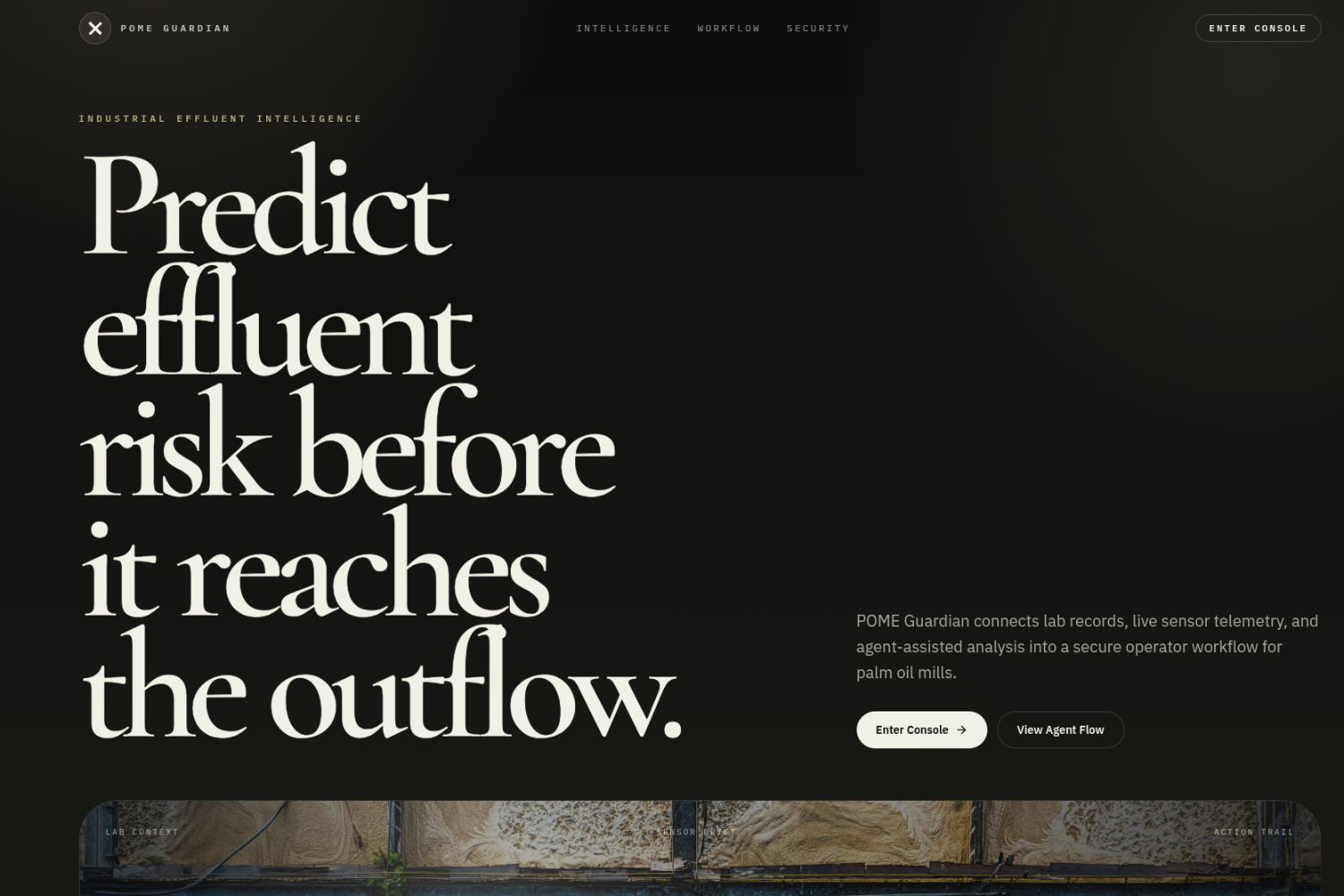
POME Guardian Agent is an AI-powered operations assistant for palm oil mill effluent wastewater treatment. It helps operators analyze lab results, detect treatment drift, assess operational risk, and generate action plans that can be reviewed and audited.
The project was built for the Google Cloud Rapid Agent Hackathon to demonstrate how agentic workflows can support real industrial operations, especially in environments where decisions are still made through manual review of lab data and operational notes.
Inspiration
Industrial wastewater treatment teams often depend on manual interpretation of lab results. Operators need to compare the latest sample with previous baselines, calculate removal efficiency, identify trends, and decide whether the treatment process is stable or at risk.
In palm oil mill effluent treatment, parameters such as COD, BOD, TSS, pH, and removal efficiency can indicate early signs of process drift. If these signals are missed, the issue can escalate into poor effluent quality, operational delays, or compliance risk.
This inspired the idea for POME Guardian Agent: an AI operations agent that turns lab data into operator-ready decisions.
What It Does
POME Guardian Agent analyzes the latest wastewater lab data and produces:
- Treatment risk level
- Risk score
- Reasons behind the risk assessment
- Suspected operational issue
- Recommended operator actions
- Persisted risk reports
- Reviewable action logs
- Agent execution evidence
The system includes two analysis paths:
- A stable automation workflow for reliable dashboard demos
- A Google ADK planner workflow that demonstrates agentic tool orchestration
The operator can run an analysis from the dashboard, review generated reports, inspect recommended actions, and mark actions as reviewed with notes.
How It Works
The system reads the latest lab sample from MongoDB and compares it with recent historical data. It calculates trends and treatment efficiency, then evaluates the condition using risk logic.
A simplified removal efficiency calculation is:
$$ \text{Removal Efficiency} = \frac{\text{Influent} - \text{Effluent}}{\text{Influent}} \times 100\% $$
The agent combines this type of calculation with trend analysis and rule-based risk scoring to determine whether the latest sample indicates a stable, warning, or high-risk condition.
How We Built It
The project is built as a multi-service application:
- React frontend for the operator console
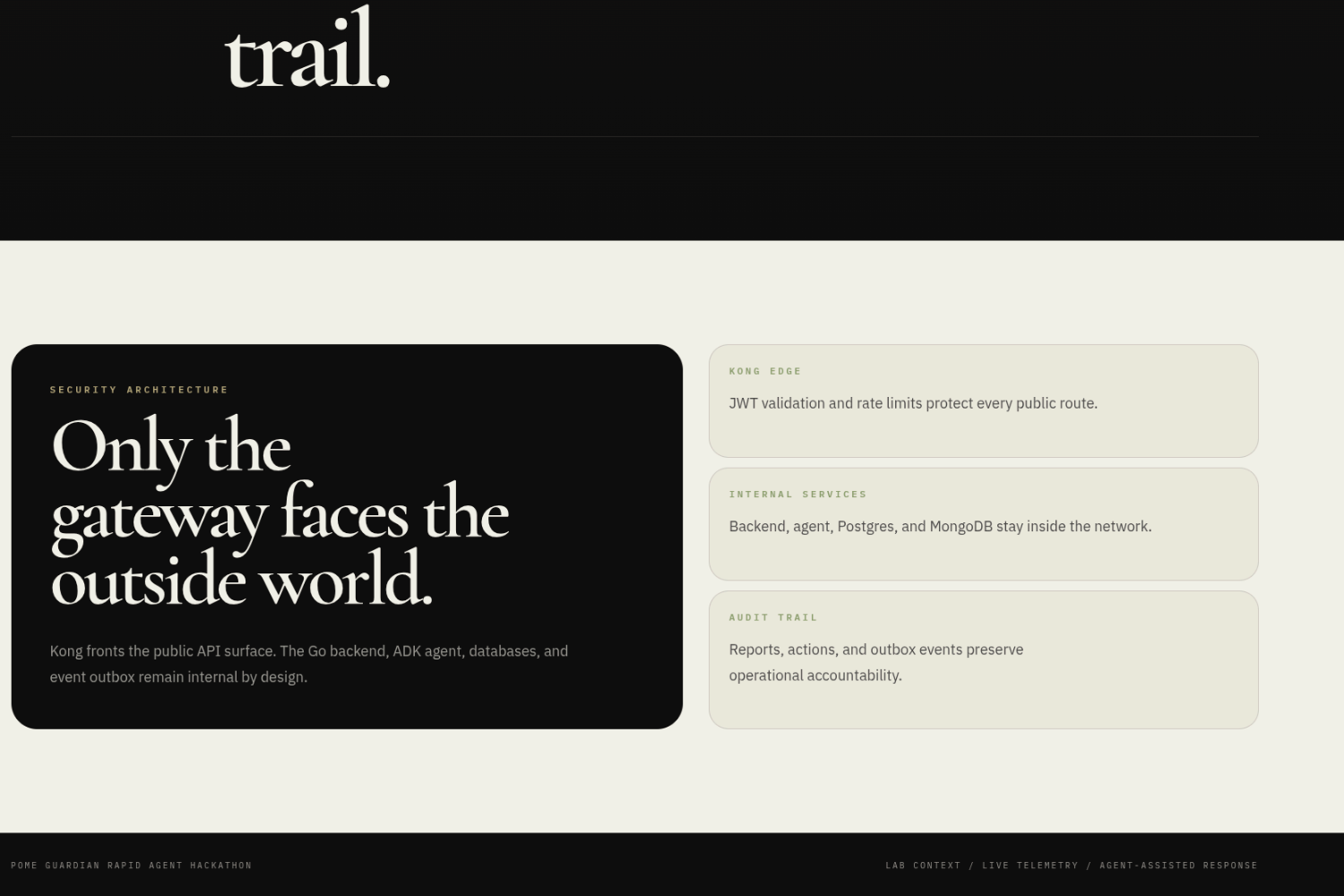
- Go backend API for authentication, reports, actions, and workflows
- Google ADK agent service for tool orchestration and analysis
- MongoDB for lab samples, sensor readings, reports, and action logs
- Postgres for operator-facing mirrored data and audit records
- Kong as the API gateway
- Cloudflare Tunnel for public access through
rapid.alvnvnc.site
The Google ADK agent uses tools such as:
- Checking MongoDB connectivity
- Reading the latest lab sample
- Retrieving recent lab history
- Calculating removal efficiency
- Calculating parameter trends
- Calculating treatment risk score
- Saving risk reports
- Creating operator action logs
- Producing notification evidence
What We Learned
This project showed how important it is to combine agentic AI with deterministic operational workflows.
For industrial use cases, reliability matters. Operators need consistent and explainable outputs, not only creative AI responses. Because of that, the project includes both a stable workflow for the main dashboard and an ADK planner path to demonstrate flexible tool orchestration.
We also learned that agent outputs become much more useful when they are connected to real operational records, such as action logs, review status, and audit evidence.
Challenges
One challenge was designing the system so that it could be both demo-friendly and operationally realistic. The dashboard needs to respond reliably, while the ADK planner flow needs to show real tool orchestration.
Another challenge was connecting multiple services together: frontend, backend, ADK runtime, MongoDB, Postgres, Kong, and Cloudflare Tunnel. Making the app publicly accessible while keeping API routes working through the same domain required careful gateway and tunnel configuration.
A final challenge was presenting risk analysis in a way that operators can understand quickly. The result needed to be more than a score. It had to explain why the condition is risky and what the operator should do next.
Impact
POME Guardian Agent helps wastewater teams move from manual review to faster, more consistent, and better-documented decisions.
By turning lab data into risk reports and action plans, the system can help operators detect treatment drift earlier, reduce human error, and improve operational readiness.
Future Improvements
Future improvements could include:
- Real-time IoT sensor ingestion
- More advanced anomaly detection
- Integration with notification channels such as email or WhatsApp
- Role-based access control for different operator levels
- Historical performance analytics
- Predictive forecasting for treatment risk
- Deployment to a managed Google Cloud environment
Summary
POME Guardian Agent demonstrates how AI agents can support industrial wastewater treatment by combining data analysis, operational recommendations, audit trails, and Google ADK tool orchestration.
The result is a practical agentic application that helps operators understand what is happening, why it matters, and what to do next.
Built With
- cloudflare-dns
- cloudflare-tunnel
- docker
- docker-compose
- fastapi
- gemini-api
- github-oauth
- go
- google-adk
- google-oauth
- jwt
- kong-api-gateway
- mongodb
- nginx
- oauth-2.0
- postgresql
- python
- react
- tailwind-css
- typescript
- vite


Log in or sign up for Devpost to join the conversation.