-
-
-
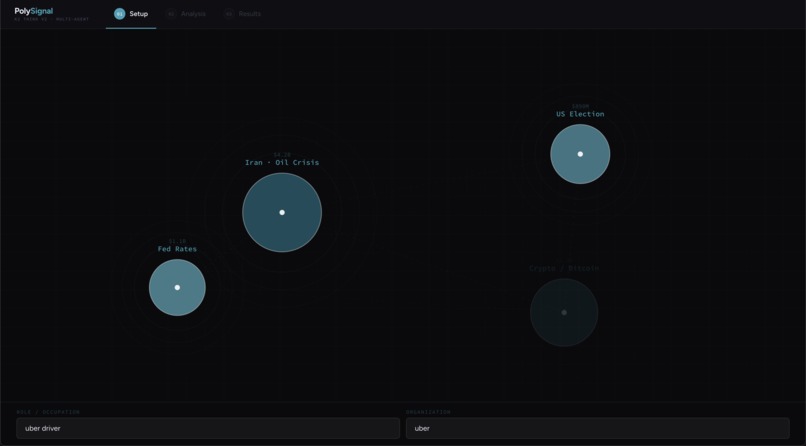
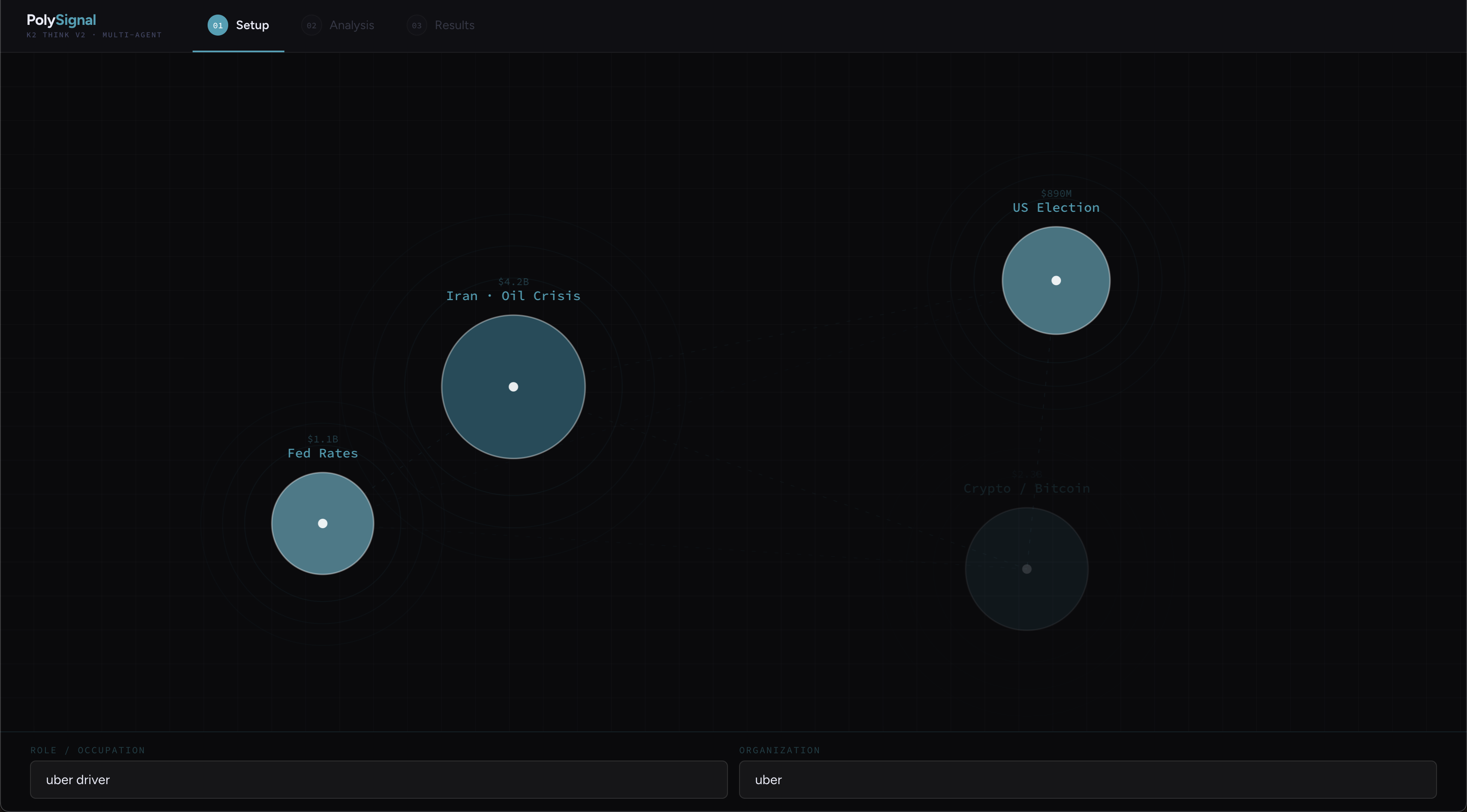
Home setup page with role and organization prompts
-
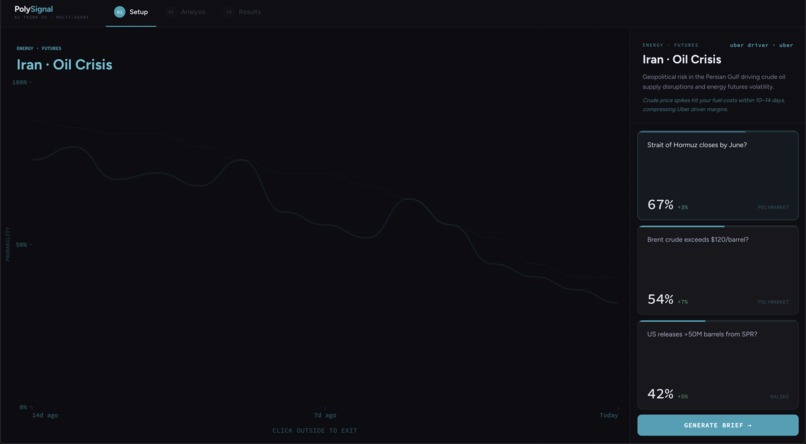
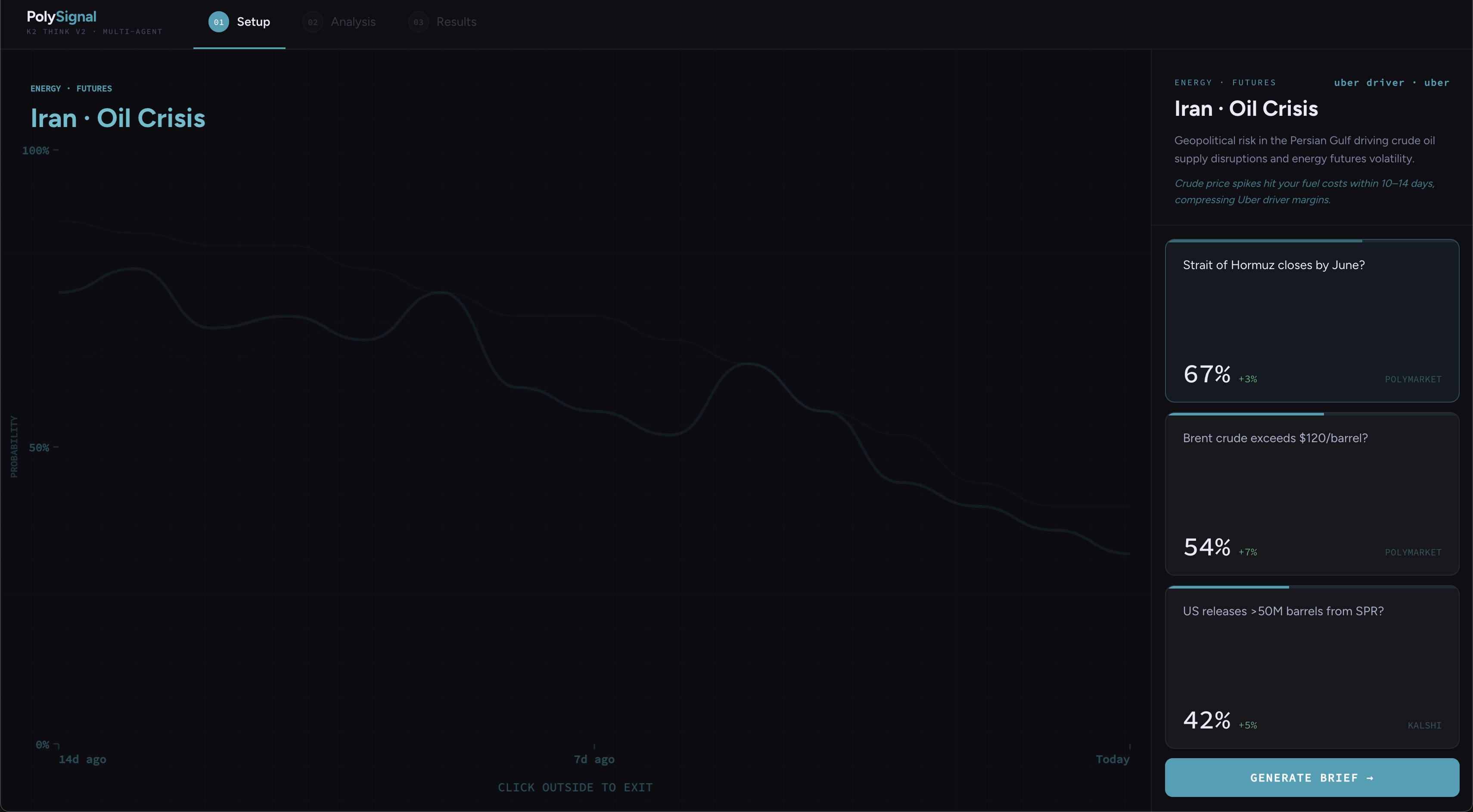
Domain and market relevant to role and organization
-
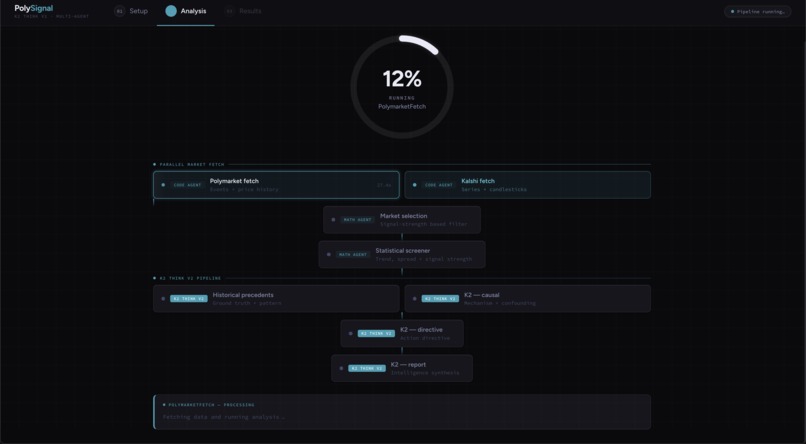
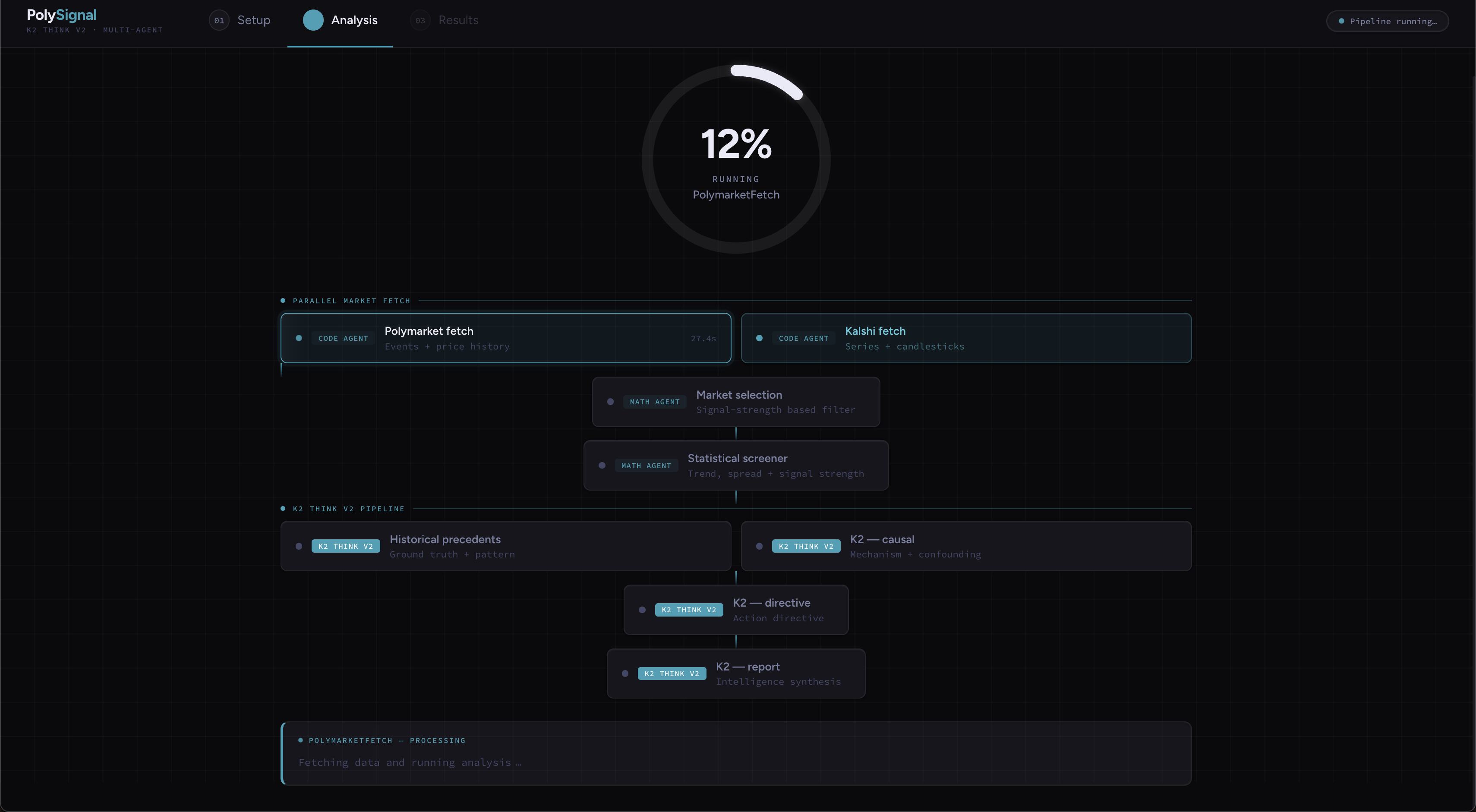
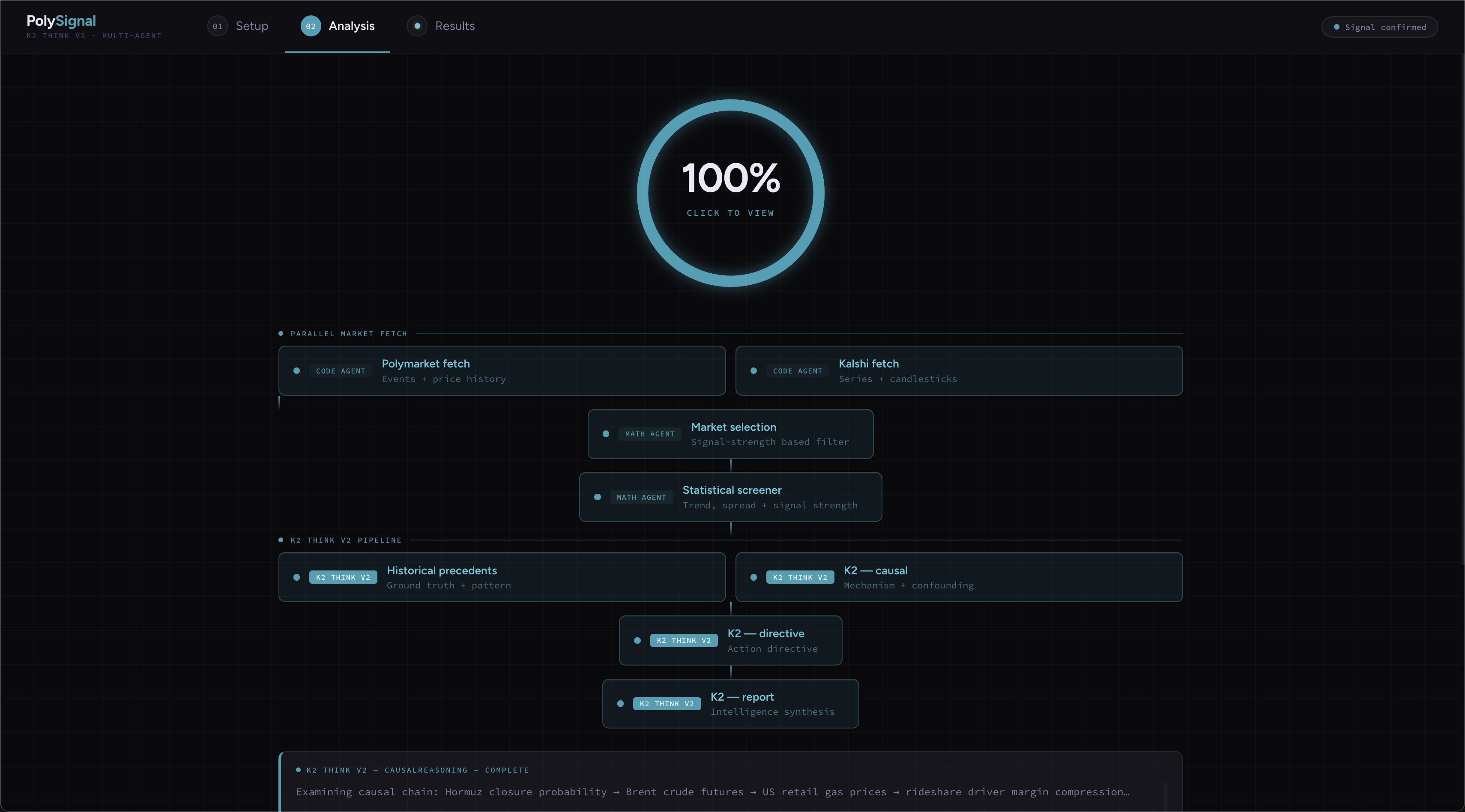
Running analysis through pipeline with parallel agents
-
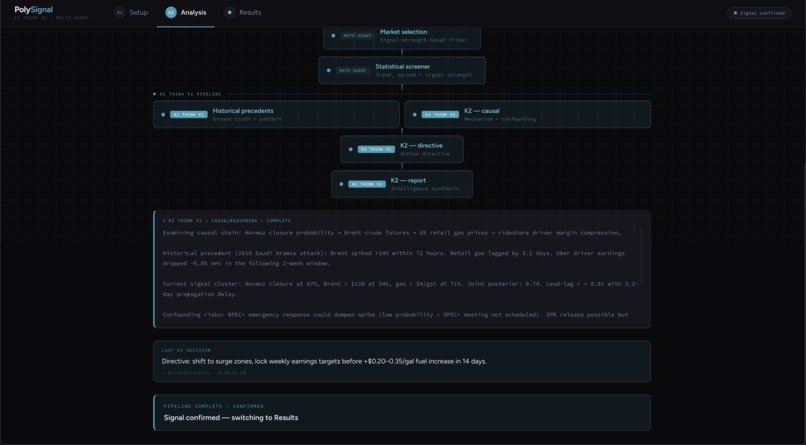
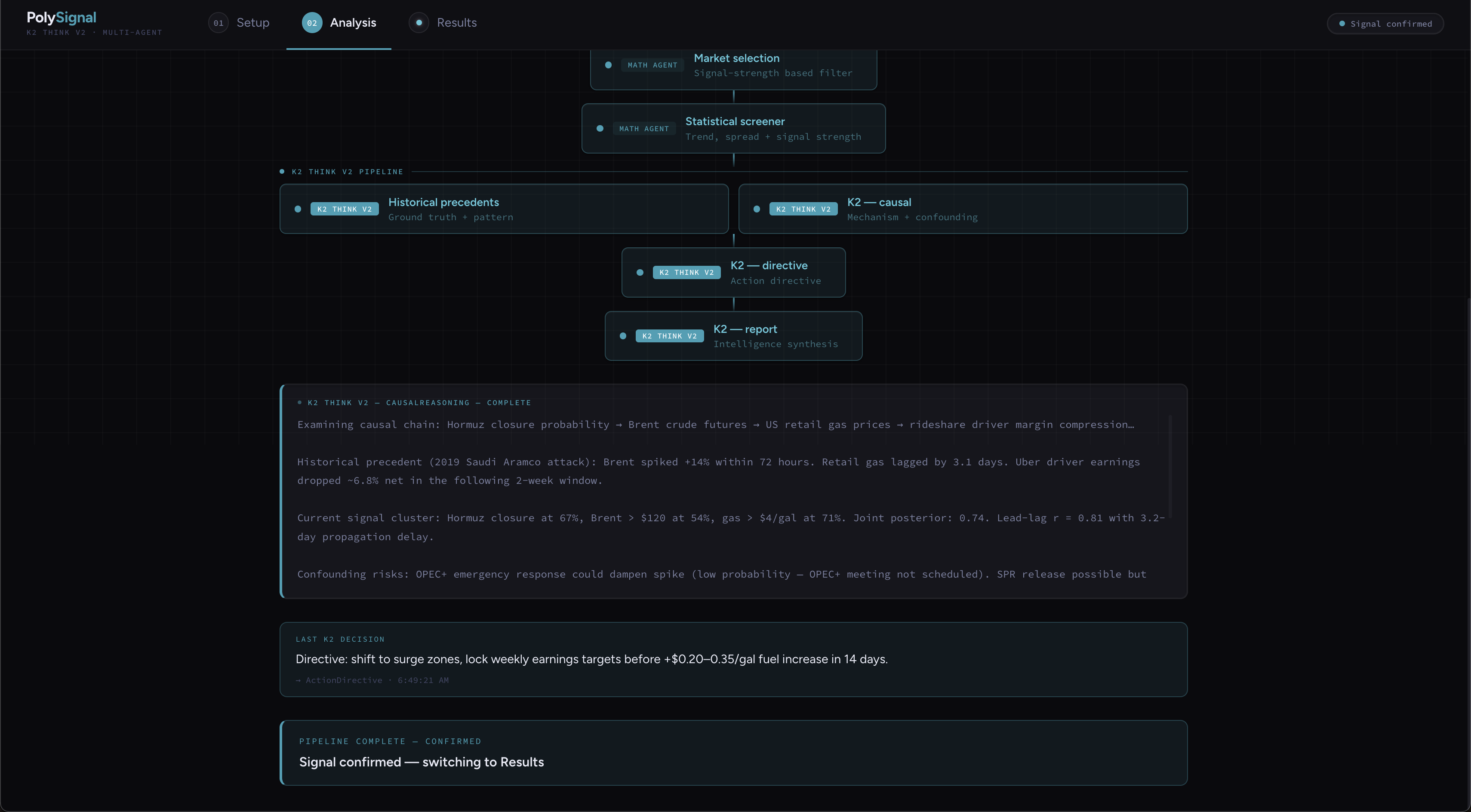
Complete analysis with k2 think critical reasoning
-
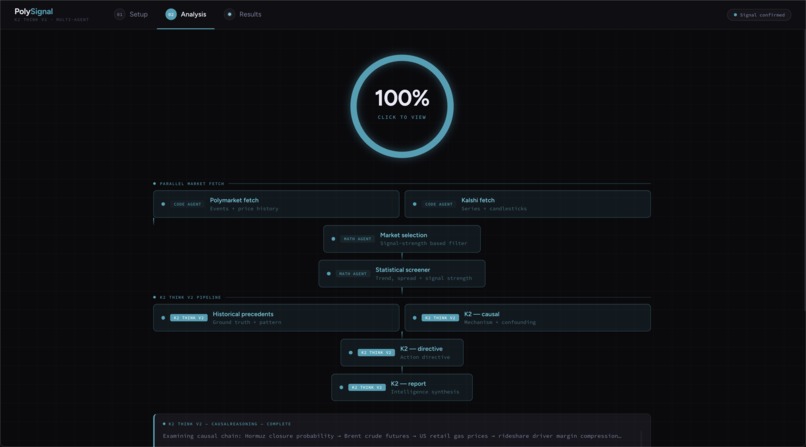
Full complete analysis screen
-
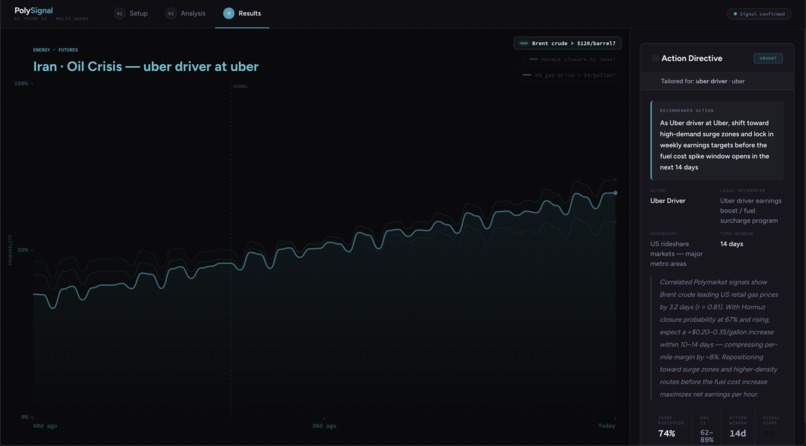
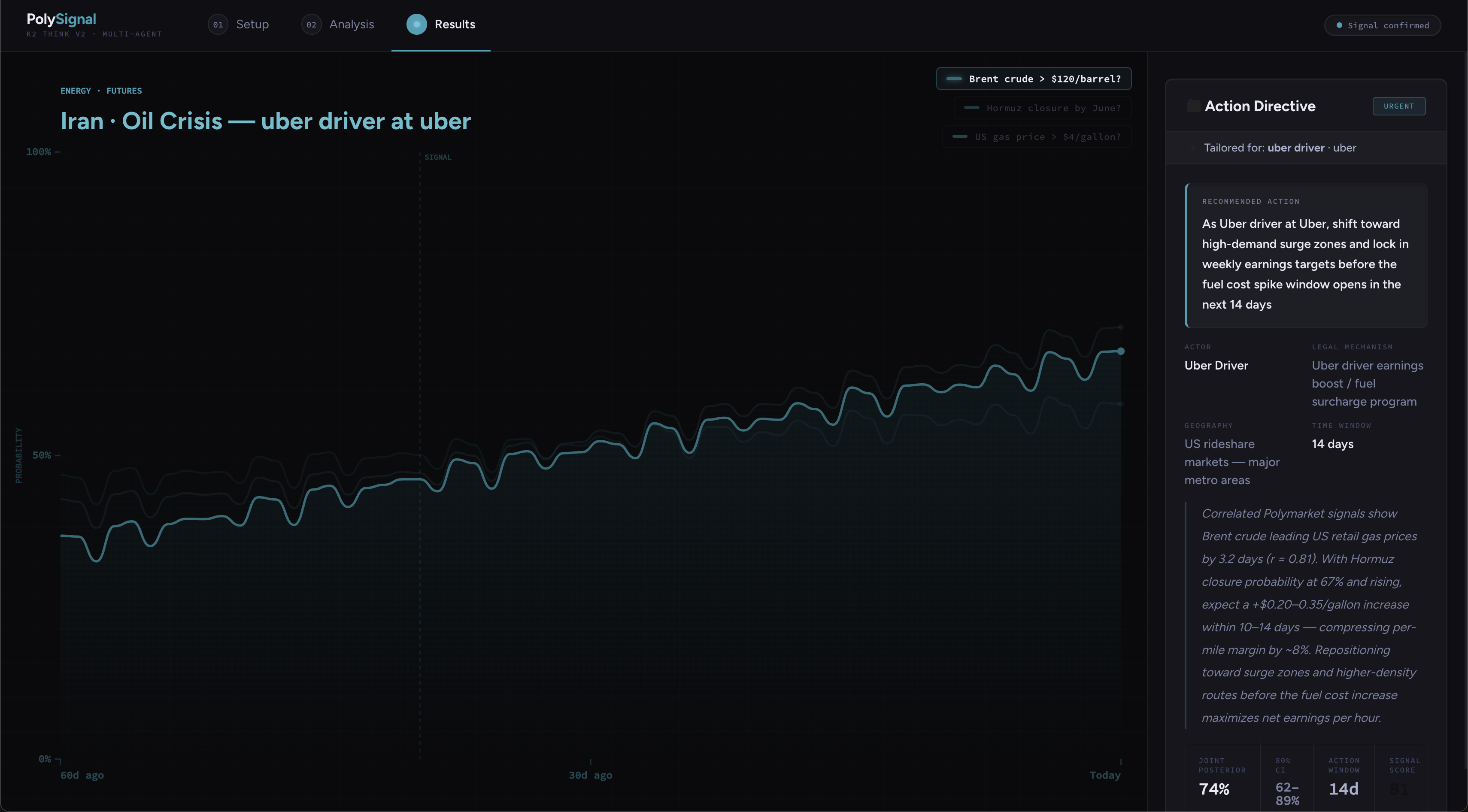
Results page with relevant markets, recommendations, and statistics and reasoning backing the decision k2think gives
Inspiration
Prediction markets predicted the Iran war hours before it happened. We built the system that tells you what to do about it.
Economic data is slow. Key indicators like inflation, GDP, and unemployment are released weeks or months after the fact — decisions by businesses, policymakers, and individuals are often based on outdated information.
Prediction markets like Kalshi and Polymarket solve this. They update in real time as traders react to new information — economic data, news, geopolitical events. A February 2026 Federal Reserve working paper confirms this, concluding that "Kalshi markets provide a high-frequency, continuously updated, distributionally rich benchmark" of value to researchers and policymakers.
The insight behind PolySignal is simple: the real value isn't just in individual prediction markets — it's in how they move together. When multiple markets shift at once (oil prices, inflation expectations, interest rate decisions), they reveal early signals about how events will unfold, often days or weeks before official data confirms it.
What It Does
PolySignal turns prediction market data into actionable decisions. Instead of showing raw probabilities, it:
- Tracks real-time prediction markets from Polymarket and Kalshi
- Identifies meaningful relationships between them
- Infers cause-and-effect chains (what's driving what)
- Translates those insights into specific actions for different users
Same data, different outputs:
An Uber driver gets:
"Gas prices likely rising in ~2 weeks — adjust driving zones and maximize short-term earnings before margins shrink."
A policymaker gets:
"Markets are pricing higher inflation, driven by food and energy signals — trend emerging ahead of official CPI data."
We don't just explain what's happening — we tell you what to do about it.
How It Works
PolySignal is built as a multi-agent pipeline designed for speed and efficiency.
1. Smart Data Filtering (Cost-Aware)
We pull thousands of markets from APIs, then use an AI filter to select only relevant markets before doing deeper analysis. K2 Think V2 receives candidates in batches and classifies each as relevant, historical precedent, or reject. Only markets that clear this filter get the expensive enrichment call — 60-day probability history and candlestick data. This keeps costs proportional to signal quality.
2. Signal Scoring
Each market is scored based on signal strength, trading volume, time horizon, and data availability.
Only high-signal markets move forward.
3. Causal Analysis (Core Innovation)
Two AI agents run in parallel. The first pulls historical precedents — real past events analogous to what current markets are pricing in. The second performs the causal analysis: given live market probabilities and their co-movement over time, what is the propagation chain from the leading signal to downstream effects?
This is where K2 Think V2 is essential. Causal reasoning across noisy, cross-domain market data isn't a retrieval problem — it requires genuine multi-step reasoning: evaluating which correlations are spurious, identifying the direction of causality, and translating probabilistic signals into a coherent propagation chain. K2 Think V2 is a reasoning-first model built specifically for this kind of structured inference. Its visible <think> process lets us stream the model's reasoning to the user in real time, so the output isn't a black box — you can watch it work through the signal before it commits to a conclusion.
This lets us detect lead-lag relationships and correlations across domains (e.g., geopolitics → oil → inflation) — inferring causal chains, not just correlations.
4. Role-Based Decision Engine
We translate signals into actions tailored to the user. Instead of generic insights, outputs are time-bound, context-specific, and directly actionable — calibrated to what you can actually do with the information.
Challenges
Cross-source deduplication. Polymarket and Kalshi both list markets for the same underlying events with different formatting. We normalize by stripping non-alphanumeric characters and matching on the first 40 characters of the lowercased title — catches the majority of duplicates without an extra AI call.
Accomplishments That We're Proud Of
The pipeline runs entirely in real time. From the moment you click run, every agent — parallel market fetches, K2 relevance filtering, statistical scoring, causal reasoning, historical precedent retrieval, and directive generation — streams its status live to the UI. You watch the system think, not just wait for a result.
We're also proud of the role-based directive engine working as intended. The same underlying signal genuinely produces different, contextually appropriate actions depending on who's asking — an Uber driver, a policymaker, a commodities trader. The system doesn't just append a job title to a generic output; K2 reasons from the specific authority and constraints of that role.
Finally, grounding the project in peer-reviewed research from the Federal Reserve gave it a foundation we're proud of. PolySignal isn't a demo of AI applied to finance — it's a direct implementation of a thesis about informational efficiency that economists at the Fed are actively studying.
What We Learned
The hardest part of this project wasn't building the pipeline — it was understanding what the pipeline should actually do. Early versions just surfaced correlated markets and left interpretation to the user. The shift to causal reasoning, and specifically to role-tailored directives, changed the product entirely.
What's Next for PolySignal
The biggest near-term opportunity is deeper Kalshi integration. Kalshi's API surface is limited — endpoints are inconsistent, return formats vary across market types, and bulk historical data is difficult to retrieve programmatically. We built the best integration we could within those constraints, but richer Kalshi coverage would meaningfully expand signal breadth. As their API matures, PolySignal is positioned to benefit immediately.
We also want to combine prediction market signals with document analysis — letting users upload earnings reports, policy briefs, or news filings and cross-referencing them against live market probabilities. That combination of structured market data and unstructured text would make the resulting directives significantly more grounded and specific.
In the long term we can look at:
- Longitudinal validation — backtesting the pipeline's directional calls against what actually happened, to measure how far ahead of official data the signals consistently run
- Alerts and monitoring — rather than running on-demand, PolySignal should watch continuously and notify users when a new cross-market correlation emerges
- Expanding the role model — the current system takes a role and organization as context; a production version would let users provide a richer natural language description of their specific situation, responsibilities, and constraints so the directive is genuinely personalized rather than inferred from a job title alone
Built With
- fastify
- k2-think-v2
- kalshi-trade-api-v2
- node.js
- polymarket-clob-api
- polymarket-gamma-api
- react
- typescript
- vite

Log in or sign up for Devpost to join the conversation.