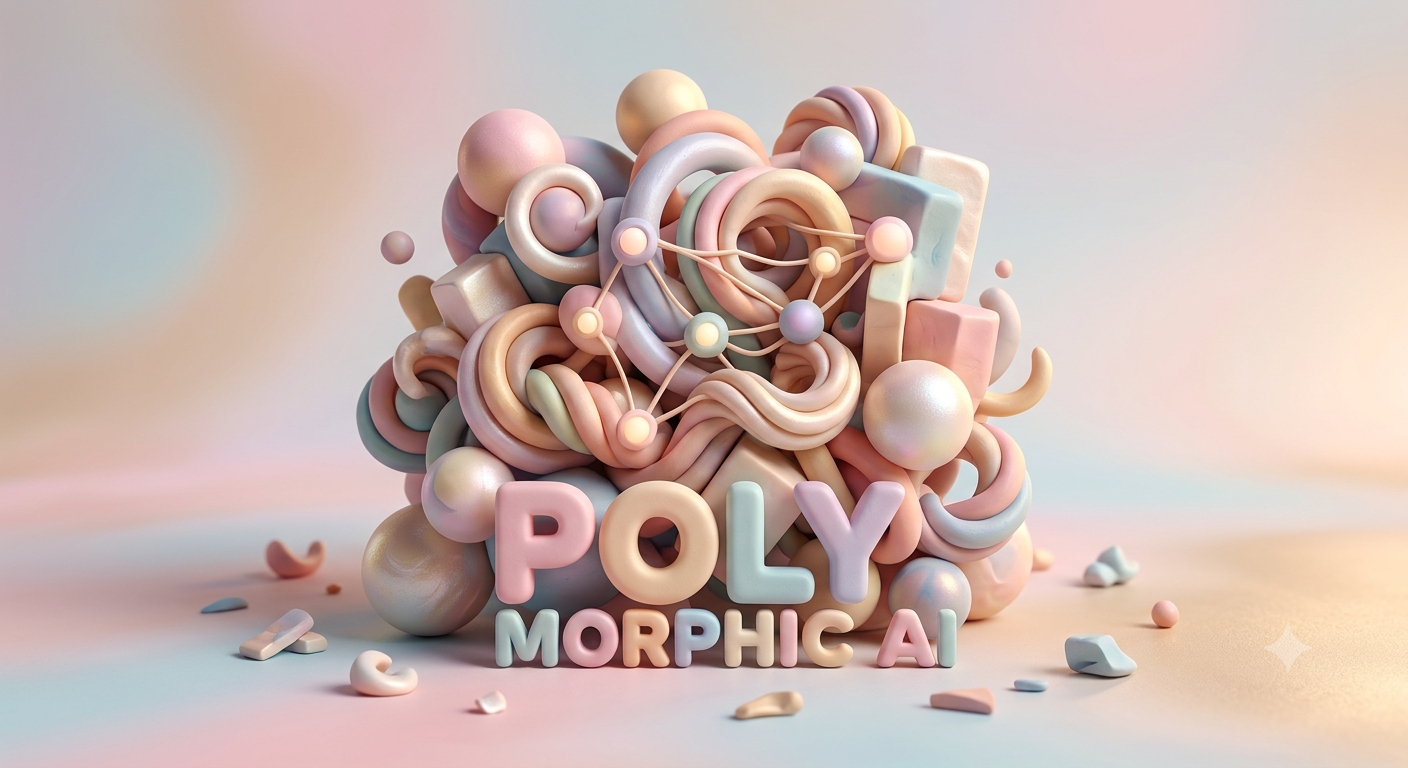
The Spark: What Inspired Me Listen, it breaks my spirit when brilliant minds—especially those navigating ADHD or dyslexia—hit an invisible wall just because the traditional system ain't built for how their brains work. The inspiration for Polymorphic AI came from looking at our community and seeing that unnecessary learning friction. It’s a lot like flying a manual drone; if the wind shifts, you need real-time, fluid adjustments, not a rigid textbook. I wanted to build a digital village that catches you before you fall, a system that dynamically molds itself to the learner’s exact needs and creates a deeply focused sanctuary. The Blueprint: How I Built It I rolled up my sleeves, fired up the Ubuntu terminal on my trusty ASUS TUF, and got straight to work. The architecture had to be as fluid and inviting as the claymorphic design we envisioned for the interface. Under the hood, it’s a tight, rhythmic dance of prompt engineering and real-time state evaluation. We engineered a progressive support loop that constantly reads the room—monitoring engagement and stepping in right when things get heavy. To get a little technical for a second, we modeled that learning friction ($F$) over time ($t$) by calculating the accumulated cognitive load ($C$) against a baseline threshold ($\theta$). We introduced a decay function to represent how our progressive support alleviates that pressure:
When $F(t)$ crosses our safety threshold, the environment automatically reshapes itself, cutting out the noise and serving up bite-sized, manageable pieces. The Climb: Challenges Faced Now, let me tell you, it wasn't all sunshine and smooth deploying. The hardest part by far was keeping the generative models from drifting off script. When you're serving neurodivergent learners, you cannot afford hallucinations or stylistic drift; the focus has to be razor-sharp. I really had to put my AI auditing hat on, rigorously testing and running quality assurance workflows to ensure the progressive support was genuinely helpful, not just adding more confusion. And balancing that heavy, complex backend logic while keeping the frontend looking like soft, approachable clay? Chile, that took some long, late nights. The Harvest: What I Learned Through this whole journey, the biggest takeaway is that empathy is the ultimate algorithm. Code is just logic, but when you infuse it with compassion and a real-world understanding of how folks actually learn, it becomes a lifeline. I grew so much as an engineer, realizing that our tools shouldn't just be smart—they need to be deeply human, patient, and adaptable. We didn't just build an application; we carved out a space where beautifully wired minds can finally thrive.

Log in or sign up for Devpost to join the conversation.