Inspiration
Lineage in a data catalog is testimony, not evidence. Someone wrote it down: by hand, from a DAG, or from a SQL parser. Then the code changed and the testimony didn't. A stale edge looks identical to a correct one. A missing edge looks like nothing at all.
There's no mechanism in any catalog for being wrong out loud. So data scientists make decisions on lineage that has quietly drifted, and the first symptom is a model that broke for reasons nobody can trace.
I wanted DataHub to be able to catch itself.
What it does
Polygraph reads the declared ML lineage from DataHub, runs the real pipeline under runtime capture, reconciles the two edge by edge, and writes verdicts back into the catalog as tags:
polygraph:verified: declared, and runtime proves data flowed along itpolygraph:phantom: declared, but nothing flowed in the captured runpolygraph:undeclared-source: runtime proves an edge the catalog never mentioned
When a run's model quality collapses, it goes further: it compares the degraded capture against a healthy baseline, ranks every operation by deviation, names the responsible one, resolves the owning team from DataHub ownership, and publishes a sha-256-verified incident report into the knowledge base.
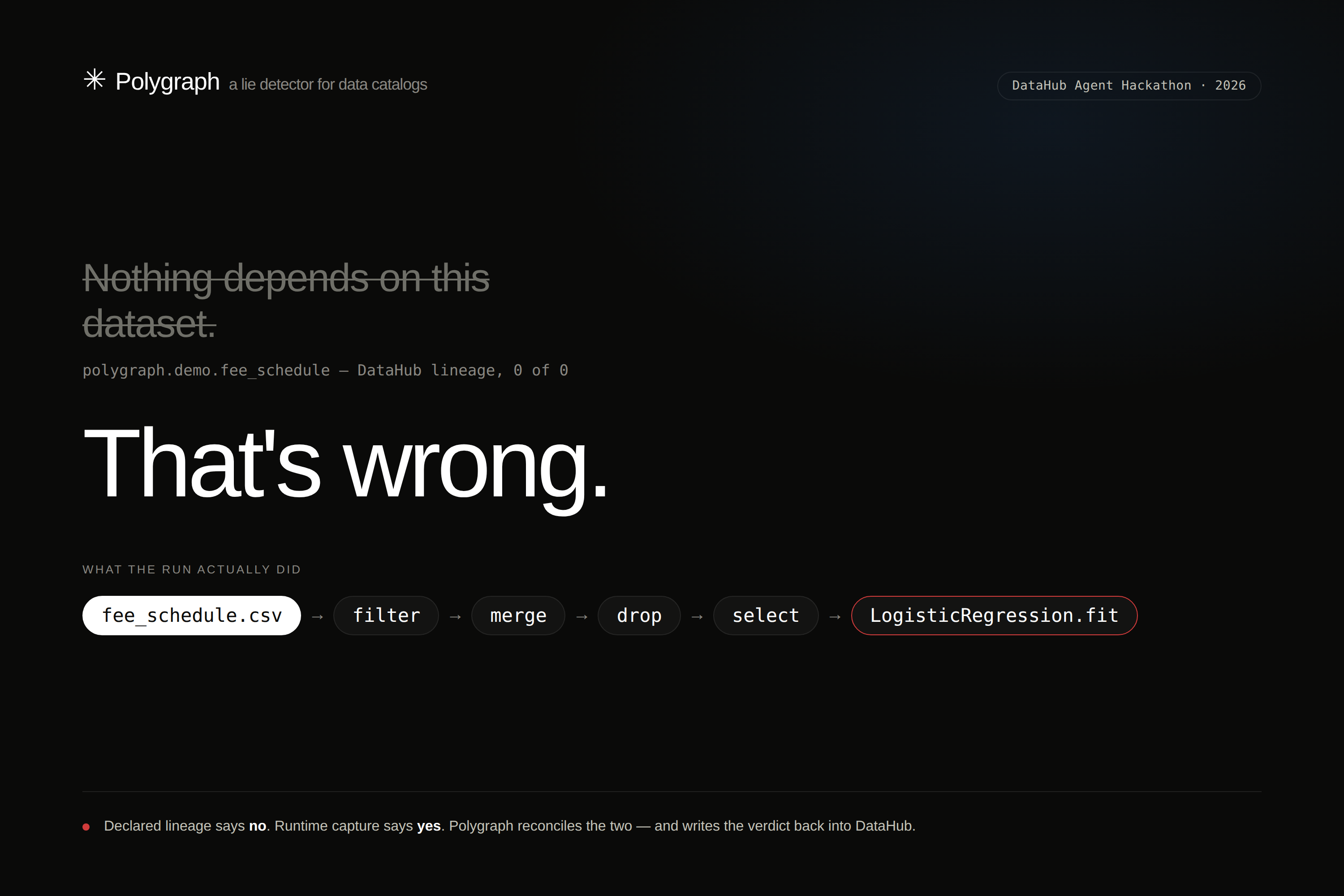
In the demo, a fraud model's catalog entry declares an archive that hasn't been read since a refactor, and omits a fee schedule that gets merged into the training set on every run. Polygraph finds both and tags them.
How I built it
AutoLineage (SSRN 6683825) is my open-source capture library: 239 import-time hooks over pandas and scikit-learn, no code changes required. Polygraph depends on it from PyPI.
DataHub provides both sides of the reconciliation: dataJobInputOutput for
the declared claim, and tags, ownership and documents for the write-back. All
via acryl-datahub 1.7.0 against an OSS quickstart instance.
The interesting engineering is the bridge. AutoLineage records at operation granularity, dataframe version to dataframe version. DataHub declares at dataset granularity. Three non-obvious decisions made that work:
- Anchors. A node is catalog-visible if it's a file read, a file write, or a fitted model. Two anchors form an edge when a path connects them through no other anchor.
- Union of paths, not shortest path. AutoLineage links
LogisticRegression.fitstraight back to an early hub node, so the shortest route from source to model skips the filter, merge and split entirely. Those operations really ran. Shortest-path would have left the incident report with nothing to name. - Self-loops carry the payload. When a transform doesn't change dataframe
identity, AutoLineage emits
parent_id == child_id. The planted bug is one of those. Discarding them is right for topology and fatal for diagnosis.
Challenges
A silent capture failure. AutoLineage's IO hooks test
isinstance(path, str), so pd.read_csv(Path(...)) records nothing at all: no
error, no file lineage, just an empty graph. Found it by noticing every
filepath was null. It's an upstream bug and it's in my Limitations section.
Polygraph almost corrupted the catalog it was auditing. DataHub's
GlobalTagsClass is a whole-aspect write: emitting [polygraph:phantom]
replaces every tag on the asset. In a real catalog that silently deletes
someone's PII or tier tags. Every write now reads first, preserves everything
outside the polygraph: namespace, and removes only stale polygraph tags.
My own integrity claim was false. The incident report says its sha-256 lets
you verify the catalog copy against the shipped file byte for byte. On Windows,
Path.write_text translates \n to \r\n, so the file on disk hashed
differently from the digest published to DataHub. Caught it by hashing the
artifact and comparing. Fixed with LF-pinned writes, .gitattributes, and a
regression test that fails if CRLF ever reaches an artifact whose hash is
published.
The catalog broke while I was auditing it, and reported healthy. Twice
during the build, once hours before recording the demo, the quickstart's
OpenSearch container died. A DataHub stack in that state answers /config,
serves every entity read, and fails only the queries that touch search, so my
first written diagnosis was confidently wrong. That outage set a design
default: Polygraph reads declared lineage through the SDK aspect route, which
kept answering from the primary store the entire time, and the search-backed
MCP path is opt-in. A default should be the one that still answers when
something else is broken.
What I learned
Reconciliation forces you to be precise about what a claim actually means. Early
on I was going to reconcile output edges too, until I realised AutoLineage
can't link a numpy predict() output into a newly constructed DataFrame, so a
declared job → predictions edge would come back PHANTOM. That would have
been a tool limitation reported as a stale catalog edge. Polygraph now scopes to
inputs, which is also what its tags actually claim: undeclared-source.
The same instinct drove attributing incidents to the job rather than a
dataset. The offending filter sits on the path from two different sources.
Picking one would look more impressive and would be a guess presented as a
finding.
Ask an agent, not the catalog
Polygraph also ships as an MCP server. mcp-server-datahub, DataHub's
official server, lets an agent read what the catalog claims; Polygraph's
server lets the same agent read what the runtime proved. Six tools:
can_i_trust, get_integrity_score, list_undeclared_sources,
list_phantom_edges, get_incident_report, explain_verdict_semantics.
polygraph ask --llm runs a real tool-use loop over all eight tools (six of
Polygraph's, two proxied to DataHub's official server) with a system prompt
that requires "Polygraph observed" for evidence and "the catalog says" for
testimony. A recorded run is in
examples/agent_transcript.md,
gated by a CI check that asserts the agent actually called tools on both
servers and cited the numbers they returned.
The constraint I cared most about: absent evidence must never read as a clean
bill of health. Every tool returns evidence_available, and asked about an
asset Polygraph has not examined, can_i_trust says so in those words. A test
asserts the tool returns no edge list at all in that case, because an empty list
reads as "nothing wrong", which is the exact failure mode this project exists
to complain about.
Lineage Integrity Score
Written to DataHub as structured properties. The obvious formula (verified-over-declared) scores a catalog 1.0 when it declares one correct edge and misses five real ones. Lineage drift is overwhelmingly a recall problem, so the score is the Jaccard index of declared vs observed edges, with precision and recall reported separately because they point at different fixes. The demo job scores 0.3333.
I also dropped a planned confidence weighting: DataHub OSS exposes no per-edge
confidence on dataJobInputOutput, so there was nothing to weight by. Inventing
a plausible-looking weight would have been the easy path.
Contributions back to DataHub
Two upstream reports came out of the build, both filed during the hackathon:
- acryldata/mcp-server-datahub#213:
the official MCP server's GraphQL documents never request
DataJob.inputOutput, so an agent cannot read a job's declared inputs over MCP at all, even though GMS exposes the aspect. One-field fix proposed, PR offered. - datahub-project/datahub#19079:
an RFC proposing lineage verification as a first-class aspect: the
VERIFIED/PHANTOM/UNDECLAREDverdicts with run-scoped evidence, so any capture tool can write them and any client can read them, instead of every verifier inventing its own tag convention.
What's next
- Proposed lineage: emit undeclared edges back as suggestions with human approval
- The RFC discussion: if #19079 gets traction, migrate the tag convention to a real aspect
- Upstream PR to AutoLineage for the
pathlib.Pathcapture bug - Multi-run evidence: aggregate captures so conditional edges stop looking phantom
Built with
python · datahub · acryl-datahub · autolineage · mcp · fastmcp ·
pandas · scikit-learn · docker
Try it out
- Repo: https://github.com/kishanraj41/datahub-polygraph
- License: Apache 2.0
- Sample outputs, verifiable without installing anything:
examples/
Built With
- acryl-datahub
- autolineage
- datahub
- docker
- fastmcp
- mcp
- pandas
- python
- scikit-learn

Log in or sign up for Devpost to join the conversation.