

Inspiration
Coding agents now open pull requests faster than people can read them, and every one of those PRs arrives with a confident description: "No behavior change." "Fixes the crash." "Routine dependency update." Review still means reading a diff, and a diff never runs. Tests stay green because they only check what someone thought to check. A dependency bump is worse: the diff is one line and the behavior change lives inside a library, so there is nothing to read at all.
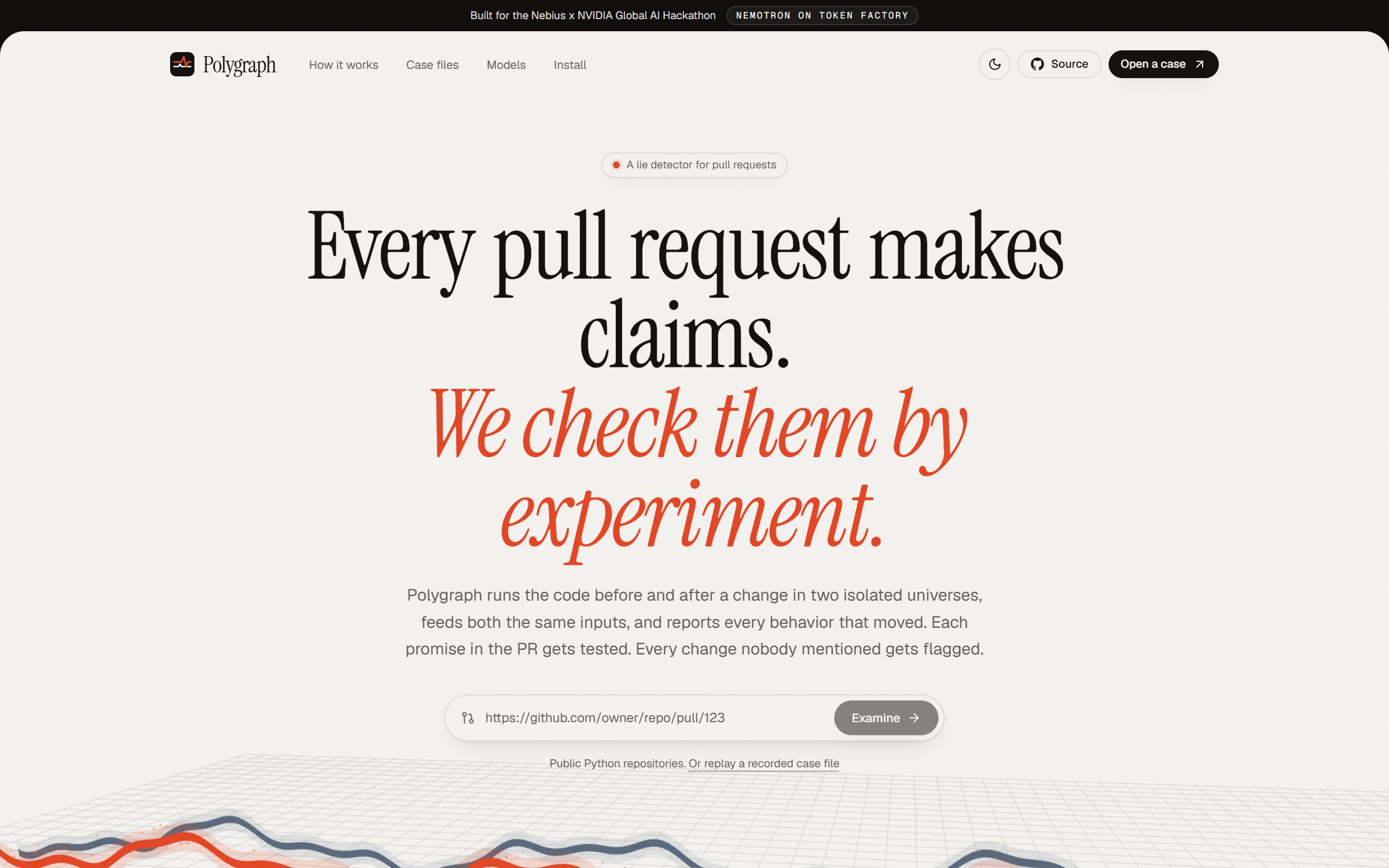
We wanted a reviewer that does not take the description's word for it.
What it does
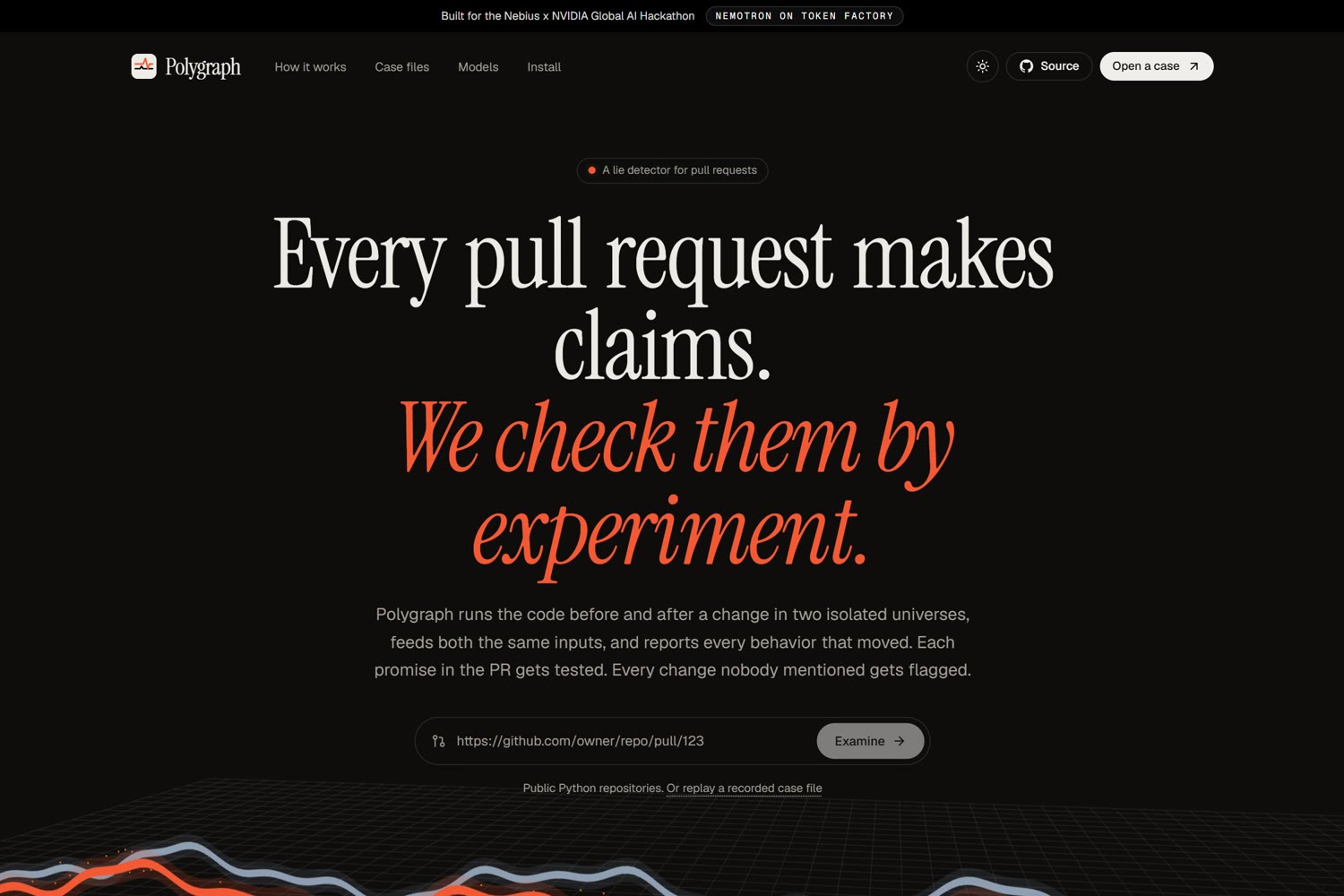
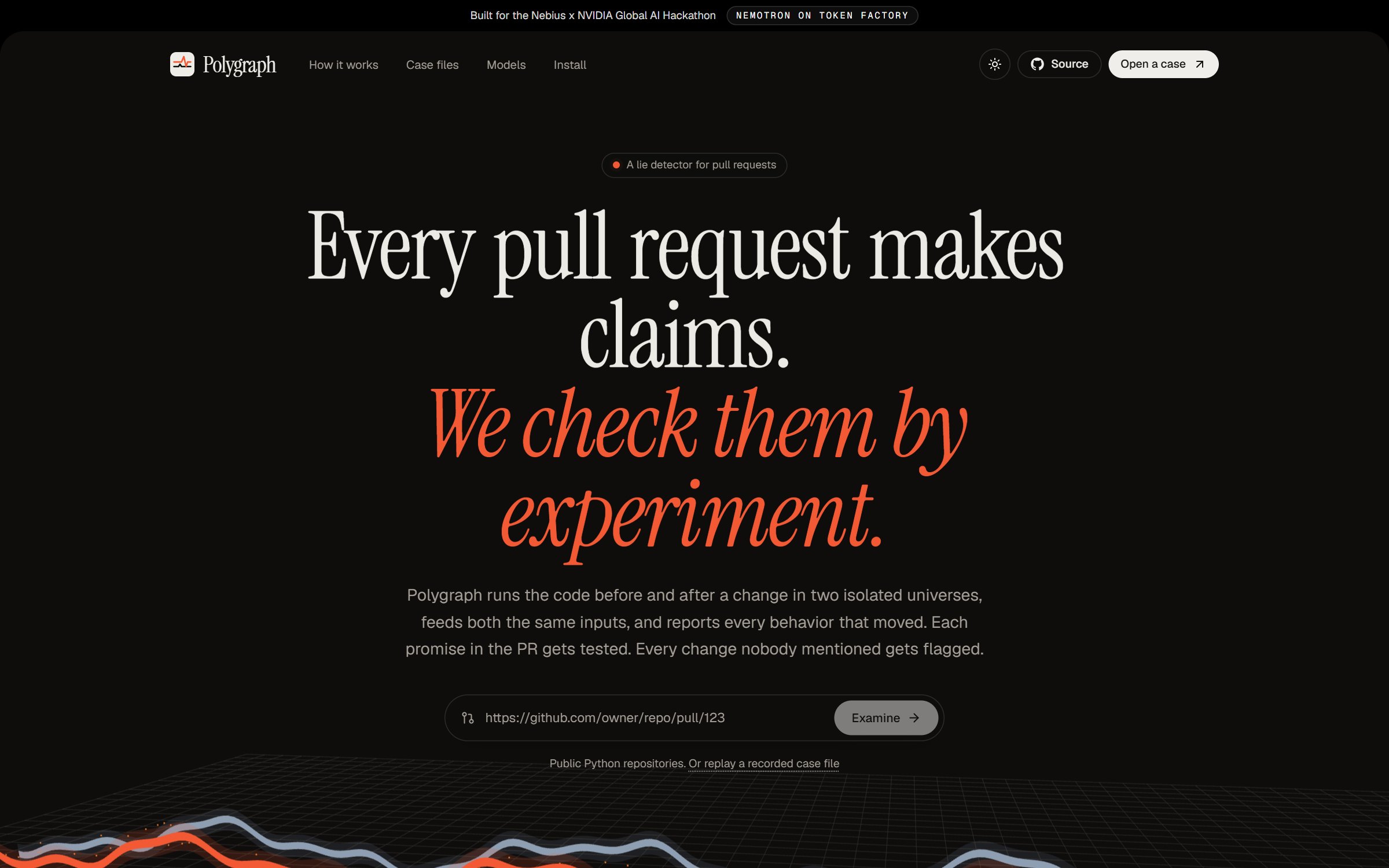
Point Polygraph at a pull request. It:
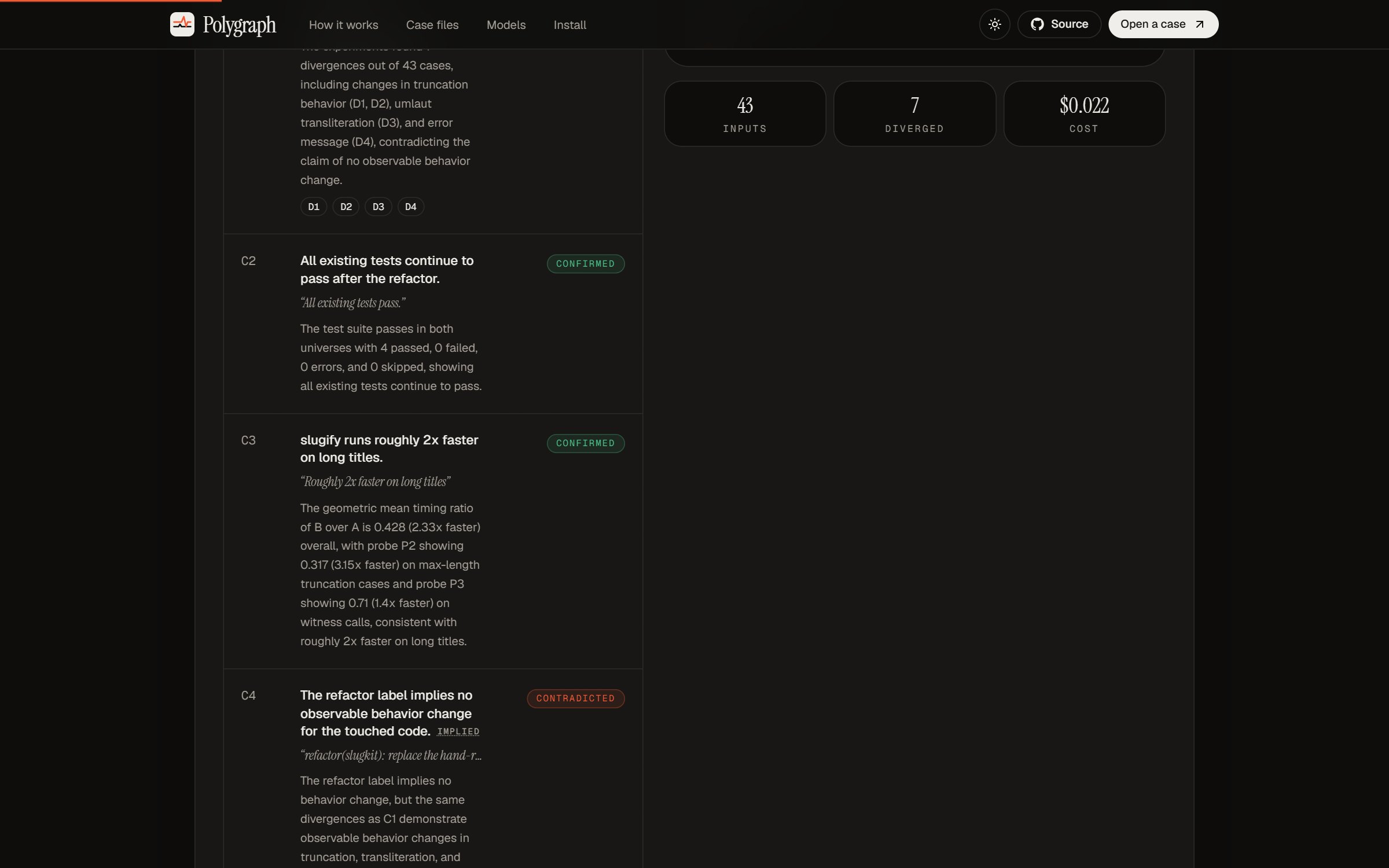
- Reads the title, description, commits and linked issues and splits them into a claim ledger, including implied claims such as "no behavior change" for a refactor.
- Builds two universes: the code before the PR (A) and after (B), each with its own interpreter and, for real projects, its own venv with the project installed. A dependency bump really runs two library versions side by side.
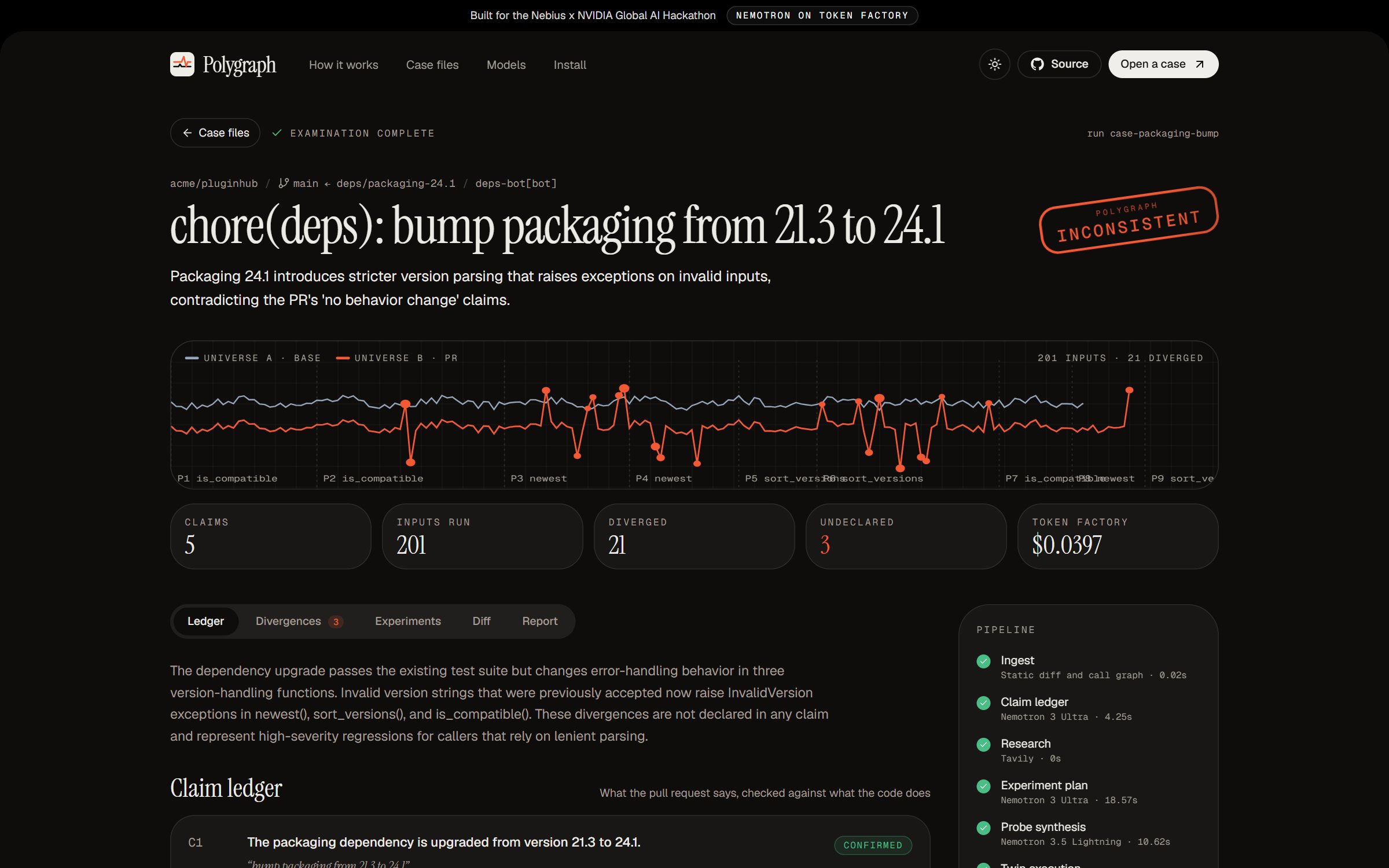
- Designs experiments, writes executable probes, and runs every probe in A, in A again (calibration, to discard noisy inputs), and in B. The project's own test suite runs in both universes, and every agreeing input is timed.
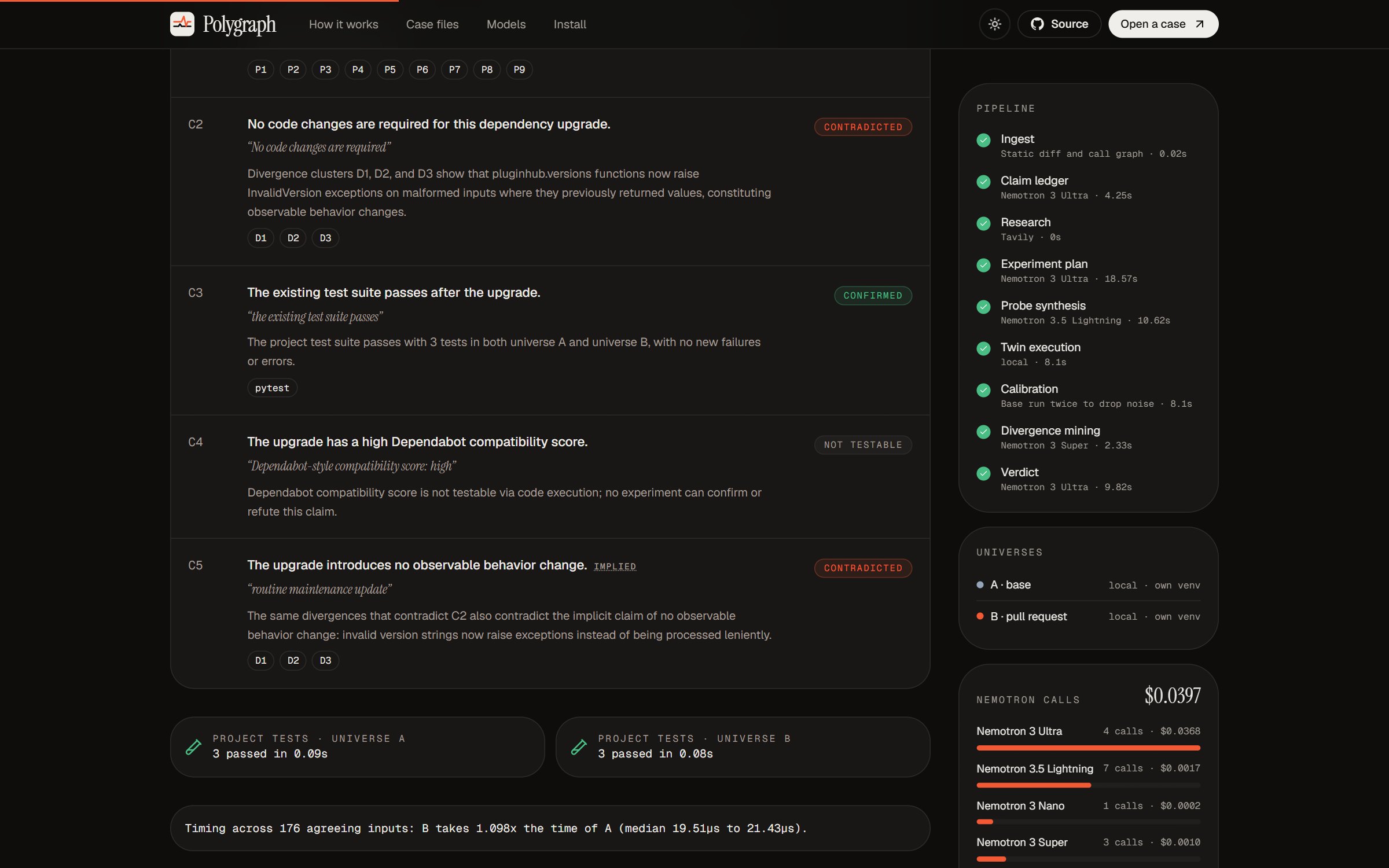
- Rules on every claim: confirmed, contradicted, or unverified, and surfaces every undeclared behavior change with a witness: the same input, the output before, the output after.
- Ships the result as a PR comment, a verdict that can gate the merge, and a pytest file that pins each finding (undeclared changes fail until they are declared or reverted).
It runs as a web app with live streaming runs, a CLI, a GitHub Action, and an API.
Results
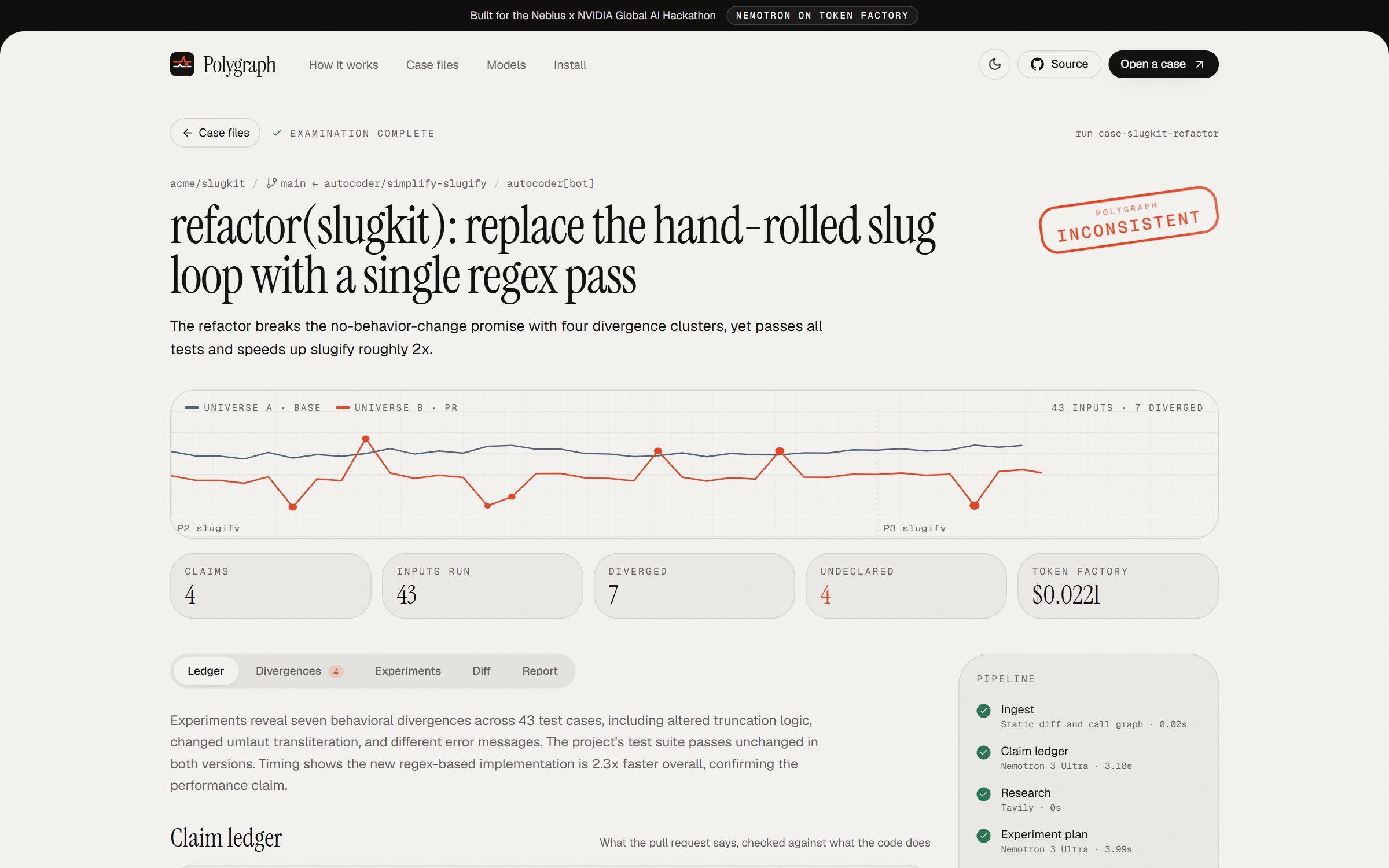
- AI-agent refactor, "No behavior change. All tests pass." Tests green, 2x speedup confirmed by timing, and
slugify('Straße')silently changed fromstrassetostrae. Verdict: inconsistent. - Dependency bump packaging 21.3 to 24.1, "routine maintenance". Tavily pulled the official changelog window (LegacyVersion removed in 22.0); Polygraph found five undeclared changes, e.g.
sort_versions(['1.0.0', 'invalid.version'])now raisesInvalidVersion. A diff-reading review by the same Nemotron 3 Ultra approved it with zero findings. - An honest rounding fix: every divergence was declared. Verdict: consistent. Polygraph clears good PRs too.
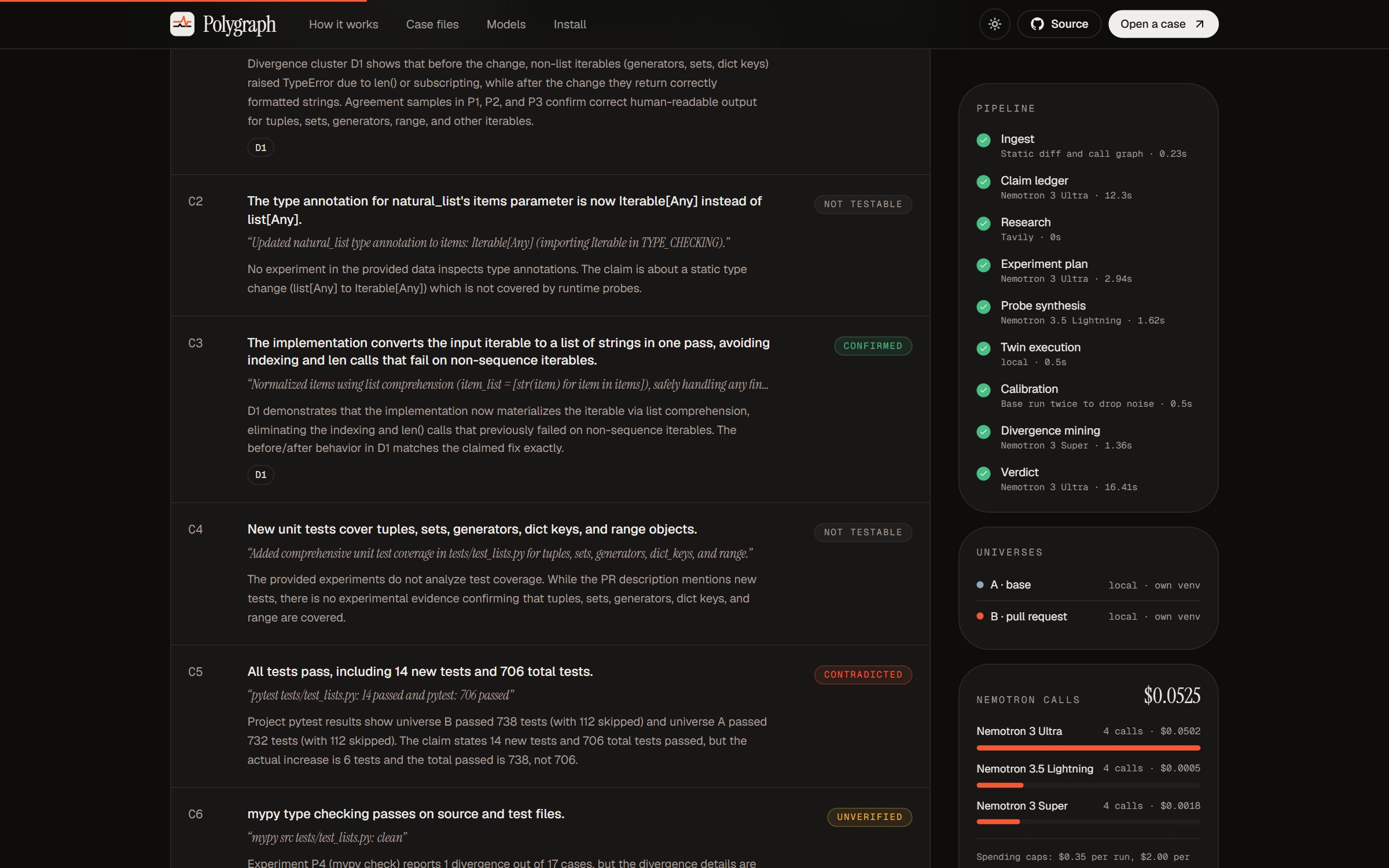
- Real merged PRs in python-humanize: honest fixes cleared with confirming witnesses, and in #381 Polygraph found that
natural_list(None)used to return''and now raisesTypeError, mentioned nowhere in the PR and approved by the diff reader. - A full examination costs 2 to 9 cents of Token Factory credit and takes under two minutes.
How we built it
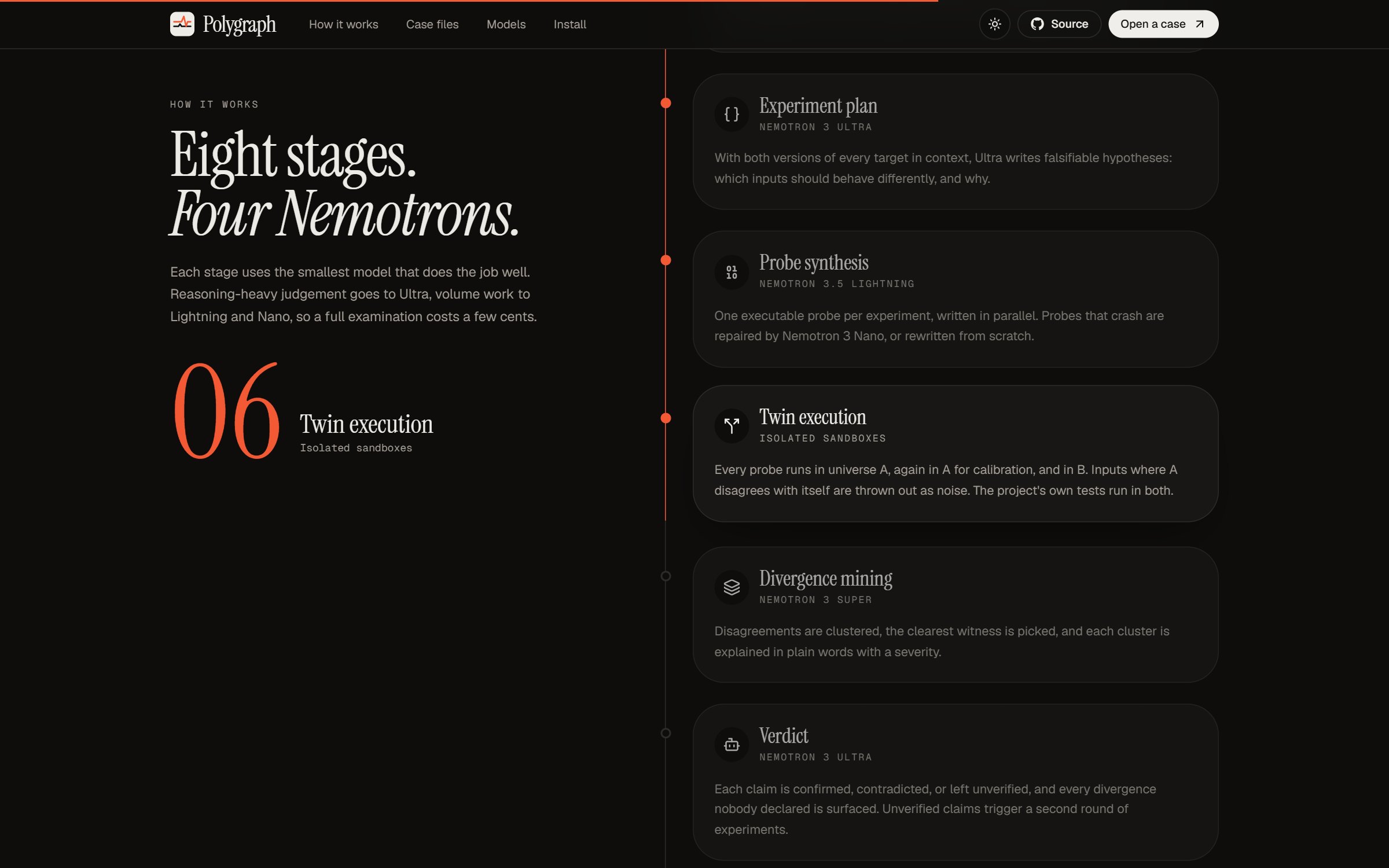
- NVIDIA Nemotron on Nebius Token Factory, four tiers, each sized to its job:
- Nemotron 3 Ultra (550B): claim ledger, experiment plan with concrete witness calls, final verdict. Reasoning on.
- Nemotron 3 Super (120B): splits each cluster of diverging inputs by root cause, explains it, rates severity.
- Nemotron 3.5 Lightning: writes executable probes in parallel (cheap, fast, 1M context).
- Nemotron 3 Nano: repairs probes that fail identically in both universes; Lightning regenerates if the repair does not compile.
- The pipeline is an agent loop: plan, write code, run it, repair it, compare, judge, and plan again for claims still unverified.
- Twin execution with a stdlib-only harness that canonicalizes outputs (type-preserving, address-scrubbed), per-case timeouts, micro-benchmarks, and calibration. Each universe is a separate tree with its own interpreter; installable projects get an editable install with an SCM version stub so generated files exist.
- Token Factory Sandboxes executor (beta): each universe becomes an immutable image, each probe a disposable branched operation.
- Tavily finds a bumped dependency's official sites through PyPI, scopes a search to them, and extracts the changelog entries between the two versions for the planner.
- Spending safety: every model call reserves its worst-case cost before it is sent; lifetime, daily, per-run and Tavily caps are enforced across processes. The public site replays recorded runs for free; live runs need an access code and are rate limited.
- Hosting at zero cost: the web app is a static Hugging Face Space where recorded runs replay in the browser, and live runs stream from a Vercel serverless function that executes a whole examination inside one streaming request.
- Front end: React, Tailwind, shadcn/ui, Framer Motion and a three.js hero with two diverging "universe" traces; light and dark themes.
- Control arm: the same Nemotron 3 Ultra reviews each PR by reading it and predicts behavior changes as concrete calls, which Polygraph then executes. That measures what reading alone gets right.
Challenges we ran into
- Reasoning budgets. Ultra sometimes spent its whole budget thinking and returned no answer. Every structured call now names a required key and retries once with reasoning off.
- Real repositories are not importable as checked out. humanize generates
_version.pyat build time. Universes now get editable installs, and import failures raised inside project code are classified as environment problems instead of being "repaired" (which wasted credits). - Fairness. Our first real-world run called an honest PR inconsistent because the author's "800 tests pass" became "726 passed, 74 skipped" on our machine. Environment-dependent claims now earn review, not guilt, and a run where nothing executed is
inconclusive. - One cluster, many causes. Grouping by function merged unrelated changes; Super now splits them by root cause.
Accomplishments that we're proud of
- A verdict computed from evidence, not from a model's opinion: the final label comes from the ledger in code.
- Catching an undeclared change in a real merged PR that people and a strong model both approved.
- Built and hosted entirely on free credits and free tiers, under hard spending caps.
What we learned
A strong model reading a small diff is genuinely good at predicting what changed: every executable prediction in our control arm was real. It is blind to what is not in the diff. The useful role for the model is not judge but experimenter: write the hypotheses, then let execution decide.
What's next
JavaScript and TypeScript universes, Hypothesis-style input shrinking for minimal witnesses, Polygraph as a check on agent-authored PRs before they reach humans, and running probes at scale on Token Factory Sandboxes.
Built With
- docker
- fastapi
- framer-motion
- github-actions
- hugging-face
- nebius-token-factory
- nvidia-nemotron
- pytest
- python
- react
- shadcn-ui
- tailwindcss
- tavily
- three.js
- typescript
- uv
- vercel

Log in or sign up for Devpost to join the conversation.