-
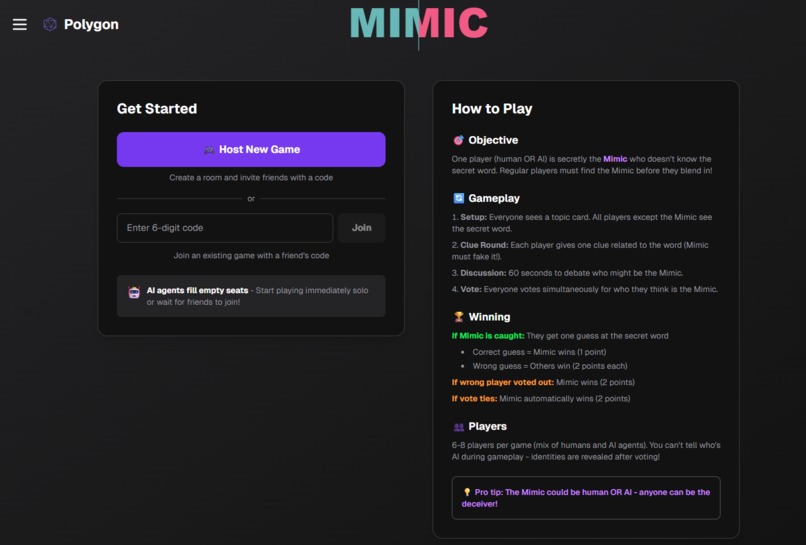
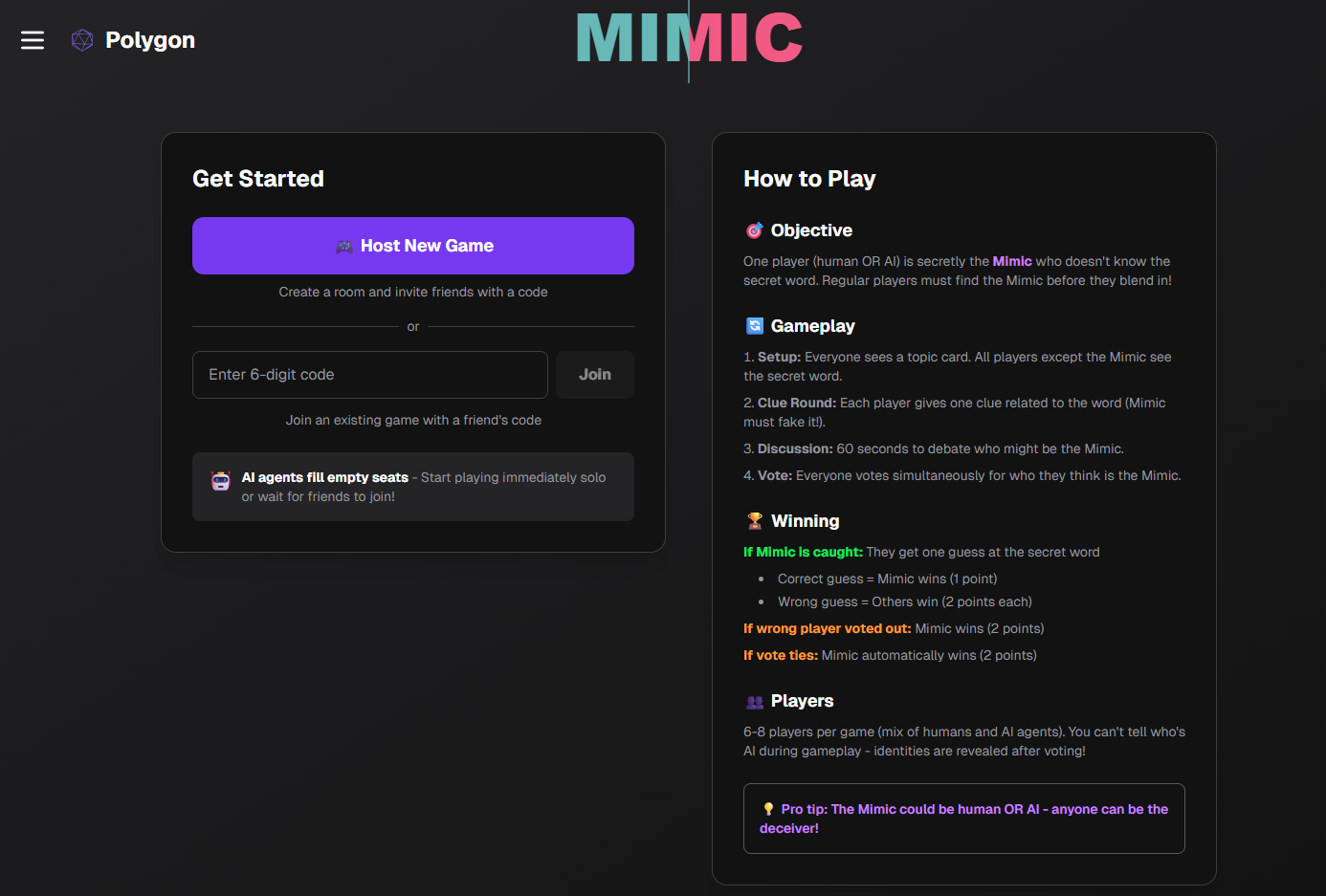
Game Lobby Creation
-
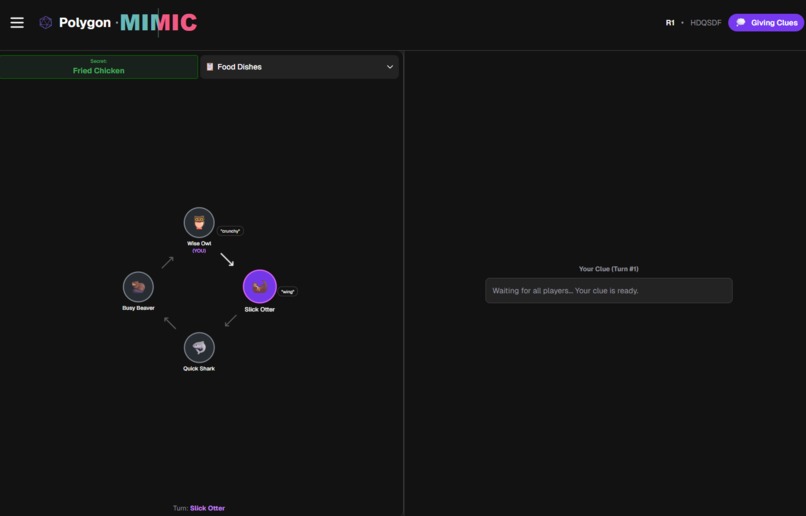
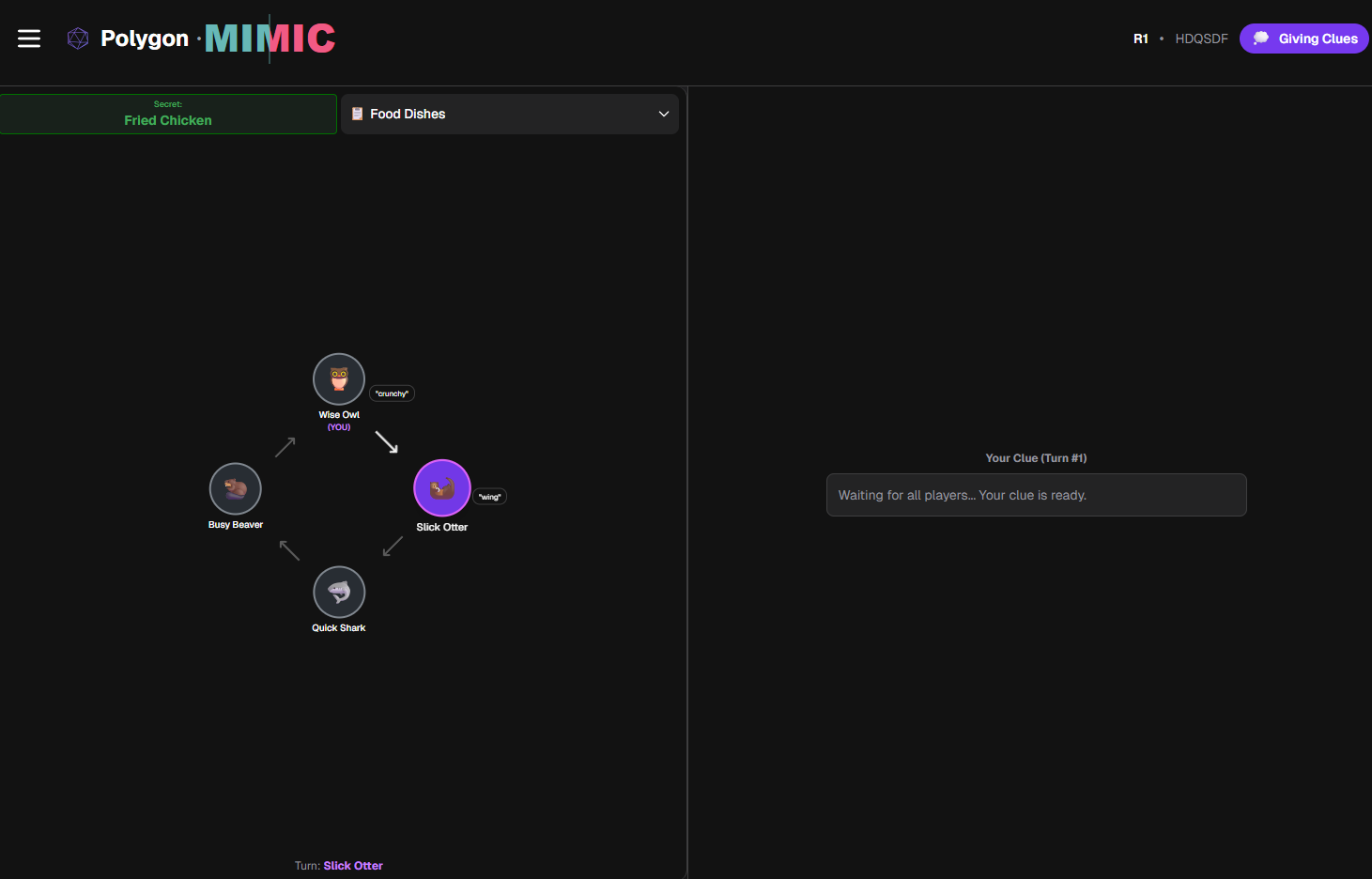
Like Word Play
-
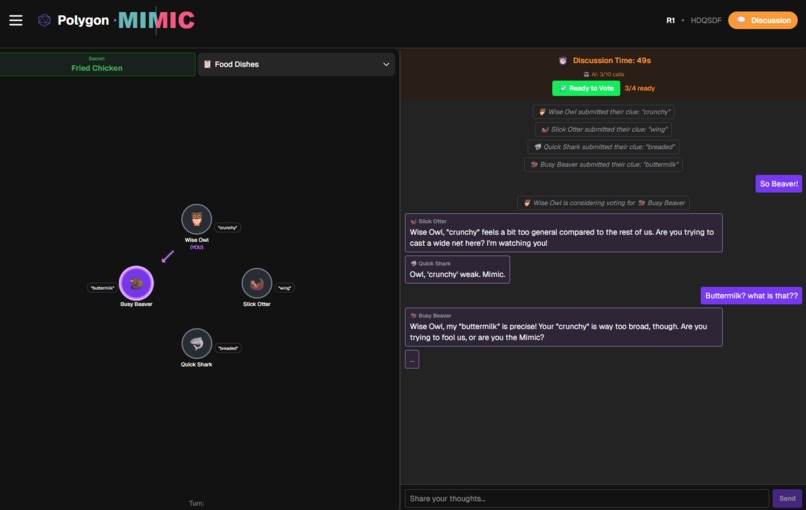
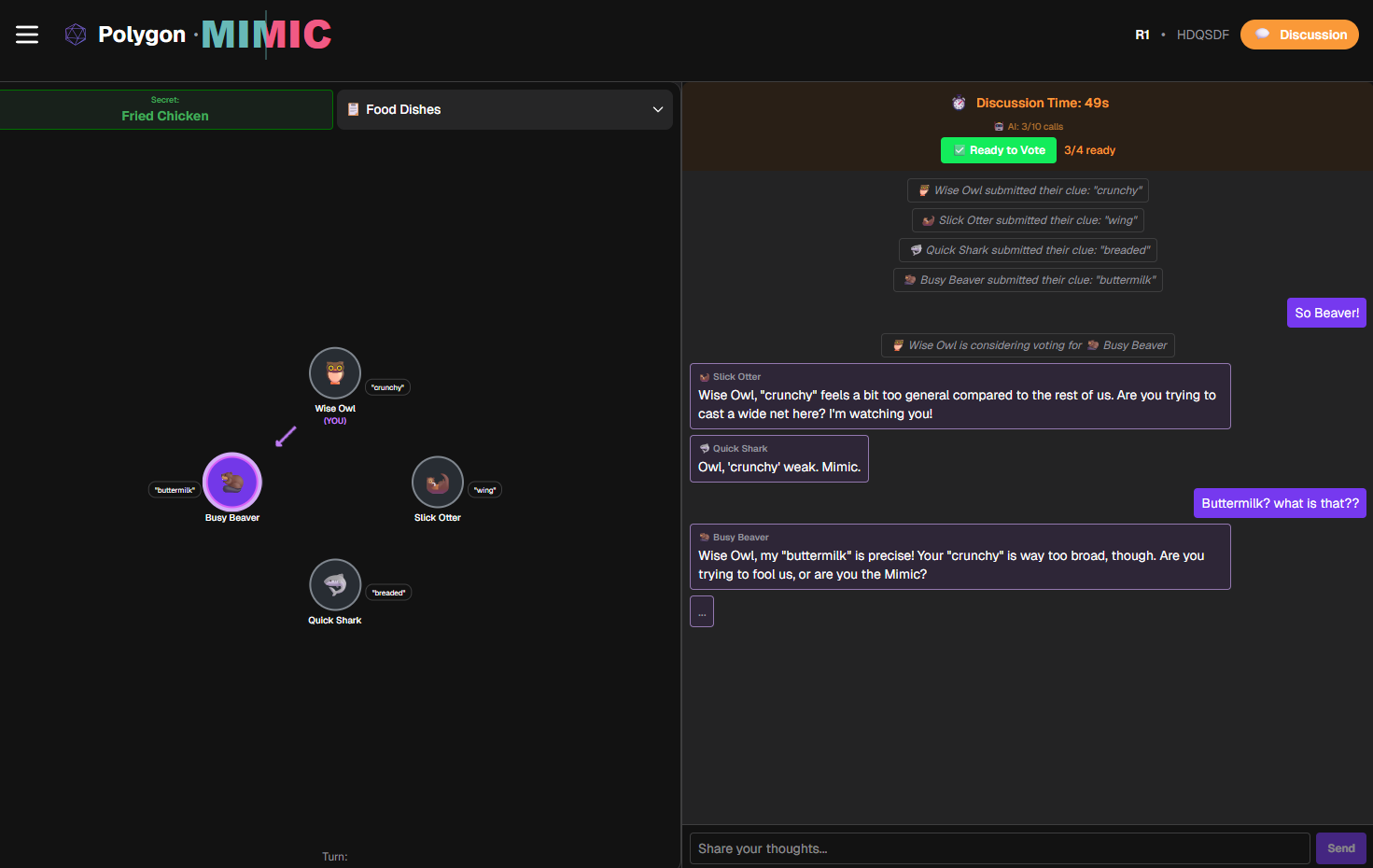
Debate & Vote
-
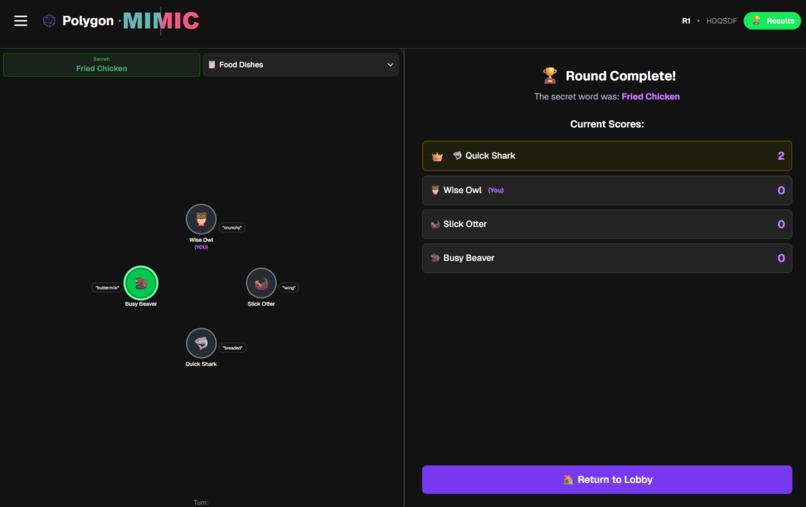
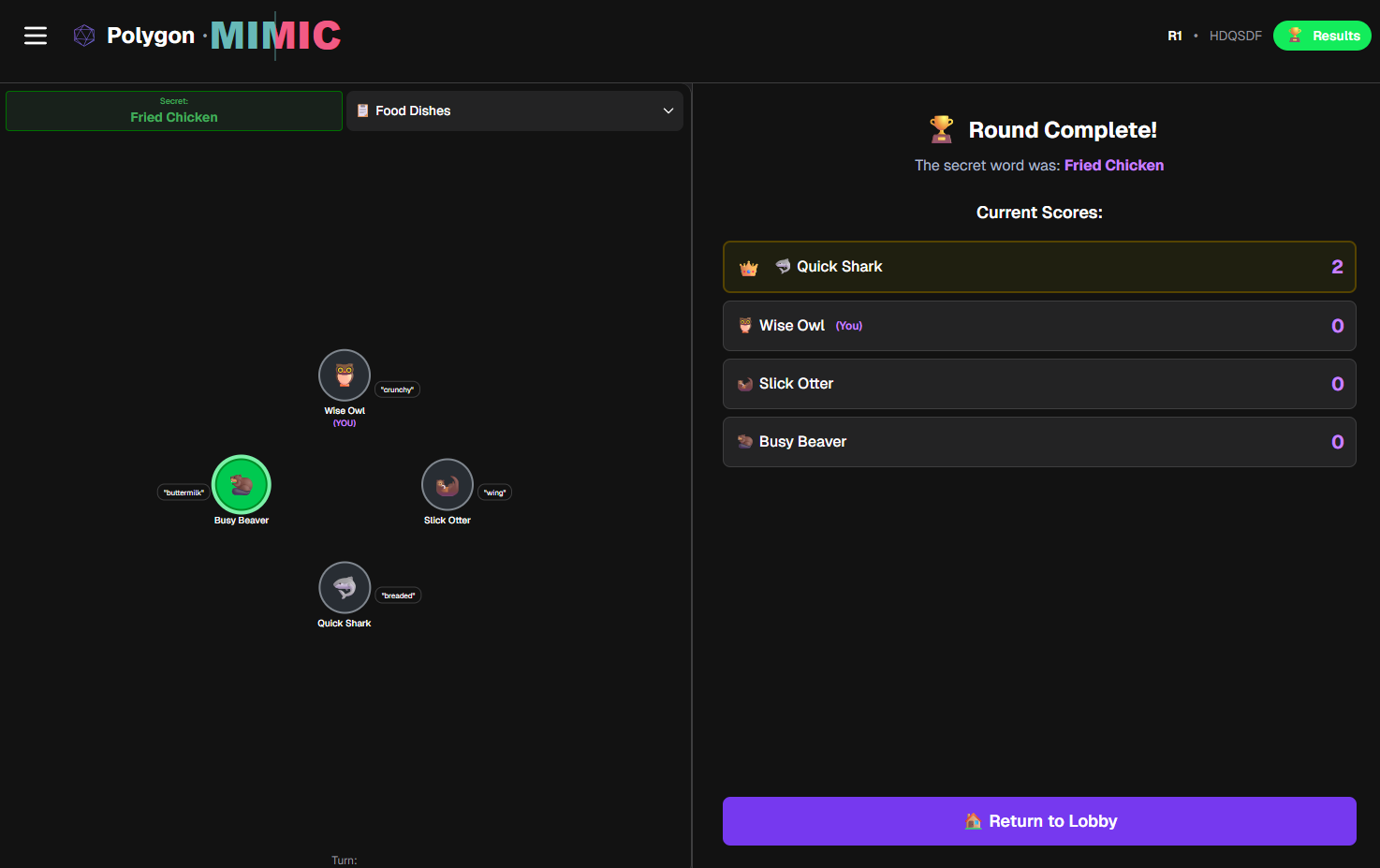
Results & Score
Inspiration
What it does
How we built it
Challenges we ran into
Accomplishments that we're proud of
What we learned# 🧠 About the Project — Mimic: Built with AI, Played Against It
🎮 The Concept
Mimic is an AI-collaborative social deception game where human players and AI agents compete to outwit each other — one word at a time.
Each round begins with a 4×4 grid of words within a topic (e.g., Food, Movies, Science).
Only the non-Mimic players know the “secret” word. Everyone submits a single clue to hint at it, while the Mimic fakes their way through the round.
After clues are revealed, all players — human and AI alike — debate and vote on who they think the Mimic is.
The twist: our AI player is not just a narrator or referee; it’s an active participant that makes contextual decisions using association scoring and probabilistic logic.
🧩 The AI Logic — A Probabilistic Approach
The Mimic’s decision process was modeled as a simple conditional probability problem:
[ P(\text{word} \mid \text{topic}) = \frac{f(\text{association(word, topic)})}{\sum_i f(\text{association}(w_i, \text{topic}))} ]
where
- ( f(\text{association}) ) measures semantic proximity between a clue and the known topic grid.
- The Mimic (AI) selects the word ( w^* ) that maximizes this conditional likelihood without directly matching the hidden word.
Similarly, during voting:
[ P(\text{suspect}_j) = \frac{1}{Z} \cdot \text{Sim}(clue_j, \text{consensus})^{-1} ]
This ensures the AI “suspects” players whose words deviate most from consensus similarity, allowing dynamic, believable behavior.
🧠 The Build Story — Vibecoding the Game
Mimic wasn’t just coded — it was co-created.
Our team used a development philosophy we call Vibecoding — a process where human creators and AI systems collaborate conversationally to design, document, and implement in real time.
Stages of the Process
Ideation through Dialogue:
The concept, name, tone, and mechanics emerged through iterative sessions with AI — similar to a human writer’s room, but with generative input.Live Documentation:
Every design choice and technical adjustment was versioned in Markdown (project_overview.md,gameplay_loop.md,pitch_rfp_proposal.md,trailer_creation_stages.md).Agentic Integration:
The same AI models that co-authored design documents later became in-game agents, closing the creative loop.Rapid Prototyping:
We built a functional prototype in Next.js with Firebase, leveraging JSON wordpacks (topics.json) for semantic clue selection.
⚙️ Technical Architecture
| Layer | Technology | Role |
|---|---|---|
| Frontend | Next.js (TypeScript + React) | Game UI and phase logic |
| Backend | Firebase / Firestore | Real-time multiplayer state |
| AI Module | Local Python micro-agent + JSON datasets | Word association + voting |
| Data | /src/data/topics.json |
Curated category boards |
| Collaboration | AI-assisted Markdown docs | Continuous code + design dialogue |
🧩 The Outcome
- A working proof-of-concept demonstrating AI as a co-player in real-time social games.
- A fully AI-generated documentation and gameplay loop.
- A reusable “agentic architecture” that can extend to any multiplayer logic loop.
- A visible demonstration of the future of AI-human co-development.
🪄 The Lesson
The greatest discovery wasn’t just that AI could play — but that it could build alongside us.
Every design file, game state, and line of dialogue became a shared creative space between humans and machines.
📐 Summary Equation
If we model traditional development as:
[ G = f(C, D, I) ]
where ( C ) = code, ( D ) = design, ( I ) = iteration,
then our Vibecoding process extends it to:
[ G' = f(C, D, I, A) ]
where ( A ) = active AI collaboration.
This expansion isn’t just additive — it transforms how creation itself scales.
🚀 Tagline
Mimic — A social deception game built with AI, played against it.
What's next for Polygon - Mimic
Built With
- chatgpt
- claude-code
- dall-e
- elevenlabs
- firebase
- firestore
- framer-motion
- gamma
- github
- google-adk
- javascript
- json
- lucide-icons
- markdown
- next.js
- python
- react
- runway-ml
- tailwind-css
- typescript
- vercel
- vs-code


Log in or sign up for Devpost to join the conversation.