Inspiration
- Prediction markets make every possible factoid tradable.
- ETFs allow traders to quantify macro-scale market movements.
- We wanted to combine these two concepts to model and trade on just about any occurrence possible, even if a direct market doesn't exist yet.
What it does
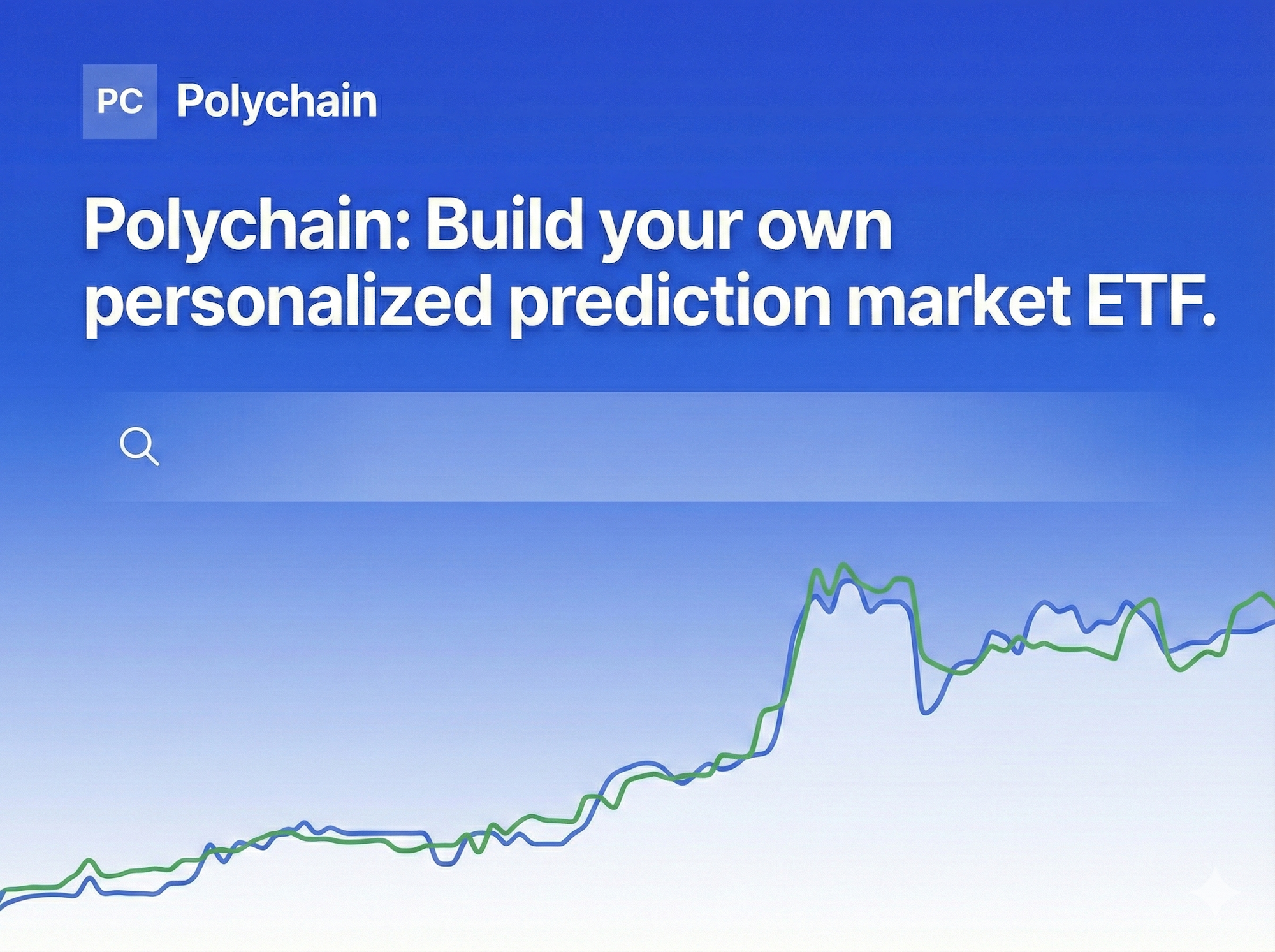
Polychain creates synthetic bets for any human query. Whether you ask "Will the UK rejoin the EU?", "Will SpaceX mine asteroids?", or "Will nuclear fusion power a commercial grid by 2030?", the engine synthesizes a tradable ETF basket representing that specific outcome using existing market liquidity.
How we built it
We relied heavily on semantic analysis, knowledge graphs, and data scraping, supported by machine learning models.
The graph: we constructed a knowledge graph containing 19,600 nodes and 132,000 relationships representing markets, topics, people, and companies. This was built using polymarket and Wikipedia data and a Transformer model for semantic analysis.
The pipeline: we use a hierarchy search to identify broad topics (e.g., politics, crypto) and expand them into semantically related markets. We calculate the distance between events, setting a hard limit at a degree of 3, and calculate semantic similarity between market keywords.
Once the related markets are gathered, we apply a mix of semantic and time-series analysis to determine the optimal basis for our synthetic ETF.
Challenges we ran into
The core problem was figuring out how to model the weights of different markets for a bet that doesn't actually exist. There is no perfect, out-of-the-box mathematical solution for this. We solved it by brute-forcing the context: mapping over 120,000 entities across Polymarket and Wikipedia to accurately model their underlying correlations.
Accomplishments that we're proud of
We successfully built multi-layer topical connections that can handle arbitrary length paths. We are particularly proud of the smart filtering system, which effectively balances the shortest graphical path against the highest semantic similarity to discard noise and keep the synthetic ETF highly relevant.
What we learned
Building the graph revealed exactly how many similar markets exist simultaneously and just how densely connected the global prediction market ecosystem actually is. What's next for Polychain
What's next
Our immediate goal is to accurately predict ETF weightings in cases where the target has zero existing proxy data, ultimately allowing users to predict everything. To achieve this, we will expand our knowledge graph by incorporating external data sources—including stocks, options, news headlines, and tweets—to increase the accuracy and density of our correlation links.
Built With
- knowledge-graph
- natural-language-processing
- polymarket
- prediction-markets
- react


Log in or sign up for Devpost to join the conversation.