-
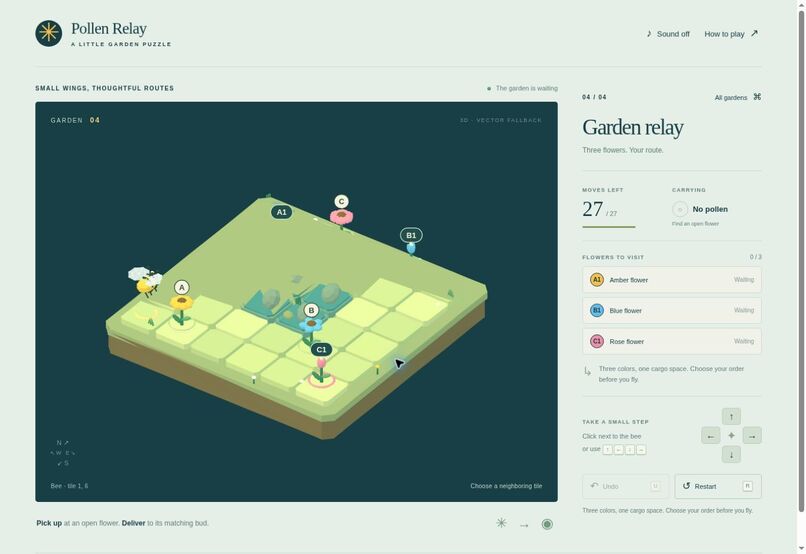
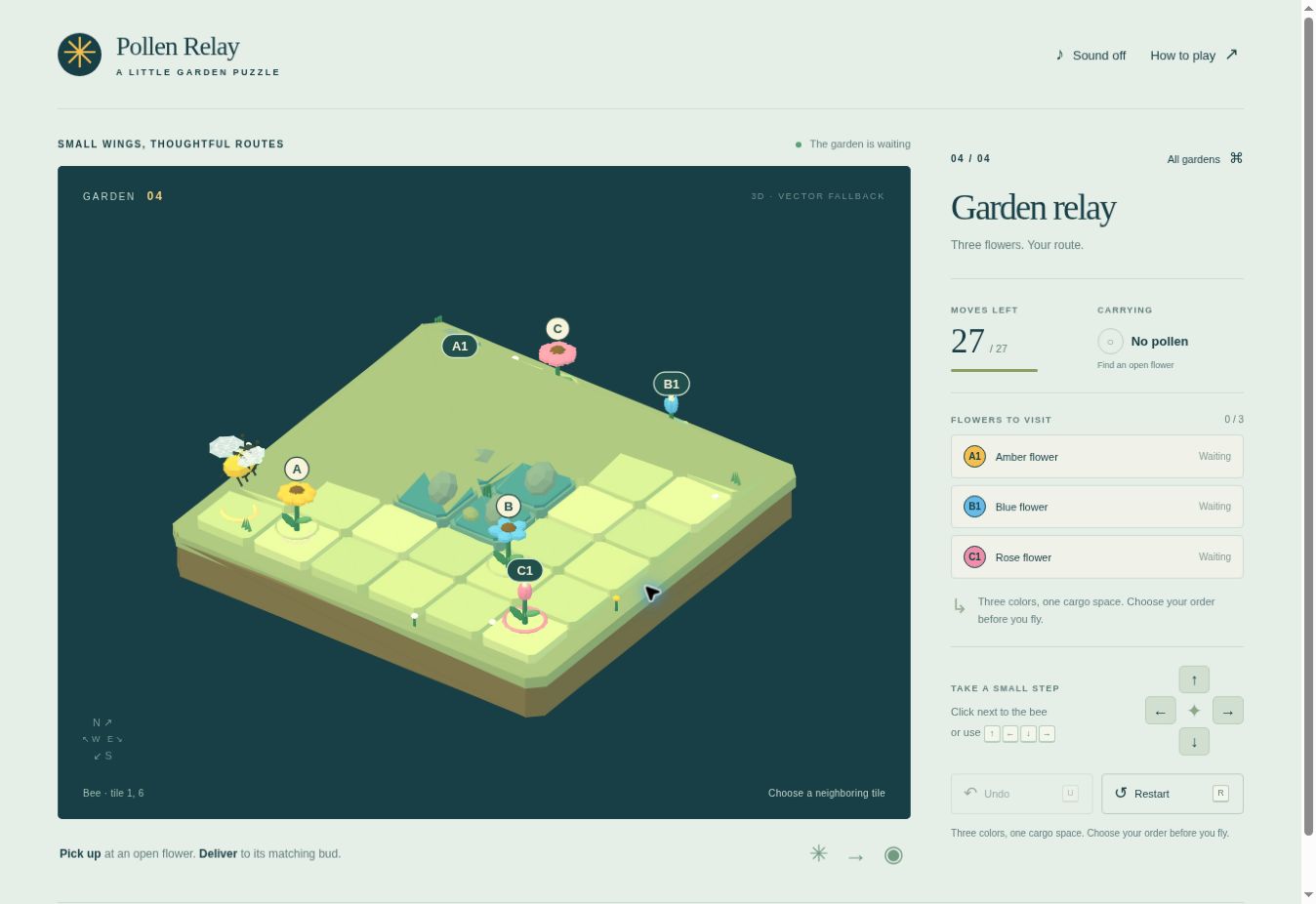
Garden 4: three pollen types, one cargo space, visible goals and move budget. Actual SVG-rendered 3D gameplay.
Inspiration
A garden can be seen as a network of visits. Pollen Relay turns that idea into a small route-planning puzzle: move a bee, match pollen to a bud and reconsider a route when another source would replace the cargo already on board.
The intended learner is someone seeking a short, self-directed activity in matching, sequencing and planning. The access barrier addressed is practical: an interactive 3D activity should still run when hardware WebGL is unavailable. The official Three.js SVGRenderer fallback keeps the same three-dimensional scene and game rules, with simpler geometry and lighting.
What it does
Guide a modeled bee through four raised 3D gardens. Open flowers supply pollen labeled A, B or C. A matching bud blooms and consumes the load. The bee has one cargo space; visiting another source replaces it. Ponds and rocks block routes, and each garden has a move budget.
The four gardens progress from a first delivery to several pollen kinds, a cargo-changing shortcut and a three-color relay. All levels are selectable. Controls include neighboring-tile clicks or taps, arrow keys, W A S D and an on-screen direction pad. Undo and restart support experimentation. Optional synthesized sound and locally saved completed-garden progress are included.
Letters and goal labels accompany colors, and the game respects reduced-motion preferences. A visible label identifies the vector-rendered 3D fallback.
An educational before-and-after example
In the third garden, the player must plan around a shortcut that changes the bee's pollen. Written instructions require mentally tracking that replacement. Here the carried letter, goal status and remaining moves change on screen after each move. The player can undo, compare a detour and try again. This is a concrete interaction example, not evidence of measured learning improvement.
How it was built
The prototype was created on 30 October 2026, within both the LaunchPad Hacks and AccessED Hacks build windows. The same common prototype is entered in both events; no separate AccessED-specific code additions are claimed.
The app uses buildless HTML, CSS and JavaScript ES modules, with locally bundled Three.js 0.187.0 under the MIT license. Garden tiles, the bee, flowers, rocks and plants are generated from original geometry in code. No external image, model or sound assets are needed. WebGL provides the richest rendering; Three.js's official SVGRenderer projects the same scene, camera and geometry when WebGL is unavailable.
A separate rules module handles movement, blocked tiles, cargo replacement, matching, delivery, move budgets and completion. Prior states support undo. Automated rule checks and a breadth-first solver verified all four level definitions, with minimum solutions of 4, 12, 11 and 21 moves. Earlier browser checks completed all four gardens; the public deployment was checked again on 31 October.
The playable app needs no installation, account, API key, paid service or runtime CDN. Progress stays in local browser storage; the app sends no telemetry. Sound uses Web Audio after interaction.
Challenges and accomplishments
Making one-cargo rules clear was the main design challenge. The first source sits one step from the bee; the visible cargo and goal labels explain subsequent choices. Later levels create planning problems through source and obstacle placement.
Supporting browsers without hardware WebGL was another challenge. The vector fallback retains the three-dimensional scene and controls while reducing rendering complexity. The result is a complete four-level loop with changing flower geometry, undo, restart, level selection and completion states.
What the build highlighted
A small cargo rule creates an interesting choice: a short route can cross the wrong source, while a detour preserves the needed pollen. Separating the rules from rendering also allows level verification independently of the rendering backend.
Limits and next steps
This is an English-language learning toy inspired by flower visits, not a biological simulation. It does not yet provide a complete nonvisual board alternative. No learner study, user counts or educational outcomes are claimed. Turkish text, remappable controls and richer nonvisual descriptions are possible future work, not implemented features.
Try it
Open the public HTTPS demo linked below in a current browser. No sign-in or setup is required. Screenshots show the actual playable experience, including the labeled SVG fallback used in this browser.
Credits and AI assistance
Anıl Göktaş commissioned and directed the project. OpenAI ChatGPT assisted with concept development, game and interface design, code, procedural geometry, levels, automated tests and project text. Codex assisted with entry adaptation and submission preparation. Three.js is used under its MIT license. No manual coding by the entrant, user research, field data or measured learning results are asserted.

Log in or sign up for Devpost to join the conversation.