PolitiWiki: Building Transparency in Nigerian Politics
🌟 What Inspired Me
As a Nigerian, I've watched countless election cycles where politicians make grand promises during campaigns, only to see those promises forgotten once they take office. The frustration of seeing the same cycle repeat—promises of better infrastructure, improved education, reliable power supply, and economic growth—without any systematic way to track accountability inspired me to create PolitiWiki.
The breaking point came during the 2023 elections when I realized there was no centralized platform where citizens could easily:
- Track what politicians promised during campaigns
- Monitor whether those promises were being fulfilled
- Access verified information about their representatives
- Contribute evidence-based updates about political performance
I wanted to solve this problem not just for myself, but for every Nigerian who deserves transparency and accountability from their elected officials.
🎯 The Problem I'm Solving
Nigerian politics suffers from a fundamental transparency gap:
- Promise Tracking: Politicians make numerous campaign promises, but there's no systematic way to track their delivery
- Information Scattered: Political information is spread across multiple sources, making it hard for citizens to get a complete picture
- Lack of Accountability: Without proper tracking, politicians face little pressure to fulfill their commitments
- Citizen Disengagement: Many Nigerians feel disconnected from the political process due to lack of accessible information
PolitiWiki addresses these challenges by creating a "political Wikipedia" where every promise, statement, and action is documented with credible sources.
🛠️ How I Built PolitiWiki
Technology Stack
I chose modern, reliable technologies to ensure the platform could scale and provide a great user experience:
- Frontend: Next.js 14 with App Router for optimal performance and SEO
- Styling: Tailwind CSS with shadcn/ui components for a clean, professional design
- TypeScript: For type safety and better developer experience
- Responsive Design: Mobile-first approach since many Nigerians access the internet primarily through mobile devices
Key Features Implemented
1. Politician Profiles
Each politician has a comprehensive profile including:
- Personal information and background
- Current office and party affiliation
- Contact information and social media
- Educational and professional history
- Performance scorecard with ratings
2. Promise Tracking System
The core feature that tracks:
- Campaign promises with sources
- Delivery status (Delivered, In Progress, Pending)
- Evidence and updates from the community
- Timeline of progress
3. Public Contribution System
Three types of submissions:
- New Politicians: Add politicians not yet in the database
- Updates: Provide new information about existing politicians
- Evidence: Submit proof for or against claims and promises
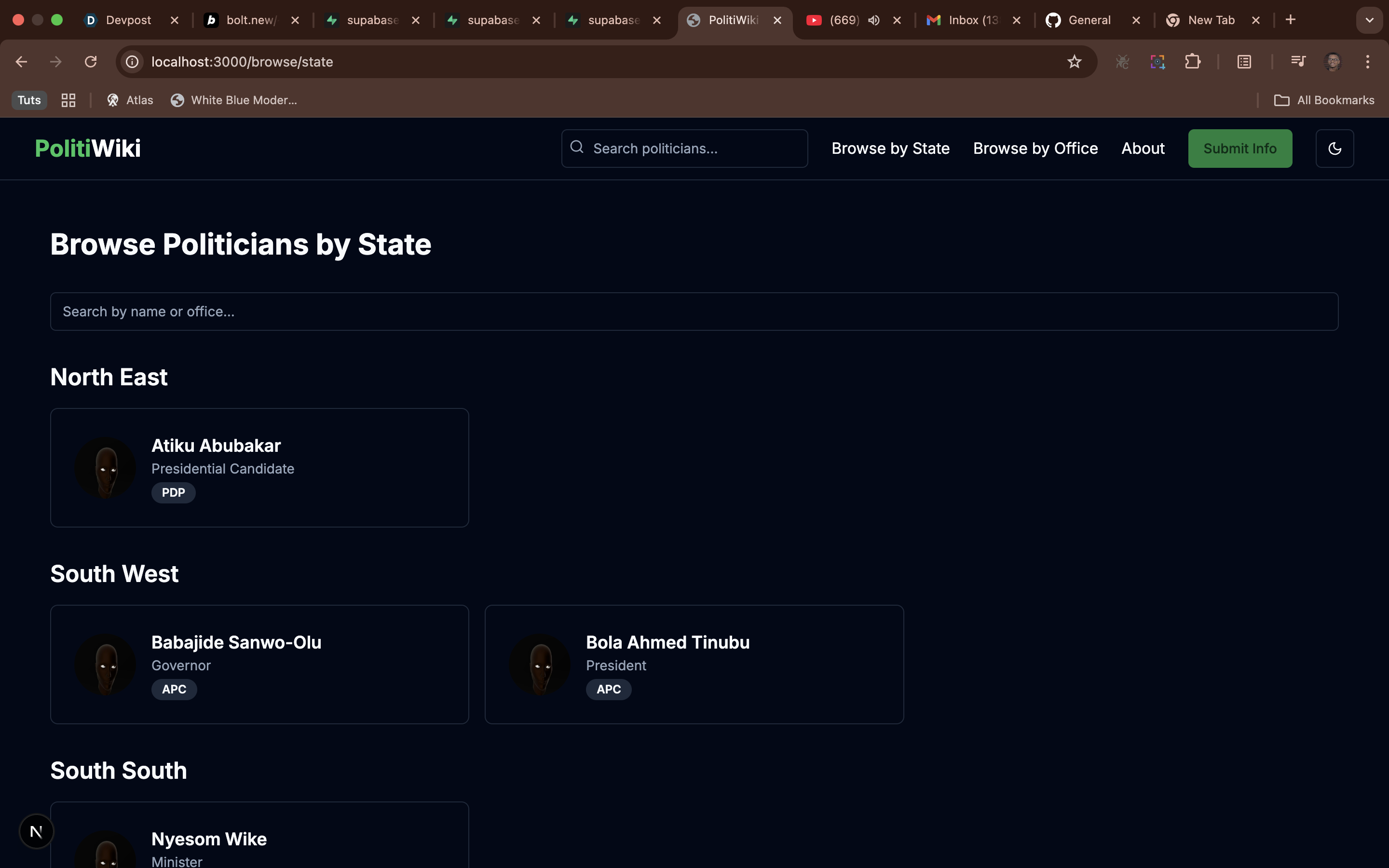
4. Browse Functionality
Users can explore politicians by:
- State/Region: All 36 Nigerian states plus FCT
- Office: President, Governors, Senators, Ministers, etc.
5. Quality Control
- All submissions require credible sources
- Moderation system for reviewing contributions
- Community reporting for inaccuracies
Design Philosophy
I focused on creating a clean, accessible design that would work well for all Nigerians:
- Nigerian Identity: Used green accents inspired by the Nigerian flag
- Mobile-First: Optimized for mobile devices since that's how most Nigerians access the internet
- Simple Navigation: Clear, intuitive interface that doesn't require technical expertise
- Fast Loading: Optimized performance for users with slower internet connections
💡 What I Learned
Technical Learnings
- Next.js App Router: Mastered the new App Router paradigm, including server components and improved routing
- Component Architecture: Built a scalable component system using shadcn/ui as a foundation
- Responsive Design: Implemented mobile-first design principles for optimal user experience across devices
- TypeScript Best Practices: Improved type safety and code maintainability
Product Development Insights
- User-Centered Design: Focused on solving real problems for Nigerian citizens rather than building features for the sake of it
- Content Strategy: Realized the importance of having a robust moderation system for user-generated content
- Scalability Planning: Designed the architecture to handle growth from hundreds to potentially millions of users
- Community Building: Understood that the platform's success depends on active community participation
Nigerian Political Landscape
- Information Gaps: Discovered how fragmented political information is across different media sources
- Citizen Engagement: Learned about the desire for political transparency among young Nigerians
- Source Verification: Understood the critical importance of credible sources in the Nigerian media landscape
🚧 Challenges I Faced
Technical Challenges
Data Structure Design
Challenge: Designing a flexible data structure that could accommodate different types of political information
Solution: Created a modular system with separate entities for promises, statements, scandals, and background information
Mobile Optimization
Challenge: Ensuring the platform works well on low-end Android devices common in Nigeria
Solution: Implemented aggressive performance optimizations and tested on various device types
Search Functionality
Challenge: Making politician search intuitive and fast
Solution: Implemented client-side filtering with plans for server-side search as the database grows
Product Challenges
Content Moderation Strategy
Challenge: Balancing open contributions with quality control
Solution: Implemented a three-tier system: community submissions, moderator review, and admin approval
Source Verification
Challenge: Ensuring all information is backed by credible sources
Solution: Made source links mandatory for all submissions and created guidelines for acceptable sources
Political Neutrality
Challenge: Maintaining non-partisan stance while tracking political performance
Solution: Focused on factual information with clear source attribution rather than opinions or ratings
Nigerian Context Challenges
Internet Connectivity
Challenge: Many Nigerians have limited or slow internet access
Solution: Optimized for performance and implemented progressive loading
Digital Literacy
Challenge: Ensuring the platform is accessible to users with varying technical skills
Solution: Created intuitive navigation and clear instructions for all features
Trust Building
Challenge: Establishing credibility in a space where misinformation is common
Solution: Emphasized transparency in our processes and clear source attribution
🚀 Future Plans
Short-term Goals
- Database Integration: Connect to a robust database system (planning to use Supabase)
- User Authentication: Implement user accounts for contributors
- Admin Dashboard: Build moderation tools for reviewing submissions
- Search Enhancement: Add advanced search and filtering capabilities
Medium-term Goals
- Mobile App: Develop native mobile applications for iOS and Android
- API Development: Create public APIs for researchers and civic organizations
- Comparison Tools: Build features to compare politicians side-by-side
- Analytics Dashboard: Provide insights on political performance trends
Long-term Vision
- Pan-African Expansion: Extend the platform to other African countries
- AI-Powered Fact Checking: Implement automated fact-checking capabilities
- Civic Education: Add educational content about democratic processes
- Election Integration: Provide comprehensive election coverage and candidate comparisons
🎉 Impact and Reflection
Building PolitiWiki has been more than just a technical project—it's been an attempt to contribute to Nigeria's democratic development. The platform represents my belief that technology can be a powerful tool for civic engagement and political accountability.
The most rewarding aspect has been designing something that could genuinely help fellow Nigerians make more informed political decisions. Every feature was built with the question: "How will this help a Nigerian citizen better understand their representatives?"
While the technical challenges were significant, the real test will be adoption and community engagement. The success of PolitiWiki ultimately depends on Nigerians embracing it as a tool for political transparency and actively contributing to its growth.
This project has reinforced my belief that as Nigerian developers, we have a responsibility to build solutions that address our local challenges. PolitiWiki is my contribution to the ongoing effort to strengthen Nigeria's democracy through technology and transparency.
PolitiWiki is live and ready to serve as a platform for political transparency in Nigeria. The foundation is built—now it's time for the community to make it a powerful tool for democratic accountability.
Built With
- nextjs
- supabase

Log in or sign up for Devpost to join the conversation.