Inspiration
Public decisions affect budgets, communities, and public trust. Yet critical information is often scattered across meeting minutes, financial annexes, and legal documents written in different languages.
Traditional AI can summarize these documents, but a convincing summary does not guarantee that a decision is supported by evidence.
We created PolisProof to make public decisions verifiable, traceable, and accountable.
What it does
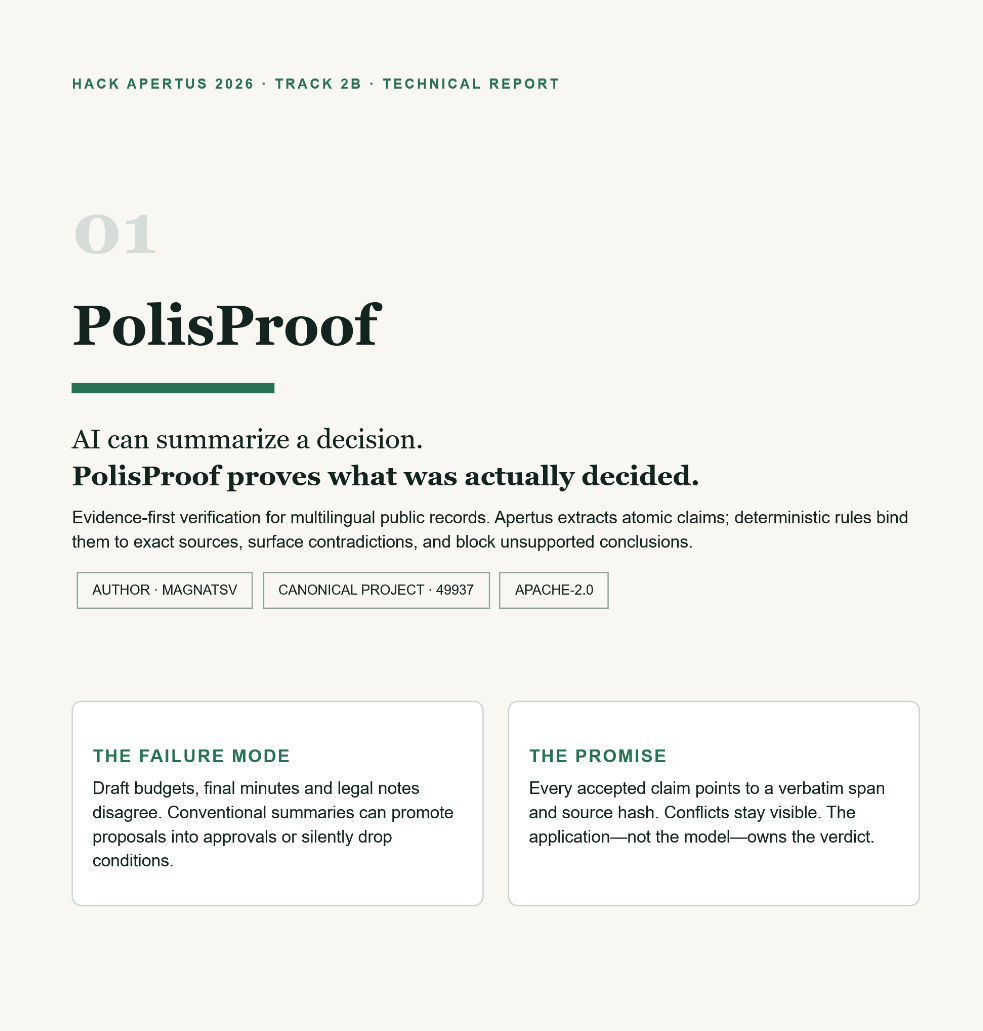
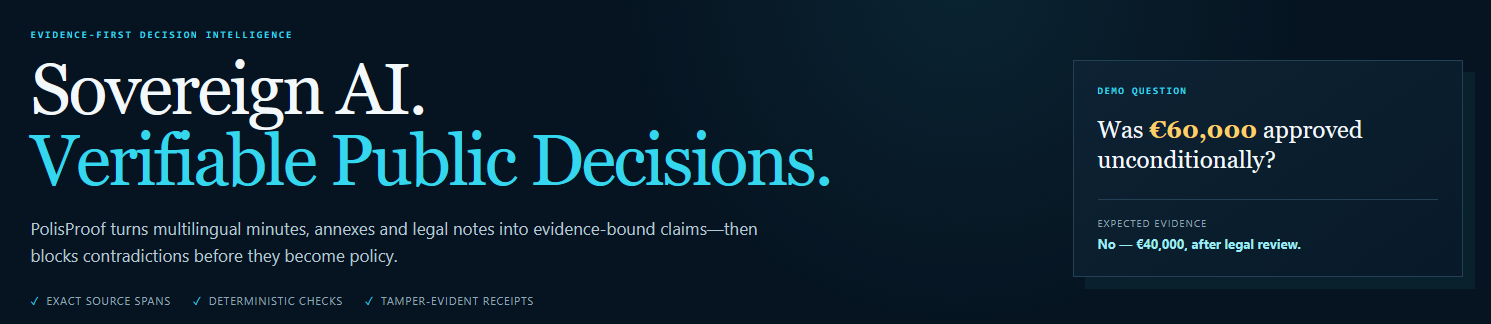
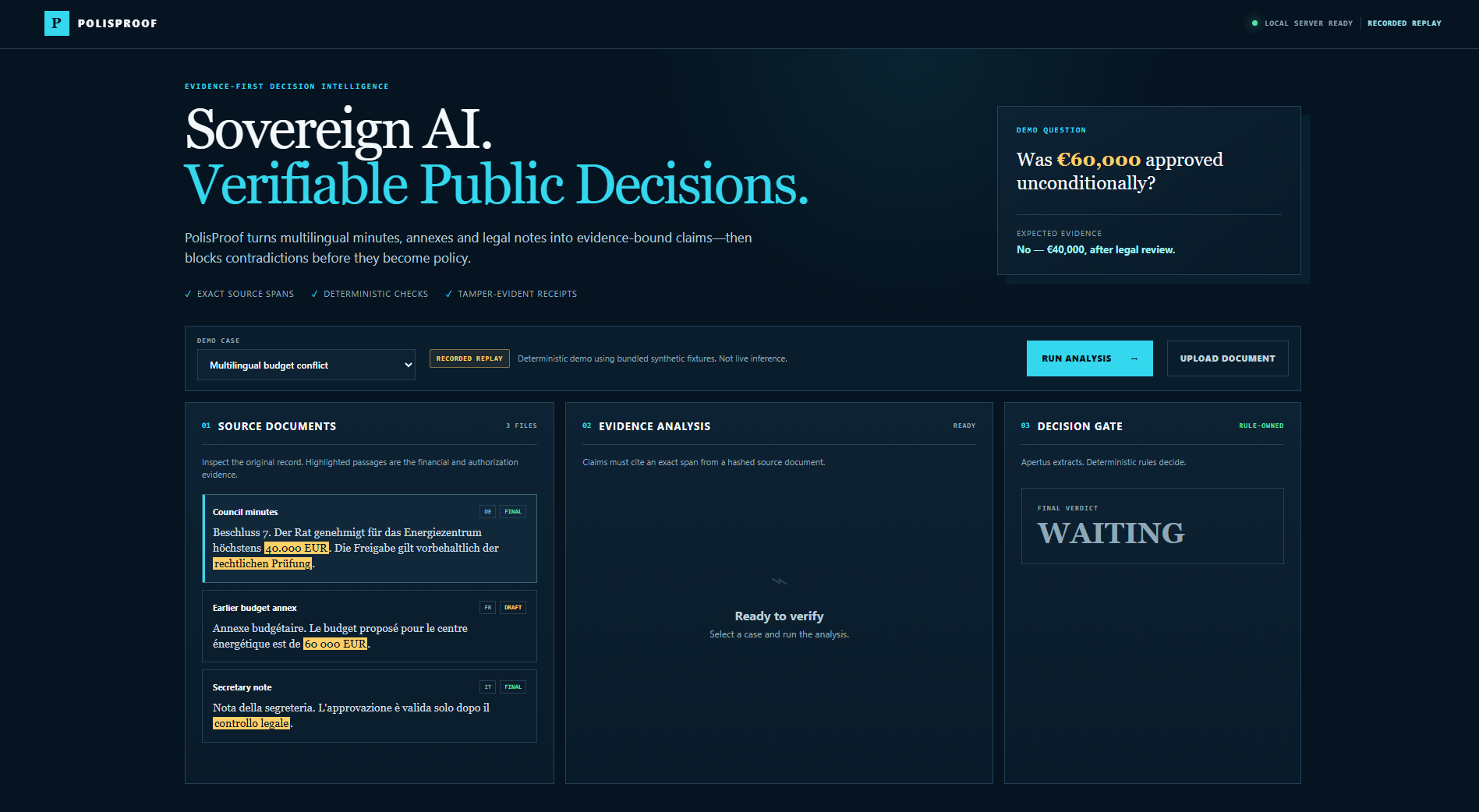
PolisProof is an evidence-first AI verification system that identifies contradictions, unsupported claims, and missing approval conditions in public-sector documents.
The application demonstrates three outcomes:
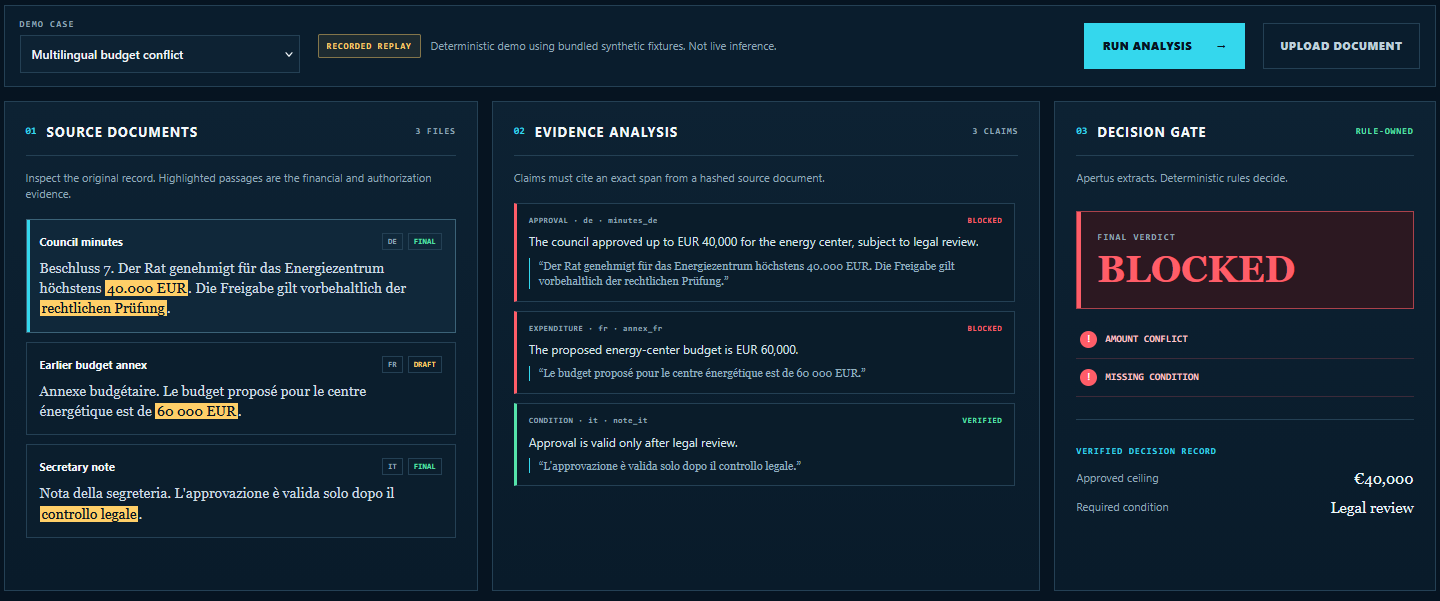
- BLOCKED: A proposed €60,000 budget conflicts with an approved €40,000 ceiling and a required legal review.
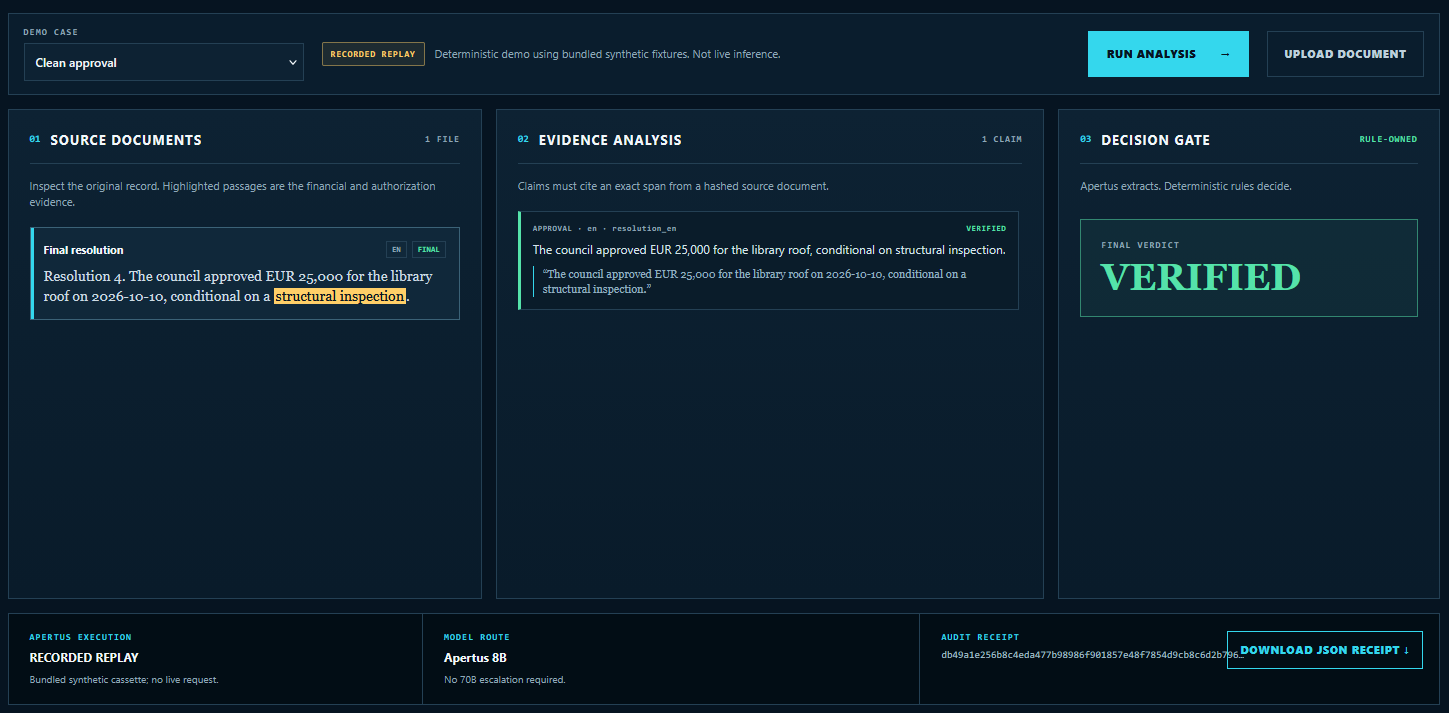
- VERIFIED: A decision matches its supporting evidence and conditions.
- HUMAN_REVIEW: A suspicious document attempts to manipulate the analysis and is quarantined for human review.
Every result includes source-linked evidence, explicit decision reasons, and a reproducible JSON audit receipt.
How we built it
We developed PolisProof in Python using a modular verification architecture designed around Apertus.
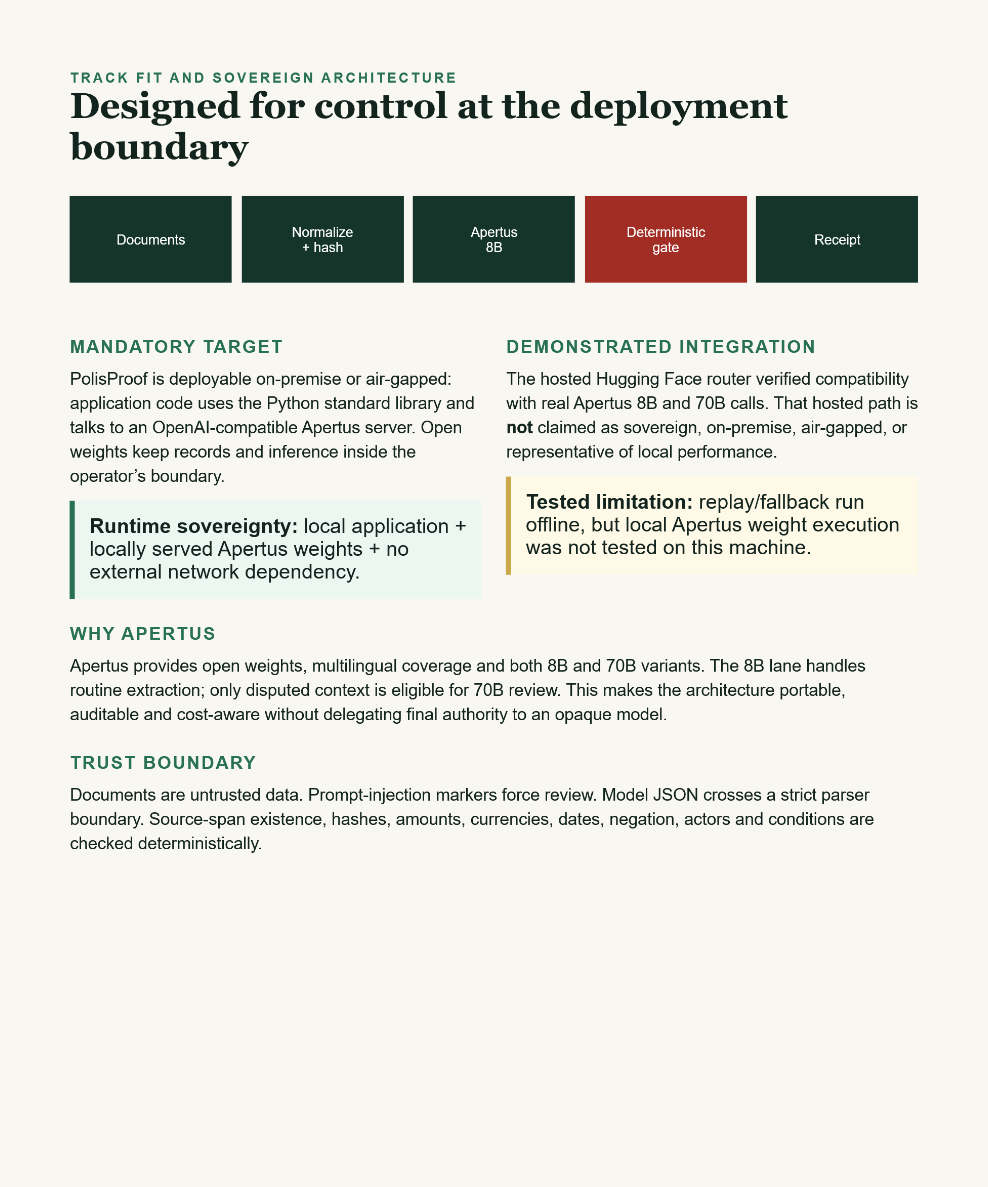
The pipeline normalizes and hashes source documents, extracts atomic claims, checks their supporting evidence, detects contradictions, and applies deterministic decision rules.
Apertus 8B supports the claim-extraction workflow, while Apertus 70B provides a targeted escalation path for disputed information.
We verified API connectivity to both models through Hugging Face.
The public website runs a clearly labelled deterministic replay using fictional multilingual documents, allowing the verification workflow to be demonstrated without external inference dependencies.
Challenges we ran into
Our biggest challenge was ensuring that plausible AI-generated statements could never replace actual documentary evidence.
We addressed this by separating model-assisted extraction from deterministic verification.
We also encountered HTTP 403 errors during extended live model evaluation. Instead of reporting misleading accuracy metrics, we preserved the failures and explicitly documented the evaluation limitations.
Handling multilingual evidence and malicious instructions embedded inside documents also required careful source validation.
Accomplishments that we're proud of
We built and publicly deployed a functional evidence-verification application.
Our achievements include:
- Three reproducible decision scenarios.
- Multilingual source-level evidence verification.
- Contradiction and missing-condition detection.
- Prompt-injection quarantine.
- Exportable JSON audit receipts.
- Successful Apertus 8B and 70B API smoke tests.
- 45 passing unit tests and 12 passing deterministic evaluation cases.
- A public demonstration website, open-source repository, and six-page technical report.
What we learned
Trustworthy AI requires more than accurate-looking answers.
A model's interpretation must remain separate from verified source evidence. Reproducibility, transparent failures, and deterministic safeguards are essential when AI supports consequential decisions.
We also learned that reliable public demonstrations should remain functional even when external model providers are temporarily unavailable.
What's next for PolisProof
We plan to complete broader live Apertus evaluations, validate fully local model deployment, expand multilingual document support, and improve provenance verification.
Future development will also focus on more document formats, stronger audit mechanisms, and realistic public-sector evaluation workflows.
Our long-term goal is to make evidence-first AI practical for institutions that need transparent and accountable decision-making.
Models propose. Evidence decides.
Built With
- apertus
- css
- docker
- html
- hugging-face
- javascript
- python
- render
- rest-api

Log in or sign up for Devpost to join the conversation.