Inspiration
AI agents can now edit files, contact online services, and prepare payments. That power is useful, but it creates a simple question: how can we let an agent work quickly without giving it unlimited control?
Written instructions are not enough. An agent may misunderstand a request, choose the wrong recipient, use a service it should not access, or repeat an old action. We built PolicyMesh to provide one clear checkpoint between an AI agent and real-world impact.
What it does
PolicyMesh checks an agent action before it can run.
It can:
- limit how much money an agent may spend;
- allow payments only to approved recipients;
- limit which files an agent may change;
- limit which online services an agent may contact;
- show the expected result before an action runs;
- ask a person to approve higher-risk actions;
- stop all actions in an emergency;
- block the same action from running twice; and
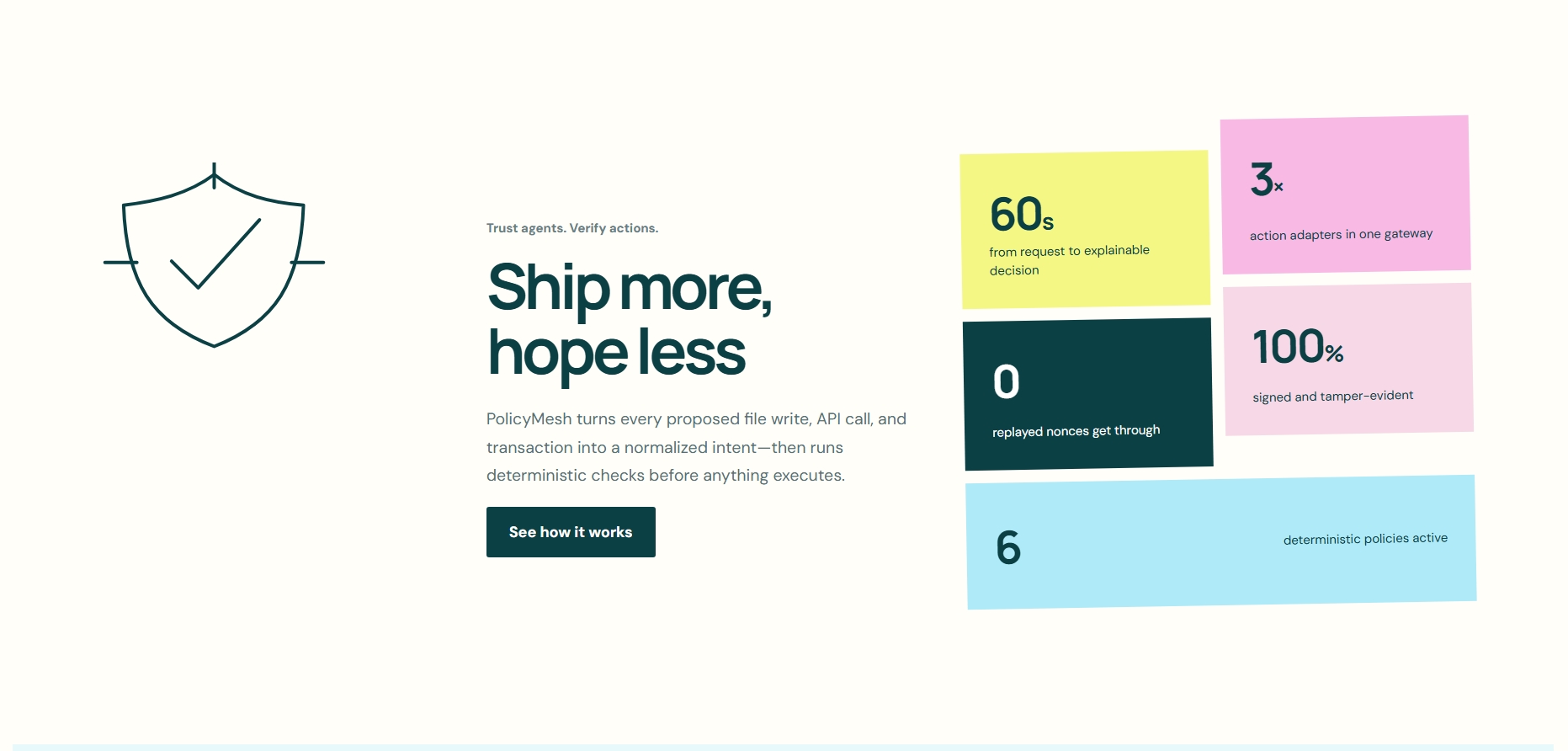
- create a signed record of every decision.
Every action receives one of three clear results: Allow, Review, or Block.
How GPT-5.6 powers PolicyMesh
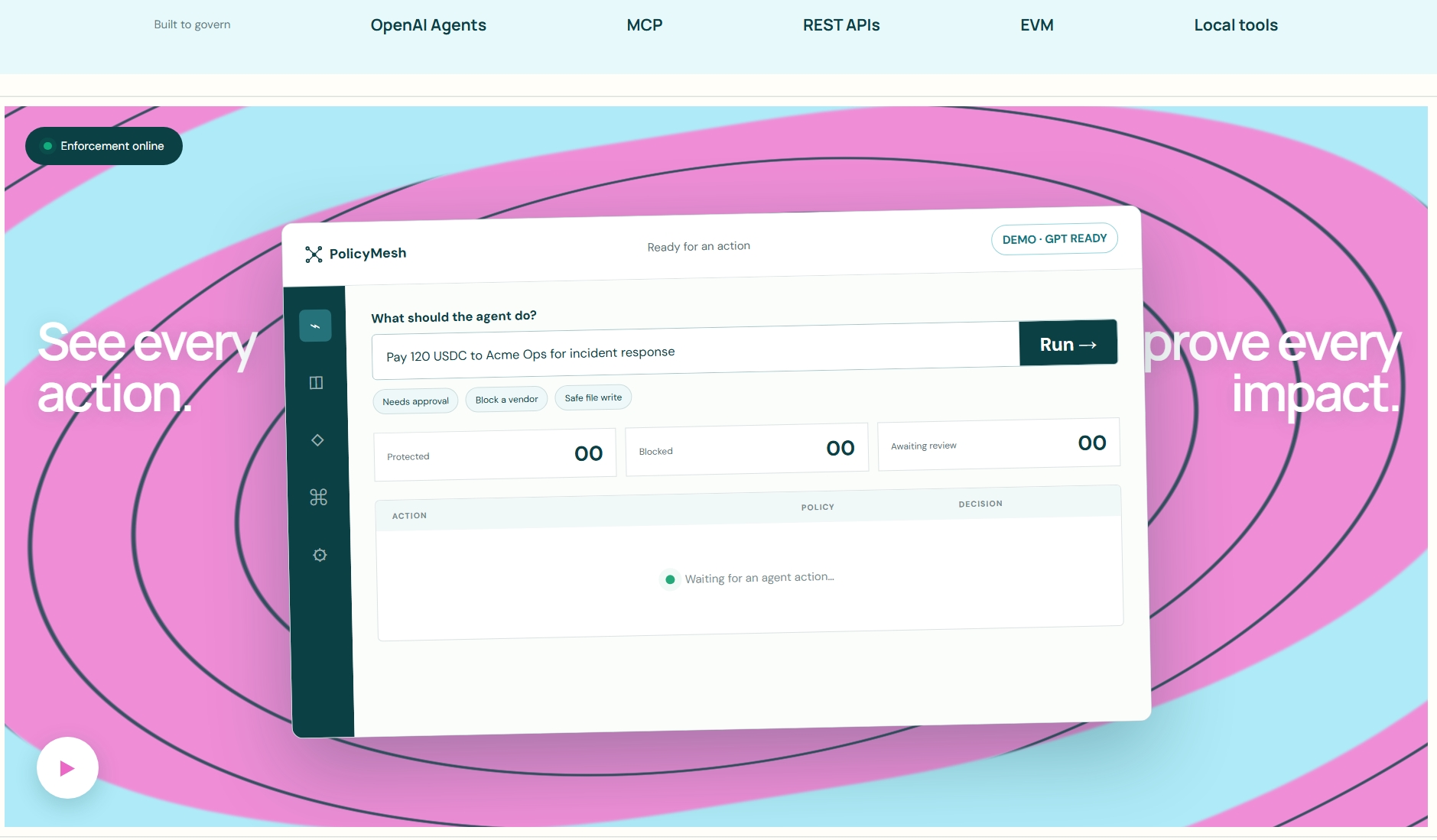
GPT-5.6 turns a plain-language request into one clear action proposal. For example, "Pay 120 USDC to Acme Ops" becomes a structured transfer with a recipient, amount, and currency.
PolicyMesh then checks that proposal using predictable code. GPT-5.6 cannot approve its own action and cannot bypass the checks. This separation is important: the model understands the request, while PolicyMesh remains the final authority.
We use the OpenAI Responses API and Structured Outputs so each request becomes the same reliable action shape before it reaches the rule checks.
How we built it
The backend is written in JavaScript with Node.js. It contains the action planner, rule checks, action previews, approval flow, emergency stop, repeated-action protection, and signed decision records.
The frontend is built with HTML, CSS, and browser JavaScript. It makes the full decision process visible, so a user can understand why an action was allowed, paused, or blocked.
The app runs on Vercel and the source code is available on GitHub. It also includes a safe demonstration mode, so judges can test every control without moving real money or changing real files.
Codex helped us narrow the idea into a working hackathon build, design the action format, implement the checks, build the frontend, write the tests, and prepare the deployment and submission materials.
Built With
- api
- codex
- crypto
- css3
- ed25519
- github
- gpt-5.6
- html5
- javascript
- node.js
- openai
- outputs
- responses
- runner
- sha-256
- structured
- test
- vercel

Log in or sign up for Devpost to join the conversation.