One-line Summary
A citation-first assistant that helps students and families understand public school policies in plain English without inventing unsupported answers.
Problem
School policies often contain the answer a student needs, but the wording can be dense, scattered, or difficult to interpret quickly. A generic chatbot may produce a fluent answer without showing whether the policy actually supports it. Students and families need a clearer path from a question to the exact passage that answers it—and a trustworthy way to hear “this document does not say.”
Solution
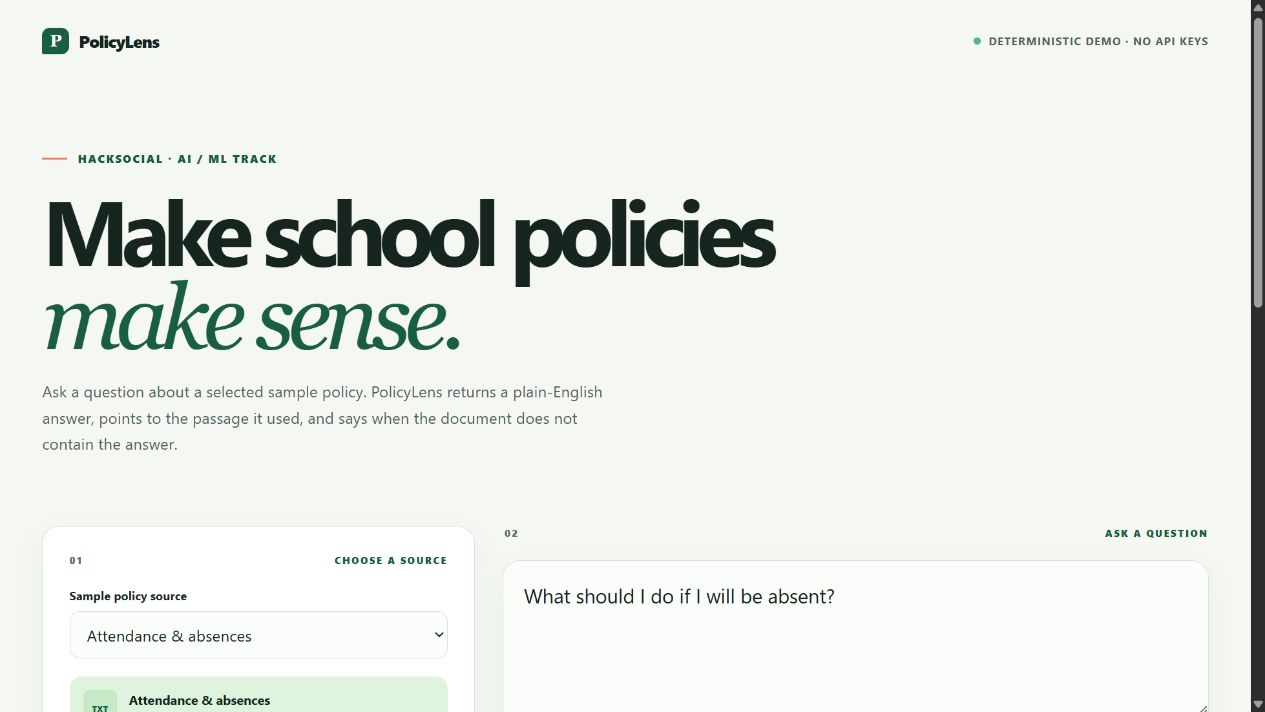
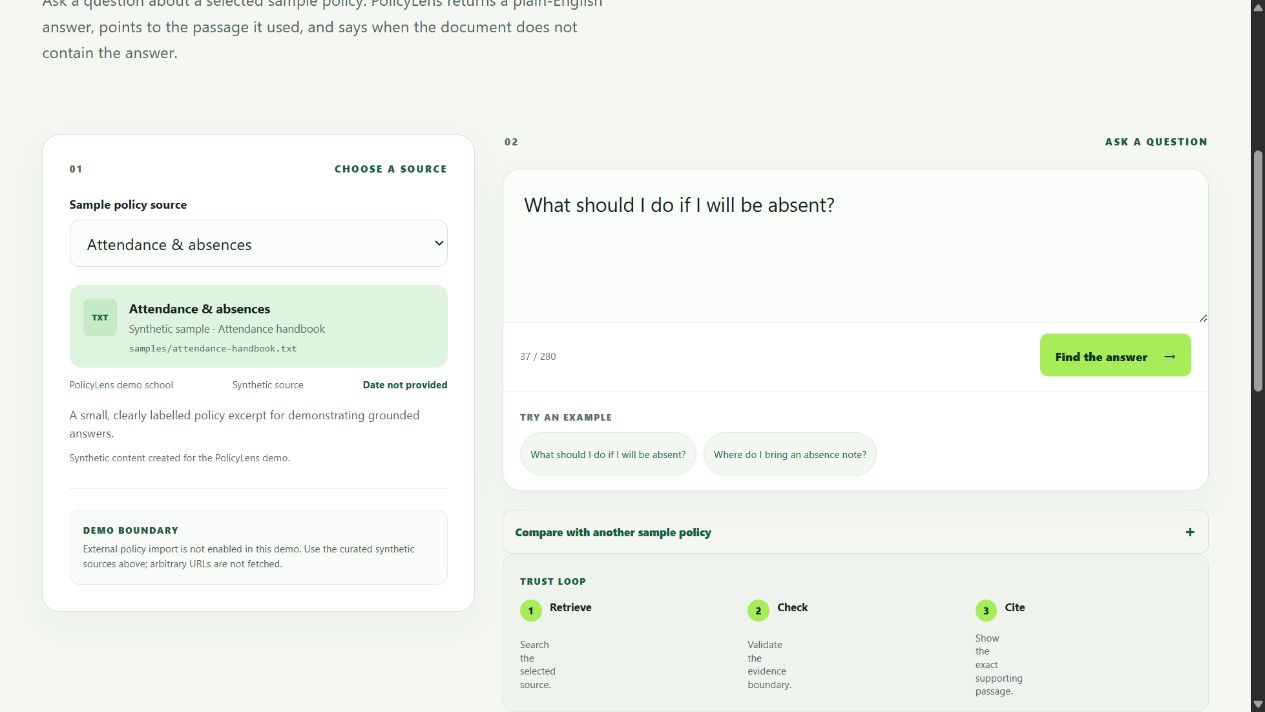
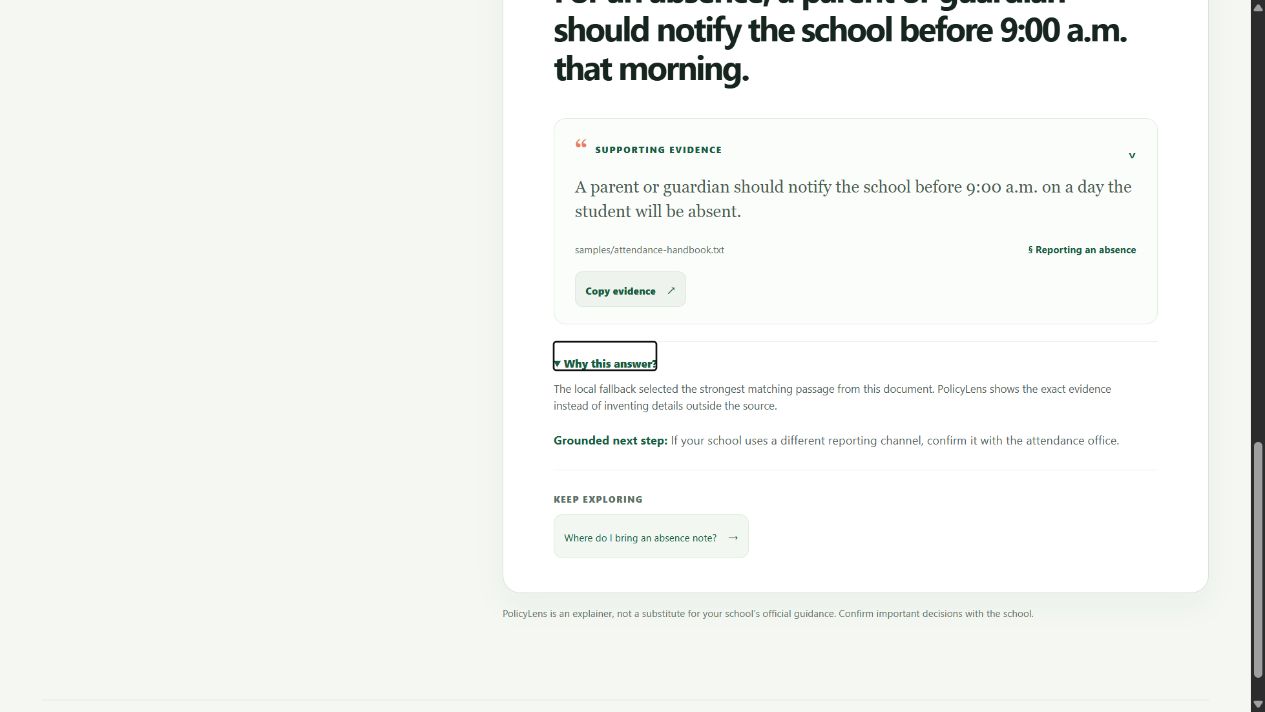
PolicyLens lets a user choose a clearly labelled policy source, ask a natural-language question, and receive a plain-English explanation grounded in retrieved evidence. The interface shows the answer status, evidence strength, source, section, exact supporting passage, and a grounded next step. When evidence is missing or ambiguous, PolicyLens abstains or asks for review instead of silently guessing.
The default demo is deterministic and runs locally without credentials. An optional server-side provider adapter can generate a constrained explanation from the user question and retrieved evidence, then validates the result against the same answer contract and falls back locally when the provider is unavailable or unsupported.
Why This Matters
Students and families should not need specialist policy knowledge to understand everyday rules about attendance, devices, accessibility, and support. PolicyLens makes the evidence boundary visible: the source passage remains separate from the generated explanation, and the product treats an unsupported answer as a reason to stop rather than an invitation to hallucinate.
How We Used AI
The product is designed around a retrieval-augmented explanation boundary: retrieve relevant source passages first, then optionally ask a provider for a short explanation using only those passages. The provider prompt treats policy text as untrusted data, requires exact evidence citations, requires explicit not-found behavior when evidence is insufficient, and asks for uncertainty language for partial evidence. Provider output is validated against a stable answer contract. Uncited, malformed, or unsupported output is rejected; bounded retries are limited to safe transient failures. No provider credentials are committed or sent to the browser. The current default demo uses deterministic local fallback answers so it remains reproducible without an API key.
No specific hosted model or provider is claimed because none is configured in the repository.
How We Used Codex
Codex helped inspect the existing React/Vite MVP, turn the product promise into a tested retrieval and answer contract, add reproducible policy ingestion and evaluation cases, build the local server-side answer boundary, add provider-safe fallback handling, harden production static serving, and iterate on the trust-focused UI. The canonical release is on the repository’s main branch. The prize-max slice contains five release commits after the reviewed hardening base and was promoted into main as one squashed release checkpoint.
What We Learned
The most useful trust feature was not a more elaborate answer—it was making the evidence boundary visible and treating unsupported or ambiguous questions as valid product outcomes. We also learned that a deterministic local fallback makes the demo reproducible while preserving a clear path to optional provider-generated explanations behind server-side validation.
Key Features
Three clearly labelled synthetic policy sources covering attendance, personal devices, and accessibility support. Query normalization and deterministic top-three retrieval with minimum evidence thresholds. Found, not-found, needs-review, and error states instead of fabricated answers. Exact evidence quotes with source and section metadata. Optional same-question comparison across two sample policies, keeping each result tied to its own source. Copy-evidence action that keeps the quote, source, and section together for sharing. Grounded follow-up questions that clear stale evidence before starting the next search. Evidence-strength label, grounded next step, disclaimer, and a “Why this answer?” explanation. Server-side request validation, response-contract validation, request-size limits, rate limiting, and optional provider fallback. Reproducible ingestion validation and a 25-case local evaluation suite. Single-origin production serving through npm start, with path-safe static assets and security headers.
Architecture
The project uses a React/Vite frontend and a small Node HTTP server so the default demo stays dependency-light and the optional provider credential never reaches the browser.
src/data/policies.js contains the synthetic source documents and their section metadata. scripts/ingest-policies.mjs validates the source model and writes the reviewable normalized corpus in data/processed/policies.json. src/lib/retrieval.js normalizes the question, ranks candidate passages, and returns bounded evidence or an abstention state. server/answer-service.mjs validates the request and creates the stable answer contract. server/provider.mjs is an optional server-side explanation adapter. It receives only the question and retrieved evidence, validates citations, and falls back to the deterministic answer path. The React UI renders the validated contract and keeps source text separate from the explanation layer.
Testing Instructions
From the repository root: npm install npm run verify npm run dev
For a production-style local demo: npm run build npm start
Then open the local address printed by the server. Try an attendance question such as “What should I do if I will be absent?”, use the optional comparison control to compare the same question with “Personal devices,” and try an unsupported question such as “What is the school lunch menu?”. Inspect the status, exact evidence, source section, comparison status, and “Why this answer?” panel.
Measured local verification passes data validation, the production build, 53 automated tests, and all 25 evaluation cases. The evaluation reports hit@3 of 15/15, found-answer citation support of 15/15, malformed-response rejection of 3/3, and complete coverage for the recorded direct, paraphrased, unsupported, and adversarial case groups.
Demo
Live demo: https://hacksocial-policylens.onrender.com Repository: https://github.com/icecold009/hacksocial-policylens Canonical branch: main Main release checkpoint: 876cdcd621ee25e4eb23650313df30e04c2b02e3 Deployed application commit: 71ace683e292a5f8edd00635e52e8e5c793429ea
Known Limitations
The included policy sources are synthetic demo fixtures, not official school policies. External URL ingestion is intentionally not implemented; arbitrary documents are not fetched by the demo. Semantic embeddings and reranking are not implemented; retrieval is deterministic lexical matching. No live provider configuration or peer usability study is claimed. Hosted desktop/fresh-tab flows are verified; incognito/private-browser, complete keyboard-only, and peer usability checks are not claimed yet. The free Render service may cold-start after inactivity; hosted latency has not been benchmarked. PolicyLens is an explainer, not official school, legal, or medical guidance. Important decisions should be confirmed with the relevant school or support team.
Built With
- artificial-intelligence
- javascript
- node.js
- react
- retrieval-augmented-generation
- vite