-
-
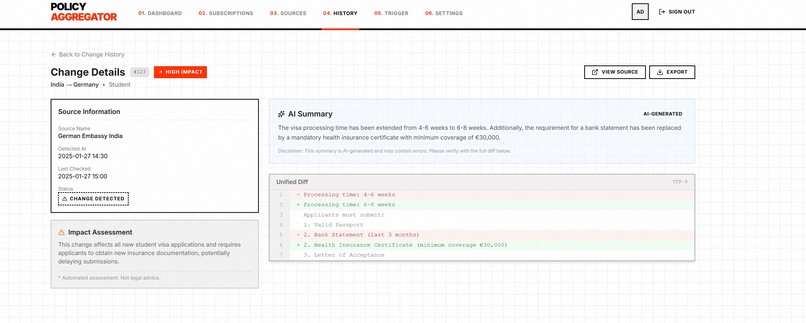
Difference evaluator for changed policies assisted by AI
-
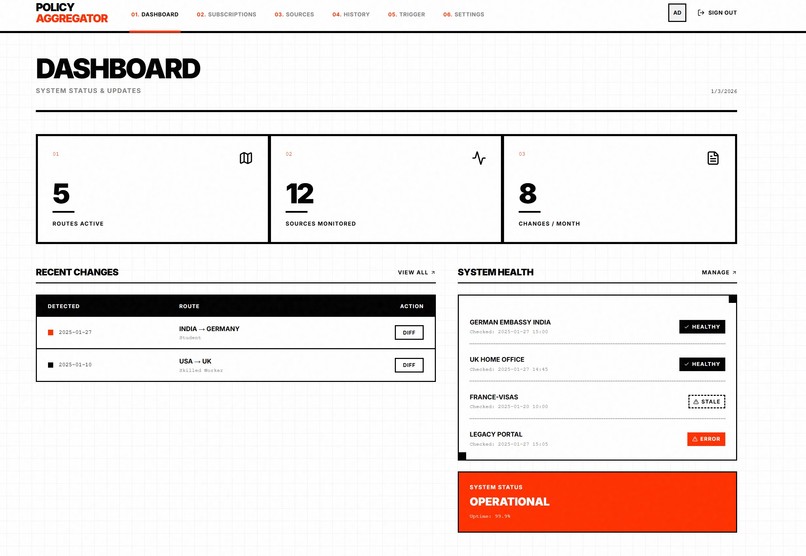
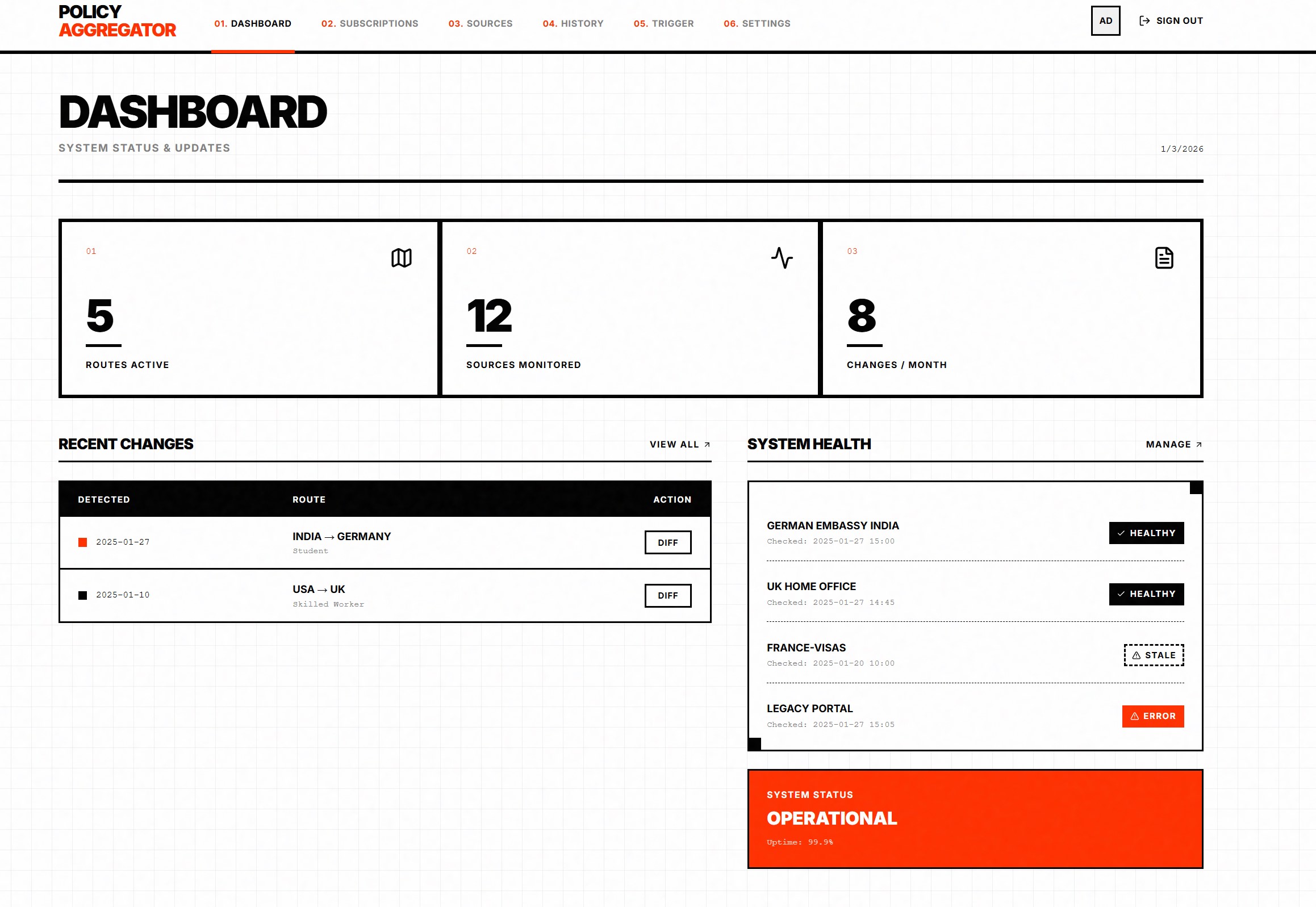
Dashboard
-
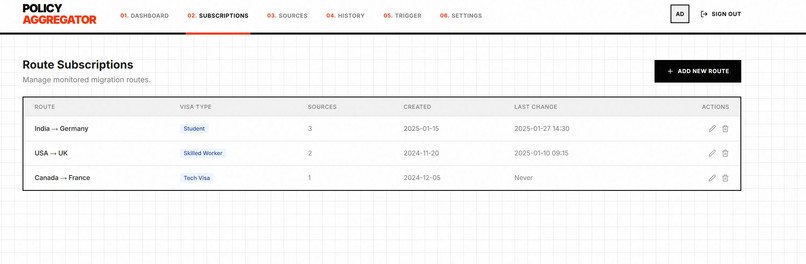
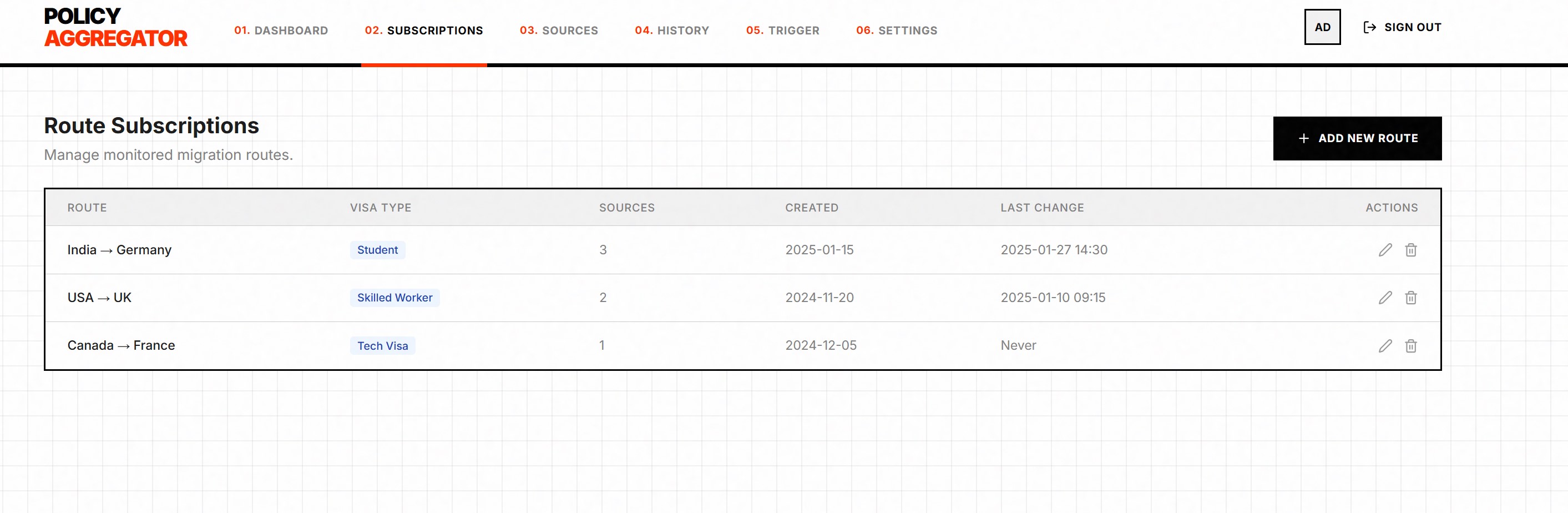
Routes to monitor
-
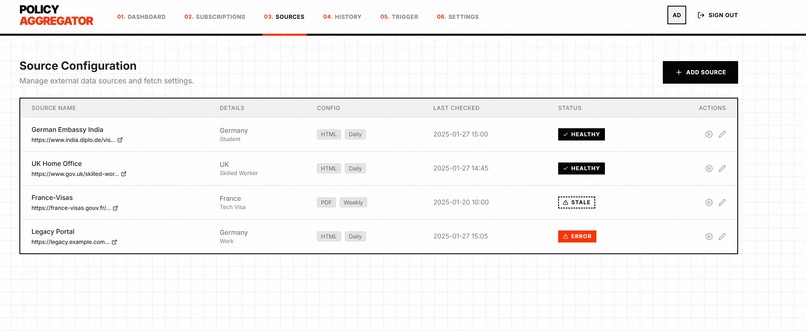
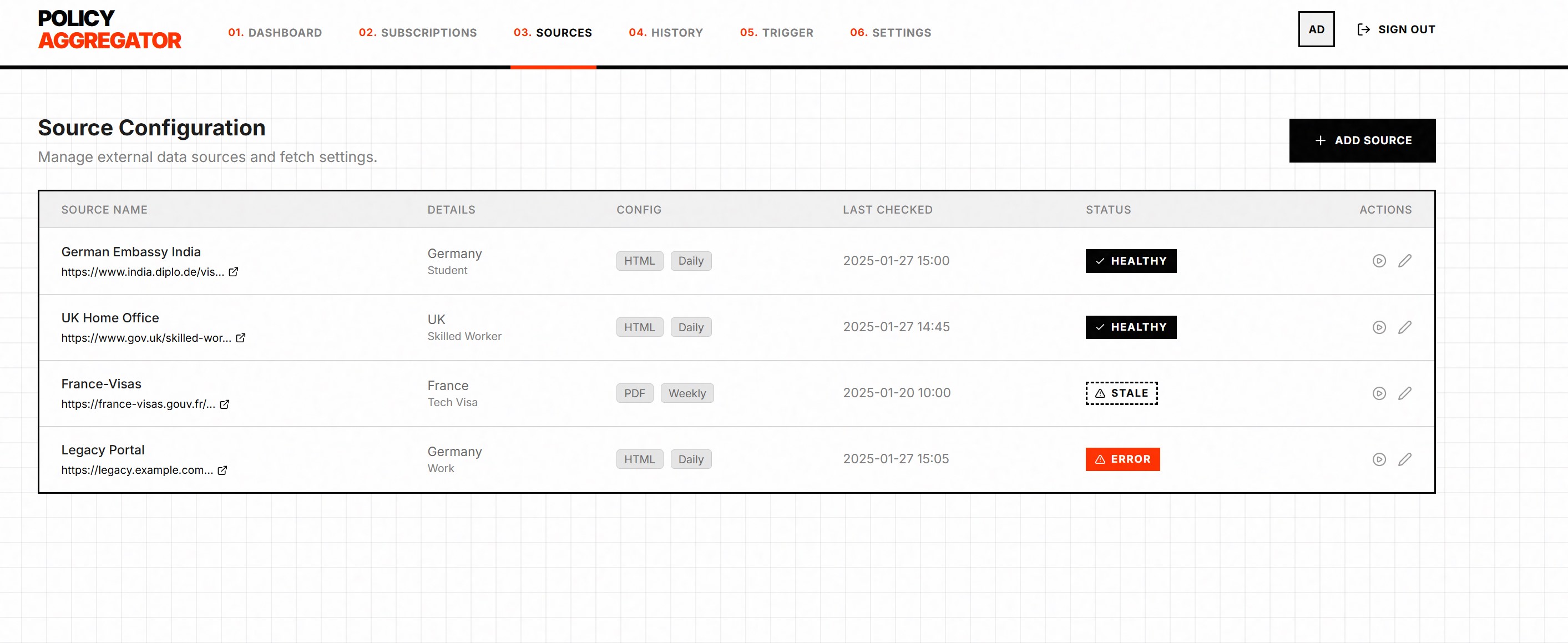
Sources to monitor for these routes
Inspiration
PolicyAggregator was inspired by a very specific and repeatable failure pattern in immigration work:
policy changes are discovered too late, and the consultant always takes the blame.
In immigration consultancies and global mobility teams, being “generally up to date” is not enough. When a rejection or RFE happens, the question is never whether the policy was unclear, but why it wasn’t caught in time. Teams had no defensible answer. There was no proof of monitoring, no audit trail, and no way to demonstrate diligence.
The insight was simple but non-obvious:
the real problem is not missing information, it’s missing evidence of vigilance.
What it does
PolicyAggregator is a route-scoped regulatory change monitoring system.
It continuously monitors official government sources for specific immigration routes (starting with India → Germany, Student and Work visas) and:
- Detects policy changes automatically
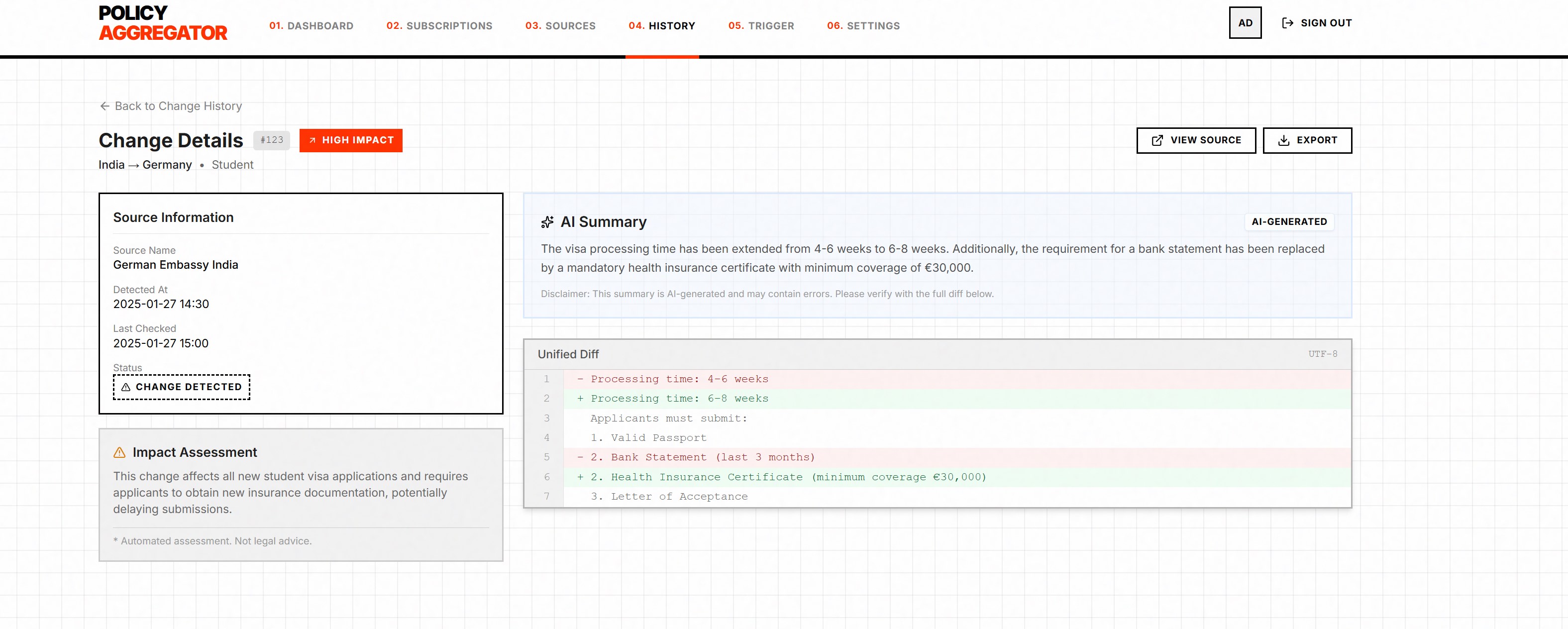
- Generates diffs showing exactly what changed
- Preserves source attribution and timestamps
- Sends proactive alerts when changes occur
The output is not just a notification, but proof that monitoring was happening before and when the change occurred.
This is intentionally positioned as risk mitigation, not productivity software.
How we built it
The system was designed to be lean, auditable, and solo-founder friendly.
Key components include:
- Source monitoring of government websites, PDFs, circulars, and FAQs
- Normalization and versioning to make policy text comparable over time
- Automated diff generation to surface meaningful changes
- Evidence storage with source URLs, timestamps, and content hashes
- Email alerts that include both the change and its provenance
Each policy snapshot is stored as a verifiable state:
[ P_t = { S, T, H(P), \Delta(P_{t-1}, P_t) } ]
This allows every alert to be backed by evidence, not trust.
The MVP runs on minimal infrastructure, keeping costs low while maintaining reliability.
Challenges we ran into
Quiet changes
Many policy updates happen silently, without announcements. Detecting meaningful changes without creating noise required careful diffing and filtering.
Inconsistent sources
Policies appear in different formats and locations. Normalizing PDFs, HTML pages, and circulars into a single comparison pipeline was non-trivial.
Alert fatigue risk
Over-alerting would destroy trust. The system had to prioritize signal over completeness.
Trust without a brand
As a new product, credibility had to be earned through transparency and evidence, not claims or marketing language.
Accomplishments that we're proud of
- Built a working, end-to-end system in weeks, not months
- Achieved route-scoped monitoring with real diffs and timestamps
- Designed a product that produces defensible artifacts, not just notifications
- Positioned the product clearly as risk coverage, avoiding feature creep
Most importantly, the system already answers the hardest client question:
“How do you know this changed after we filed?”
What we learned
- In B2B, risk avoidance beats efficiency gains
- Narrow scope increases trust and accountability
- Proof is more valuable than prediction
- Time-bound pilots convert faster than open-ended subscriptions
- A product that reduces blame has intrinsic value
What's next for PolicyAggregator
Short-term priorities:
- Convert early pilots into paying customers
- Expand coverage within the same route (additional authorities and sub-pages)
- Improve change classification to reduce false positives
Medium-term:
- Add more high-risk routes
- Introduce downloadable audit reports for internal reviews
- Integrate with case management workflows without becoming one
Long-term:
PolicyAggregator aims to become the default evidence layer for regulatory monitoring, where teams can confidently say:
“We were monitoring. Here is the proof.”
Built With
- openrouter
- postgresql
- python
- react

Log in or sign up for Devpost to join the conversation.