-
-
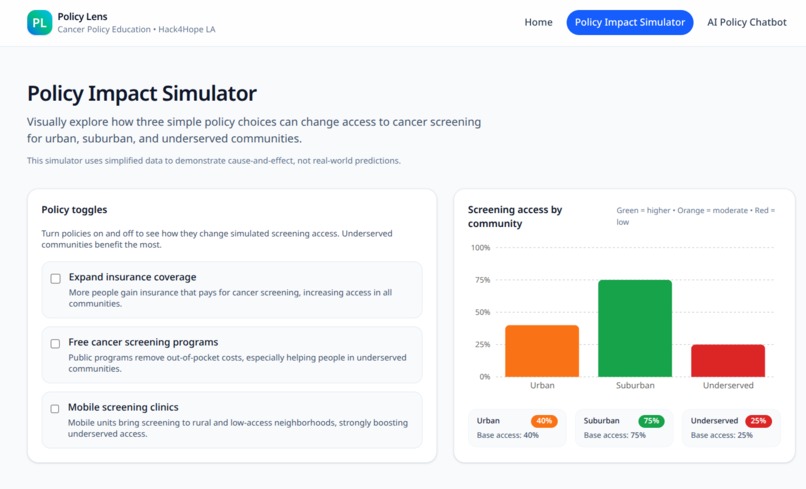
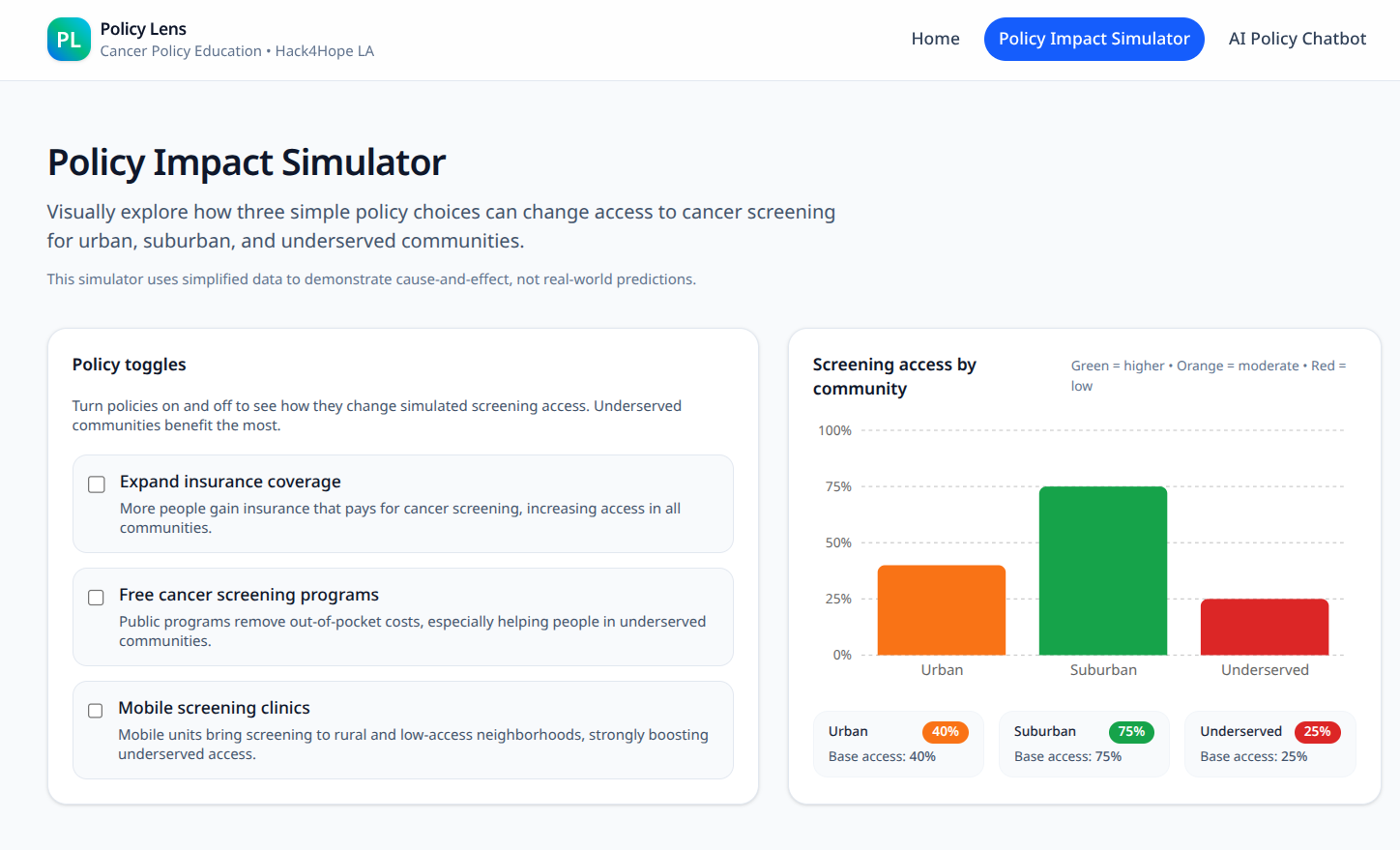
Policy Simulator
-
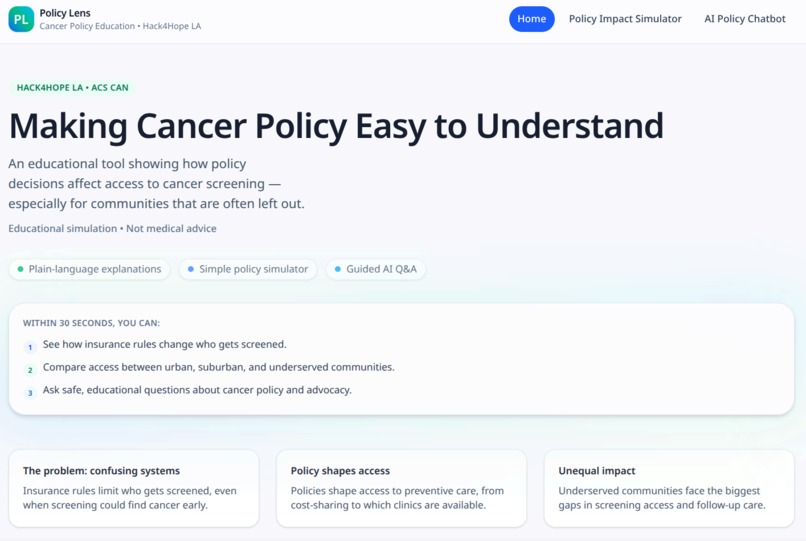
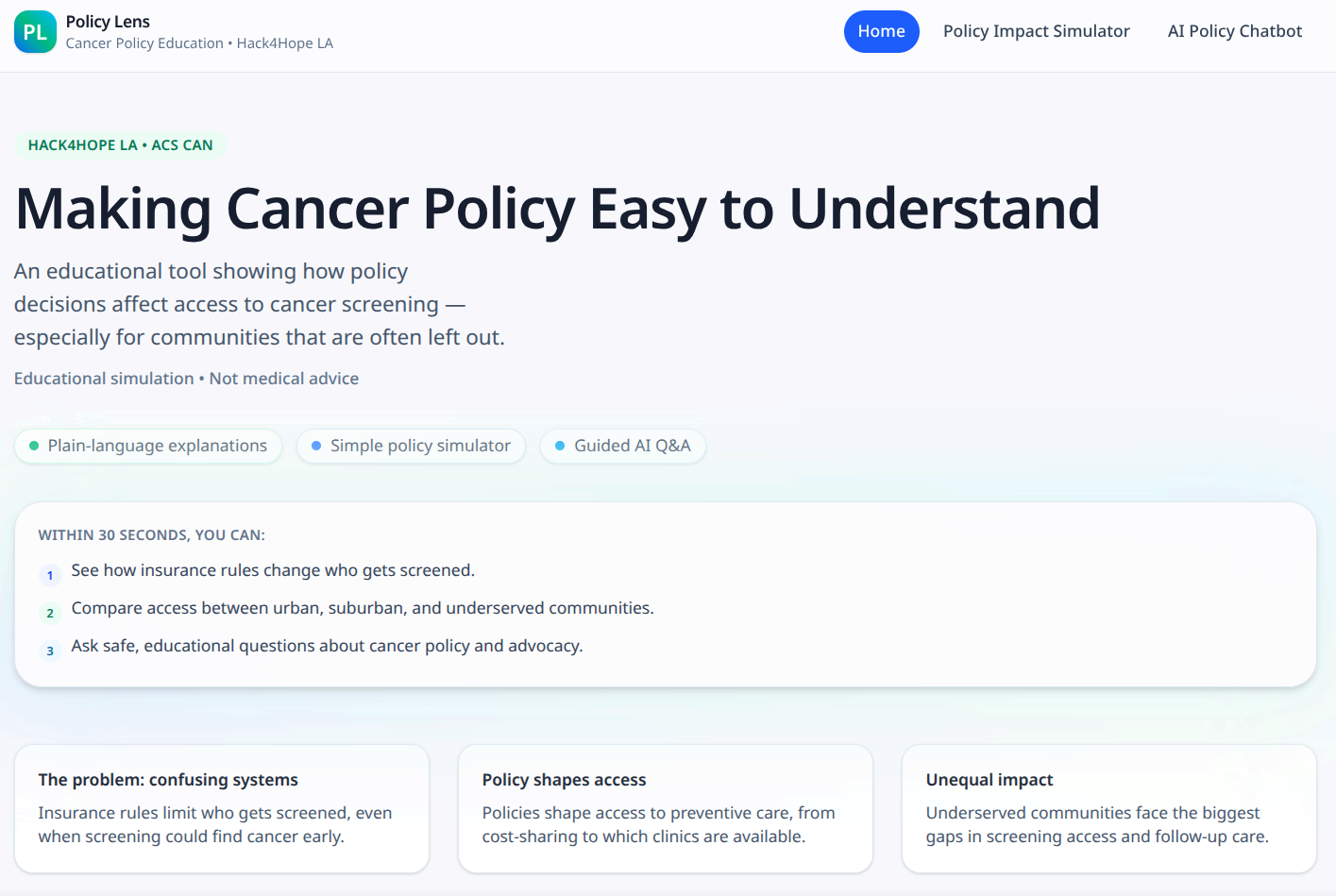
Home Page
-
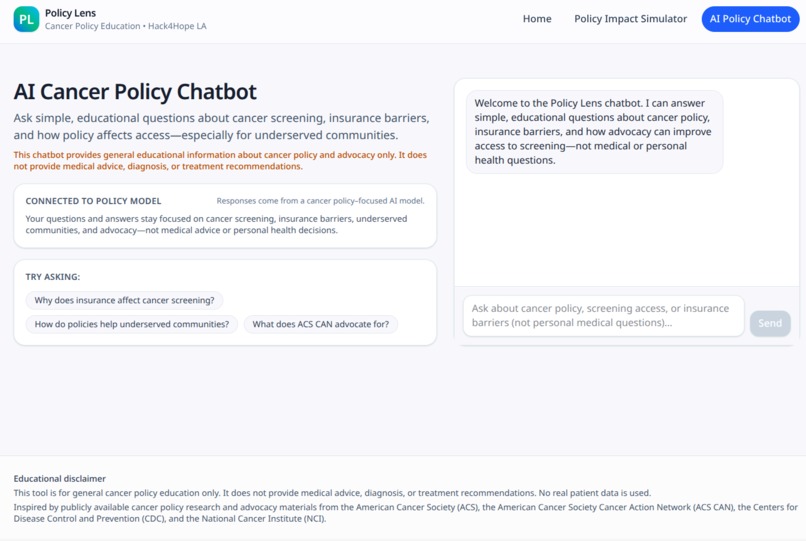
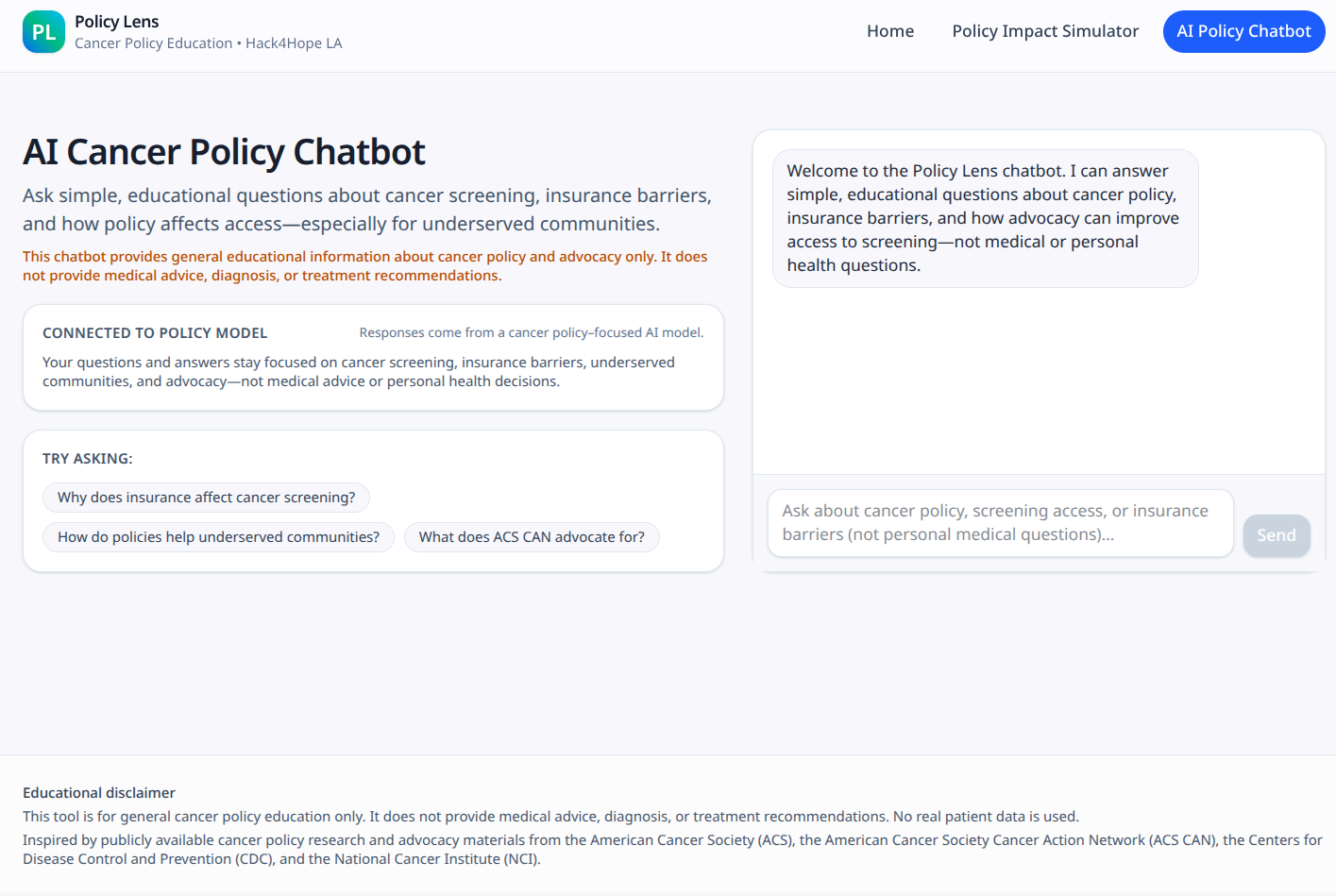
Policy Chatbot
Project Overview
I built PolicyLens, an educational web application that helps people understand how cancer policies affect access to cancer screening.
The main problem I addressed is that cancer policy is complex and difficult for non-experts to understand, even though it strongly affects real outcomes like early detection and access to care.
I built this project using React for the frontend, Tailwind CSS for clean and accessible design, and Recharts for simple data visualization. I also integrated an AI-powered chatbot using a large language model API to answer policy-related questions in plain language.
When creating this solution, I took conceptual guidance from publicly available information and advocacy work by:
- American Cancer Society (ACS)
- American Cancer Society Cancer Action Network (ACS CAN)
- Centers for Disease Control and Prevention (CDC)
- National Cancer Institute (NCI)
All data shown in the app is simplified and educational, not real patient or clinical data.
Purpose
In the context of cancer, many people struggle not because of a lack of medical treatment, but because they do not understand how insurance rules, screening programs, and policy decisions affect their access to care. This confusion is especially harmful for underserved communities.
My motivation for this project was to create a tool that explains cancer policy in a way that is quick, visual, and easy to understand for first-time users.
I believe this project matters because awareness is the first step toward advocacy and better decision-making. When people understand how systems work, they are more likely to ask questions, seek screening, and support positive change.
In the future, this project could be expanded to include localized policy education, multilingual support, and collaboration with advocacy organizations. Even in its current form, PolicyLens helps users understand systems that shape cancer outcomes and encourages informed discussion rather than confusion.
How It Works
A user can interact with PolicyLens in three simple ways:
1. Learn the basics
The landing page explains:
- What cancer policy is
- Why it matters
- Who it affects
All content is written in clear language with minimal text so users can understand the topic in under a minute.
2. Explore policy impact through a simulator
The policy impact simulator shows three community types:
- Urban
- Suburban
- Underserved
Users can toggle simple policy options such as:
- Expanding insurance coverage
- Offering free screening programs
- Using mobile screening clinics
The simulator updates screening access percentages to visually demonstrate how different policies can affect different communities.
The simulator uses illustrative, simulated values to show cause-and-effect relationships, not real-world predictions.
3. Ask questions using the AI chatbot
Users can ask educational questions such as:
- Why does insurance affect cancer screening?
- How do policies help underserved communities?
The chatbot responds using preloaded policy context and:
- Does not give medical advice
- Does not provide diagnosis
- Focuses only on education and awareness
Inspiration
Cancer is not only a medical problem. Many outcomes depend on policies like insurance coverage, screening programs, and access to care.
These policies are difficult to understand for most people, especially students and community members. The inspiration for PolicyLens came from realizing that many people want to understand or help with cancer issues but do not know how policy affects real lives.
I wanted to create something simple, visual, and approachable that explains cancer policy in plain language.
What It Does
PolicyLens is an educational web app that helps users understand how cancer policies affect access to screening.
It includes:
- A simple landing page that explains cancer policy
- A policy impact simulator for different communities
- An AI chatbot that answers policy-related questions in easy language
The app is designed for first-time users and does not require any background knowledge.
How I Built It
I built PolicyLens as a frontend web application using React.
The UI was designed with a nonprofit and health-tech style to keep it calm, readable, and accessible.
The simulator uses simplified educational values to demonstrate policy impact.
The chatbot uses an AI model through an API and is restricted to policy education only.
All development was done during the hackathon, and the project is demo-ready.
Challenges I Ran Into
The biggest challenge was simplifying complex cancer policy concepts without making them confusing or misleading.
I had to carefully decide:
- What information to include
- What to leave out
- How to keep the app understandable without oversimplifying
Another challenge was designing the UI so users could understand everything quickly without instructions. I focused heavily on clarity and user experience.
Accomplishments That I’m Proud Of
- The app explains cancer policy in under 30 seconds for a first-time user
- The simulator clearly shows how policies affect different communities
- The chatbot provides safe, educational answers
- The project feels like a real advocacy tool, not just a technical demo
What I Learned
I learned that simple design and clear language are more powerful than complex features.
I also learned how strongly policy decisions influence health outcomes, especially for underserved communities. This project helped me understand how technology can support education and advocacy, not just technical solutions.
Github Repo
Built With
- html
- javascript
- openrouterapi
- react
- tailwind

Log in or sign up for Devpost to join the conversation.