-
-
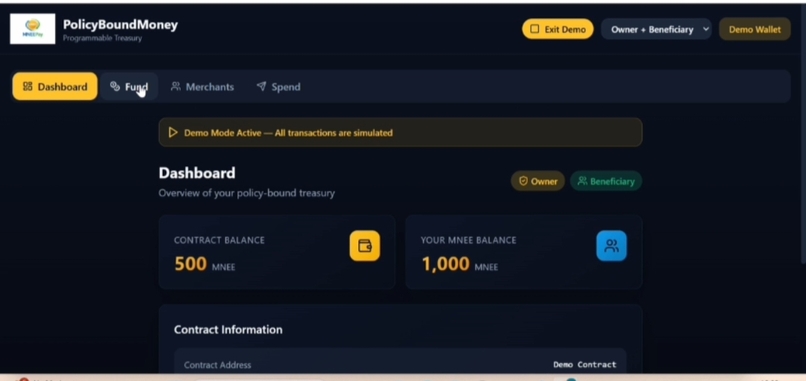
programmable treasury
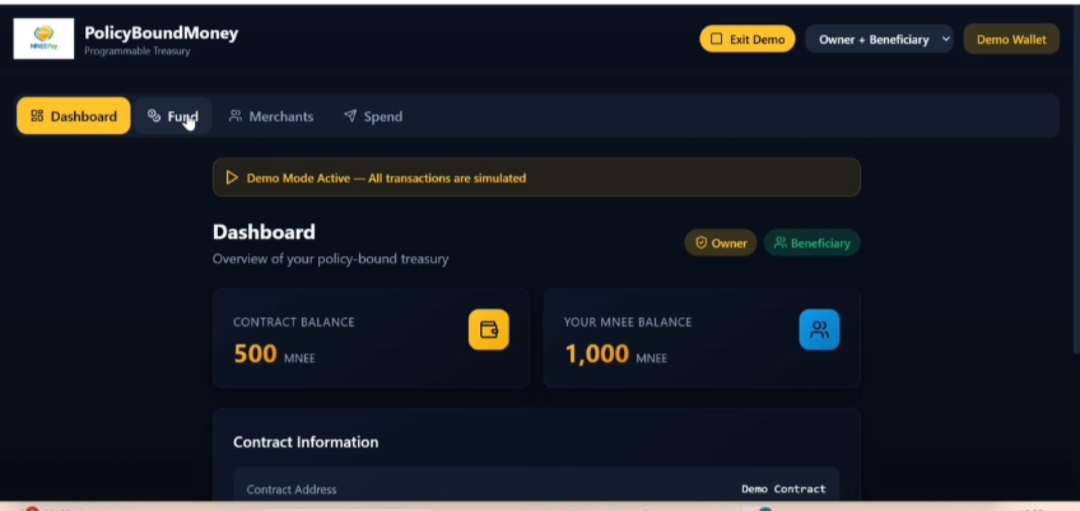
About the Project — MNEEPay 💡 Inspiration
While exploring programmable money and stablecoins, we noticed a real-world gap:
Money is digital, but spending rules are still manual.
Businesses, DAOs, creators, and even individuals often need control over how funds are spent, not just who holds them. Existing wallets allow transfers, but they do not enforce policies such as:
“This money can only be spent with approved vendors”
“Funds should be used only for specific purposes”
“Spending must be transparent and verifiable”
The MNEE stablecoin, being USD-backed and deployed on Ethereum, provided the perfect foundation to experiment with policy-driven programmable money. This inspired us to build MNEEPay — a simple but powerful system where rules live on-chain and money obeys them automatically.
📚 What We Learned
During the development of MNEEPay, we learned:
How ERC-20 stablecoins (MNEE) can be integrated directly into smart contracts
How to design policy-enforced financial logic using Solidity
Best practices for secure fund handling and role-based access control
How to build end-to-end Web3 systems: smart contract → deployment → frontend interaction
The importance of keeping systems minimal but impactful in hackathons
We also gained deeper insight into how programmable money can act as financial infrastructure, not just a payment tool.
🏗️ How We Built It
MNEEPay was built as a full-stack Web3 application with a strong focus on clarity and reliability.
- Smart Contract Layer
Written in Solidity 0.8.20
Uses the official MNEE ERC-20 contract
Core contract: PolicyBoundMoney.sol
Enforces spending rules directly on-chain
Key logic:
Funds are deposited in MNEE
Only approved merchants can receive payments
Beneficiaries cannot bypass rules
Every action emits on-chain events for transparency
Mathematically, spending is constrained as:
AllowedSpend ( 𝑢 , 𝑚 , 𝑎
)
{ true ,
if 𝑚 ∈ AllowedMerchants ∧ 𝑎 ≤ Balance
false ,
otherwise AllowedSpend(u,m,a)={ true, false,
if m∈AllowedMerchants∧a≤Balance otherwise
This ensures deterministic and trustless enforcement.
- Backend & Deployment
Hardhat for compilation and deployment
Environment variables managed via .env
Deployed on Ethereum Sepolia testnet
Fully verifiable on Etherscan
- Frontend (Demo Interface)
Built with React.js + ethers.js v6
Simple UI to:
Fund the contract
Approve merchants
Execute spending
View remaining balance
Designed specifically for live demo recording
🚧 Challenges We Faced
Network & tooling compatibility Managing Hardhat, ethers v6, and testnet RPCs required careful configuration.
Token approval flow Ensuring correct ERC-20 approval before transfers was critical for smooth UX.
Balancing simplicity and power We intentionally avoided over-engineering while still delivering a real, usable financial primitive.
Each challenge reinforced the importance of clean design and strong fundamentals.
🌍 Why This Matters
MNEEPay demonstrates that:
Programmable money doesn’t need to be complex
Financial rules can be transparent, automated, and enforceable
Stablecoins like MNEE can power the next generation of:
Automated finance
Controlled treasuries
Trust-minimized commerce
This project aligns perfectly with the hackathon vision:
Stable, programmable, and accessible money for everyone.
🔮 What’s Next
Future extensions include:
AI agents spending MNEE within predefined policies
Multi-user treasuries with spending limits
Time-based or recurring programmable payments
Creator and DAO tooling built on top of MNEEPay

Log in or sign up for Devpost to join the conversation.