-
-
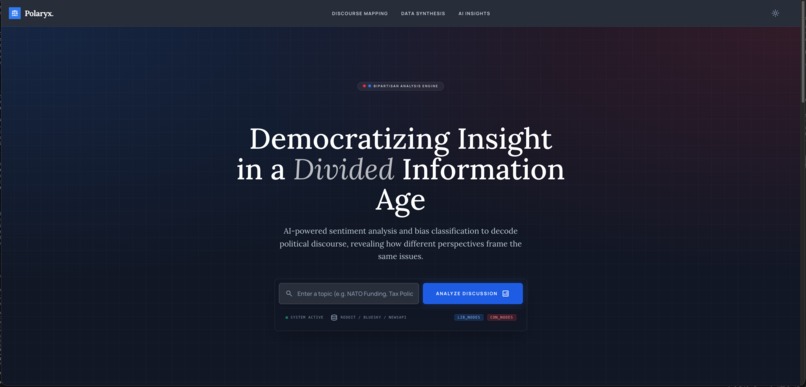
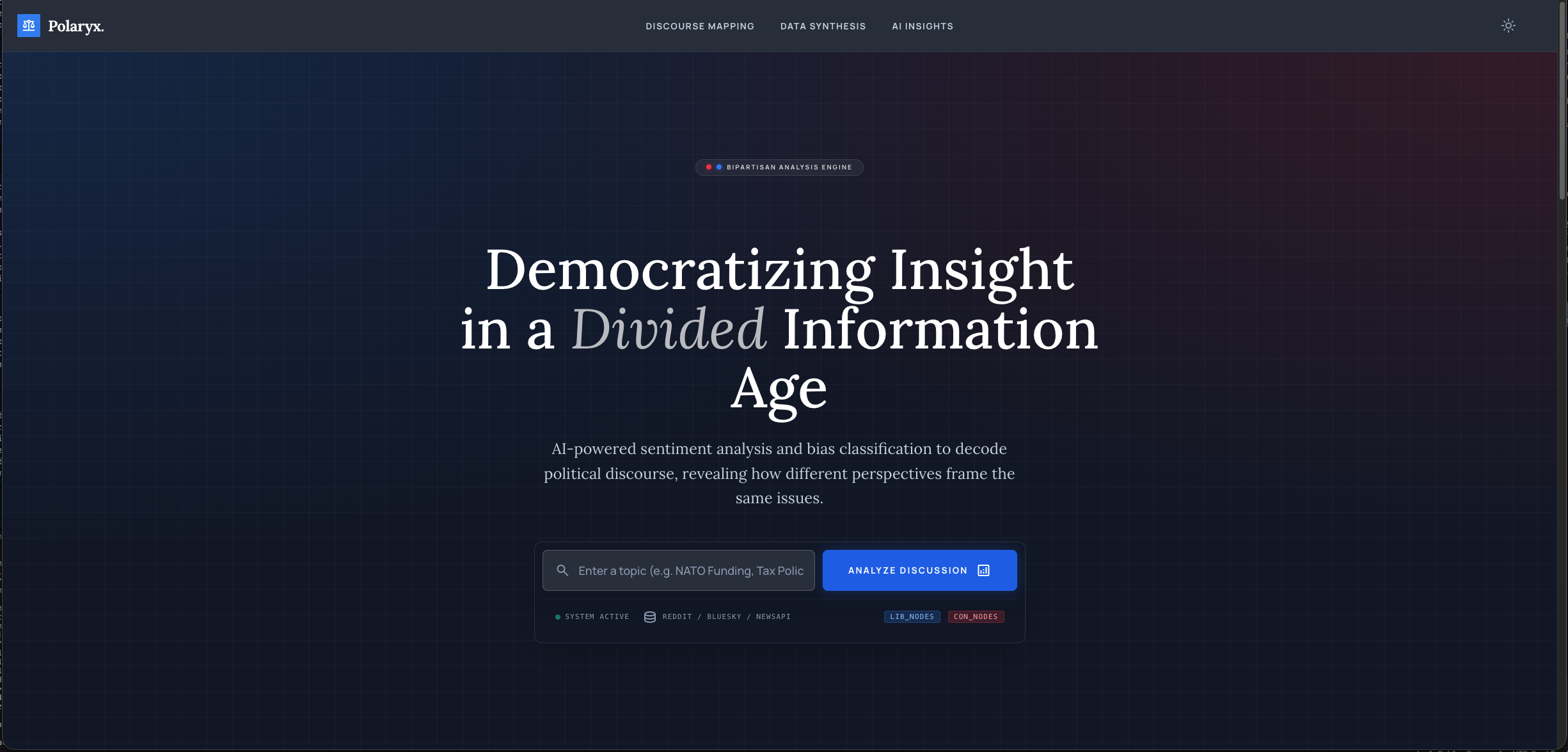
Landing Page
-
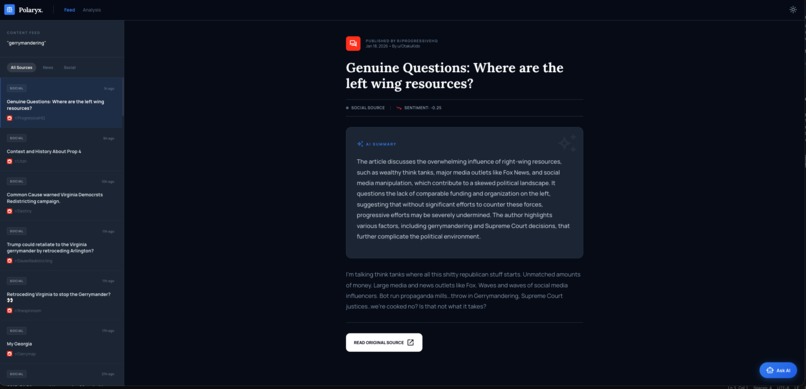
Deep look into articles and sources
-
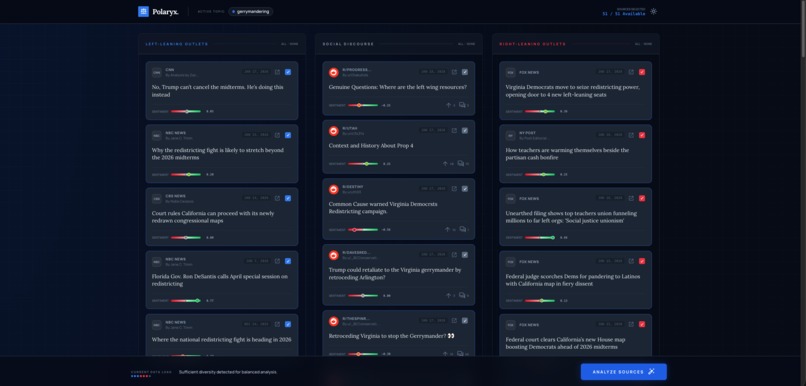
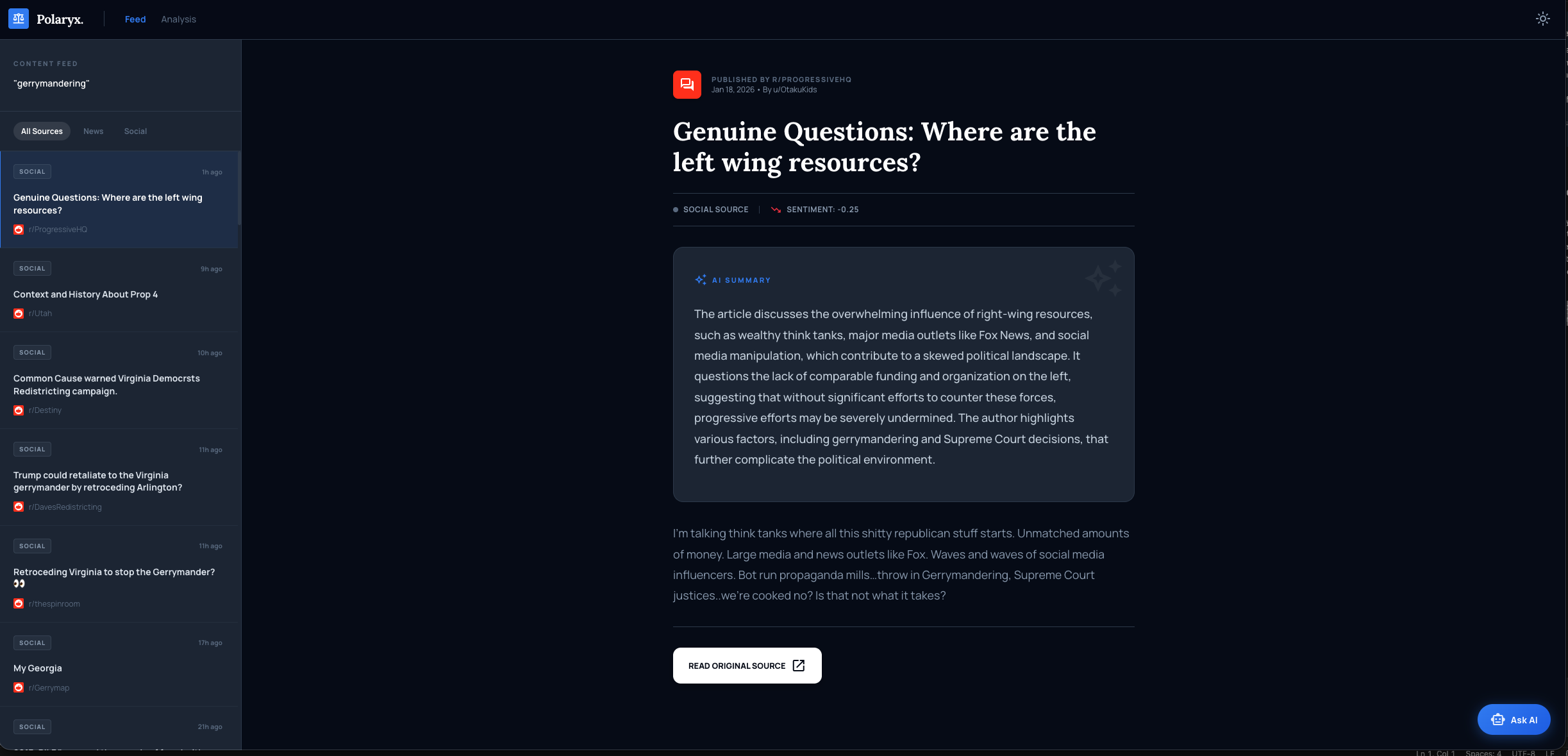
Preview of articles and discussion for user
-
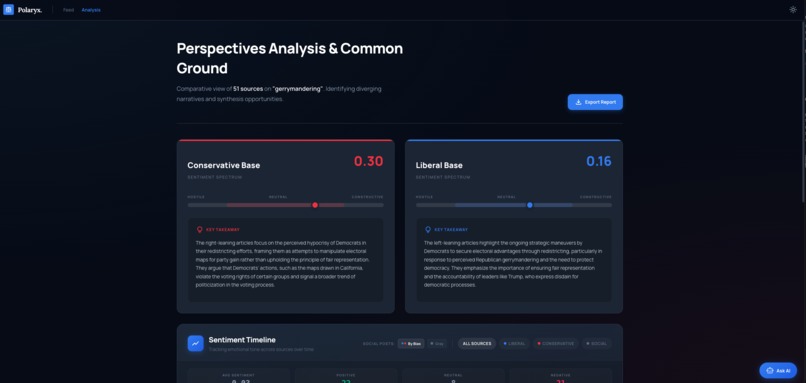
Overall political views
-
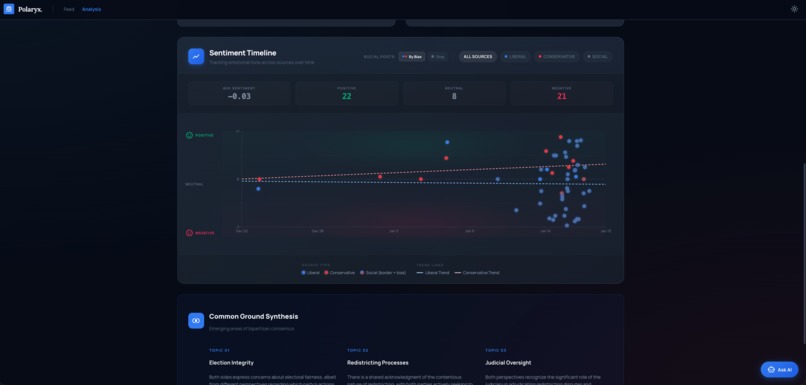
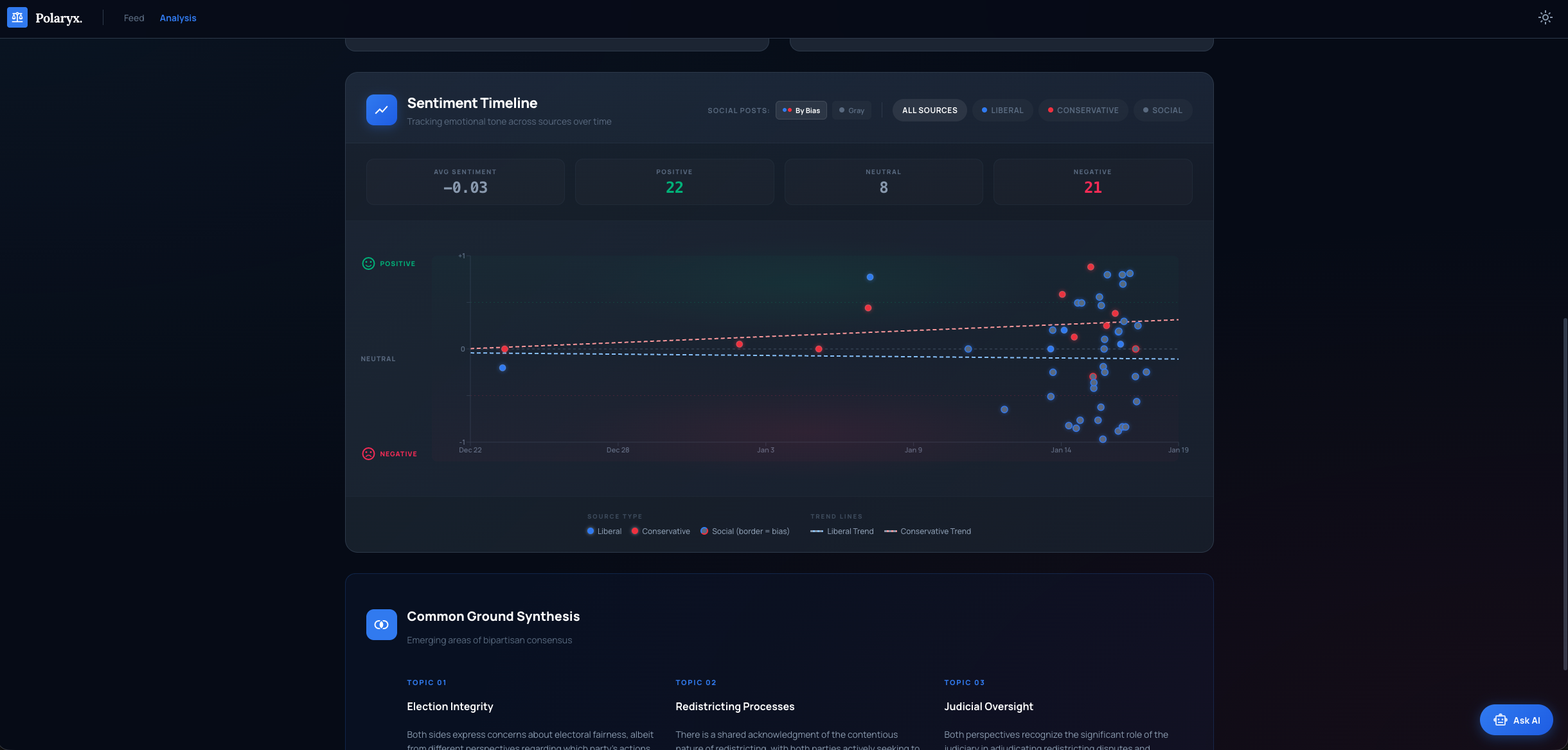
Sentiment Timeline

Inspiration
In a world where algorithms prioritize engagement over accuracy, misinformation has become a smog that obscures the truth and deepens societal divides. We realized that many people aren't choosing to be misinformed; they are trapped in echo chambers that feed them a singular, often distorted, viewpoint. This fragmentation leads to misguided decisions and a breakdown in civil discourse. Inspired by the urgent need for information equity, we set out to build a platform that cuts through the noise. By aggregating diverse news sources, analyzing sentiment, and transparently visualizing bias, we aim to empower users to see the full story, challenge their own perspectives, and navigate the complex media landscape with clarity and confidence.
What it does
Polaryx acts as a comprehensive media analysis tool designed to break down echo chambers. It aggregates real-time news articles from a wide range of outlets across the political spectrum, such as CNN, Fox News, and independent sources, and cross-references them with public discourse from social platforms like Reddit and Bluesky, leveraging AI to assign sentiment scores and detect bias in coverage. Polaryx further visualizes these disparities through an interactive dashboard featuring sentiment timelines and side-by-side narrative comparisons, allowing users to instantly see how the same event is being framed differently by various sources and helping them identify misinformation.
How we built it
We architected a robust full-stack solution to handle real-time data aggregation and analysis. The backend is built with Python and FastAPI, utilizing asynchronous programming to simultaneously scrape dozens of news sites and fetch social media discussions from Reddit and Bluesky without blocking. We employed Neon for persistent storage and integrated OpenAI and Google Gemini APIs to perform advanced sentiment analysis and bias detection on the collected text. On the frontend, we used React with TypeScript to create a responsive, type-safe interface and data visualization libraries like Recharts were implemented to render complex sentiment timelines and comparisons in an intuitive, easy-to-digest format.
Challenges we ran into
One significant hurdle was reliably obtaining data from a multitude of news outlets. Many modern sites use complex dynamic loading and anti-scraping measures, which required us to build custom scrapers using BeautifulSoup and rigorous error handling. While developing the sentiment analysis, we found that quantifying "bias" was inherently difficult as our initial sentiment models struggled to distinguish between strong opinion and objective reporting. We found that fine-tuning our prompts and combining results from multiple AI models helped us achieve a more balanced and accurate scoring system.
Accomplishments that we're proud of
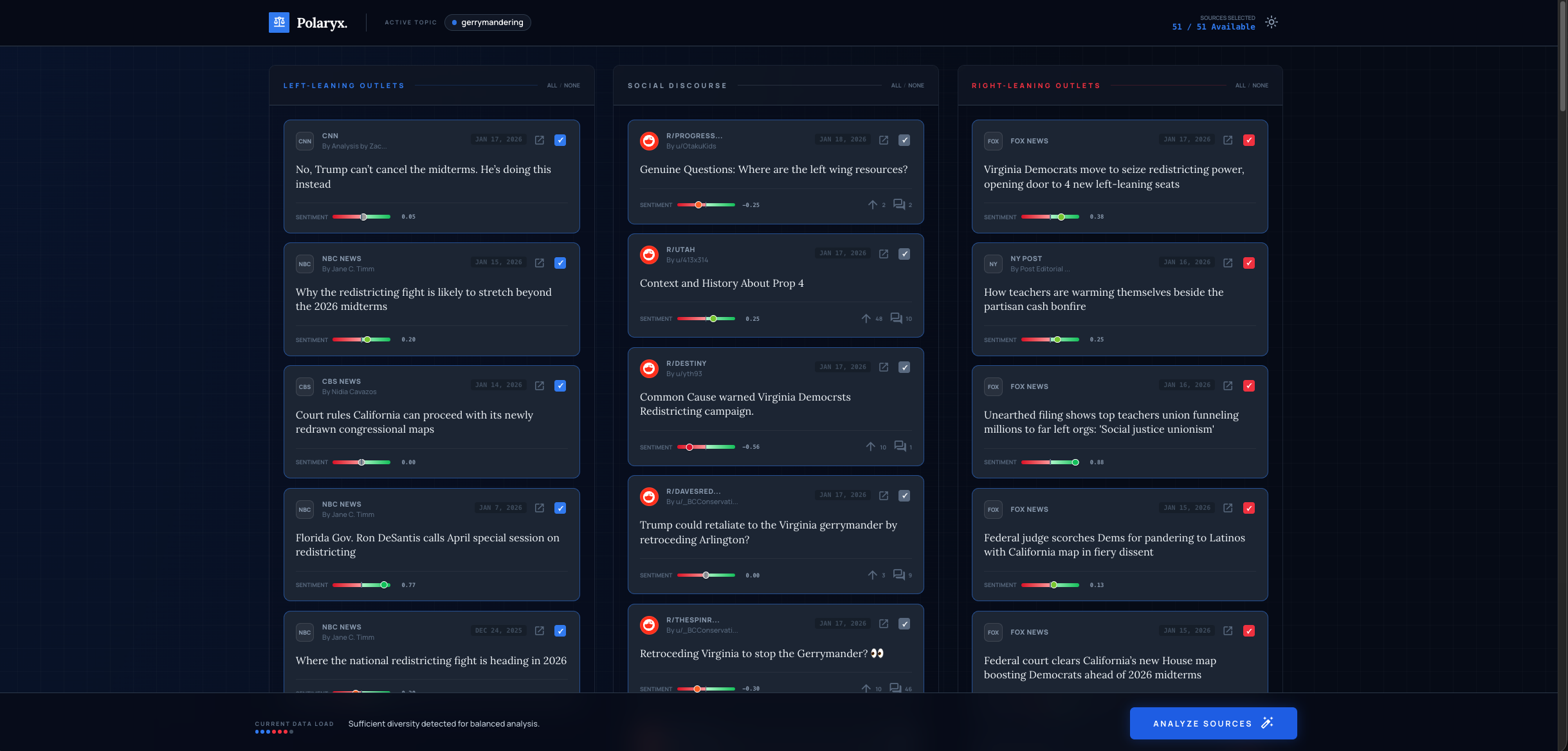
We are most proud of creating a seamless pipeline that takes a raw user search and transforms it into a multi-dimensional analysis in seconds. Our "Narrative Comparison" feature was a major milestone as it brought our application to life allowing users to read side-by-side left and right wing news outlets as well as public opinion to provide coverage for one generic topic. By integrating real-time social sentiment data alongside these traditional sources, we successfully created a holistic view that captures not just what is being reported, but how it is being received by the public providing a powerful juxtaposition which empowers users to instantly identify media framing and form their own independent conclusions based on the full picture.
What we learned
We gained a deep appreciation for the complexity of natural language processing and the nuance required to analyze political discourse fairly, discovering how "neutrality" isn't just about finding the middle ground, but about exposing the full spectrum of viewpoints. On a technical level, we mastered asynchronous Python patterns to handle high-volume I/O operations and learned how to structure a scalable React application that can visualize heavy data loads without performance degradation.
What's next for Polaryx
As our main goal is to build a community around informed discussion, we plan to implement user accounts to allow researchers or curious citizens to save narrative tracks over time. We also aim to expand our data sources to include international news outlets to provide a global perspective on domestic issues. Finally, we plan on exploring browser extension capabilities that can provide real-time bias context overlays directly on news websites as users browse, bringing our insights to them wherever they consume information.
Built With
- beautiful-soup
- blueskyapi
- fastapi
- gemini
- neon
- newsapi
- openai
- python
- react
- redditapi
- sass
- typescript
- uvicorn
- vader


Log in or sign up for Devpost to join the conversation.