-
-
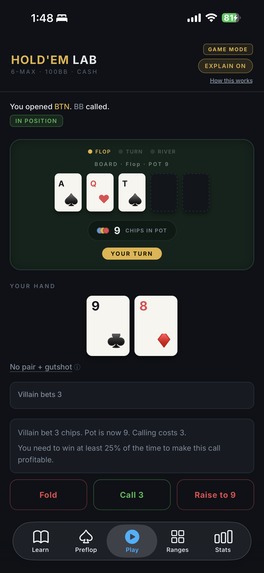
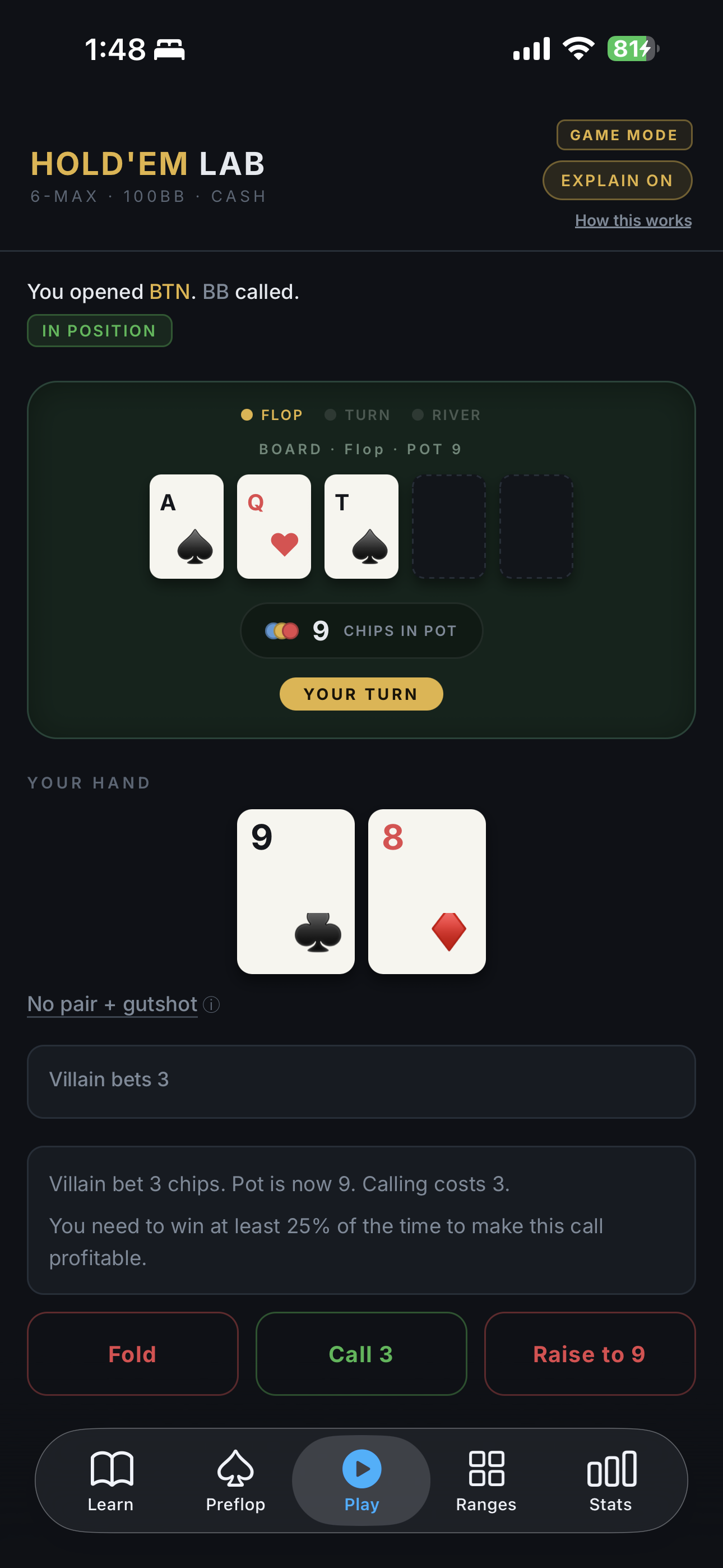
Its the main play screen, where players can take their skills to the table
-
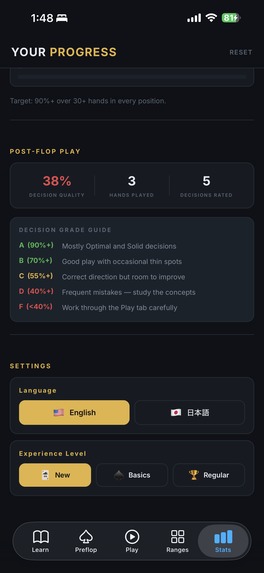
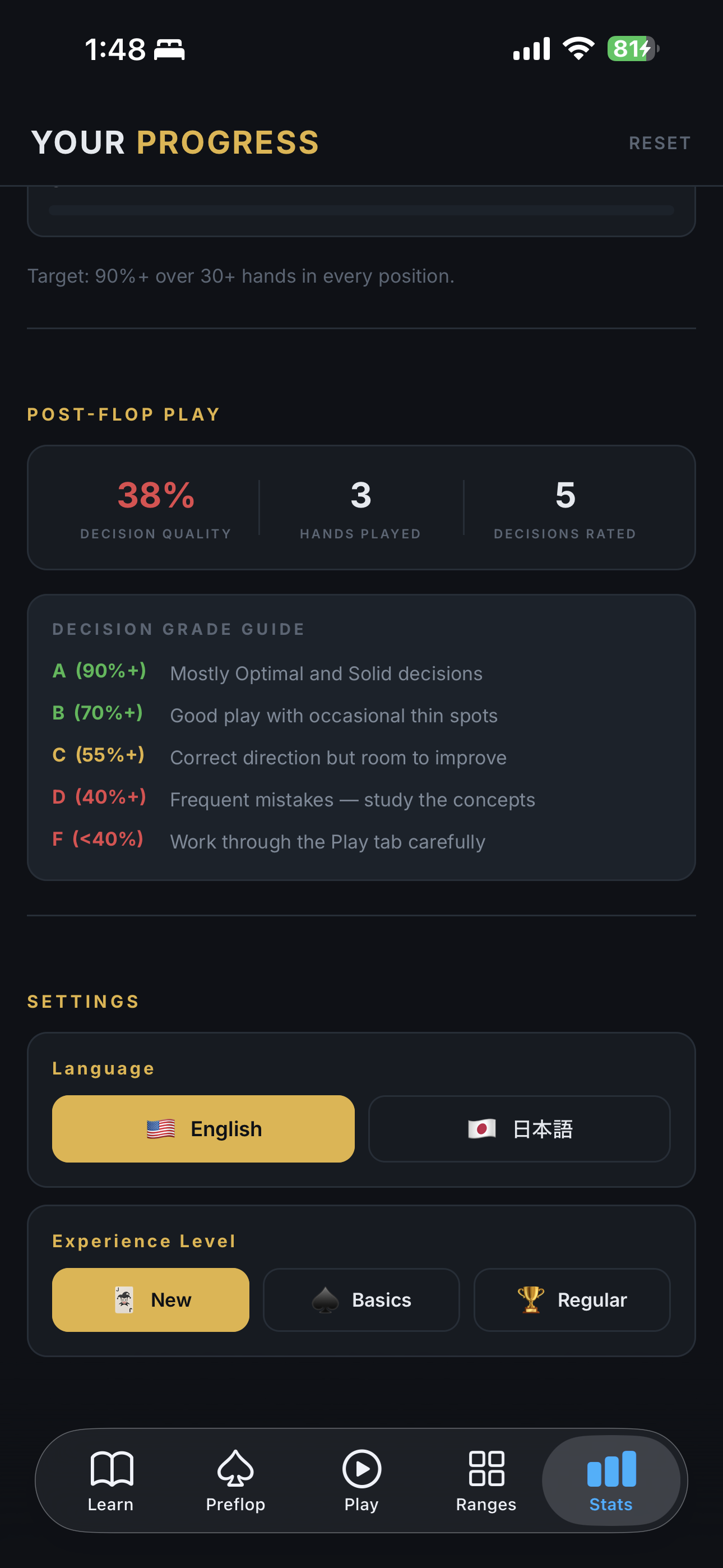
Players can go and see their history and track how they have done
-
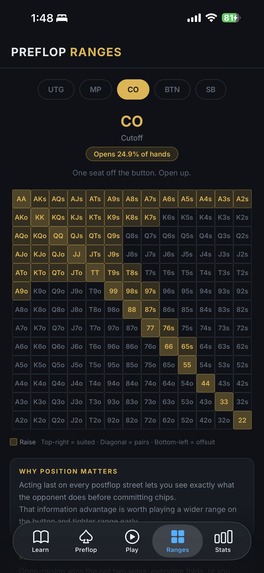
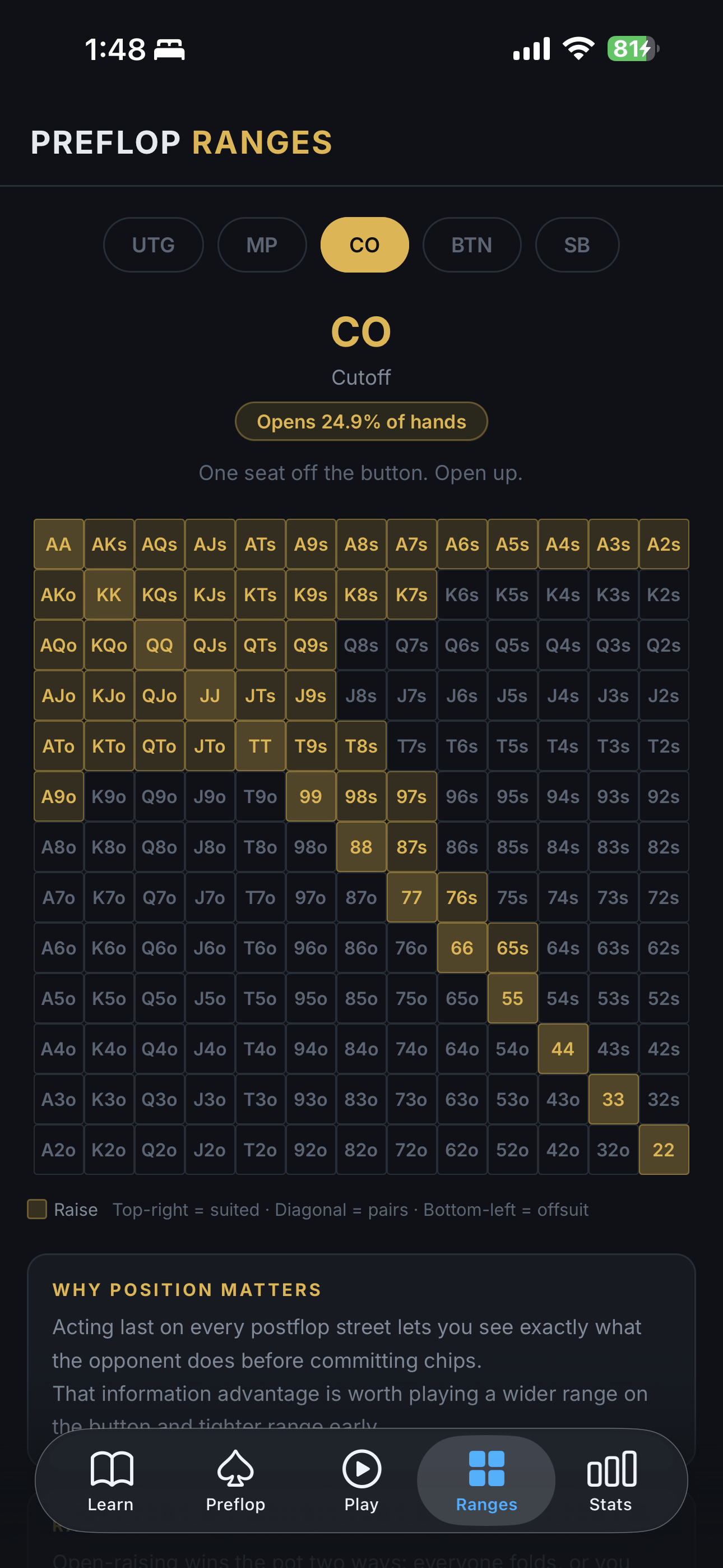
This is GTO table, where players can check their hand against the typical strength
-
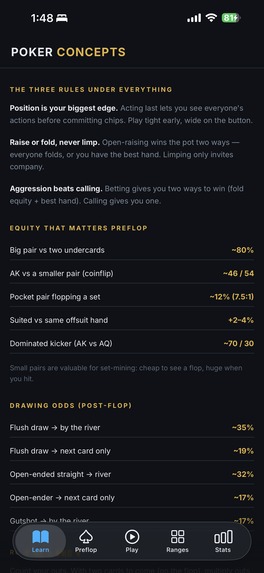
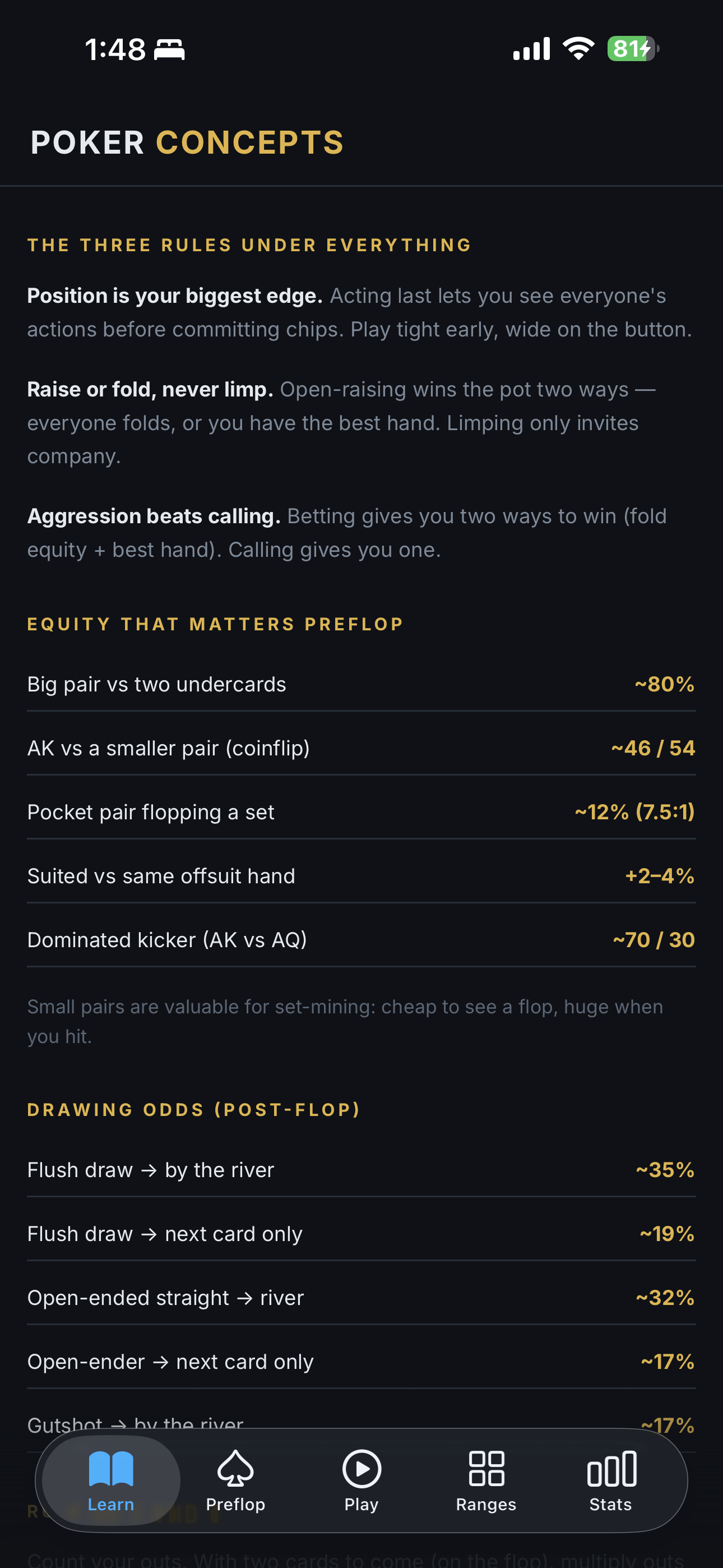
This is the library for beginners to read up on what they are getting into
-
The simple app Icon
Inspiration
I suck at poker. That's the honest starting point. I watched people play on YouTube and kept wondering how they got so good, and I didn't know where to even start learning. Instead of just Googling it, I asked AI — and that conversation turned into "why not just build the thing that teaches me?" So I did. This app started from zero poker knowledge, not from expertise.
What it does
Hold'em Lab is a bilingual (English/Japanese) No-Limit Hold'em trainer with five parts:
- Concepts — plain-language lessons on position, equity, pot odds, and the "rule of 2 and 4" for drawing odds
- Ranges — a tappable 13×13 opening-range chart per position, sized to be legible on mobile without pinch-zooming
- Preflop — deals a random hand and seat, grades your raise/fold decision against real ranges, and shows a live accuracy streak
- Play — a full simulated hand (flop → turn → river) against an AI opponent with a realistic betting range. Every decision gets graded (Optimal / Solid / Thin / Inaccuracy / Mistake) with the actual win-probability math explained in plain language, plus a breakdown of which hands in the opponent's range currently beat you and what board cards to watch for
- Progress — tracks accuracy by position and overall decision quality over time
A first-time tutorial walks new users through what all of this means before they touch a real hand, since early testing showed that jargon like "You opened CO, BTN called" is meaningless to a total beginner without translation.
How I built it
This is my first vibe-coded project. I started with the most basic prompt I could write and built from there entirely through conversation with Claude, deploying and iterating through Replit. I didn't have a spec or a feature list going in — I had a rough idea and a willingness to keep asking people what they thought.
My actual process was: build something, hand it to people who knew the rules of poker but weren't good at it (the exact audience I was building for, since that was me too), watch them use it, ask what confused them, and go back and change it. Repeat. Nearly every feature in the app — the tutorial, the felt-table visual, the tap-to-inspect range grid, the plain-English equity explanations — came directly out of watching a real person get stuck on something and fixing that specific thing.
Challenges I ran into
- Finding the middle that worked for everyone. My testers ranged from complete beginners to people who knew poker's rules but not its strategy, and building something that served both without talking down to one or overwhelming the other took real iteration — that tension shaped most of the redesigns.
- Making the math trustworthy without making it unreadable. Early versions surfaced raw numbers ("equity 41%, need 29%") that beginner testers couldn't parse. It took several passes — plain-English framing, then a "why" explanation naming which hands beat you and which board cards to fear — before it actually taught anything.
- "Game mode" not feeling like a game. Real user testing, including at poker bars in Yokohama, surfaced that a plain results screen didn't register as an active hand in progress. Fixed with a felt-table visual, street-progress dots, an animated pot display, and a pulsing "your turn" cue.
- Doing all of this for the first time. Setting up a developer account, using Xcode, submitting to App Store Connect — none of it was familiar going in.
Accomplishments that I'm proud of
Everyone who saw the app wanted to use it immediately — that reaction, from real people at a poker bar with zero prompting, is the thing I'm proudest of. And separately: this is the first app I've ever shipped. Developer account, Xcode, App Store submission, all of it for the first time. It's rudimentary, but it's real, and it's out there.
What I learned
That the hardest part of a "teaching" app isn't the correctness of the math, it's translating correct math into a sentence a beginner will actually understand on first read. And that building for people who aren't you — by actually watching them use it instead of guessing — beats any amount of planning up front.
What's next
Bringing greater value to the user and building in a streak feature. And getting into more places where poker is actually played — more bars, more communities, more real players — to keep the feedback loop going and make the app genuinely useful to the people who'll actually use it.## Inspiration
Built With
- app-store-connect
- css
- game-theory
- i18n
- javascript
- mobile-first-design
- monte-carlo-simulation
- poker
- react
- replit
- testflight

Log in or sign up for Devpost to join the conversation.