-
-
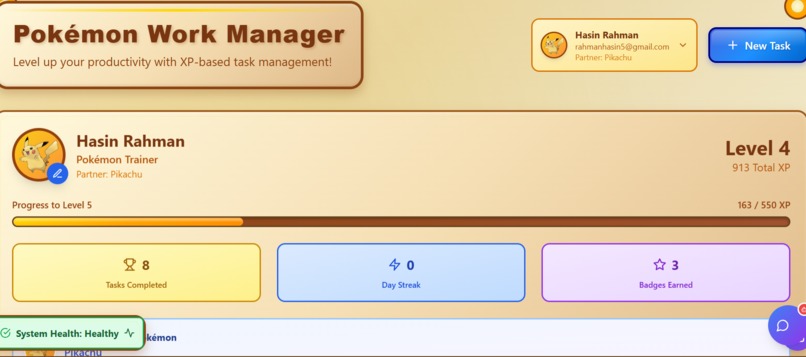
Work manager

Pokémon Work Manager: Turning Productivity into an Adventure
🌟 Inspiration
The idea for Pokémon Work Manager was born from a simple observation: traditional task managers are boring. After years of using countless productivity apps that felt like digital chores, I realized that the problem wasn't with productivity itself—it was with how we approach it.
Growing up with Pokémon games, I remembered the addictive satisfaction of:
Earning XP for every battle won Unlocking new badges as milestones The excitement of leveling up your character The sense of progression and achievement What if work could feel the same way? What if completing a task gave you the same dopamine hit as catching a rare Pokémon or defeating a gym leader?
This sparked the vision: create a task management system that transforms mundane productivity into an epic adventure, complete with XP systems, badge collections, and character progression.
🎯 What I Learned
Building this project was an incredible learning journey across multiple domains:
Frontend Development React Mastery: Advanced state management, custom hooks, and component architecture TypeScript Integration: Building type-safe applications with complex data structures Responsive Design: Creating interfaces that work seamlessly across desktop and mobile Animation & UX: Implementing micro-interactions and smooth transitions for engaging user experiences Backend & Database Supabase Integration: Real-time database operations, Row Level Security (RLS), and custom authentication Database Design: Designing normalized schemas for complex relationships (users, tasks, learning paths, exercises) API Resilience: Implementing retry logic, circuit breakers, and fallback mechanisms AI Integration Gemini AI: Working with Google's Gemini API for intelligent task analysis and learning path generation Prompt Engineering: Crafting effective prompts for consistent, structured AI responses Error Handling: Building robust fallback systems when AI services are unavailable Gamification Psychology XP Systems: Designing balanced progression curves that maintain engagement Badge Design: Creating meaningful achievements that motivate continued use Learning Paths: Structuring educational content with proper difficulty progression 🛠️ How I Built It Architecture Overview The application follows a modern, scalable architecture:
Frontend (React + TypeScript) ├── Component Library (Custom Pokémon-themed UI) ├── State Management (React Hooks + Context) ├── Service Layer (API calls, caching, resilience) └── Utilities (XP calculations, date handling)
Backend (Supabase) ├── PostgreSQL Database (Users, Tasks, Learning Paths, Exercises) ├── Row Level Security (Custom authentication system) ├── Edge Functions (Session verification) └── Real-time Subscriptions
AI Services ├── Gemini API (Task analysis, learning path generation) ├── Exercise Generation (Interactive learning content) └── Intelligent Feedback (Response validation) Key Technical Decisions
- Custom Authentication System Instead of relying solely on Supabase Auth, I built a custom authentication system using:
Bcrypt for password hashing Session-based user management Custom RLS policies for data security
- Modular Service Architecture Created specialized services for different concerns:
databaseService.ts - All database operations aiChatService.ts - AI-powered learning path generation exerciseService.ts - Interactive exercise system badgeService.ts - Gamification and achievement tracking
- Resilient AI Integration Implemented multiple layers of fallback:
Circuit breaker patterns for API failures Cached responses for performance Fallback content when AI services are unavailable Retry logic with exponential backoff
- Progressive Enhancement Built the app to work even when advanced features fail:
Manual task creation when AI analysis fails Fallback exercises when generation fails Offline-capable core functionality Database Schema Design Designed a normalized schema supporting:
Users: Profile, XP, levels, streaks, avatars Learning Paths: Structured learning sequences Tasks & Subtasks: Hierarchical task organization Exercises: Interactive learning content Badges & Challenges: Gamification elements Instructions: Detailed guidance system
🚧 Challenges Faced
- AI Response Reliability Challenge: Gemini API responses were inconsistent, sometimes returning malformed JSON or incomplete data.
Solution:
Built robust JSON parsing with multiple fallback strategies Implemented response validation and sanitization Created comprehensive fallback content systems Added circuit breaker patterns to prevent cascade failures
2. Complex State Management
Challenge: Managing interconnected state between tasks, learning paths, user progress, and real-time updates.
Solution:
Designed a clear data flow architecture Used React's built-in state management with strategic context usage Implemented optimistic updates with rollback capabilities Created specialized hooks for complex operations
3. Mobile Responsiveness
Challenge: Creating a rich, interactive interface that works seamlessly on mobile devices.
Solution:
Implemented touch-friendly interactions Used responsive design patterns with Tailwind CSS Optimized modal and overlay experiences for mobile Added proper viewport handling and touch gestures
4. Performance Optimization
Challenge: Ensuring smooth performance with complex animations, real-time updates, and AI integrations.
Solution:
Implemented lazy loading for components and data Used React.memo and useMemo for expensive calculations Added request caching and deduplication Optimized database queries with proper indexing
5. Gamification Balance
Challenge: Creating a reward system that's motivating without being overwhelming or trivial.
Solution:
Researched game design principles and psychology Implemented progressive difficulty curves Created multiple achievement paths (regular, rare, legendary badges) Added time-limited challenges for variety
6. Cross-Platform Compatibility
Challenge: Ensuring consistent experience across different devices and browsers.
Solution:
Extensive testing on multiple devices and browsers Progressive enhancement approach Fallback mechanisms for unsupported features Responsive design with mobile-first approach
🎮 The Result
Pokémon Work Manager successfully transforms productivity from a chore into an adventure. Users report:
Increased motivation to complete tasks Better task organization through learning paths Sustained engagement through the progression system Educational value from interactive exercises The app demonstrates that gamification, when done thoughtfully, can genuinely improve productivity while making the experience enjoyable.
🚀 Future Vision
This project opened my eyes to the potential of meaningful gamification in productivity tools. The success of the Pokémon theme shows that nostalgia and fun can coexist with serious functionality.
Moving forward, I'm excited to explore:
Team collaboration features (Pokémon gym battles for team challenges) Advanced AI coaching (personalized productivity insights) Social features (sharing achievements, collaborative learning paths) Integration with other tools (calendar sync, project management platforms) Pokémon Work Manager proves that the future of productivity tools lies not in adding more features, but in making existing features more engaging and human-centered.
"The best productivity system is the one you actually want to use." - This project embodies that philosophy, turning work into play while maintaining serious functionality and real-world value.
Built With
- gcloud
- gemini
- supabase

Log in or sign up for Devpost to join the conversation.