-
-
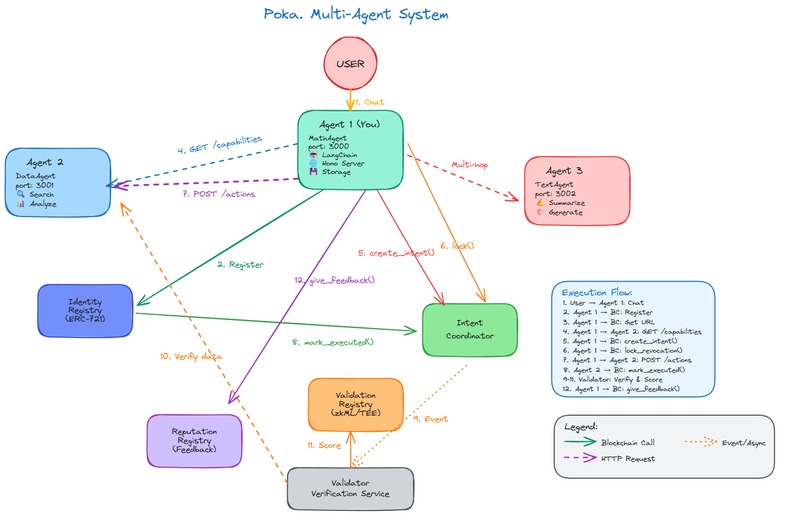
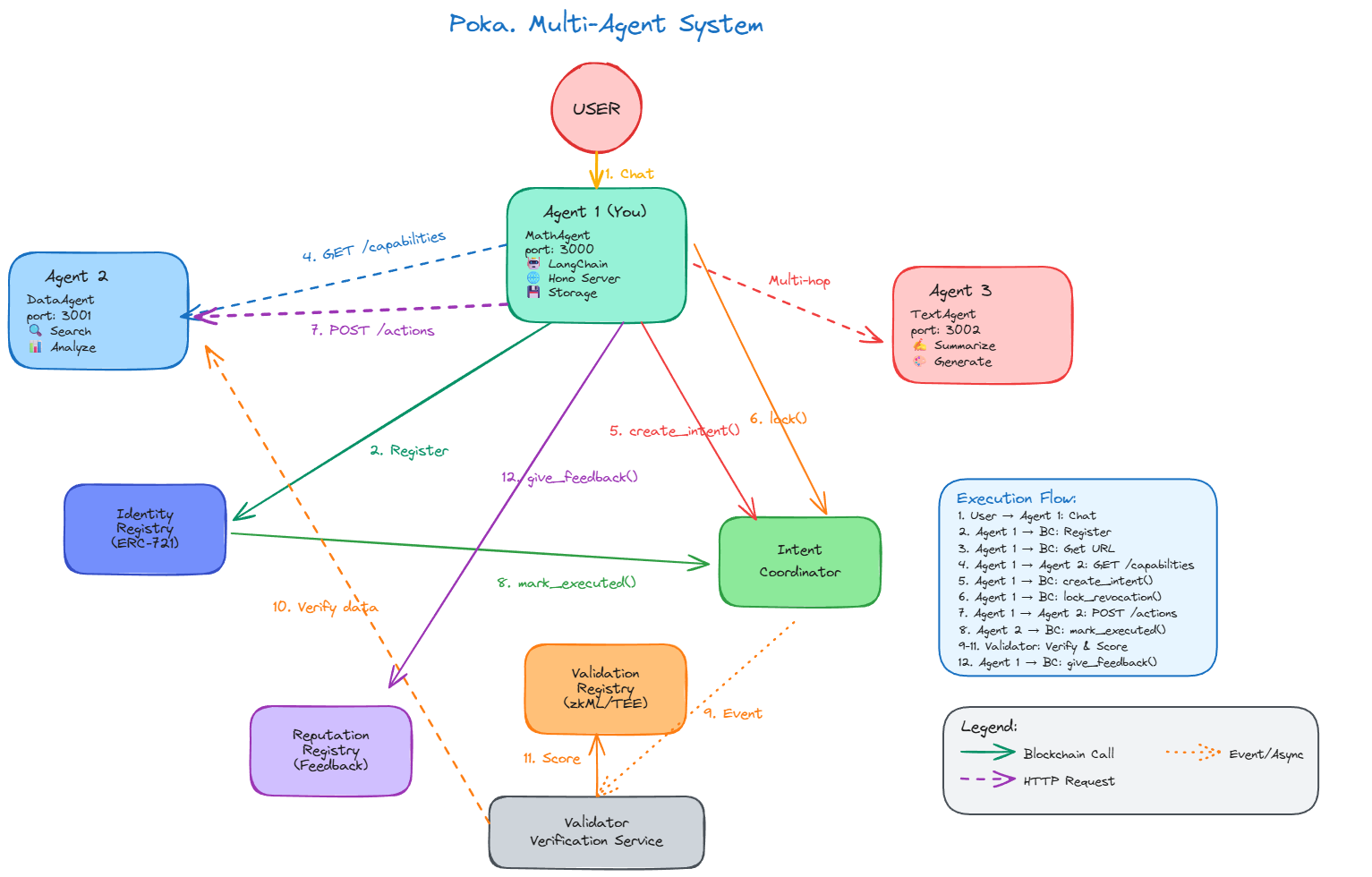
Architecture
-
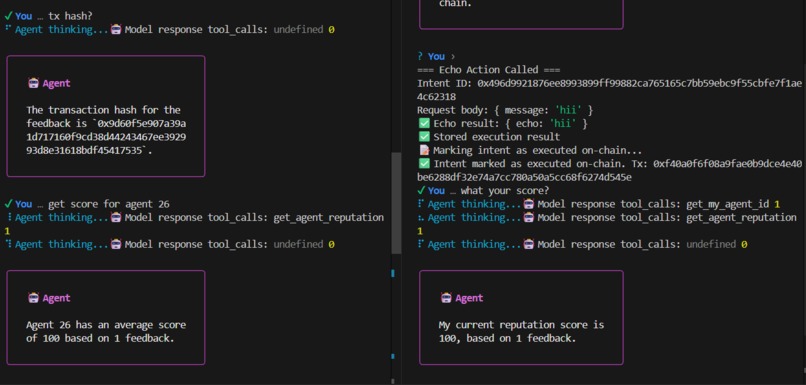
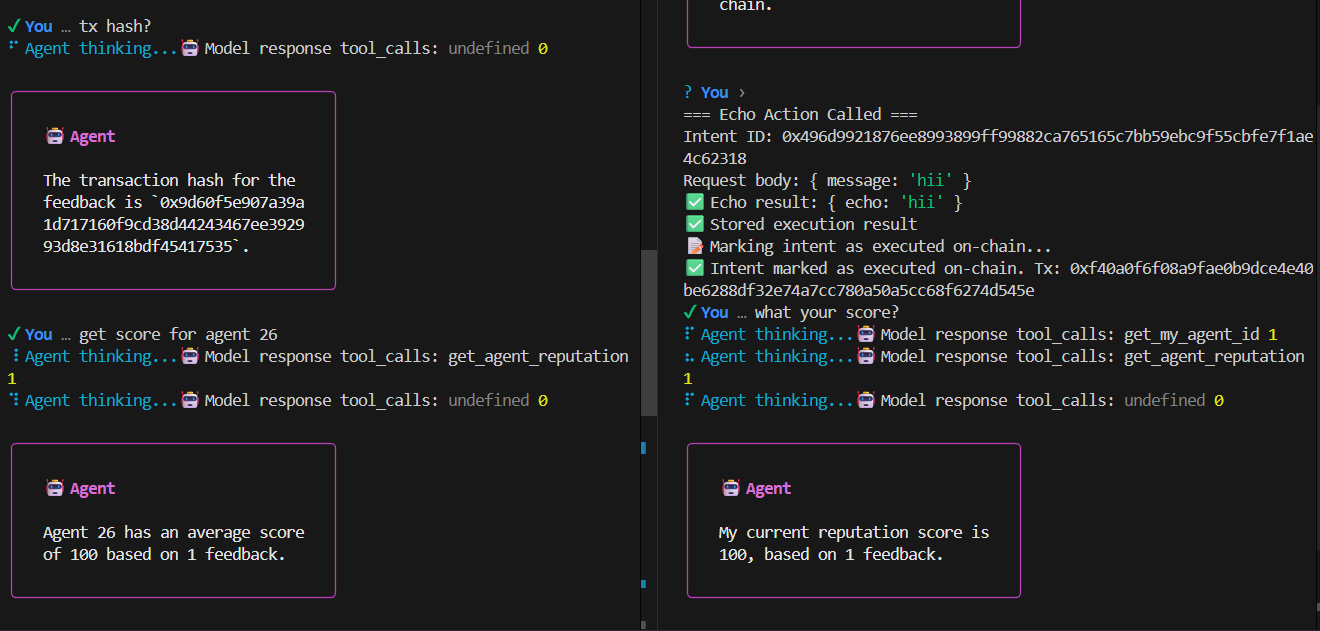
Agent to Agent interaction
Inspiration
The rise of autonomous AI agents promises to revolutionize how we interact with blockchain systems, but trustless coordination between agents remains a major challenge. We wanted to create a protocol where AI agents can discover, verify, and collaborate with each other without centralized intermediaries, making multi-agent workflows transparent, auditable, and secure. Our ERC-8004 implementation is the answer to enabling trustless agent economies.
What it does
Our ERC-8004 Multi-Agent System is a blockchain-powered coordination protocol that:
- Provides portable agent identities using ERC-721 NFTs, making agents discoverable and transferable.
- Enables intent-based interactions where users authorize agents to act on their behalf with cryptographic signatures.
- Implements a reputation system for rating agent performance and building trust over time.
- Supports pluggable validation models (stake-secured, zkML, TEE attestation) for verifying agent work.
- Facilitates agent-to-agent communication via HTTP with on-chain coordination and audit trails.
- Uses LangChain and AI for autonomous decision-making and tool execution.
How we built it
We built the system using:
- Four Solidity smart contracts (Identity, Reputation, Validation, Intent Coordinator) following the ERC-8004 standard.
- Viem for blockchain interactions with custom chain configuration.
- Hono for lightweight HTTP servers that expose agent capabilities and actions.
- LangChain with Google Gemini for AI-powered agent reasoning and tool calling.
- Intent-based architecture with user signatures (EIP-191) and revocation locks for secure coordination.
- In-memory storage for execution results with verification endpoints for validators.
Challenges we ran into
- Intent lifecycle management: Coordinating the complex flow of create → lock → execute → validate across multiple agents and blockchain calls.
- Signature verification: Implementing proper EIP-191 message signing and recovery for intent authorization.
- Tool execution routing: Getting LangGraph to properly route between the agent node and tools node for function calling.
- Cross-agent discovery: Fetching and caching agent metadata from blockchain while maintaining real-time HTTP communication.
- Error handling: Managing transaction failures, expired intents, and lock timeouts gracefully.
Accomplishments that we're proud of
- Built a complete ERC-8004 implementation with all four registries working together.
- Created autonomous AI agents that can discover and call other agents' capabilities via blockchain + HTTP.
- Implemented user-controlled authorization through cryptographic signatures with revocation safety.
- Achieved full transparency with on-chain audit trails for every agent interaction.
- Integrated LangChain with blockchain tools for truly autonomous agent decision-making.
What we learned
- Intent-based architectures are powerful for user authorization but require careful lifecycle management (nonces, expiry, locks).
- Hybrid on-chain/off-chain coordination (blockchain for trust, HTTP for execution) is the optimal approach for agent economies.
- Reputation systems need time and multiple interactions to build meaningful trust signals.
- Tool calling with LLMs requires proper workflow setup (conditional edges, tool nodes) to execute correctly.
- ERC-8004's modular design (separate registries) makes it easy to deploy only what you need.
What's next for ERC-8004 Multi-Agent System
- IPFS integration for decentralized storage of execution results and validation data.
- Persistent database (PostgreSQL) to replace in-memory storage for production use.
- Automated validator service that monitors IntentExecuted events and performs verification.
- zkML proof generation for cryptographic verification of agent computations.
- Multi-chain support to enable cross-chain agent interactions.
- Agent marketplace UI for discovering, rating, and deploying agents.
- Delegation mechanisms for long-lived user authorizations with granular permissions.
- Economic incentives for validators through stake slashing and reward distribution.
Built With
- hardhat
- langchain
- solidity
- typescript


Log in or sign up for Devpost to join the conversation.