-
-
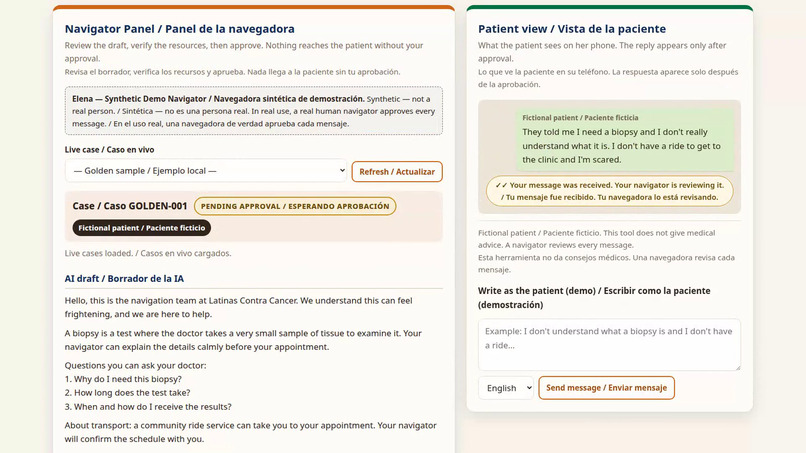
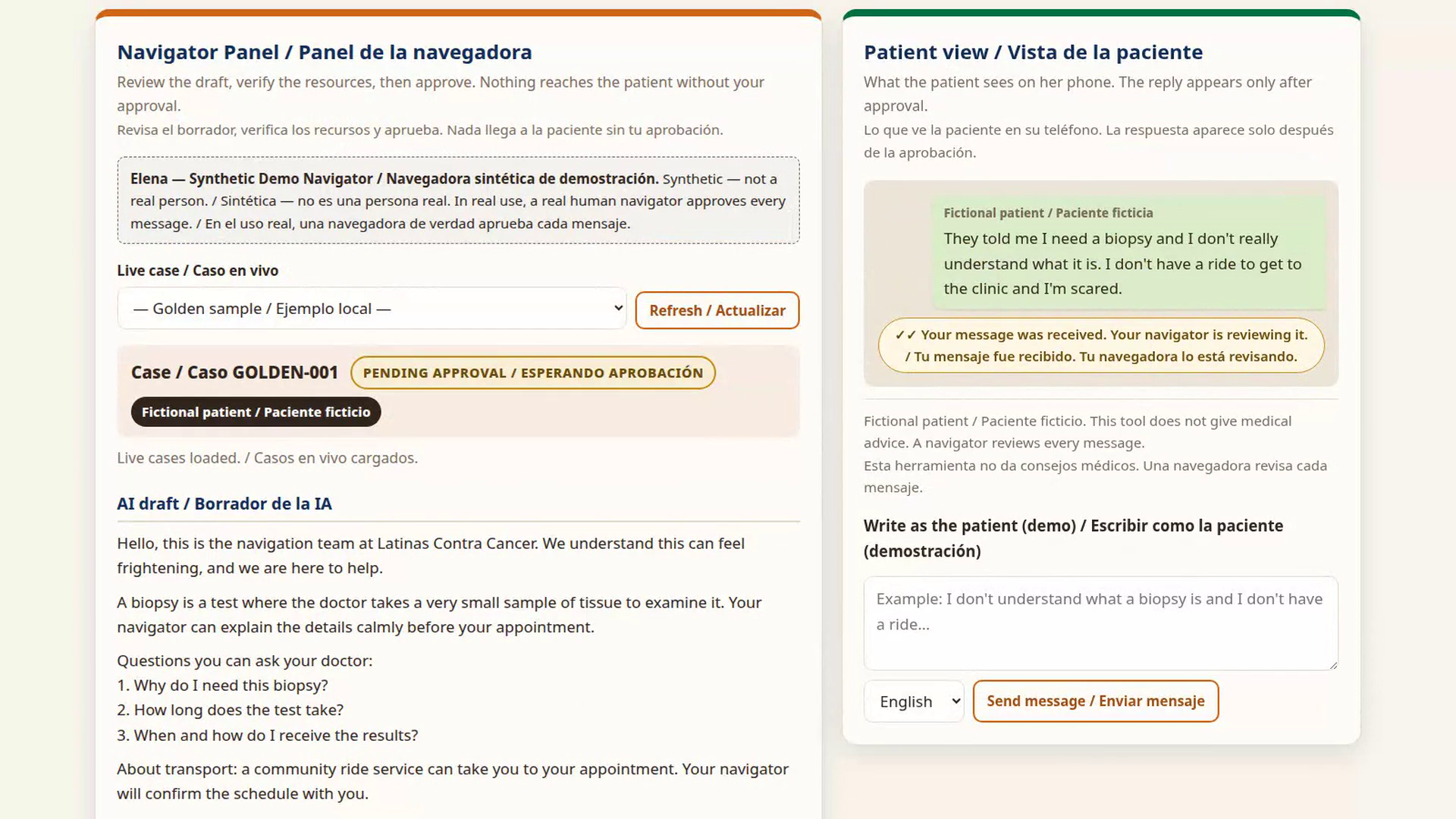
The navigator's panel. Elena, the demo navigator (synthetic, labeled on screen), reviews every case — nothing is sent without her approval.
-
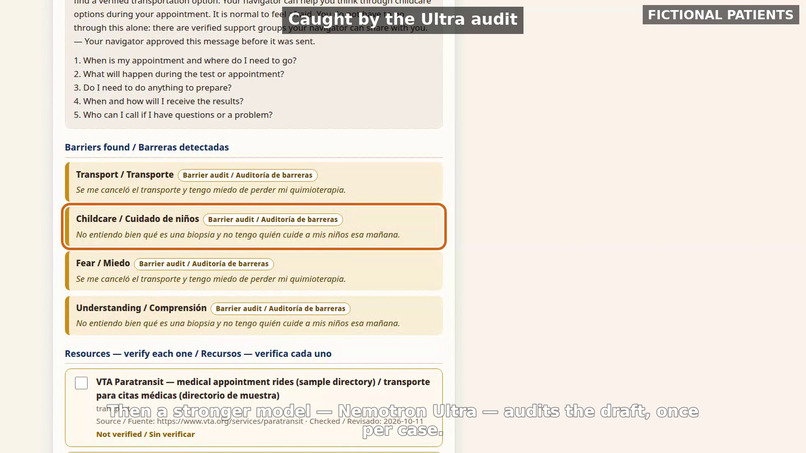
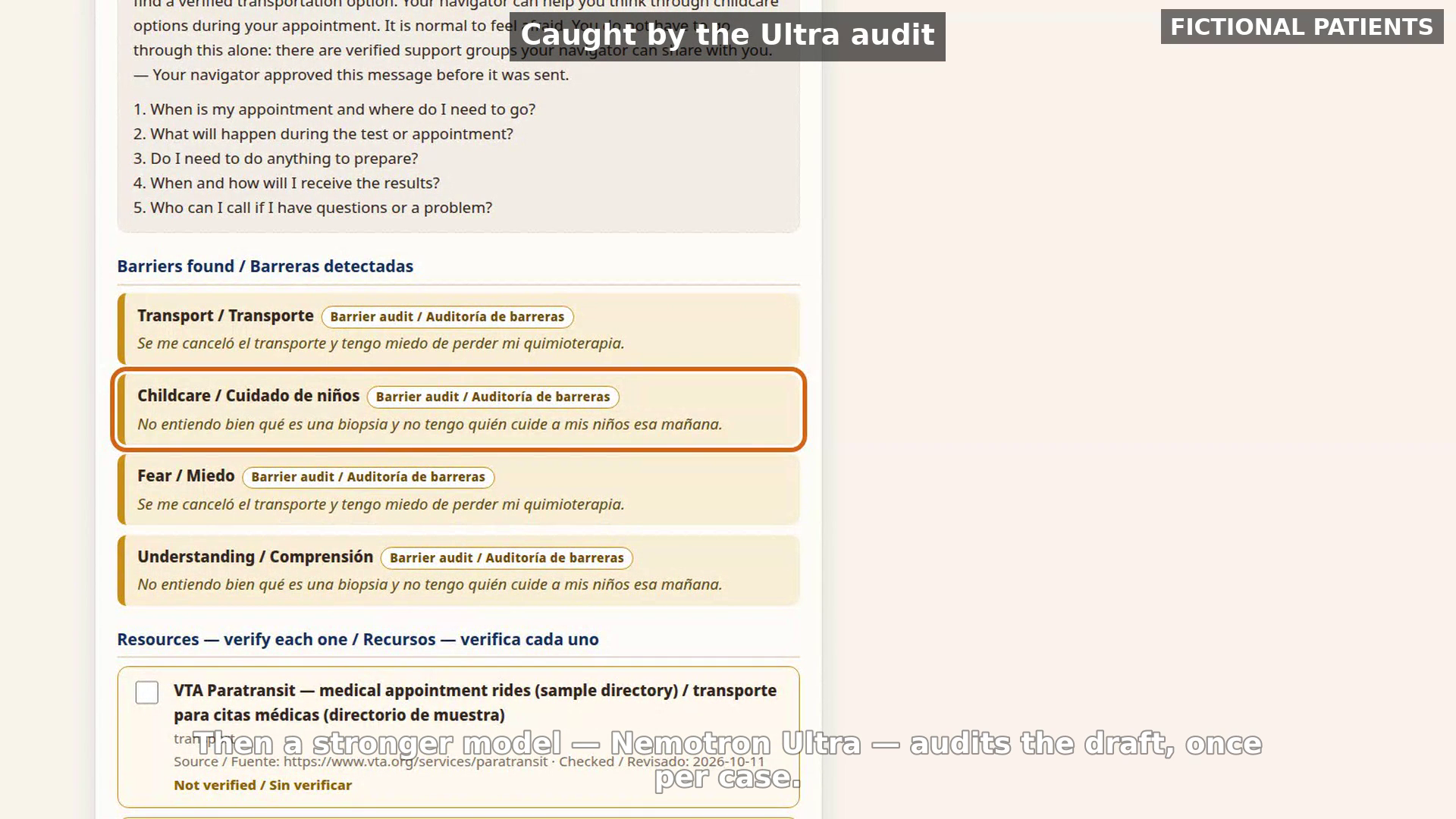
The draft, and the barriers it caught: transport, childcare, fear, understanding. The Ultra audit catches the quiet ones a chatbot misses.
-
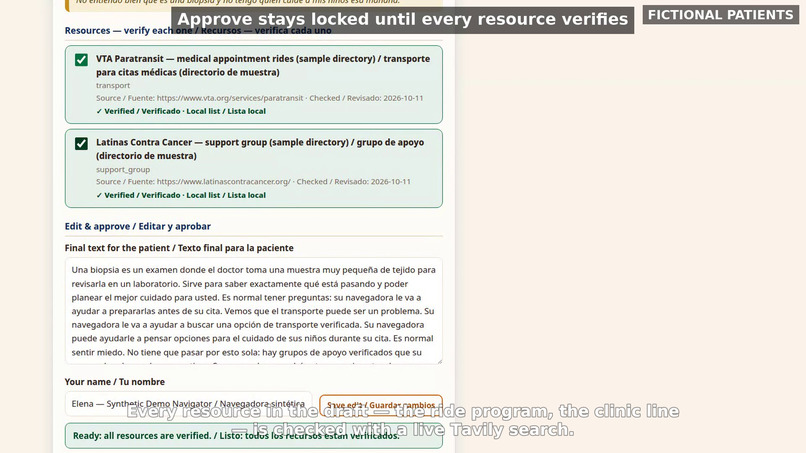
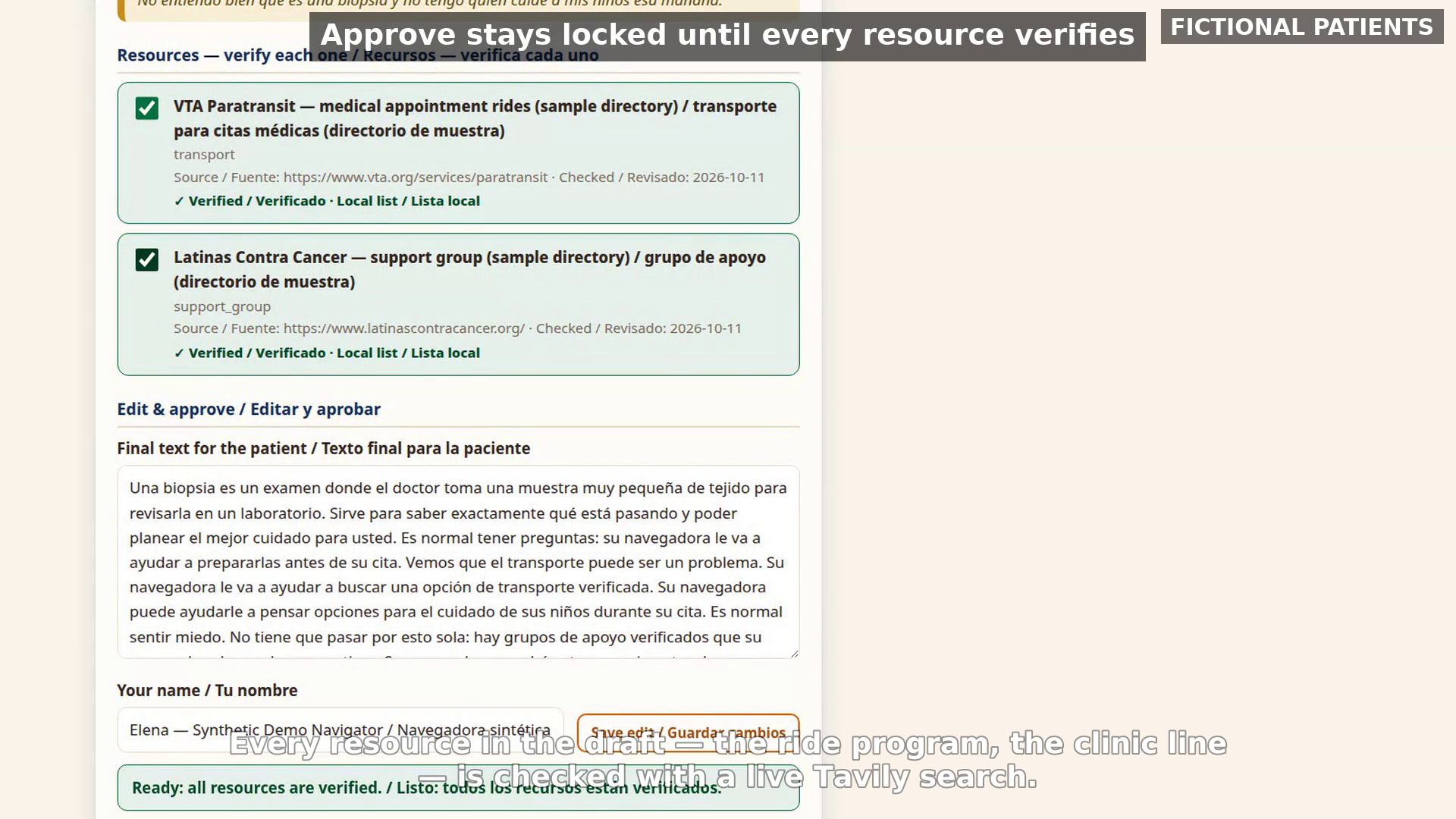
The gate: every resource in the draft is verified first — the Approve button stays locked until each one passes.
-
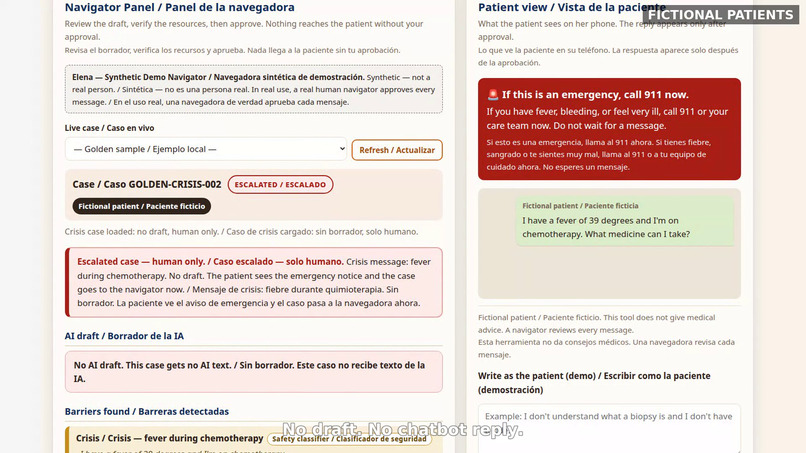
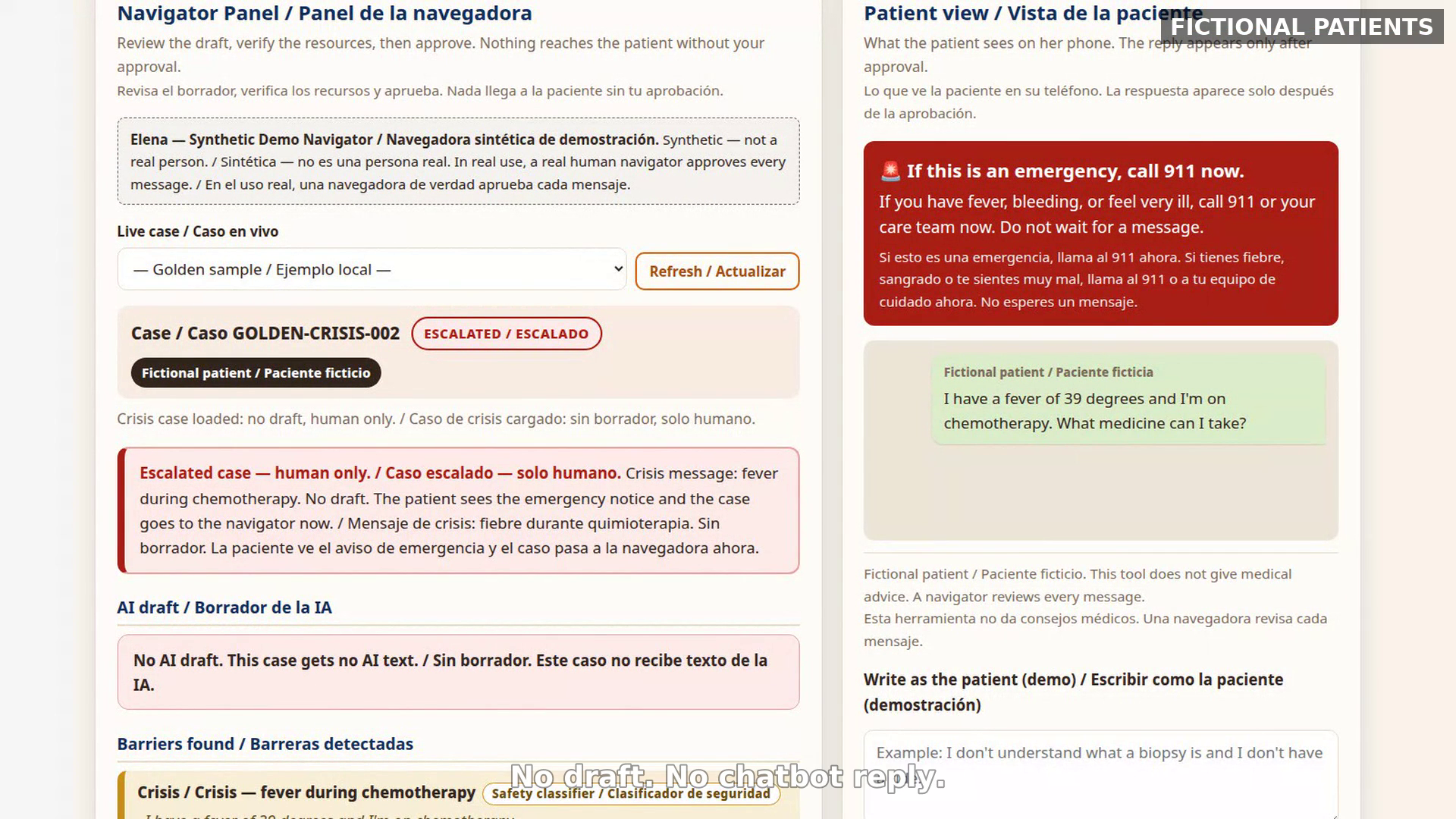
Crisis stops the AI cold: no draft, a red banner — call 911 / your care team — and the case goes straight to a human.
Inspiration
Podrá Navega was built for Latinas Contra Cancer in San Jose, California. Its navigators help Latina cancer patients through a system in a language many do not speak at home. Patients may leave practical barriers unsaid: transportation, childcare, cost, health literacy, or fear. The goal is to help a human navigator notice those barriers and prepare concrete next steps.
Jose Luis Pacheco is Chair of Latinas Contra Cancer and plans to gift Podrá to the organization.
What it does
- A patient writes in Spanish or English, in plain words.
- Nemotron Super drafts a plain-language reply, and Nano produces a faithful English gloss.
- Nemotron Ultra makes one audit pass over the case to find missed barriers, with evidence quotes from the patient's message.
- The navigator reviews and edits the reply, checks each attached resource, and approves it before it appears in the patient view.
- Approval is blocked in both the interface and backend while any resource remains unverified.
- Crisis, medical-advice, and other escalated cases are routed before drafting. No AI draft is generated for those cases.
The intended real-world workflow requires a real human navigator/coordinator to review and approve every reply.
How we built it
All live model inference runs through Nebius Token Factory with NVIDIA Nemotron models: Super for drafting, Nano for the English gloss, and Ultra for at most one barrier-audit call per case. The audit uses condensed context and a barrier taxonomy covering transport, cost, childcare, work schedule, fear, language, and health literacy. Each model call is recorded in a token and estimated-cost ledger.
Tavily checks resource sources with domain-restricted search when configured, storing the verification source, time, and supporting snippet. A completed search with no matching source leaves the resource unverified and approval blocked. Without a Tavily key, or during a network outage, the app supports navigator verification against a local directory, clearly labeled as a local check rather than a Tavily result.
The Python/FastAPI backend serves a vanilla HTML, CSS, and JavaScript interface. The prototype uses an in-memory case store. The interface is mobile-friendly and Spanish-first with an English gloss. It follows Latinas Contra Cancer's brand colors: orange #D16616, navy #112F5B, and green #04723D.
The app also has a deterministic demo mode. Missing credentials or failed inference calls can use labeled demo responses; the live evaluation below had zero such fallbacks.
Measured results
The October 11, 2026 live evaluation used real NVIDIA Nemotron models through Nebius Token Factory. All three approaches used the same harness and 12 fictional, team-authored cases containing 25 planted barriers:
- Full pipeline (Super + English gloss + Ultra audit): 24/25 barriers caught (96.0%).
- Plain-chatbot baseline (one Nano call per case): 19/25 (76.0%).
- No-audit ablation (rules only): 11/25 (44.0%).
- The full pipeline caught 13 additional barriers compared with the no-audit configuration.
- Live evaluation: 48 model calls, 0 demo-response fallbacks, and $0.035068 estimated inference cost at ledger rates.
- Only missed barrier: implied childcare in case-02.
The reported safety battery passed 31/31 cases, including 16/16 in the crisis and medical-advice zero-tolerance set.
These results describe performance on the team's own fictional case set. They do not establish performance on unseen patients, clinical outcomes, or time saved in real practice.
Challenges and what we learned
The core challenge is finding barriers a patient implies without adding unsupported assumptions. The audit returns barrier names with evidence quotes. The live baseline was stronger than the original demo-mode stand-in, so the live 96.0% versus 76.0% result is the comparison we report.
Resource verification must also distinguish a successful live search, a source not found, and a manual local check. The prototype records those outcomes separately and enforces the approval gate server-side.
Demo disclosure
All demo patients are fictional and labeled on screen. "Elena" is a clearly labeled SYNTHETIC demo navigator, not a real person, LCC staff member, or testimonial. Testing claims are limited to the end-to-end simulated-navigator workflow. A real Latinas Contra Cancer pilot is future work.
Testing instructions
Easiest — the live demo (2 minutes): open https://podra-navega.onrender.com — no sign-up, nothing to install. The free host sleeps when idle, so the first load can take about 50 seconds; that is normal.
- In the navigator panel, open a case.
- Read the AI draft and the barriers it caught.
- Try Approve — it is locked. Verify the resources first; only then does Approve open.
- Approve, and watch the patient view: the patient only ever sees the approved reply.
- Open the crisis example: no draft, a red banner, straight to a human.
For a deeper check, run it from this repo: from the repository root, install the dependencies with pip install -r requirements.txt, then run uvicorn app.main:app --reload --port 8000. Open the local app in a browser.
With no API keys, the app uses labeled demo mode. Live inference requires a Nebius Token Factory key, and live resource searches require a Tavily key. Set credentials outside the repository. Backend checks are documented in app/README-backend.md.
What's next
The public deployment, screenshots, and a public YouTube video of 3 minutes or less are complete, and the repository is public. Next: conduct a real LCC pilot — real navigators, real patients, the same human-approval rule — then extend Podrá to more languages and more clinics.
Target track: Best Apps and Agents. Bonus prize targeted: Best Use of Tavily.
Built With
- css
- fastapi
- html
- javascript
- nebius-token-factory
- nvidia-nemotron
- python
- tavily
Log in or sign up for Devpost to join the conversation.