-
-
GetPodPoints.Com
-
GetPodPoints.Com
Inspiration
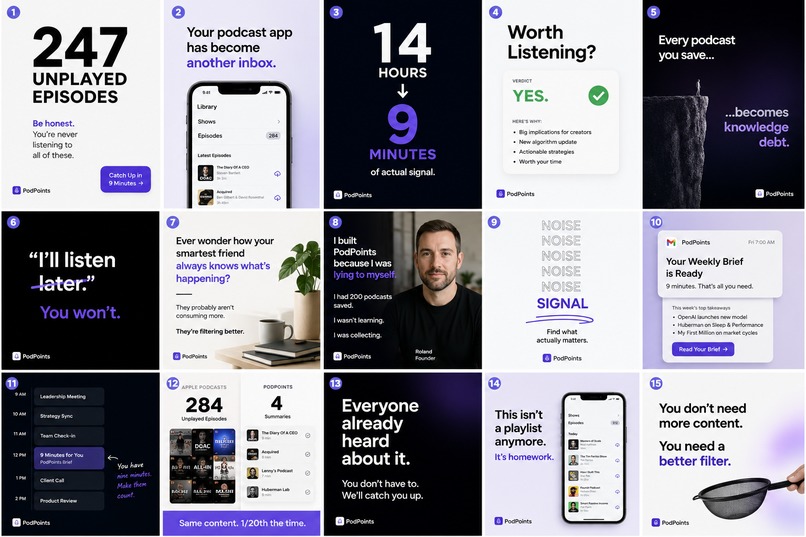
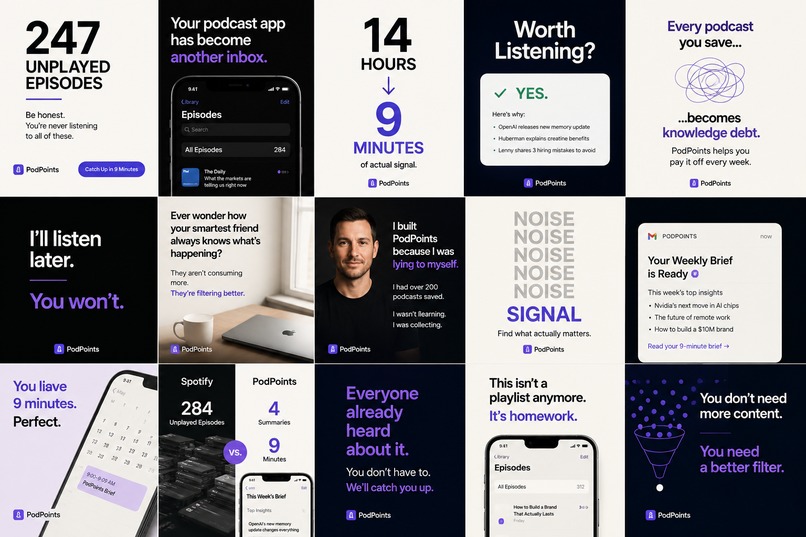
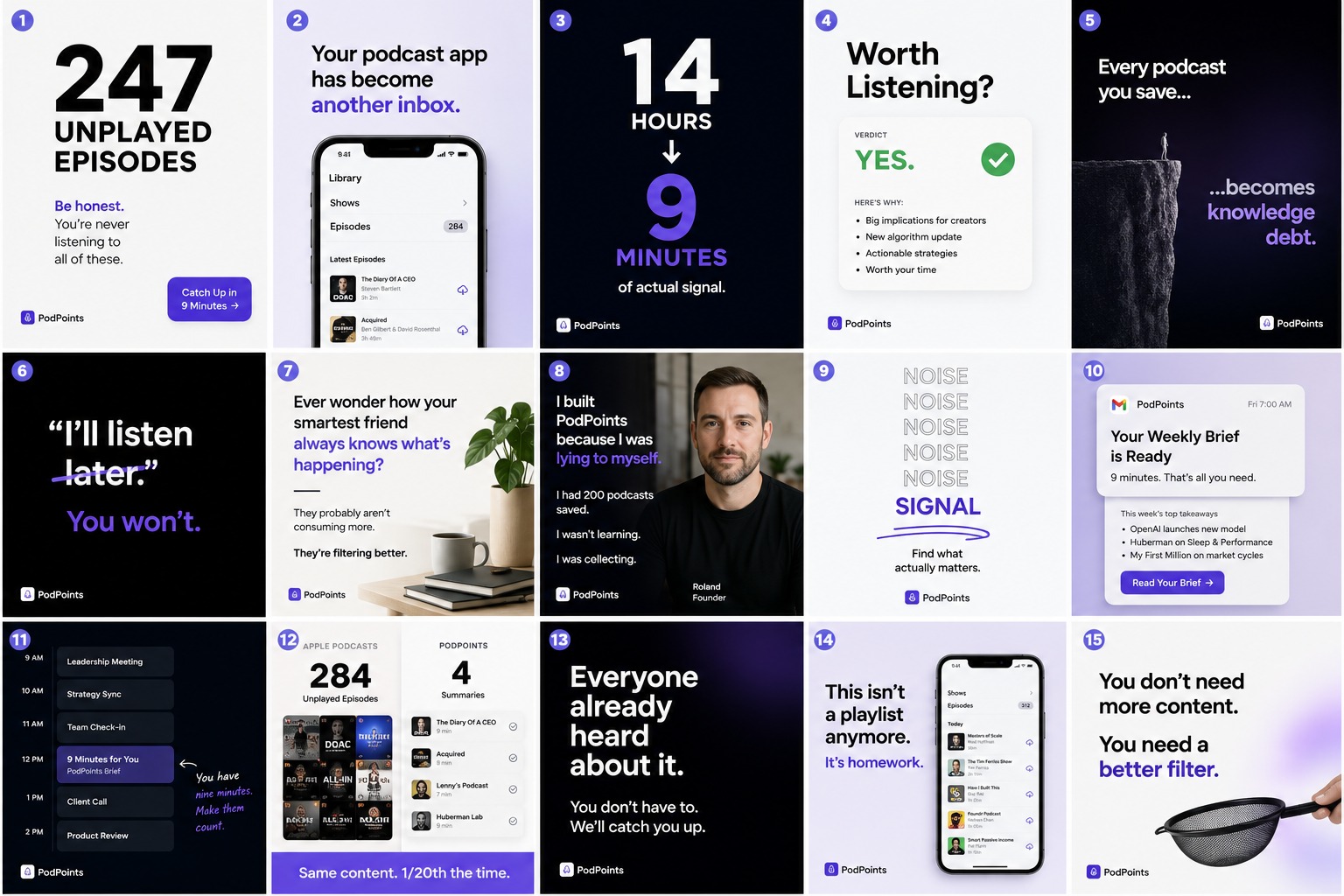
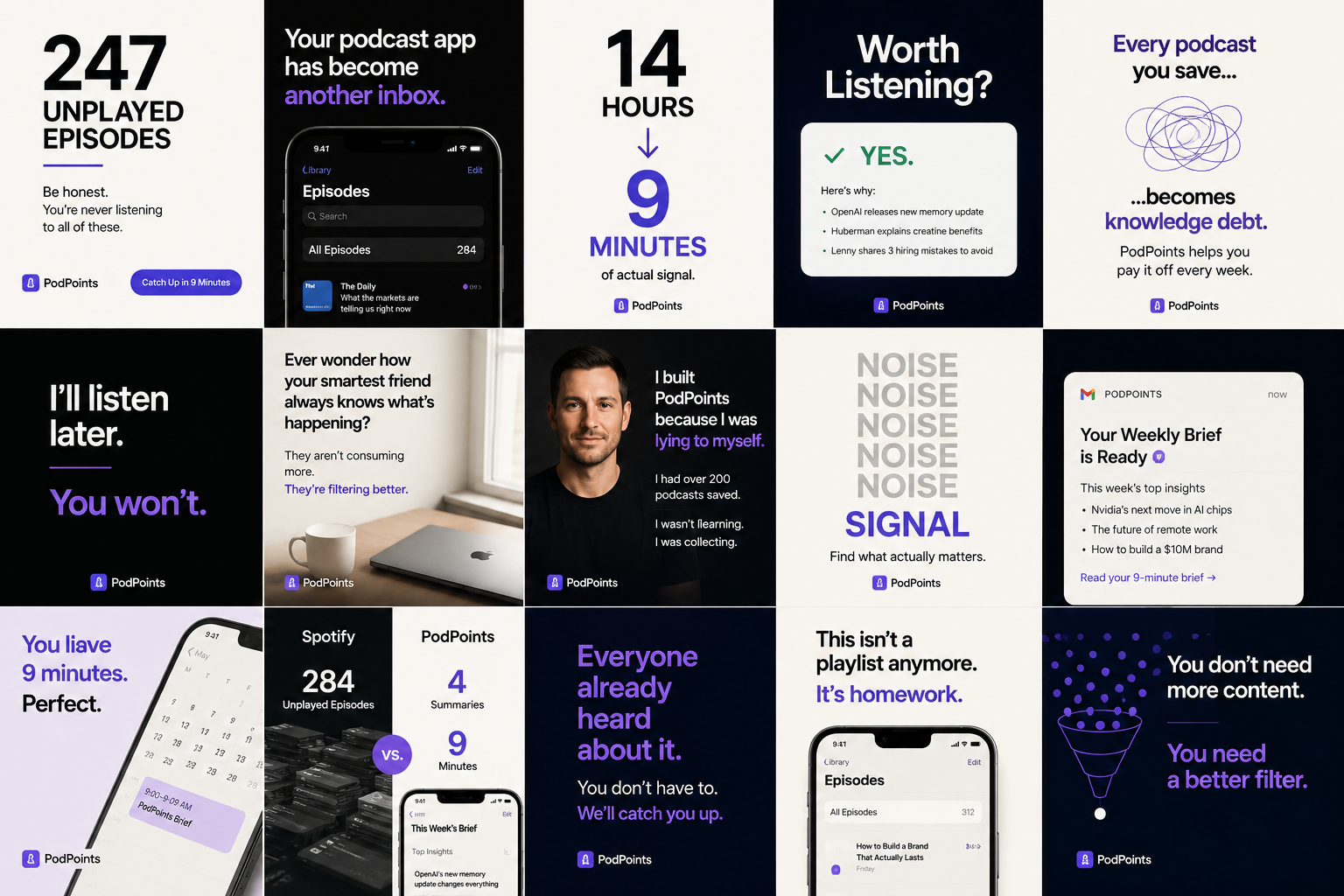
I have several podcasts that I try to listen to religiously because they help me stay current on technology, business, marketing, AI, and other topics that are important to my me and my career.
The problem is that many podcast episodes are between 1-3 hours long. Even when an episode looks valuable, I do not always have enough time to listen to the entire conversation or it ends up being a waste of time and the title hooked me in with no real substance. Over time, episodes begin piling up, and it becomes difficult to know which ones are actually worth the time commitment.
That inspired us to build GetPodPoints: a podcast intelligence platform that helps people stay informed without having to listen to every minute of every episode.
Our goal is simple:
Help users feel caught up without requiring them to listen to everything.
What it does
GetPodPoints allows users to select the podcasts they care about and automatically processes newly released episodes.
For each episode, we generate:
- A concise executive summary
- The most important ideas
- Actionable takeaways
- Timestamped highlights
- Notable quotes and moments
- A recommendation to listen, skim, or skip
These insights are combined into a weekly email brief, allowing users to understand what happened across hours of podcast content in just a few minutes.
GetPodPoints is not intended to replace podcasts. Instead, it acts as a filter. Users can quickly decide which episodes deserve their attention and jump directly to the most valuable sections.
How we built it
GetPodPoints is built around an asynchronous processing pipeline that handles podcast discovery, transcription, summarization, and email delivery.
The application uses:
- Laravel for the backend
- React and Inertia for the user interface
- PostgreSQL for storing podcasts, episodes, transcripts, and summaries
- Redis and Laravel Horizon for background processing
- Scheduled jobs for checking podcast feeds
- Cloud object storage for temporarily storing audio files
- Speech-to-text models for transcription
- Large language models for structured summaries
- An email delivery service for sending weekly briefs
Users can search for podcasts or add a show through its RSS feed. The system regularly checks subscribed feeds for new episodes and stores their metadata while preventing duplicate processing.
For each new episode, GetPodPoints first checks whether the podcast has provided a public transcript. When a usable transcript exists, the application downloads it and converts it into a consistent internal format.
When no transcript is available, the system downloads the public episode audio and processes it through OpenAI Whisper model. The resulting transcript is divided into timestamped segments so that important moments can be linked back to the correct point in the episode.
Long transcripts are broken into manageable sections. Each section is analyzed individually before the results are combined into a final structured episode brief. The completed episode summaries are then assembled into a personalized weekly email.
Challenges we ran into
The largest challenge was reliably finding podcast episodes and obtaining accurate transcripts.
Podcast RSS feeds are not always consistent. Different publishers structure their feeds differently, use different identifiers, and sometimes modify episode information after publication. We had to build safeguards to prevent the same episode from being discovered or processed multiple times.
Transcript availability was another major challenge. Some podcasts provide clean, timestamped transcripts. Others provide incomplete transcripts, plain text without timestamps, unsupported formats, or no transcript at all.
The system needed to determine whether an existing transcript was usable before falling back to audio transcription.
Processing the audio introduced additional challenges. Episodes can be several hours long and may include:
- Multiple speakers
- Advertisements
- Music
- Background noise
- Inconsistent microphone quality
- Large audio files
- Missing or inaccurate episode durations
Because transcription and summarization can take much longer than a normal web request, we had to move the processing into retryable background jobs. We also needed to preserve timestamps throughout the entire pipeline and clean up temporary audio files after processing.
Another challenge was producing summaries that were genuinely useful. A generic paragraph describing an episode was not enough. The output needed to help users decide whether the episode deserved their time.
We created structured prompts that require the AI to identify the most important ideas, practical takeaways, useful timestamps, and whether the episode is worth listening to in full.
Accomplishments that we're proud of
We are proud that GetPodPoints turns a complex, multi-step process into a simple experience for the user.
A user only needs to select the podcasts they care about. PodPoints handles the rest:
- Detecting newly released episodes
- Finding an existing transcript
- Downloading and transcribing audio when necessary
- Preserving timestamps
- Extracting the most valuable information
- Generating a structured episode brief
- Combining the results into a weekly email
We are also proud that the system prefers existing transcripts before performing expensive audio transcription. Completed transcripts and summaries can be reused, preventing the same episode from being processed repeatedly.
Most importantly, the application produces more than a basic summary. It gives users a clear recommendation about whether an episode is worth listening to and shows them exactly where the most valuable moments occur.
What we learned
This project taught us that building a useful AI application involves much more than sending content to a language model.
The quality of the final result depends heavily on everything that happens before the AI prompt:
- Discovering the correct episode
- Validating the RSS feed
- Preventing duplicate processing
- Finding the best available transcript
- Cleaning and normalizing transcript data
- Preserving accurate timestamps
- Handling long inputs
- Recovering gracefully when an external service fails
We also learned the importance of designing an AI system around a specific user outcome.
The goal was not simply to create shorter versions of podcast transcripts. The goal was to help busy people save time, stay informed, and make better decisions about which content deserves their attention.
The real value of PodPoints is not the summary alone. It is the complete system that automatically transforms hours of unstructured podcast audio into a concise and actionable intelligence brief.
What's next for GetPodPoints
The next step is improving the personalization and usefulness of each weekly brief.
Future features may include:
- Personalized summaries based on a user’s career and interests
- Customizable email delivery days and times
- Full-text transcript search
- The ability to ask questions across a personal podcast library
- Saved highlights and episode collections
- Topic-based summaries across multiple podcasts
- Slack and additional delivery options
- Support for additional languages
- Team and enterprise accounts
- Self-hosted transcription to reduce processing costs
- Improved recommendations based on user feedback
Our long-term vision is for GetPodPoints to become a personal intelligence layer for podcasts.
Instead of opening a podcast app and seeing an overwhelming backlog, users will receive a focused brief showing them what matters, what they can skip, and exactly where to listen when an episode deserves a deeper dive.

Log in or sign up for Devpost to join the conversation.