-
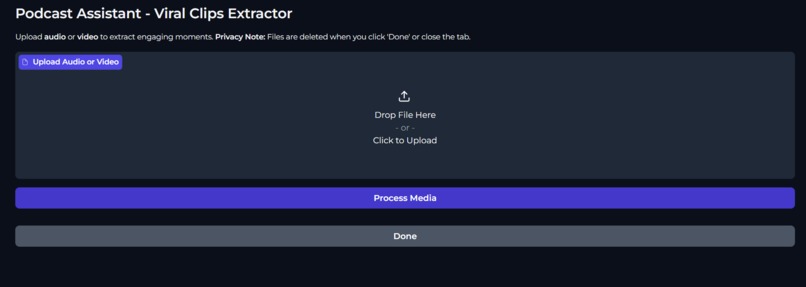
front-page
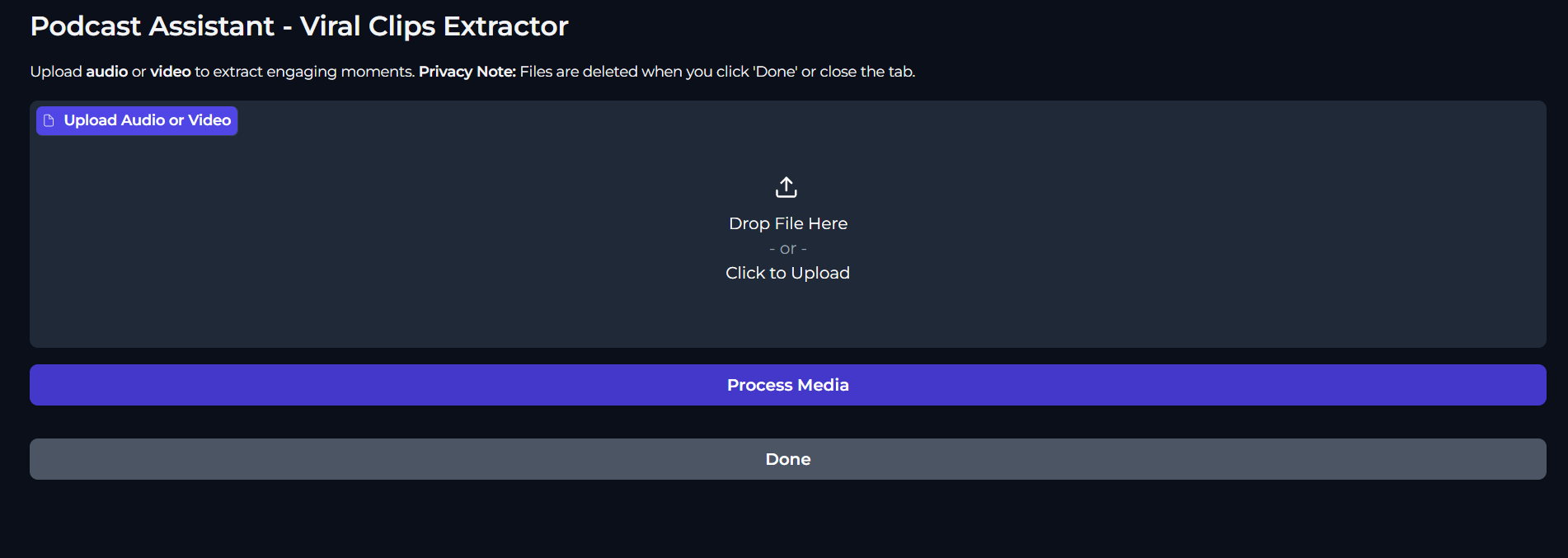
Inspiration
Whilst talking with a friend, they mentioned that even though they like the experience of recording episodes for their podcast and handling the montages, they find the process of finding engaging clips for their social media pages tiring and time-consuming. That's when the idea for a content creator assistant started, hoping to keep only the fun part of creating and automate the rest.
What it does
It takes media files as input and exports short clips that are most likely to fit the needs for promotional material.
How it was built
By using pre-existing models, I tried to create a new service that can handle large media files with as little computational power as possible, saving resources and keeping costs to a minimum. It is mainly built in Python and uses Gradio for the frontend and Docker for containerization.
Challenges
Considering the cost limitations, one of the greatest challenges was to build a new service that can process large media files but can also run on relatively limited resources. Keeping the voice quality as one of the top priorities and the ability to work with multiple languages, the process of finding a good enough balance was the most time-consuming.
Accomplishments
After a lot of trial and error, and back-and-forth between deployment and provider options, the main skeleton of the project has been stabilized using better models than it did when it started whilst achieving a relatively low cost. Even better was when it passed the first tests and my friend got to work with it with ease.
Lessons learned
It was a test of my git knowledge as well as my previously lacking familiarity with independent monitoring and firewall tools. Setting up my own separate VPS was also a first, as well as combining that many different models for a single purpose.
What's next for Podcast Assistant
I plan to expand it further with automated descriptions for uploaded episodes and catchy title suggestions.
Built With
- api
- docker
- git
- github
- github-actions
- gradio
- hugging-face
- javascript
- openai
- pyannote
- python
- sentence-transformers
- silero-vad

Log in or sign up for Devpost to join the conversation.