Inspiration
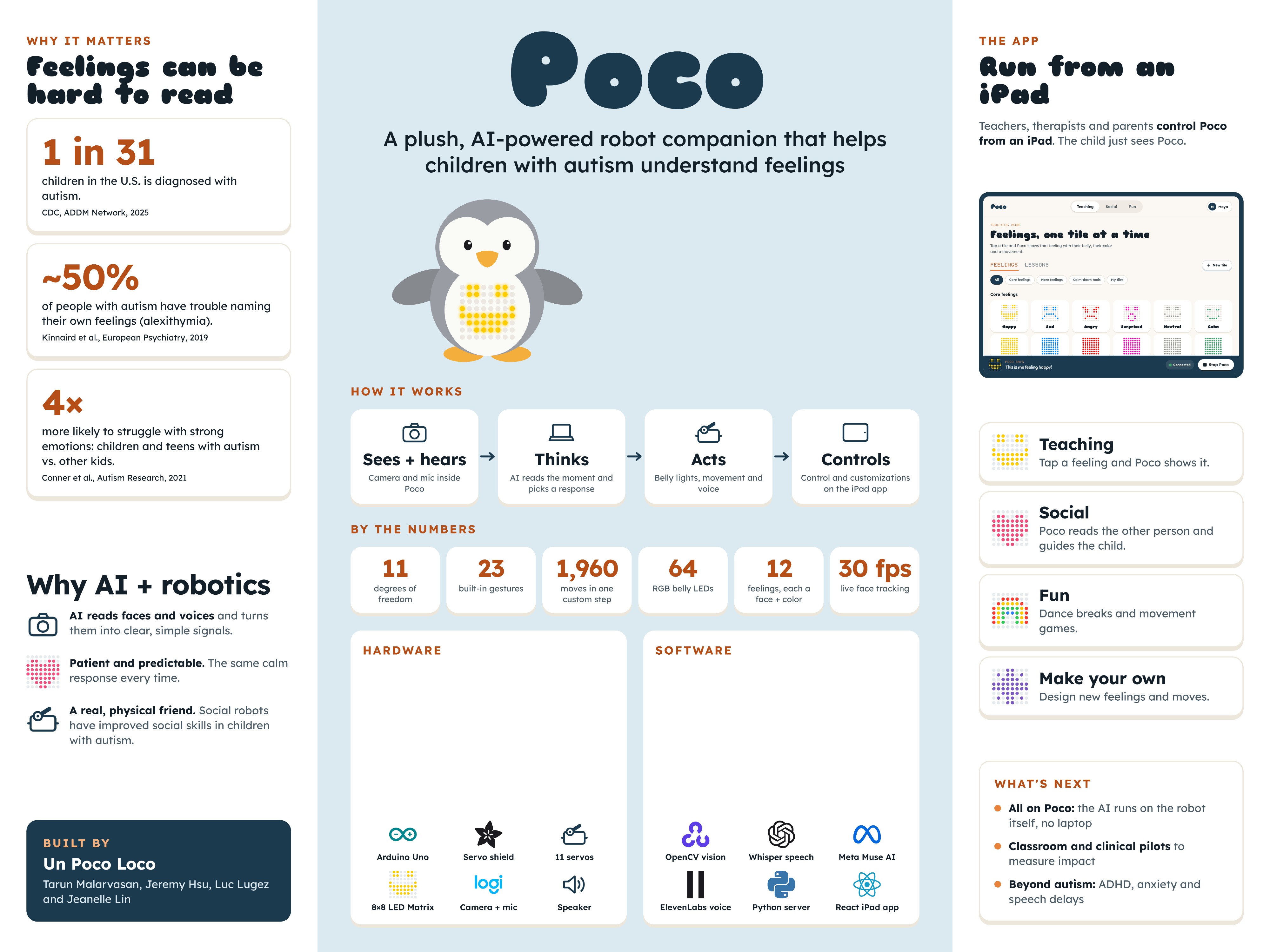
1 in 31 children in the U.S. is diagnosed with autism (CDC, 2025), and children with autism are 4× more likely to struggle with strong emotions (Conner et al., 2021). About half of people with autism also have trouble naming their own feelings (Kinnaird et al., 2019).
Yet emotion practice is still often a printed cartoon face and the same question over and over: "Is this person happy or sad?" Nothing responds, nothing adapts, and nothing about it feels like play. And recognizing "sad" on a flashcard is very different from spotting it on a real person's face, mid-conversation.
What it does
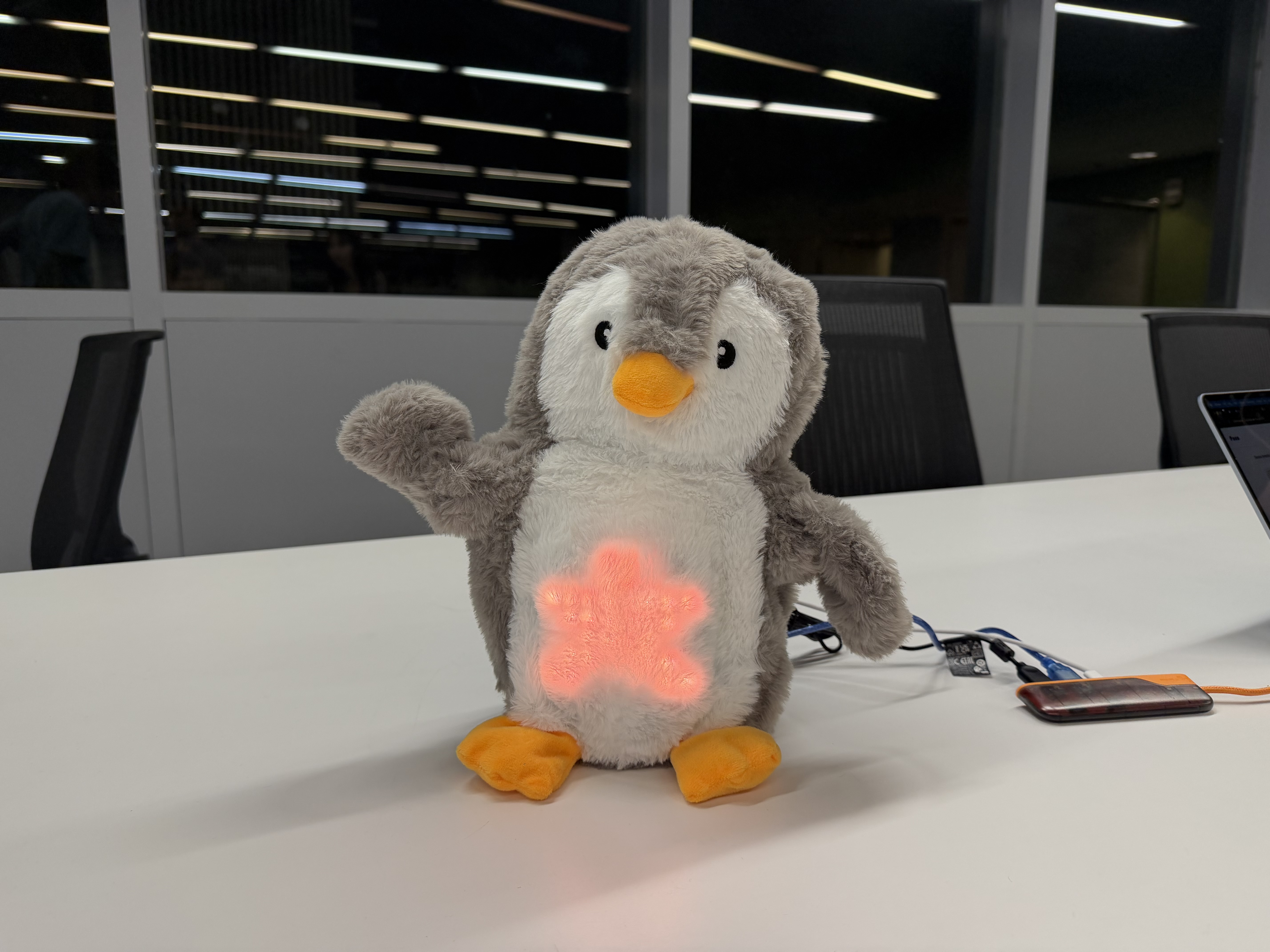
Poco is a plush robot penguin powered by AI, with three modes, all switched from an iPad:
- Social mode: Poco's camera and mic face the friend the child is talking to, and everything Poco says goes to the child. Friend: "I've got three exams and I'm really stressed." Poco, to the child: "You could ask which exam worries them most." Poco's default is silence; it only speaks when it has something worth saying.
- Teaching mode: tap a feeling and Poco acts it out, with the same face, color, movement and words every time. Lessons, calm-down tools like deep breaths, and custom feelings and moves (1,960 movement combinations per step).
- Play mode: the child talks to Poco directly. Poco answers, dances and makes faces, and teaches one small piece of each feeling the way therapists do.
The iPad app is for the grown-up. A 7-step setup personalizes Poco to each child (what calms them, how they communicate), and a session log shows what Poco noticed, what it did, and why.
How we built it
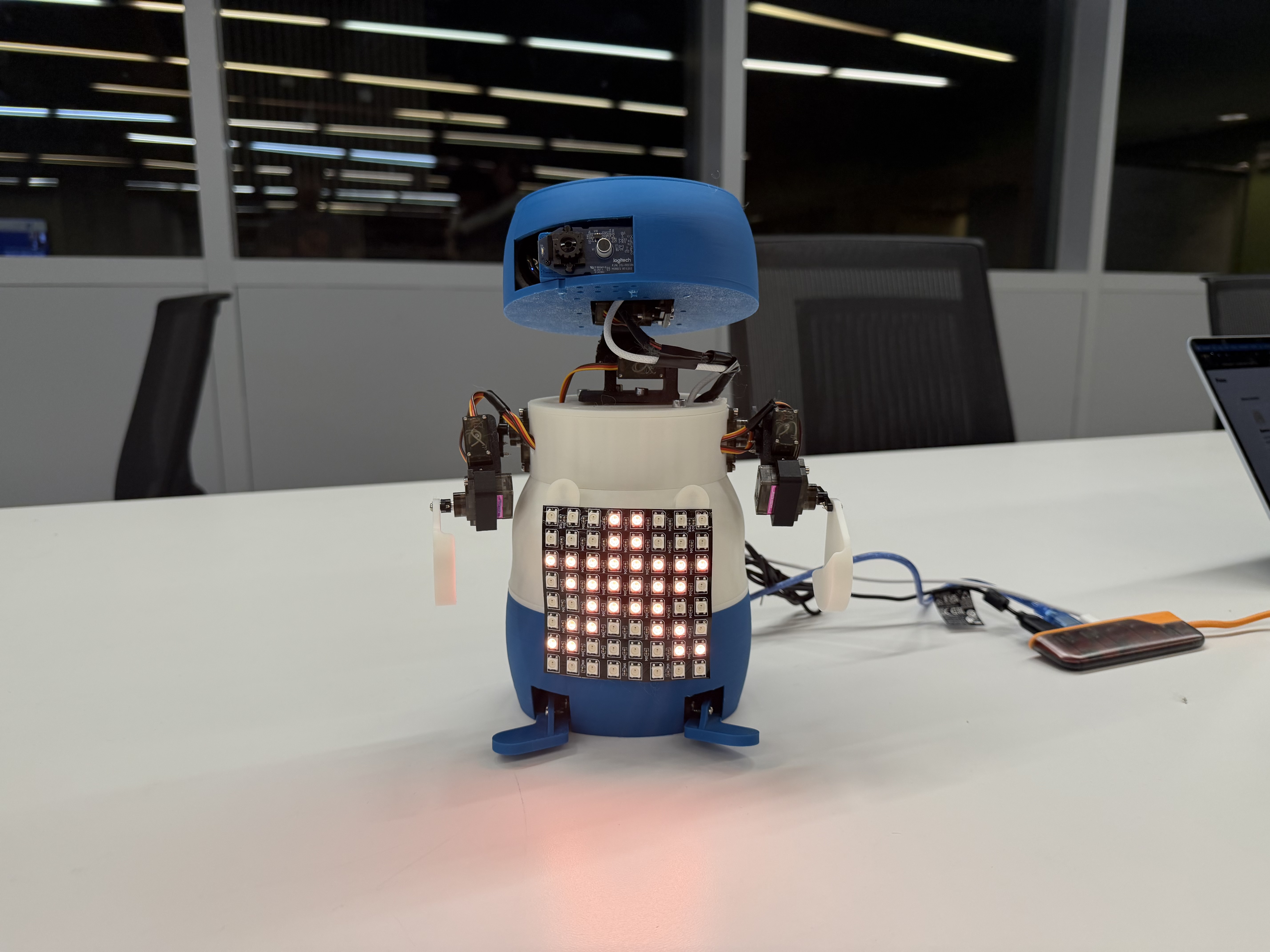
iPad app → WebSocket → laptop server → USB serial → Arduino → 11 servos + 8×8 LED belly
- Vision: OpenCV with the YuNet face detector and the HSEmotion emotion model, smoothed so Poco doesn't flicker between labels, at 30 fps
- Speech: Silero VAD to detect speech and Whisper to transcribe it, fused with facial emotion on one timeline
- Judgement: Meta Muse returns a schema-validated choice: what Poco should say (or nothing), a gesture, a belly color, and the reason
- Voice: ElevenLabs v3, with Poco's tone matched to the moment
- Memory: Backboard, opt-in, so Poco remembers the child between sessions
- Hardware: Arduino Uno, a PCA9685 servo shield, 11 servos (11 degrees of freedom), 23 keyframed gestures, and an 8×8 NeoPixel belly
- App: React + TypeScript + Vite, wrapped for iPad with Capacitor and Xcode
Challenges we ran into
- Poco kept hearing itself. Whisper transcribed Poco's own voice as the friend's words, so we mute the mic while Poco speaks.
- Emotion models are less reliable than they look. We swept 300 threshold combinations on recorded faces, and dropped "disgust" because the model couldn't tell it apart from anger.
- Chatbot vs. coach. Early Poco answered the friend directly. Separate Social and Play modes with separate prompts fixed it.
- Servo limits. Poco's arms rest at their limits, which flattened idle motion, so Poco now measures each servo's range at startup.
Accomplishments that we're proud of
- Full loop on real hardware: face + voice → understanding → voice, gesture and belly, at a steady 30 fps
- Vision + speech fused: Poco matches words to the speaker's face, so it catches "I'm fine" said with a sad face
- Dynamic, not scripted: Poco's AI decides in the moment what to say, how to move, and how to help.
- Built to move: 11 servos, 1,960 movement combinations per step, and a 64-LED belly showing 12 feelings
What we learned
- Robotics: designing natural motion within real physical limits: calibrating each of Poco's 11 servos, building keyframed gestures, and keeping movement smooth and safe
- Computer vision and AI: how pretrained emotion models behave on real faces, and how to tune them with our own recorded data instead of guessing thresholds
- Designing for human connection: building technology that supports a relationship between two people instead of replacing it, which is why Poco coaches the child rather than talking for them
What's next for Poco
- Run the AI fully on Poco, no laptop needed, with a local model for families who want nothing to leave the room
- Pilot Poco with kids, teachers and therapists, starting with our teammate's brother
- Help more children: ADHD, anxiety and speech delays
Built With
- arduino
- backboard
- cad
- capacitor
- elevenlabs
- llm
- muse
- opencv
- python
- react
- servos
- typescript
- websockets
- whisper


Log in or sign up for Devpost to join the conversation.