-
-
How it reads
What Inspired Us
Ever watch your grandmother leave a clinic, prescription in hand, nodding politely while quietly praying she remembers whether it’s one pill or two, and before or after food? For millions of elders, deciphering a doctor's messy scribble is a daily, stressful guessing game. Seeing this in our own families broke our hearts and became the spark for PocketPharmist. We knew we had to build something that felt less like a cold tech tool and more like a helping hand.
##How We Built It
We didn't build this sitting safely behind a computer screen; we walked straight into local pharmacy shops and hospital OPD counters to watch how prescriptions actually get handled.
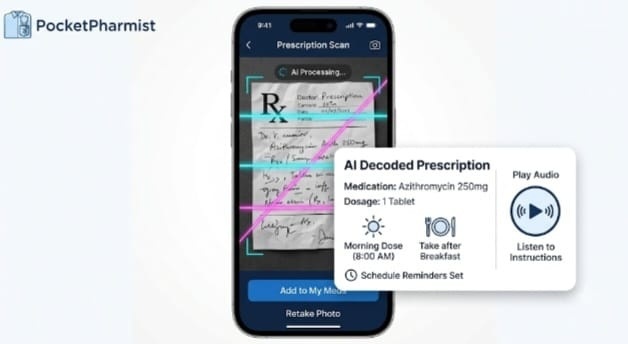
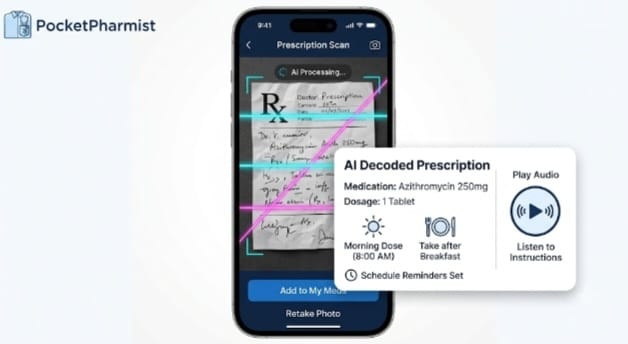
The Snapping Tool: Users simply snap a photo of the prescription.
The AI Brain: Our AI cuts through the illegible handwriting, translating the doctor's shorthand.
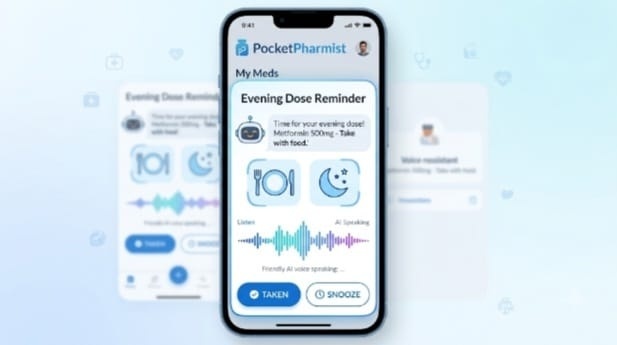
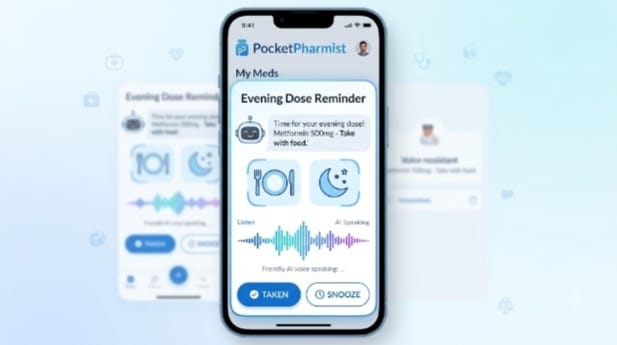
The Human Touch: It converts those notes into dead-simple visual cues—like a little sun for morning or a plate for food—paired with simple text and a built-in voice agent that reads it all aloud in Bengali and Hindi. No app learning curve, no English medical jargon.
##The Challenges We Faced
The Handwriting Wall: Let’s be honest—doctors' handwriting is legendary for a reason. Training our AI to reliably make sense of chaotic, rushed scribbles was a massive hurdle.
Designing for Everyone: How do you build an app for someone who can't read at all? We had to completely rethink user interfaces, leaning heavily on intuitive icons and voice-first design so literacy is never a barrier.
##What We Learned
We learned that the best healthcare tech doesn't come from a textbook; it comes from humility and listening. By testing our ideas directly with ground-level pharmacists and elderly patients, we realized true innovation isn’t about flashy features—it’s about making sure no one takes the wrong dose just because of a messy pen stroke, delivered the way a caring family member would explain it.
Built With
- amazon-web-services
- fastapi
- google-cloud-vision-ocr
- python
- react-native
- text-to-speech-api

Log in or sign up for Devpost to join the conversation.