-
-
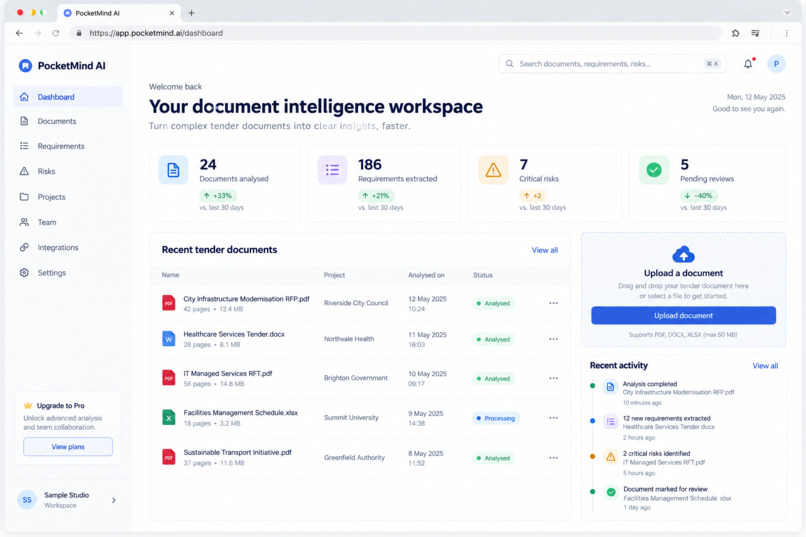
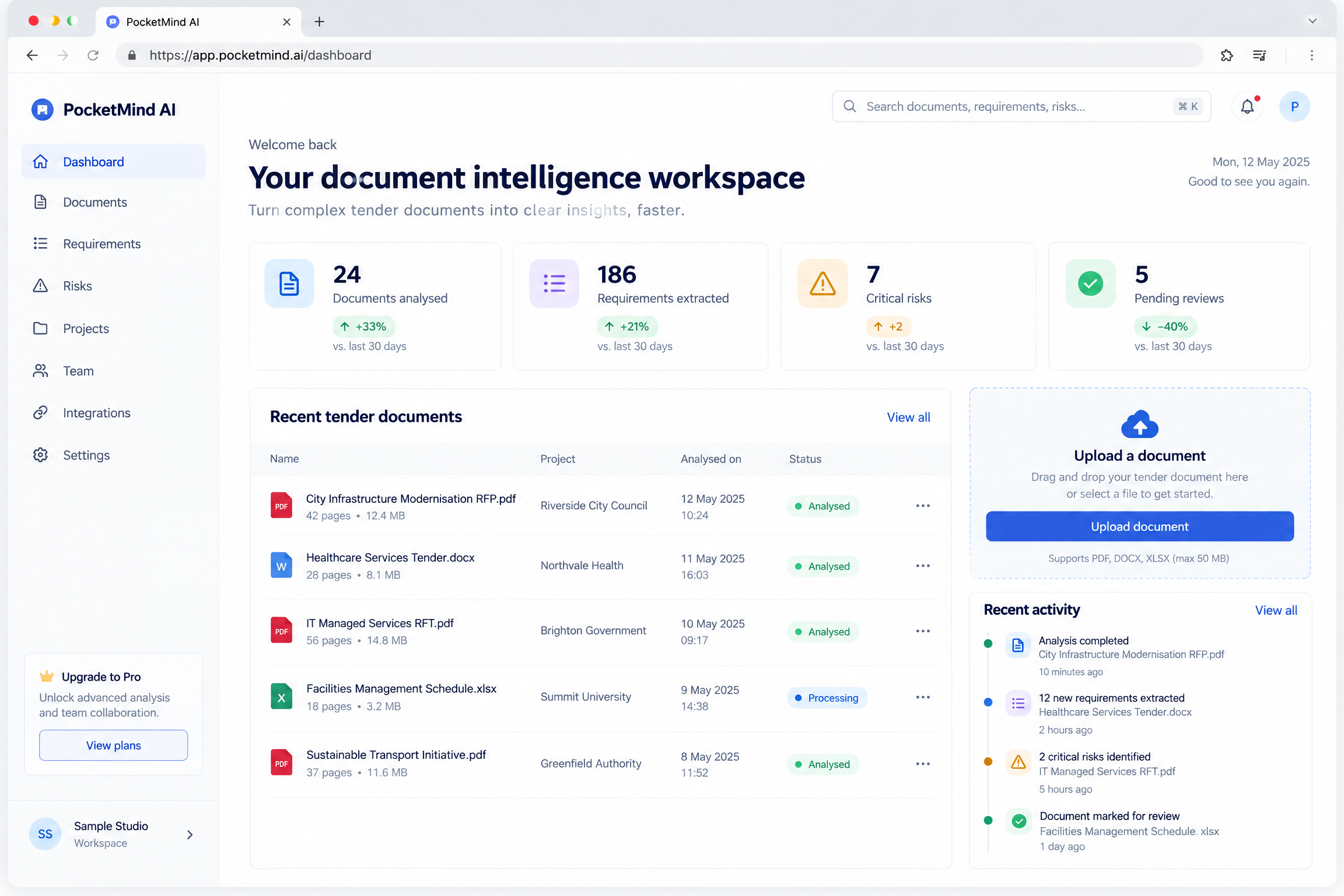
Dashboard for tracking documents, extracted requirements, critical risks and pending reviews. Illustrative demo data.
-
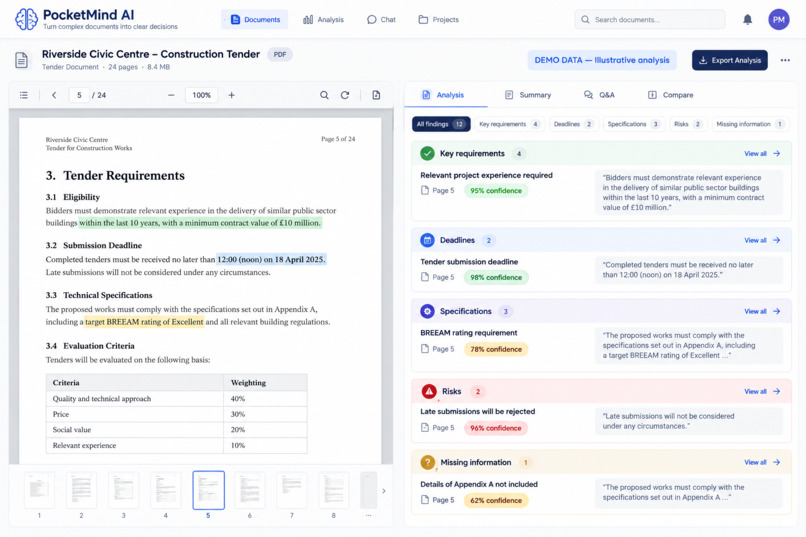
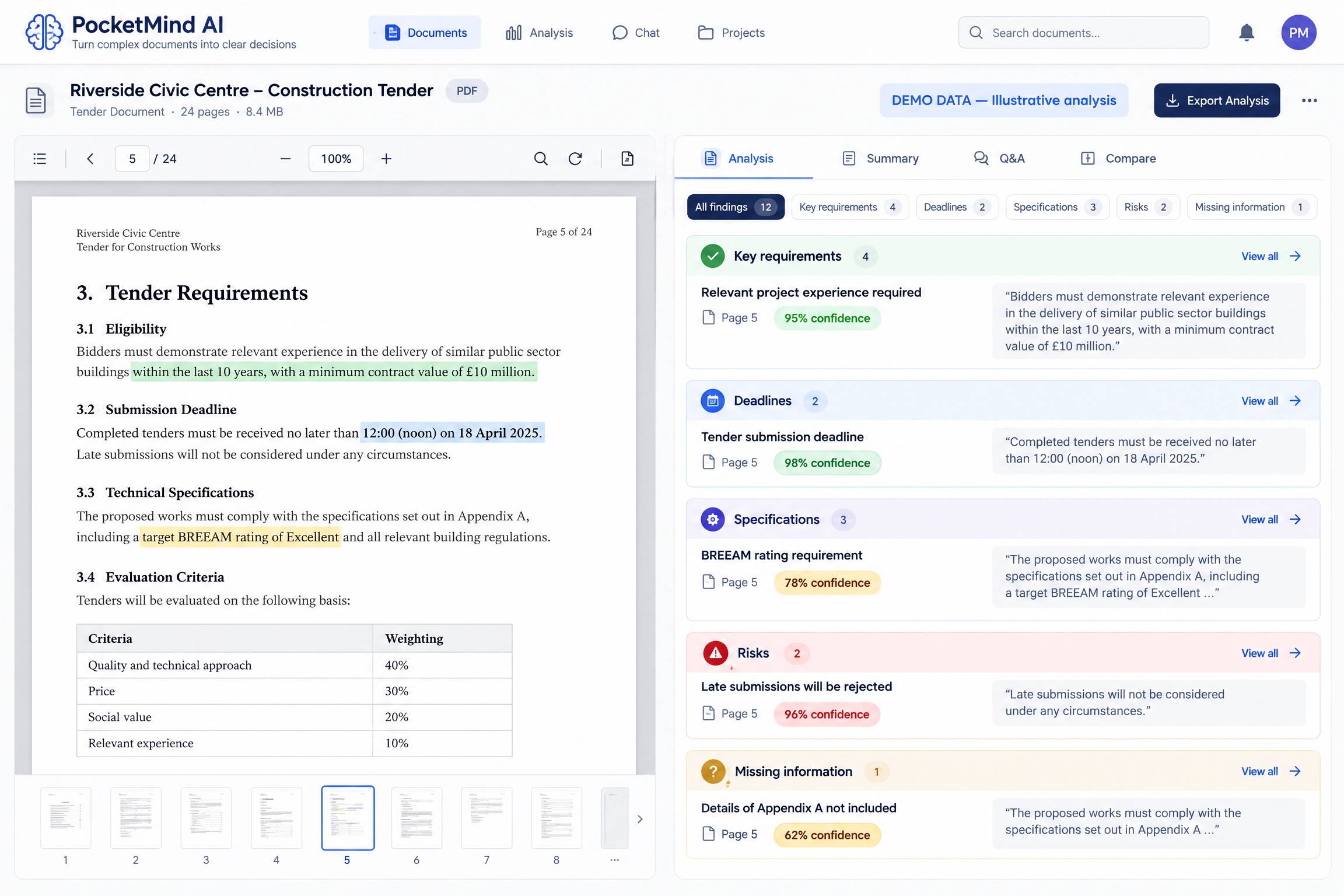
Analyse complex PDFs, uncover requirements and risks, and verify every finding against its source page.
-
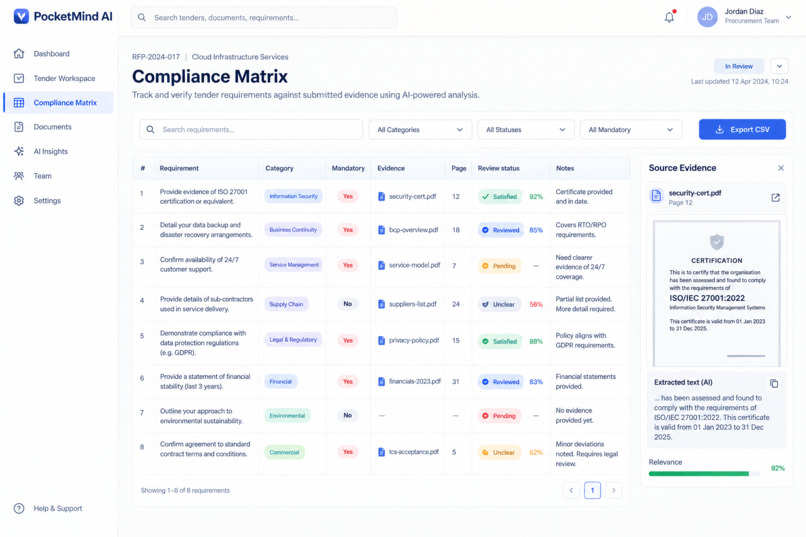
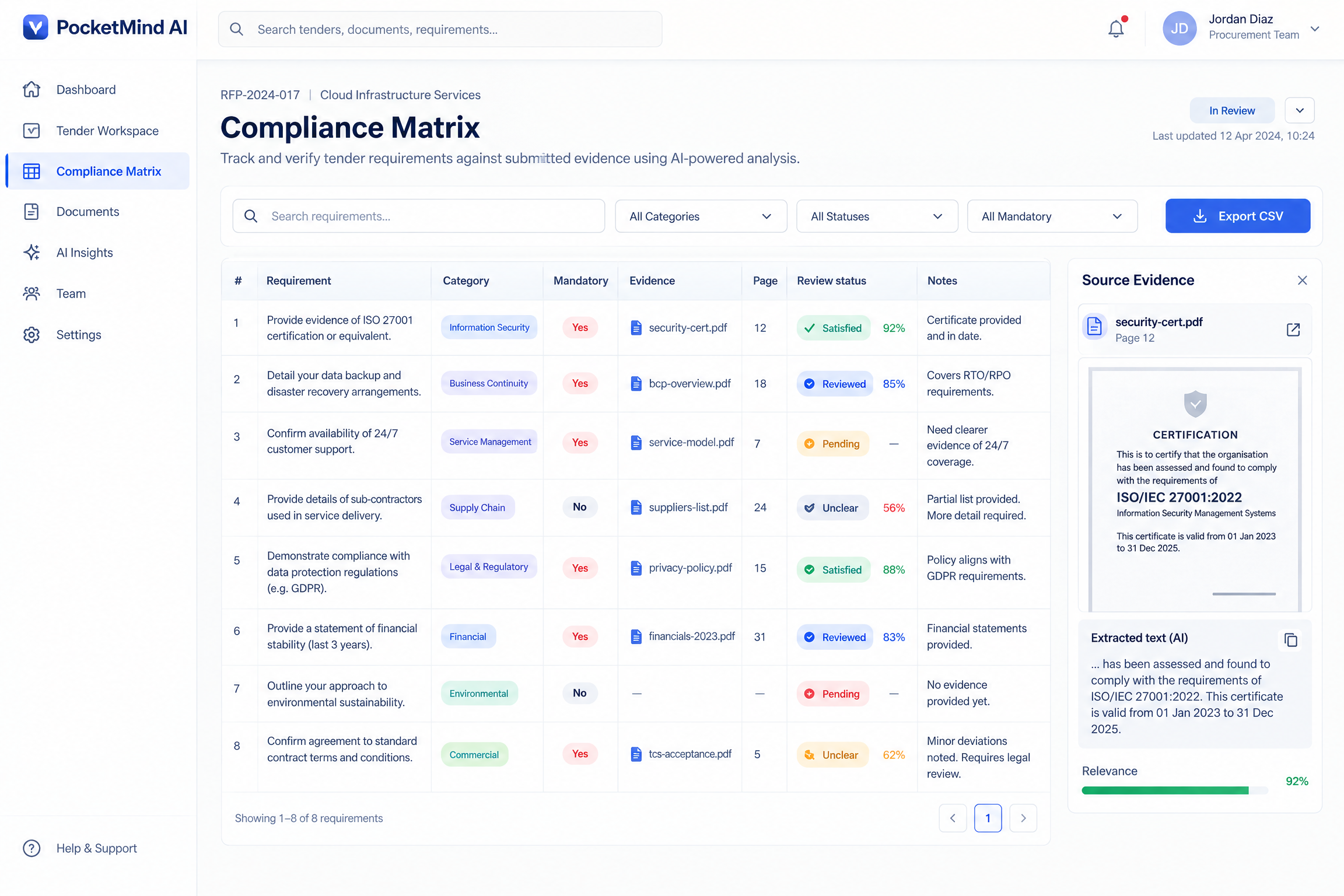
Review mandatory requirements, evidence and status in one structured compliance matrix. Fictional demo data.
-
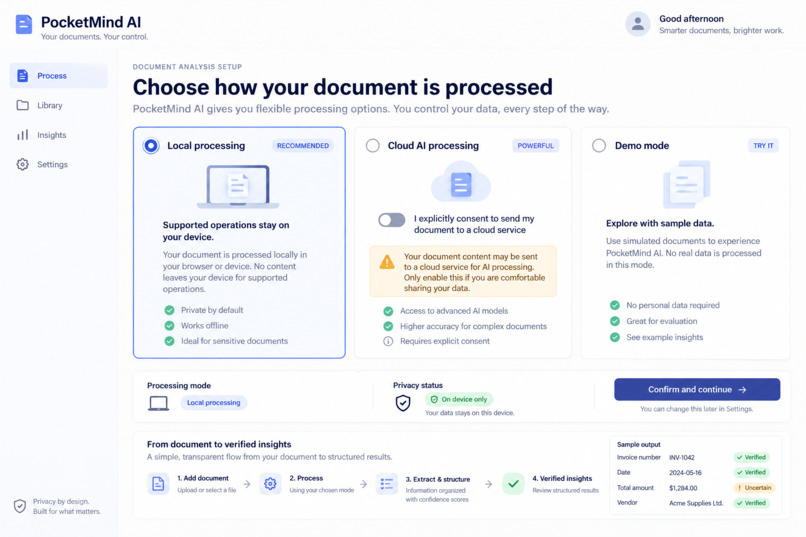
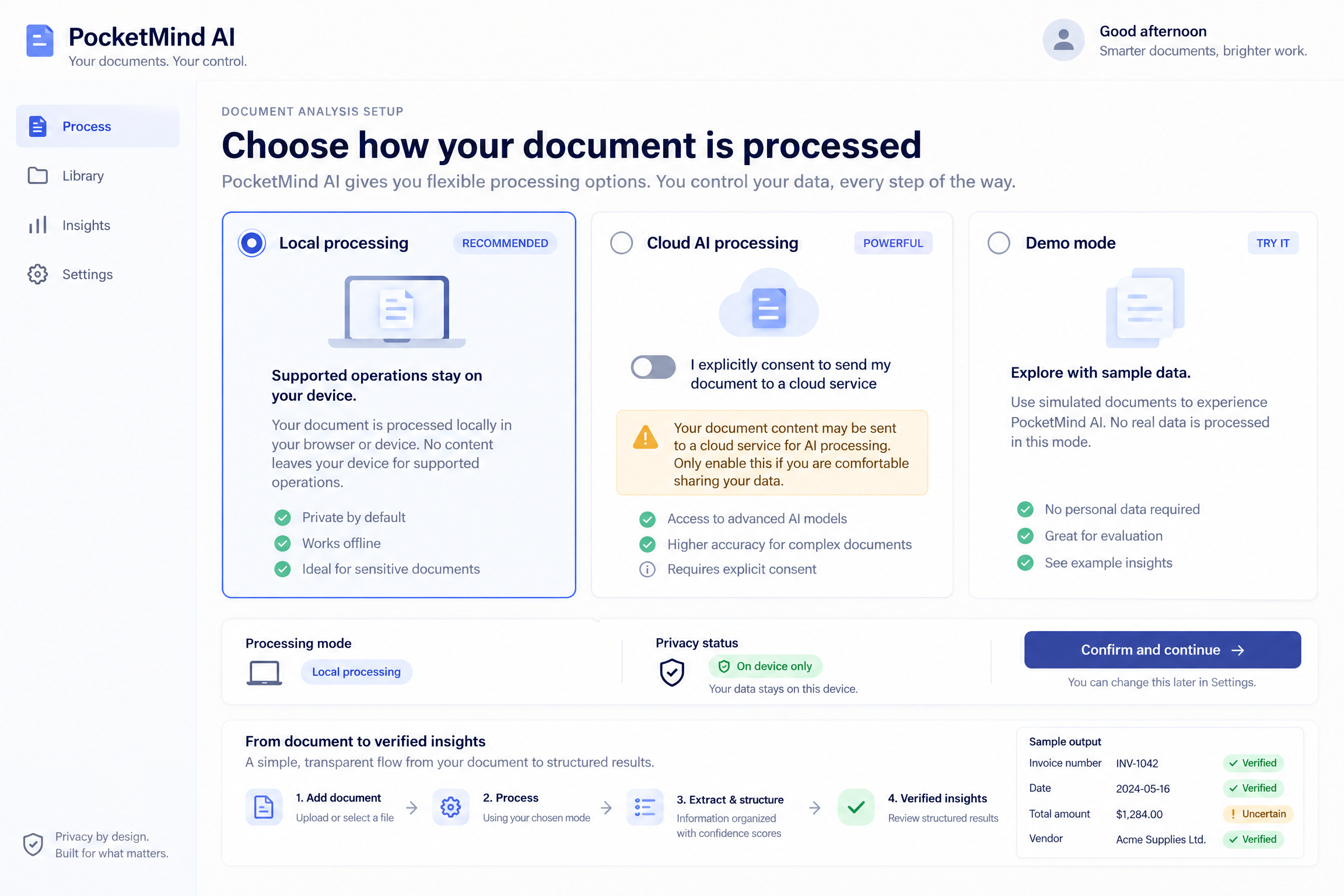
Choose local, cloud or demo processing and understand how your document is handled before analysis.
PocketMind AI
From complex documents to actionable, verifiable intelligence.
Inspiration
Important business decisions often depend on information hidden inside large and complex documents.
Companies participating in public procurement, tender processes and RFPs must review extensive PDFs, technical specifications, appendices and regulatory references to identify deadlines, mandatory requirements, quantities, qualifications and potential risks.
Much of this work is still performed manually. Finding one missing requirement or overlooking an important detail can result in wasted time, costly rework or even a disqualified proposal.
We wanted to explore a better approach: what if AI could transform complex document packages into structured, actionable information while keeping users in control of their documents?
That idea became PocketMind AI.
What it does
PocketMind AI is an AI-powered document intelligence assistant designed to help professionals understand and analyse complex PDF documents.
Instead of simply summarising documents or providing a conversational interface, our vision is to extract information that people can actually use in their workflows.
The platform focuses on identifying:
- Mandatory requirements and compliance items.
- Important deadlines and submission conditions.
- Quantities, specifications and technical information.
- Missing information and potential inconsistencies.
- Relevant references and supporting evidence.
A key principle is traceability: extracted information should remain connected to its original document and page, allowing users to verify the evidence and review AI-generated results.
Our goal is to turn document analysis into a structured, reviewable workflow that supports better decisions without replacing human judgement.
How we built it
PocketMind AI is designed around a hybrid AI architecture, exploring the combination of on-device processing and cloud-based AI through Firebase AI Logic.
The architecture separates document-processing tasks according to their complexity and processing requirements.
Where appropriate, lightweight operations can be performed locally. More demanding analysis can use cloud-based AI models through Firebase AI Logic, with explicit user authorisation.
The intended processing pipeline includes:
- Document ingestion and PDF text extraction.
- OCR support for scanned documents.
- Document classification and identification of relevant sections.
- AI-assisted extraction of structured information.
- Evidence tracking, confidence indicators and human review.
Our technical approach draws on experience with React, TypeScript, AI integrations, APIs, cloud services and OCR-based document workflows.
We also identified an opportunity to connect document analysis with structured legislative information. Resources such as ctresb/leis, which organises Brazilian legislation into structured Markdown documents with source references and metadata, provide an interesting direction for future development.
Challenges we ran into
One of the main challenges was balancing AI capabilities with document privacy and user control.
Not every document should automatically be sent to a cloud service. We therefore considered how processing decisions, cloud consent and user visibility should be incorporated into the architecture.
Another challenge is the reliability of document extraction. PDFs are not always machine-readable, and scanned documents, complex tables, inconsistent formatting and OCR errors can affect the quality of extracted information.
We also recognised that AI-generated answers need evidence. A result without a traceable source is not sufficient when someone is preparing a formal proposal or reviewing contractual requirements.
These challenges reinforced the importance of combining AI automation with source references, uncertainty awareness and human verification.
Accomplishments that we're proud of
We are proud of establishing a focused product direction around a concrete professional problem rather than building another generic AI chatbot.
Our main design principles are:
- Hybrid processing: choosing appropriate processing paths for different tasks.
- User control: making cloud processing an explicit decision.
- Structured intelligence: turning unstructured documents into organised information.
- Traceability: connecting results to their original sources.
- Human oversight: keeping users responsible for reviewing and approving important findings.
We believe these principles provide a meaningful foundation for practical AI-assisted document analysis.
What we learned
This project reinforced an important lesson: applying AI to professional workflows requires more than generating convincing answers.
Useful AI systems need reliable input processing, structured outputs, traceable evidence and appropriate human oversight.
We also learned that privacy should be considered at the architectural level, rather than added as an afterthought.
The hybrid AI approach encouraged us to think more carefully about which tasks need cloud intelligence, which can be handled locally and how users should remain informed and in control.
What's next for PocketMind AI
Our next step is to validate the approach with companies, consultants and professionals who regularly prepare proposals and analyse tender documents.
We plan to improve PDF and OCR processing, strengthen requirement extraction, introduce compliance matrix exports and expand connections to trusted legislative sources.
We also want to evaluate the system using real-world documents, measuring extraction accuracy, time saved, correction rates and user confidence.
Our long-term ambition is to make PocketMind AI a reliable document intelligence layer for professional decisions.
PocketMind AI — Understand complex documents. Extract what matters. Stay in control.
Built With
- ai
- artificial
- firebase
- generative
- intelligence
- logic
- ocr
- processing
- react
- typescript
- web

