Inspiration
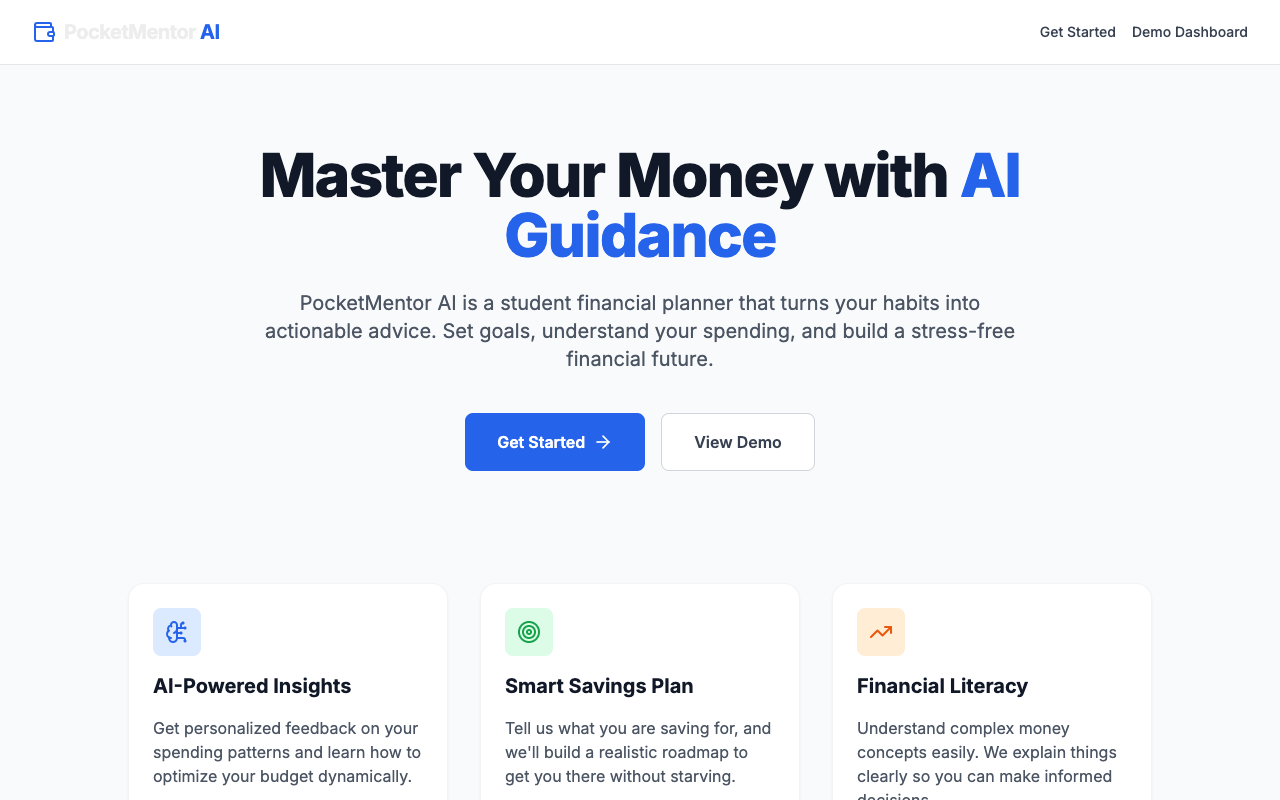
Millions of students and young adults enter the real world completely blind to personal finance. Traditional budgeting apps act like spreadsheets—they passively track where your money went, but they don't actively teach you how to fix your habits or plan for the future. We wanted to build something different: an app that doesn't just track your money, but actually mentors you.
What it does
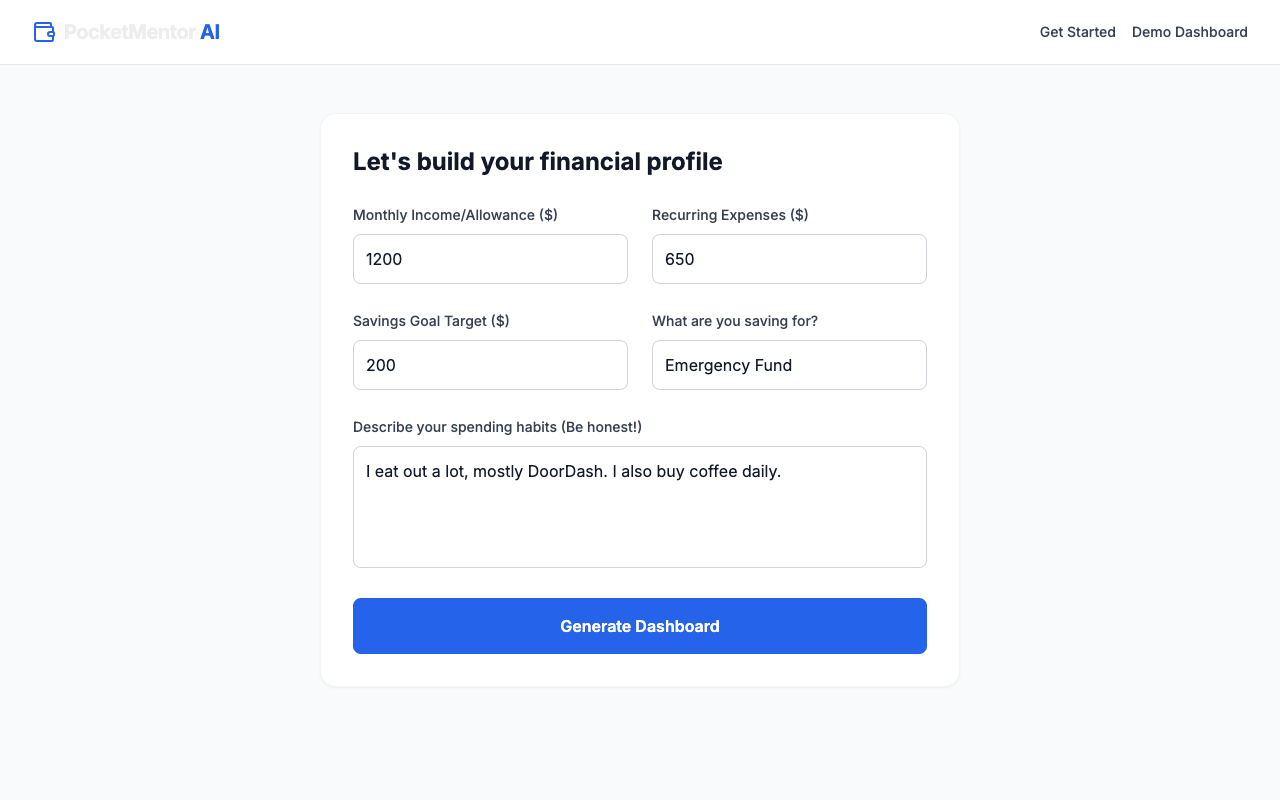
PocketMentor AI is a personalized financial coach. Users enter their monthly income, fixed expenses, savings goals, and most importantly, their raw spending habits (e.g., "I eat out a lot on DoorDash"). In seconds, the app generates a personalized dashboard featuring: AI Budget Summary & Savings Roadmap: A clear timeline to hit their exact goals. Behavioral Spending Alerts: The AI catches risky habits and provides 3 actionable steps to mitigate them. Dynamic Explainer Cards: If the AI notices a specific habit, it generates a financial literacy lesson (like explaining the "Latte Factor" or the "50/30/20 Rule") so the user actually learns. Scenario Simulator: An interactive slider that lets users see how cutting discretionary spending instantly recalculates their savings timeline.
How we built it
We built the frontend using Next.js 14 (App Router), TypeScript, and Tailwind CSS for a highly responsive, clean UI. For the AI brain, we integrated the NVIDIA NIM API, specifically utilizing the meta/llama-3.1-70b-instruct model. We built a secure serverless route (/api/analyze) that takes the user's financial profile, sanitizes the inputs to prevent prompt injection, and forces the LLM to return a strictly structured JSON payload. The Next.js frontend then parses this JSON to beautifully render the data visualizations and cards.
Challenges we ran into
Getting a Large Language Model to consistently output perfect, parsable JSON for a UI to consume is notoriously difficult. If the LLM hallucinates markdown or breaks the structure, the entire React dashboard would crash. We overcame this by implementing Zod schema validation on the server. If the LLM output doesn't perfectly match our required structure, it is safely caught and handled without breaking the user experience. We also had to migrate our models mid-build to ensure we were using the latest active Llama 3.1 endpoints on NVIDIA NIM.
Accomplishments that we're proud of
We are incredibly proud to have shipped a fully functional, crash-proof, and secure application. The UI feels indistinguishable from a polished startup product, and the AI integration is fast and genuinely provides high-quality, grounded financial advice rather than generic chatbot text.
What we learned
We learned a massive amount about LLM prompt engineering for structured data, securing serverless Next.js API routes, and utilizing NVIDIA's high-performance inference microservices (NIM) for lightning-fast AI responses.
What's next for PocketMentor AI
We plan to integrate the Plaid API to pull in live bank transaction data automatically, removing the need for manual onboarding. We also want to introduce gamified "savings streaks" to keep users motivated over months.
Built With
- llama-3.1
- next.js
- nvidia-nim
- react
- tailwindcss
- typescript
- vercel

Log in or sign up for Devpost to join the conversation.