-
-
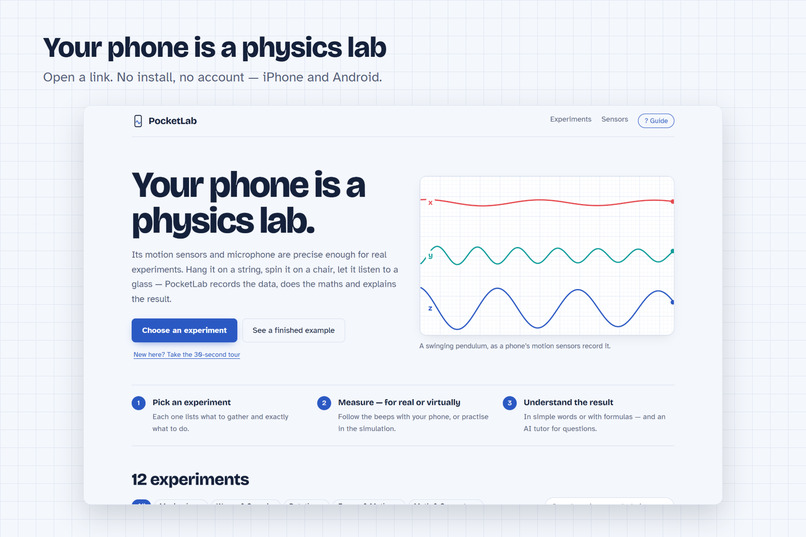
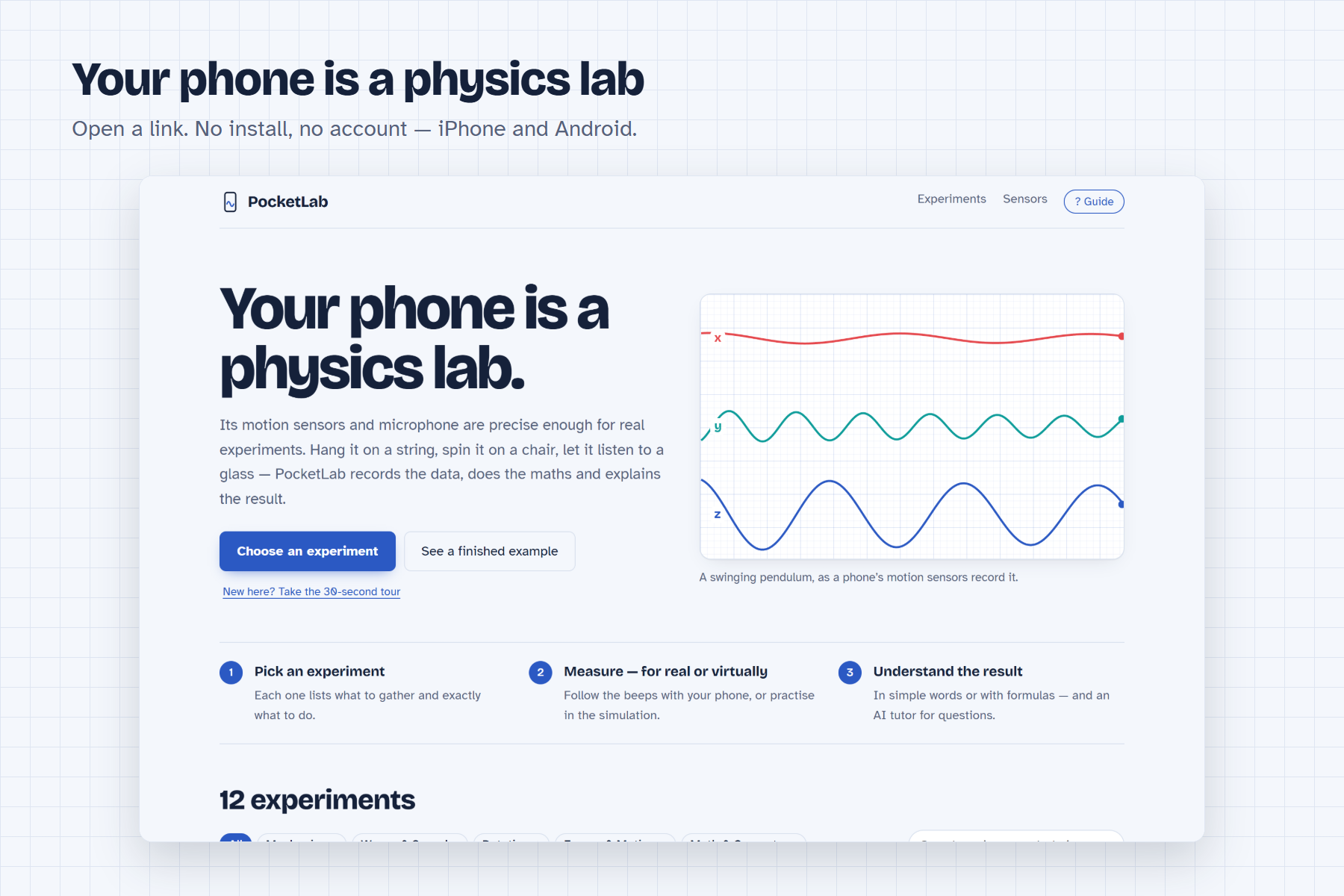
Open a link and your phone becomes a physics lab: the live trace is what its motion sensors record on a swinging pendulum.
-
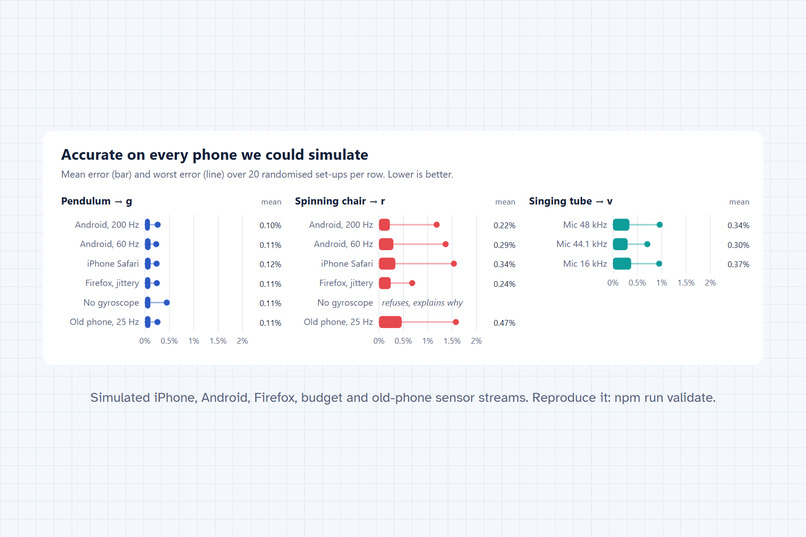
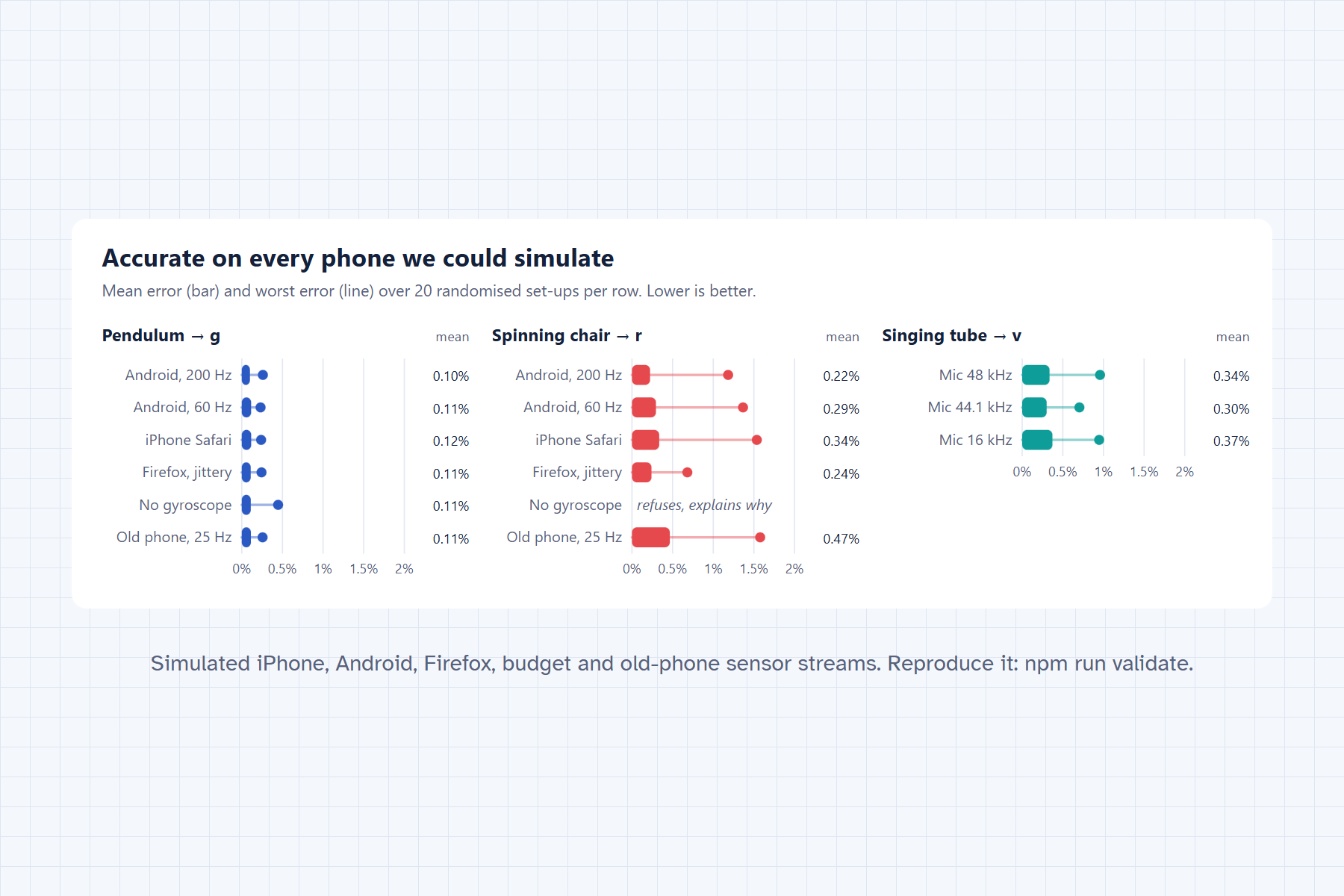
Accurate on every phone we could simulate: under 0.5 % mean error, under 2 % in the worst case.
-
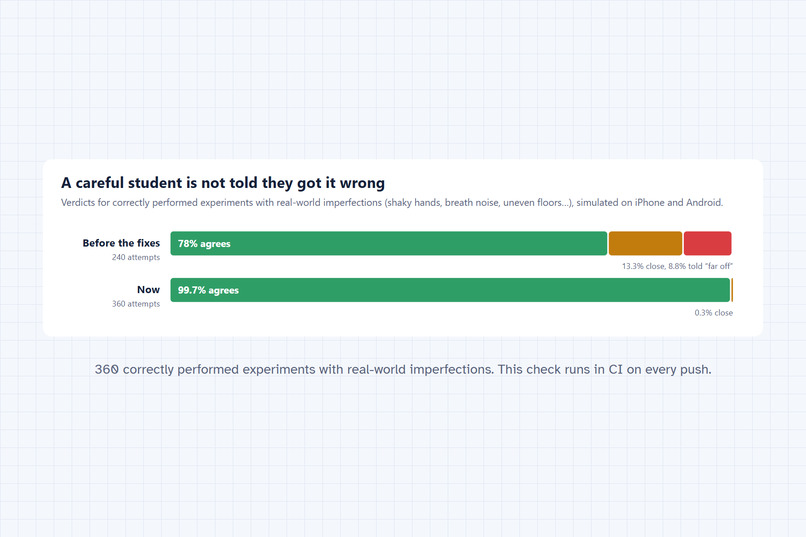
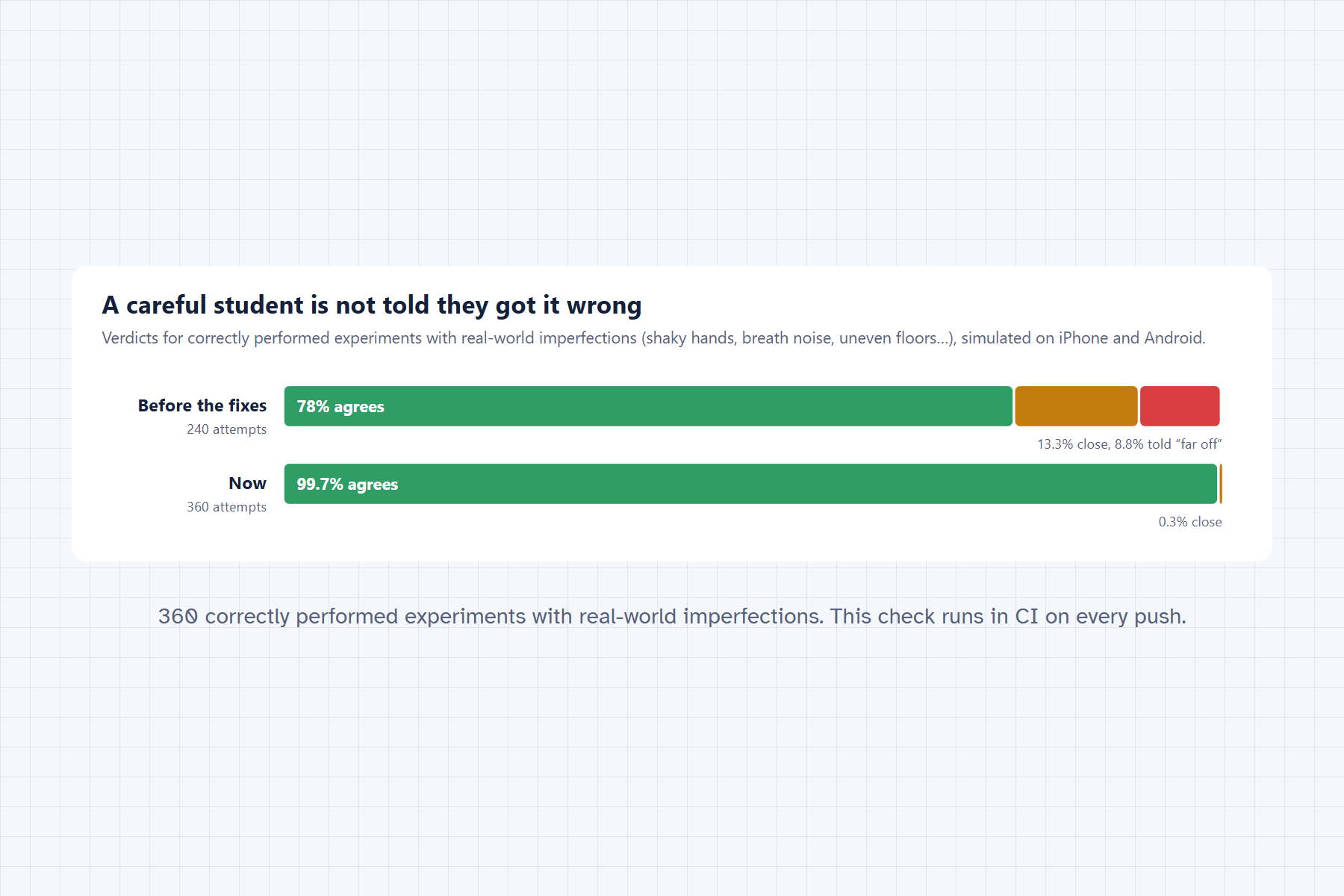
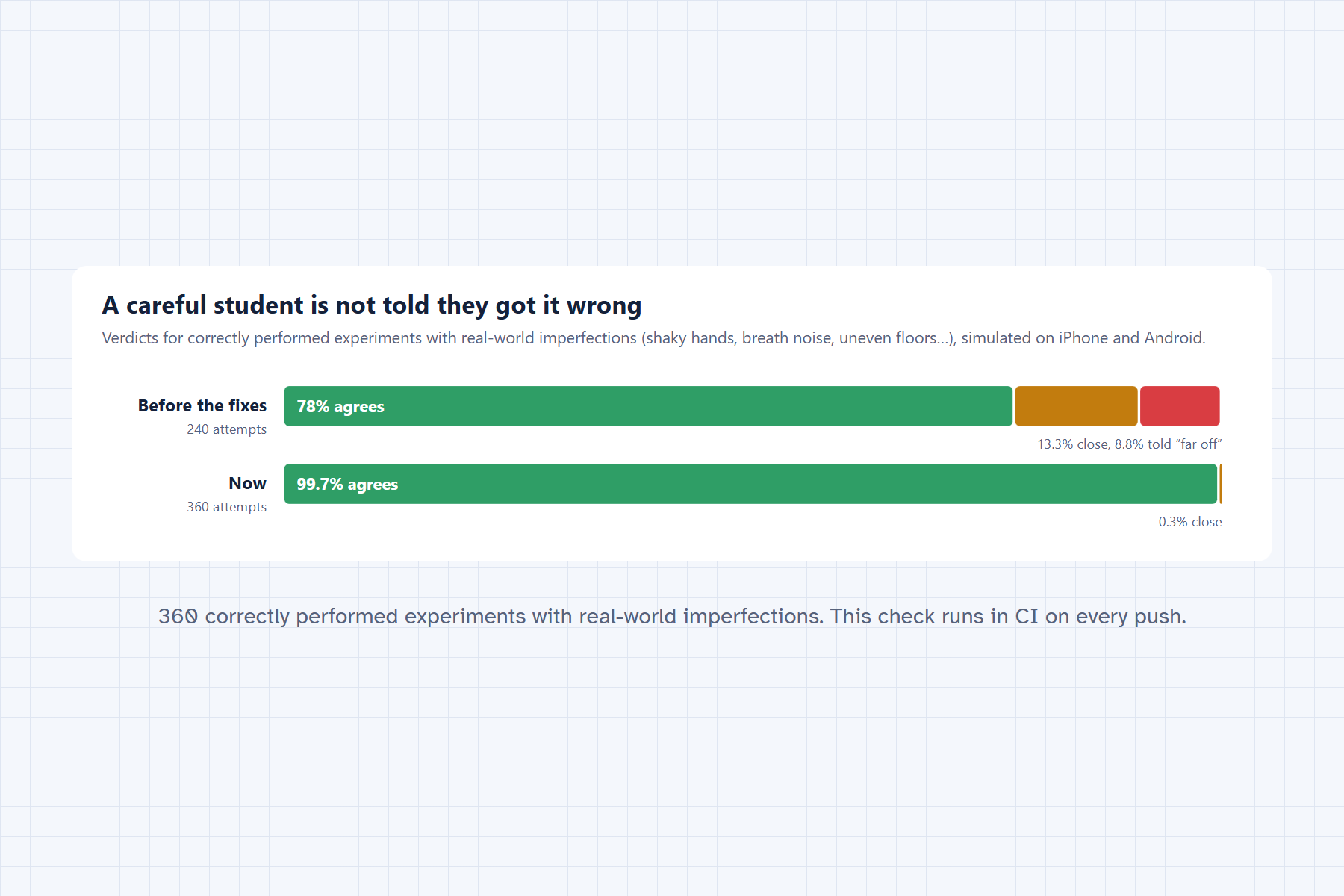
A careful student is not told they got it wrong: 99.7 % of correct experiments now "agree", up from 78 %.
-
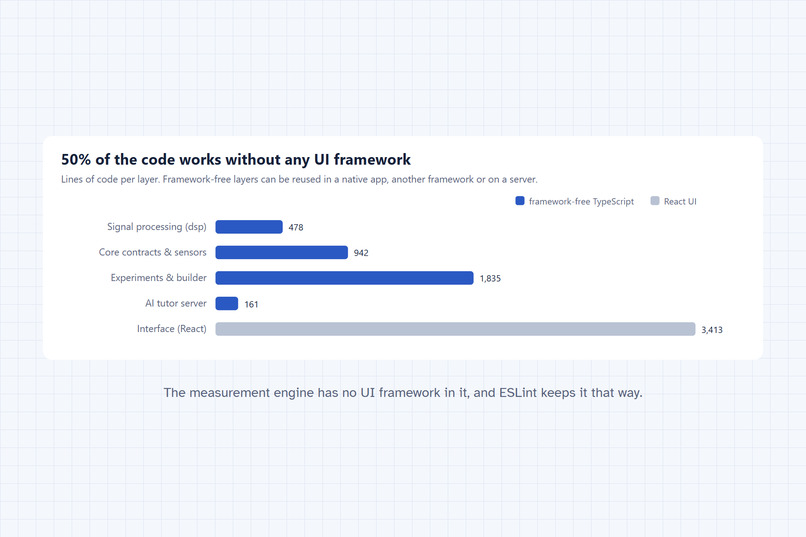
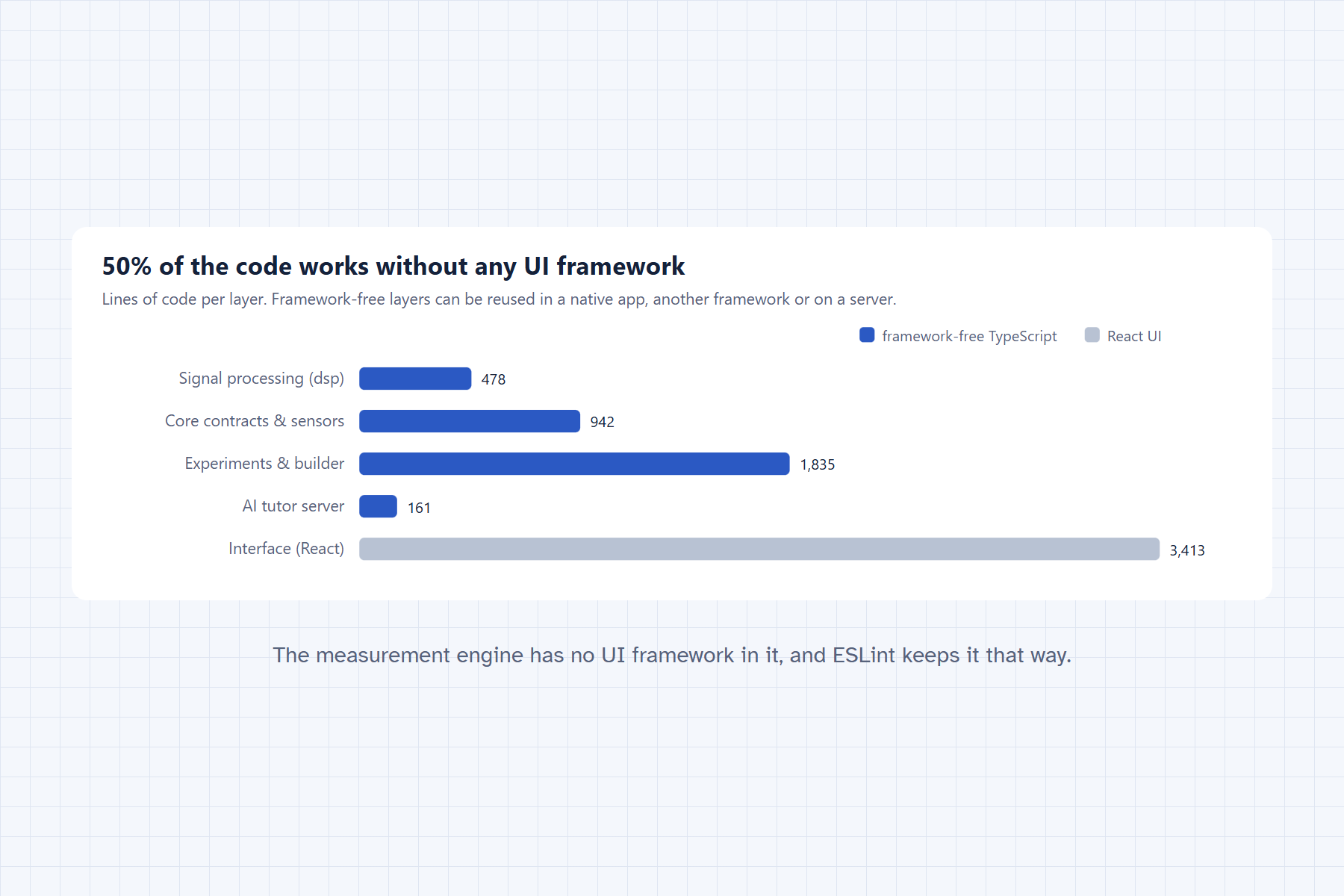
Half of the code works without any UI framework: the measurement engine is reusable anywhere.
-
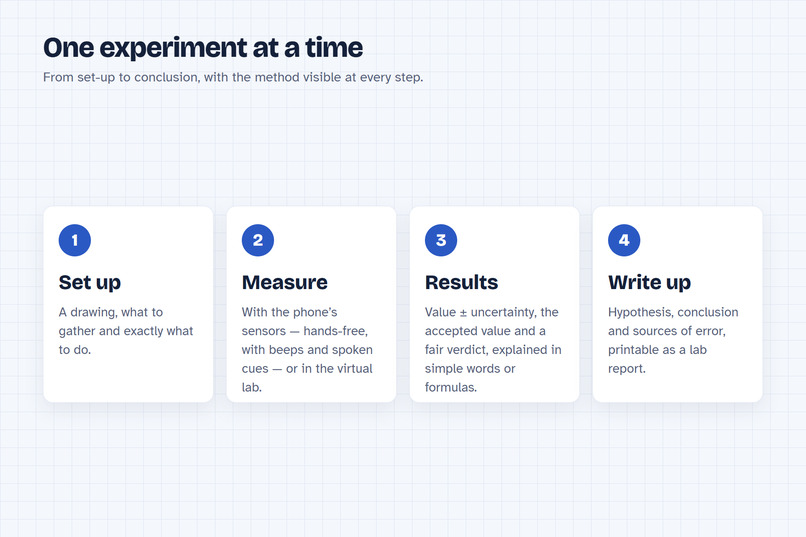
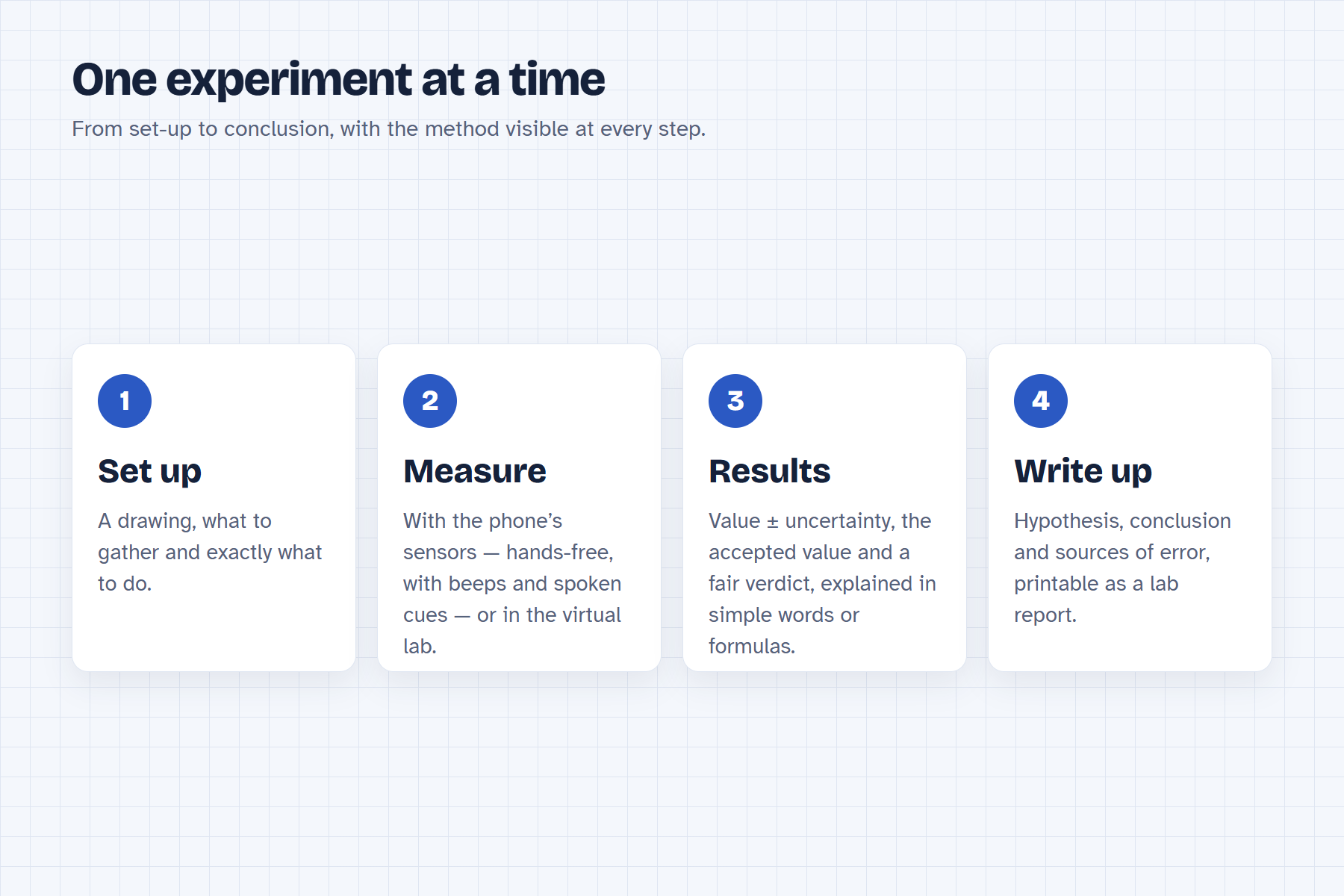
One experiment at a time: set up, measure (for real or virtually), understand the result, write it up.
-
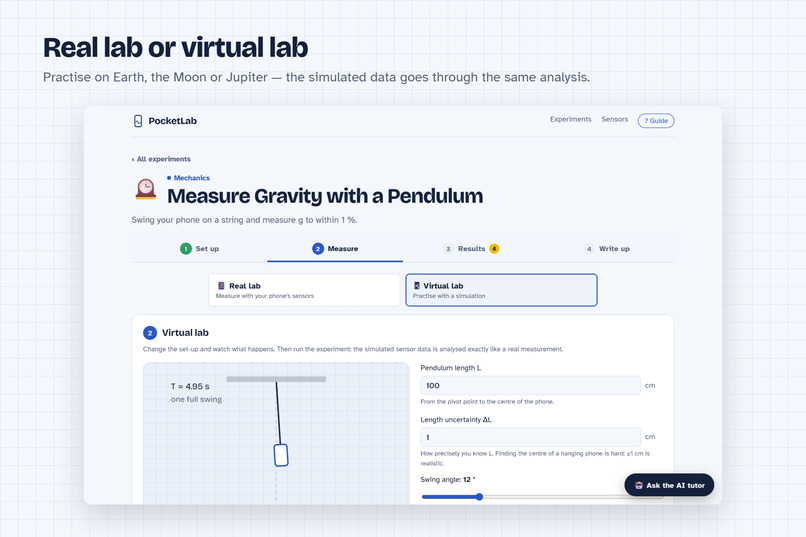
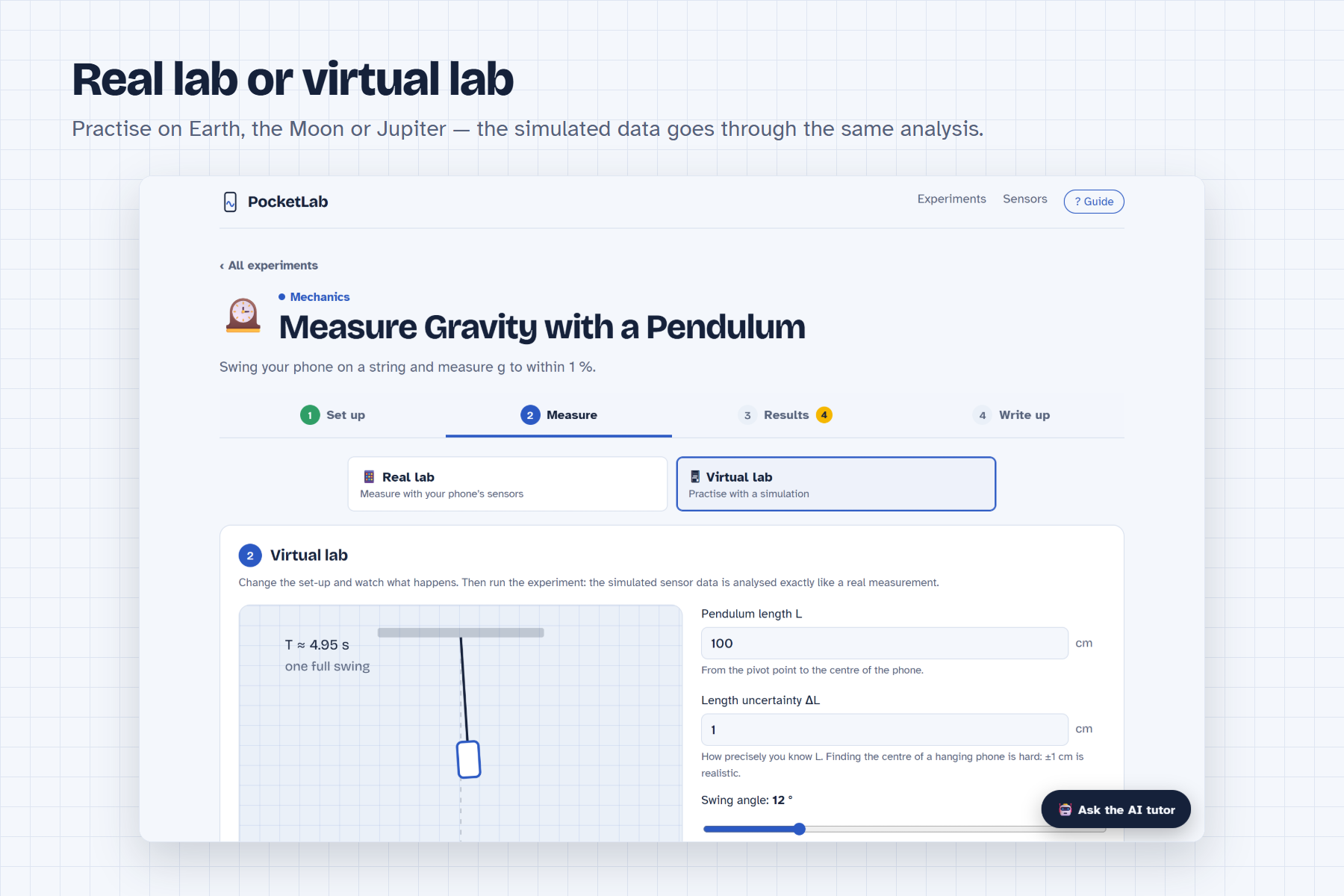
Virtual lab: practise on Earth, the Moon or Jupiter; the simulated data goes through the same analysis as a real one.
-
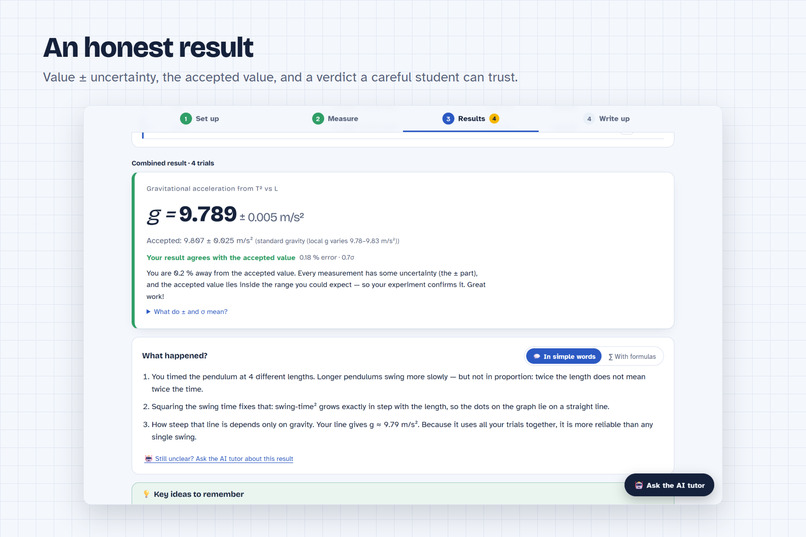
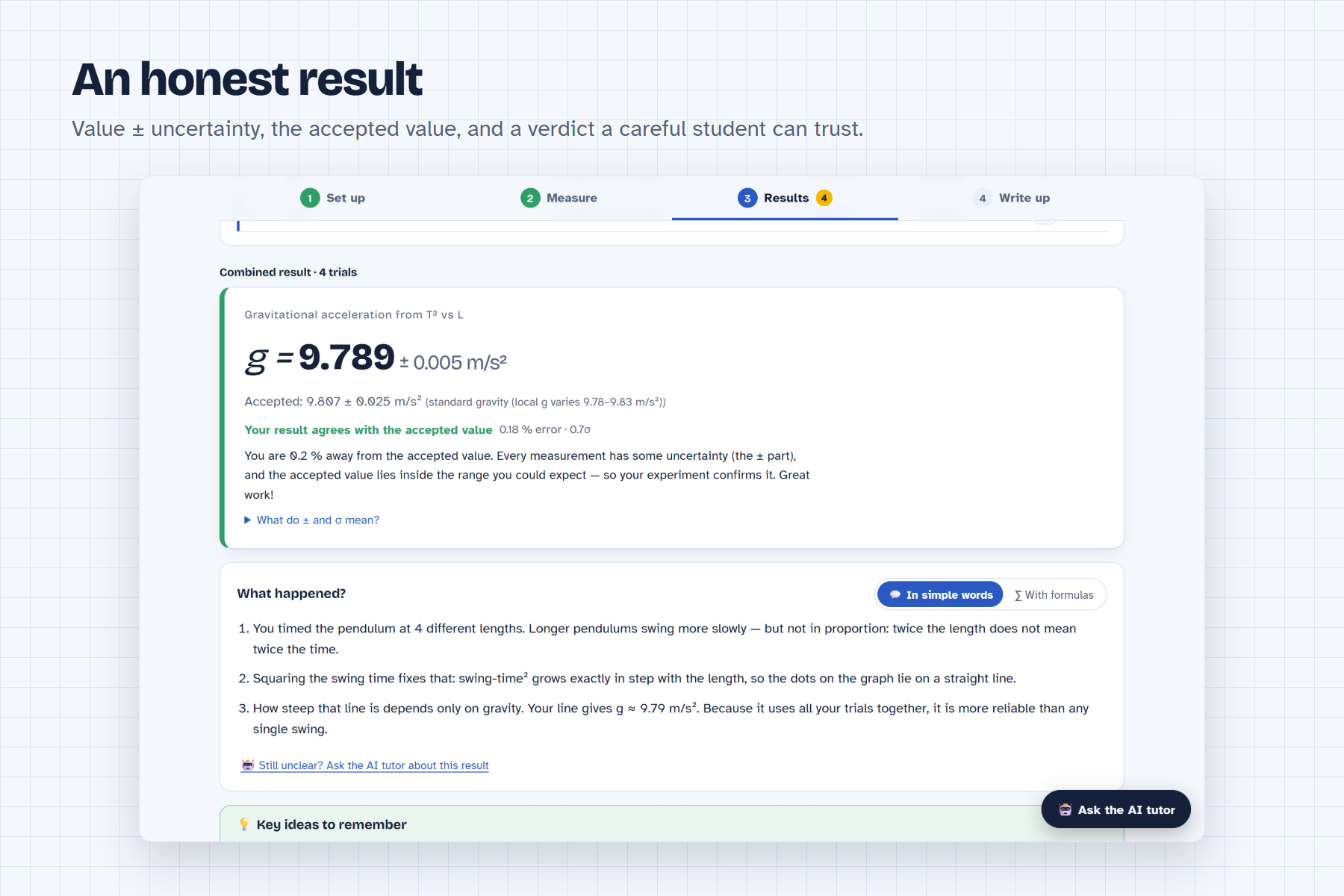
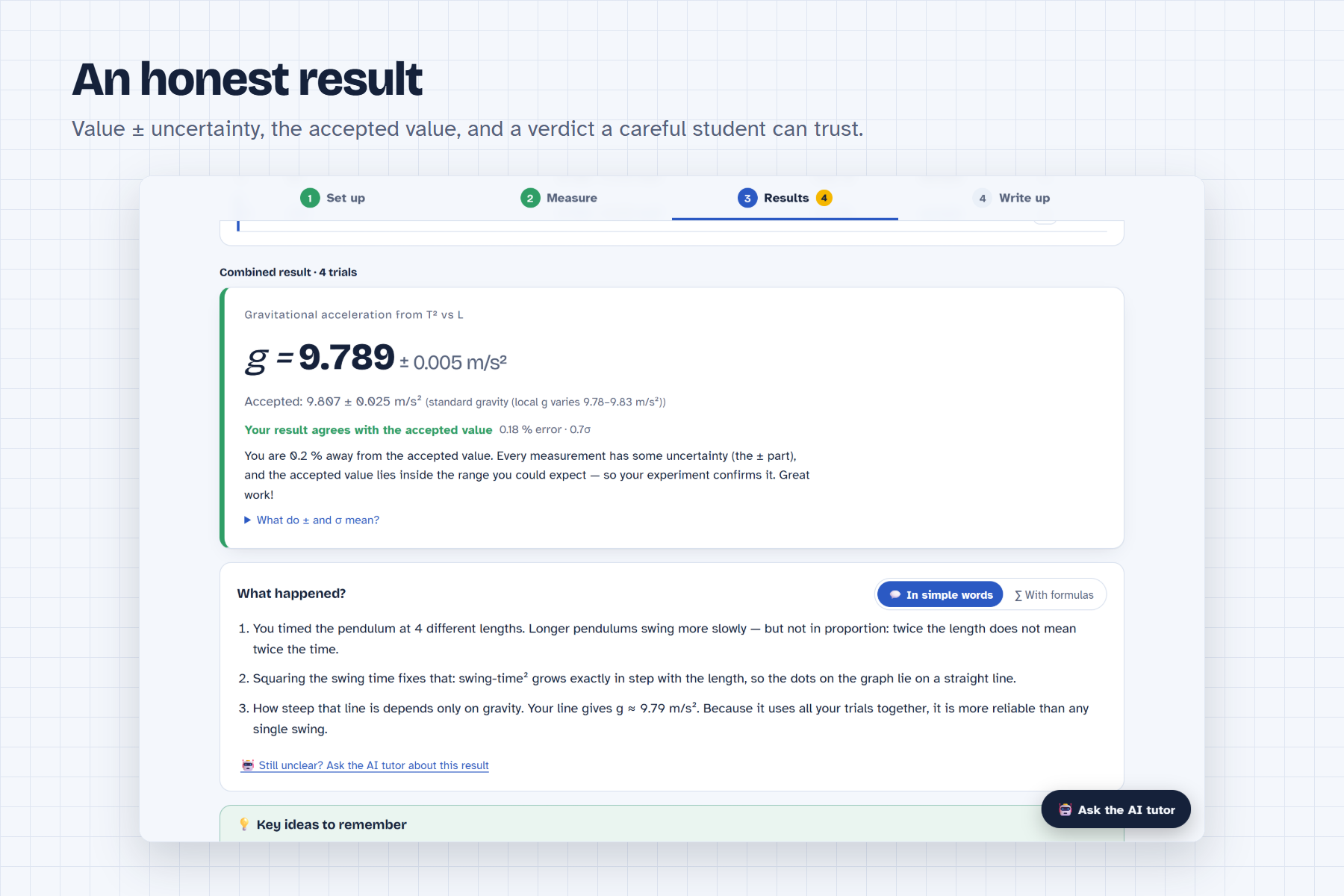
An honest result: g = 9.789 ± 0.005 m/s², 0.18 % from the accepted value, with a verdict and an explanation.
-
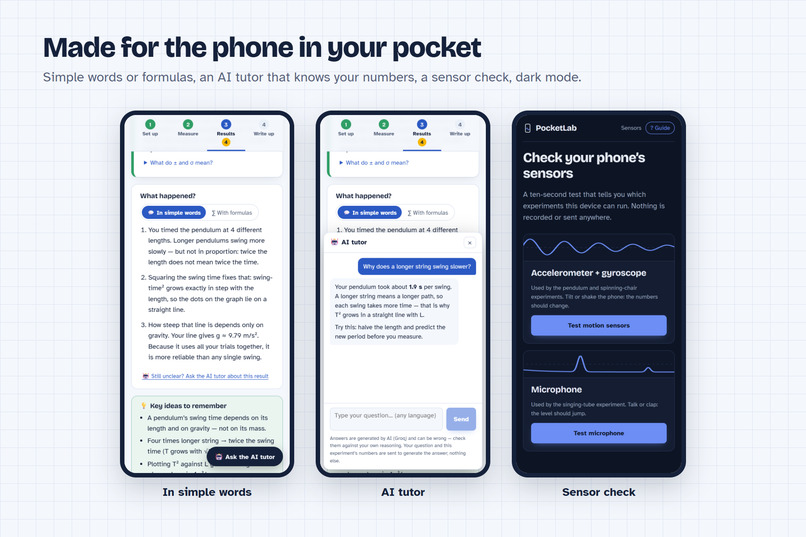
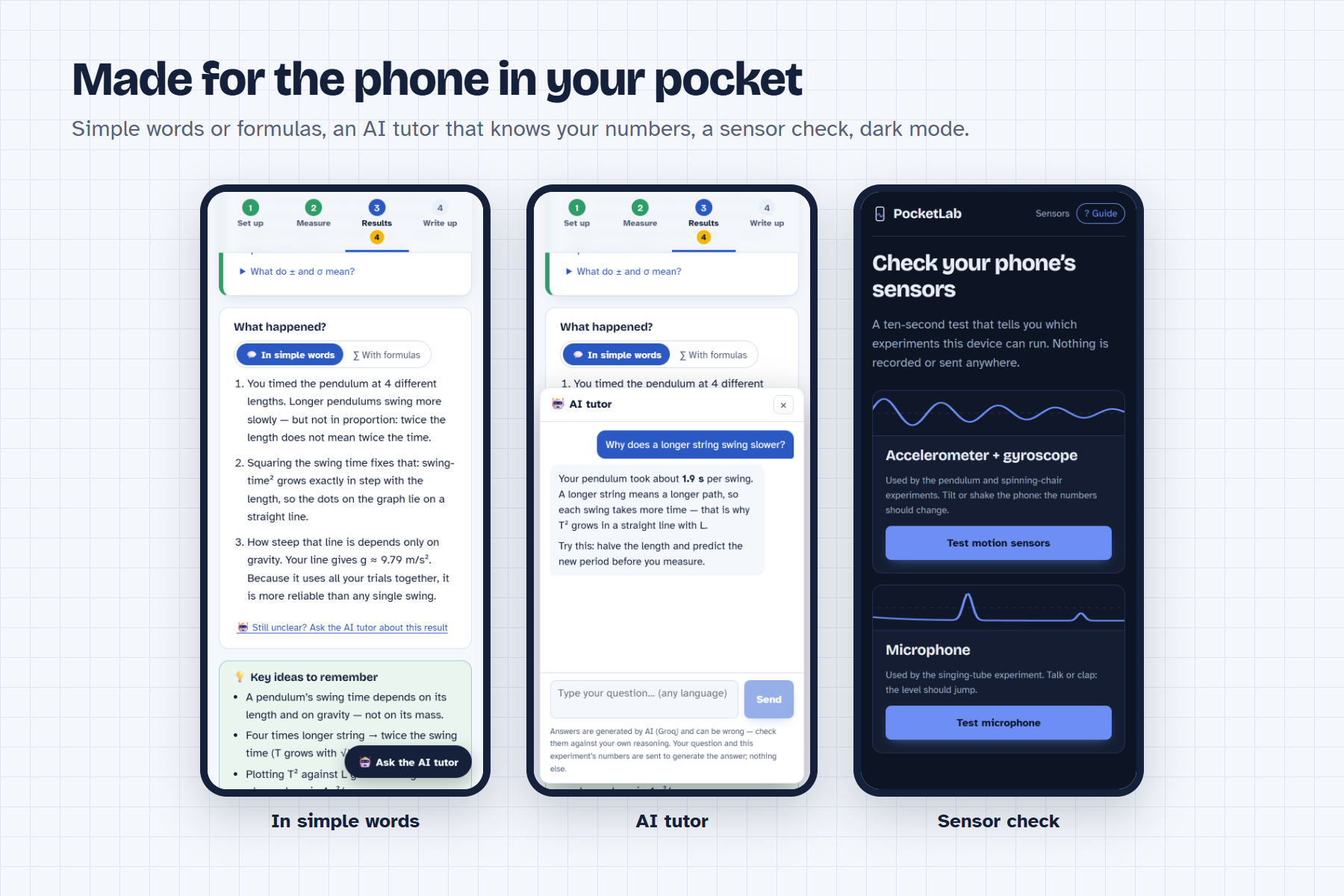
Made for phones: explanations in simple words, an AI tutor that knows your numbers, a sensor check, dark mode.
💡 Inspiration
Physics is learned by measuring, but a data logger and a set of sensors cost more than many schools spend on a whole lab — the OECD's PISA 2015 report shows large gaps in science equipment between advantaged and disadvantaged schools. Meanwhile almost every student already carries an accelerometer, a gyroscope and a calibrated microphone: their phone.
So the sensor is not the problem. The problem is everything after it. Raw-data apps give a student a wiggly graph and stop there:
- Which axis do I look at?
- How do I get the period out of this?
- How sure am I — and is my answer right?
That is exactly where a student without a teacher or lab experience gets stuck. We wanted an app that walks a student through one experiment at a time, from set-up to conclusion, and shows its working instead of hiding it.
🔬 What it does
PocketLab is a web app — open a link, no install, no account. 👉 Try it · see a finished experiment, no phone needed
- 12 experiments with the phone's own sensors — gravity from a pendulum, the speed of sound from a singing tube, centripetal acceleration on a spinning chair, a spring constant, friction, musical pitch, wave speed on a string, landing force, feeling heavier in a lift, turntable speed, ramp slope and swing length.
- Two modes. Real lab records the sensors hands-free — countdown, beeps, vibration and spoken instructions, because you cannot read a phone that is swinging. Virtual lab is an animated simulation with sliders (try a pendulum on the Moon or Jupiter), and its data goes through exactly the same analysis as a real recording.
- An honest result — value ± uncertainty, the accepted value, the % error and a verdict a student can trust: agrees, close or far off, and why.
- Two explanations of every result — in simple words, using the student's own numbers and no formulas, or with formulas, the full derivation — plus the 2–3 key ideas to remember.
- An AI tutor inside every experiment that sees the student's numbers and answers in any language. It is told to use only the measured data and to guide rather than hand out answers.
- Design your own experiment — pick what the phone measures (period, frequency, pitch, peak acceleration, rotation speed, tilt), type a textbook formula such as
4π²m/T², and share the experiment as a file with classmates. - A lab report — hypothesis, conclusion and error sources, printable to PDF, raw data as CSV/JSON.
- A game-style guided tour on first visit, and a sensor check that tells you which experiments your phone can run.
The physics behind the flagship experiment
A pendulum's period depends only on its length and on gravity:
$$ T = 2\pi\sqrt{\frac{L}{g}} \quad\Longrightarrow\quad g = \frac{4\pi^2 L}{T^2} $$
Measure at several lengths and plot \( T^2 \) against \( L \): the points lie on a straight line, and its slope gives gravity from all trials at once — which also cancels a constant error in measuring the length:
$$ T^2 = \frac{4\pi^2}{g}\,L \quad\Longrightarrow\quad g = \frac{4\pi^2}{\text{slope}} $$
A phone is not a point mass, so PocketLab treats it as a physical pendulum of height \( h \approx 15\ \text{cm} \):
$$ L_{\text{eq}} = L + \frac{h^2}{12L} $$
The other experiments use the same idea — one clean formula per experiment, e.g. \( a = \omega^2 r \) on the spinning chair and \( v = 4f\,(L + 0.3d) \) for a singing tube closed at one end.
🛠️ How we built it
TypeScript, React and Vite, deployed on Vercel; the AI tutor is a small serverless function calling Groq.
The heart of it is a measurement engine with no UI framework in it, in four layers — and ESLint fails the build if a lower layer ever imports a higher one:
dsp  ←  core  ←  experiments  ←  ui
FFT     contracts   12 plugins      React pages
filters recordings  builder         (the only React code)
fits    sensors     virtual labs
- Our own signal processing (~480 lines): radix-2 FFT, Welch spectra, a prominent-peak search, zero-phase biquad filters, the period by least squares through zero crossings, and uncertainty propagation.
- Every experiment is a plugin — metadata plus one pure function. Nine of the twelve are pure data, a few lines each, in the same format the experiment builder saves:
const def = registry.get('pendulum')!;
const result = def.analyze(recording); // pure: Recording → AnalysisResult
result.story;  // explanation in simple words
result.steps;  // explanation with formulas
- Recordings are versioned JSON, resampled to 100 Hz, so any measurement can be replayed, shared with a teacher or turned into a test.
- Builder formulas go through a safe recursive-descent parser — no
eval— with implicit multiplication, and uncertainties are propagated through them numerically.
To know whether it is right, we wrote a physics simulator of every experiment and a model of how each phone platform delivers its data: iPhone Safari inverts accelerations and relabels the gyroscope axes, Android sends 50–200 Hz, Firefox batches events, budget phones have no gyroscope, old phones sample at 25 Hz. npm run validate runs every experiment 20 times on every simulated phone with randomised set-ups and writes a report anyone can reproduce:
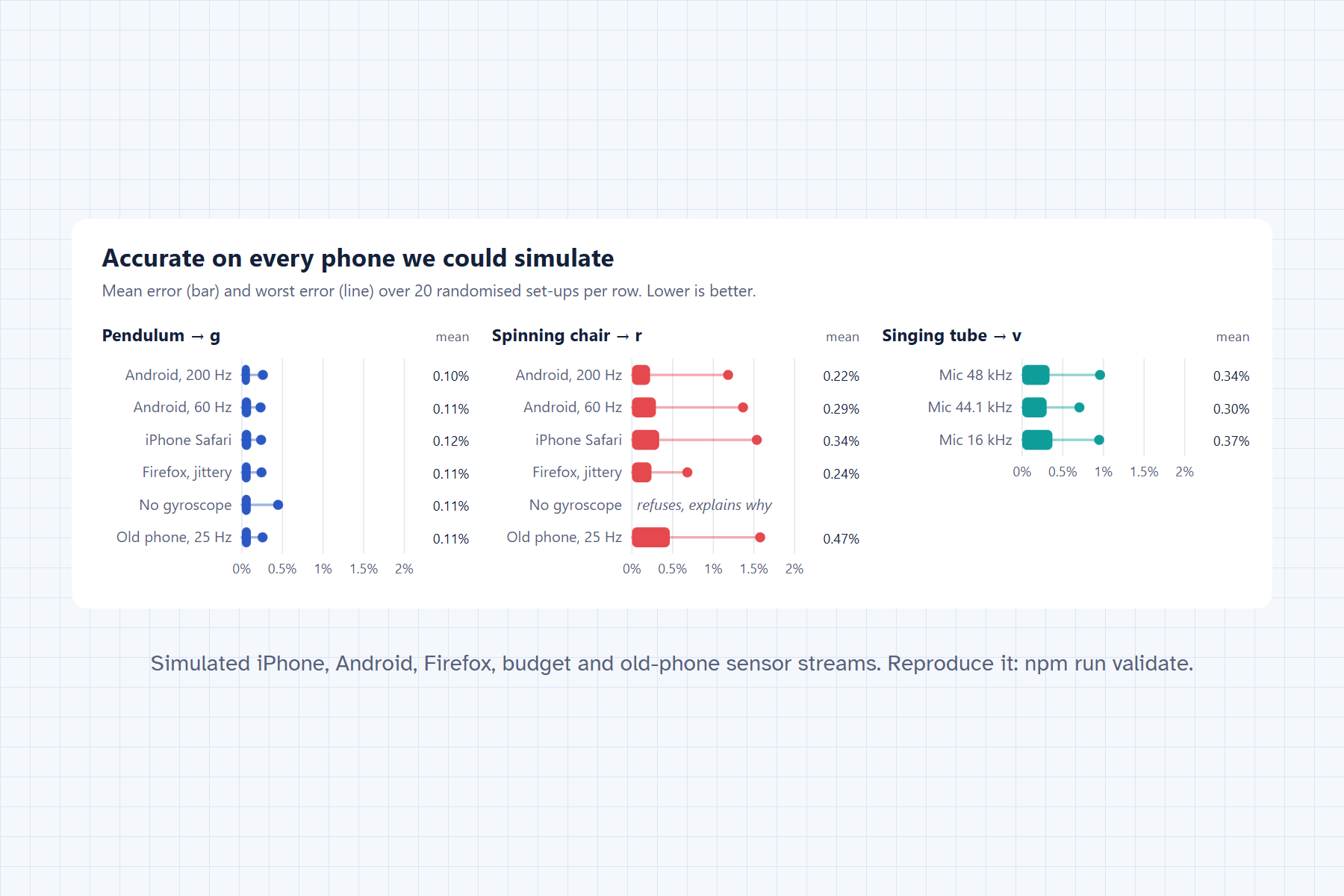
100 unit tests, 24 end-to-end tests on desktop and phone screens, 92 % line coverage of the engine, and CI on every push.
🧗 Challenges we ran into
1. A careful student was sometimes told they were wrong. This was the biggest one. We simulated 240 correctly performed experiments with everything that happens anyway on a real phone — a trembling hand at release, the phone twisting on its string, sensor bias, an uneven floor, breath noise, mains hum, a guessed room temperature. Only 78 % were told "agrees"; 9 % were told "far off". Digging in found real bugs:
- breath rumble was being mistaken for the tube's note;
- a detrending step biased pendulum periods by up to 0.25 %;
- the verdict ignored the uncertainty of the accepted value itself.
Now 359 of 360 agree and none is told "far off" — and this check runs in CI, so it cannot quietly come back.
2. Every real phone surprised us. The first iPhone test of the spinning chair returned a radius of 0.2 cm instead of 25 cm — iOS labels the gyroscope axes differently. On an iPhone 12 Pro the jump experiment said "too uncertain" because the noise estimate included the jump itself. Since then no analysis relies on an axis name or a sign.
3. Browsers guard sensors closely. Phones only give motion data to https pages, and iOS only after a permission prompt inside a tap — the whole capture flow is built around that.
🏆 Accomplishments that we're proud of
- Gravity to about 0.1 % in simulation, with an uncertainty that honestly contains the true value.
- A student who did everything right is not told they got it wrong.
- Half of the code is framework-free, so the engine can move to another framework, a native app or a server without touching the physics.
- Works from a link on iPhone and Android, offline as a PWA, and measurements never leave the device.
📚 What we learned
The hard part of a measurement app is not the measurement — it is trust: an uncertainty that means something, a verdict that is fair, and an explanation a 15-year-old can follow. And simulations find bugs, but only real phones find the surprising ones.
🚀 What's next for PocketLab
- More experiments: the Doppler effect, free fall timed by sound, the magnetic field of a coil, damped oscillations.
- Translations — all experiment text already lives in the plugin definitions.
- A teacher view that collects a class's recordings.
- Validation against school lab equipment.
Built With
- devicemotion
- eslint
- fft
- github-actions
- groq
- node.js
- playwright
- pwa
- react
- signal-processing
- typescript
- vercel
- vite
- vitest
- web-audio-api

Log in or sign up for Devpost to join the conversation.