
Inspiration
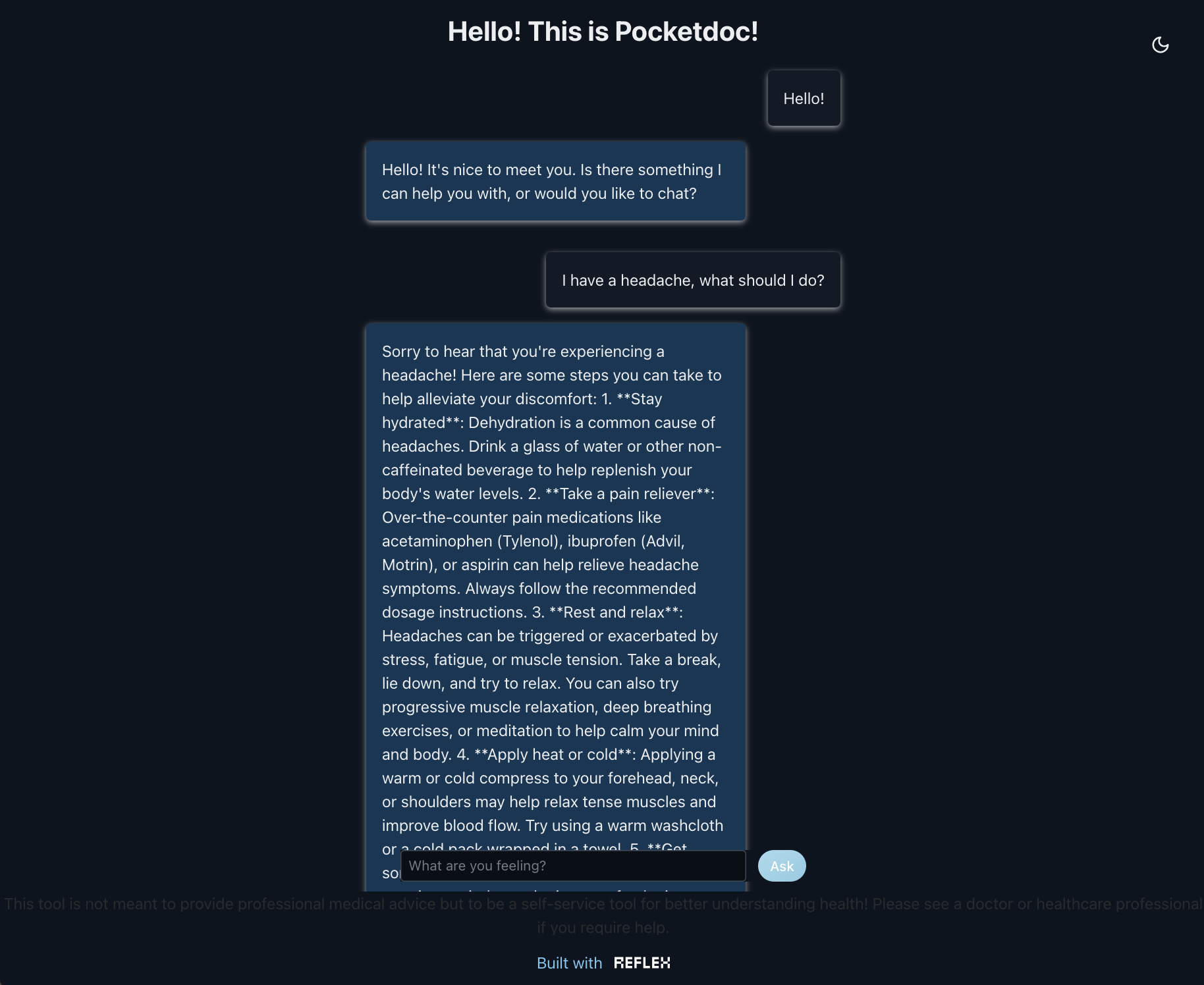
We were inspired by the need to provide patients with a reliable tool that can simplify the process of online diagnosis. Too often, when we Google our symptoms, we're met with exaggerated results that make it seem like we’re facing life-threatening conditions. Our web app combines AI with real time data from Groq to create accurate and accessible solutions to the diagnosis without unnecessary panic.
What it does
Our web app takes patient symptoms, synthesizes data using Fetch AI and Groq to provide real time diagnosis based on patient symptoms. Llama Guard ensures that the data is handled securely and protects sensitive information maintaining user privacy.
How we built it
We used Fetch AI to have multi-agent communication to talk to each other, reflex for a user-friendly interface and Groq as a large language model to process and generate the potential diagnosis. Python served as the backbone of our app organizing the data flows between Fetch AI, Reflex and Groq while also handling backend logic for symptom processing and diagnosis generation. Llama Guard was integrated to ensure secure data management.
Challenges we ran into
One of the challenges we faced was integrating Fetch.AI to process increasingly complex and case-specific data. We were able to overcome the challenge by using a bureau of local agents to simulate greedy linear search to efficiently narrow down a patient's ailment without an enormous space complexity. We also tapped into the vast resources of the Agentverse to enable user input, Groq interfacing, web scraping, summarization, diagnosis, and recommendation. It was also challenging to ensure Groq’s AI could deliver accurate diagnosis results. Balancing the need for user-friendly design with the complexity of medical data was another challenge.
Accomplishments that we're proud of
We are proud of successfully integrating Fetch AI with verified websites like WebMD's data. Another accomplishment was the effective implementation of Groq's large language model, which provided reliable and precise diagnosis predictions. Ensuring that the AI could interpret and analyze symptom data without overwhelming or misinforming users was a critical milestone. We are proud of creating a secure environment through the integration of Llama Guard. This ensured not giving any misinformation or unnecessary panic to patients.
What we learned
We learned a lot about using AI in healthcare applications, from securing data with Llama Guard to synthesizing real-time medical data. The project also fortified the importance of user-centered design in creating tools that patients trust and feel comfortable using.
What's next for Pocketdoc
We are excited to hear back from our mentors and talk to actual health professionals to make sure Pocketdoc complies with health regulations. We also aim to introduce features like multilingual support, and deeper integration with wearable devices for real-time health monitoring.

Log in or sign up for Devpost to join the conversation.