Inspiration
The ability to predict people movement will enable numerous interesting applications in areas such as urban planning and transportation. Although GPS sensors make it possible to compute locations, it does not work very well under certain scenarios such as intensive trace tracking, due to its low accuracy in indoor environment and its high battery consumption. With a rapidly growing market, nowadays smartphones are designed and equipped with more and more powerful sensors, enables them to collect a handful of various data sets containing rich information and interesting facts which awaits people to uncover. In this project, we develop an application in R called Smartracer to predict people's locations and their activities based on the data set collected by PocketCare, their location/activity traces then can be further used to improve transportation system and urban planing.
What is PocketCare
PocketCare is developed by Lab for Advanced Network Design, Evaluation and Research (LANDER) at SUNY Buffalo. This App will periodically collect information in your vicinity from interfaces such as Bluetooth, WiFi, GPS and Activity recognition module. Besides, PocketCare also asks users to input their health status (e.g., feel well, or having a flu) and provides useful health tips. The rich data set collected will be used to research user mobility pattern, in addition, the proximity information along with their users’ input on their health status, will be used to monitor flu propagation, and ultimately help users to improve health. Finally, incentives are given to active users to encourage to them to use more of the App.
How I built it
Smartracer consists of two parts:
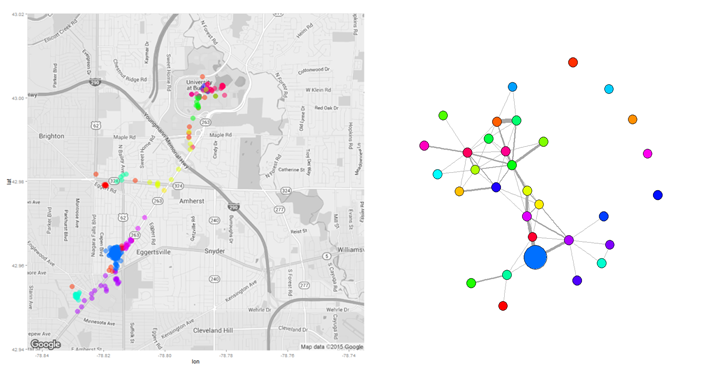
1) In the first part, Smartracer will retrieve representative locations(places that people frequently visit in their daily lives) from WiFi access point scan result collected on smartphones, based on these location information, we are able to compute the transition probability between them.
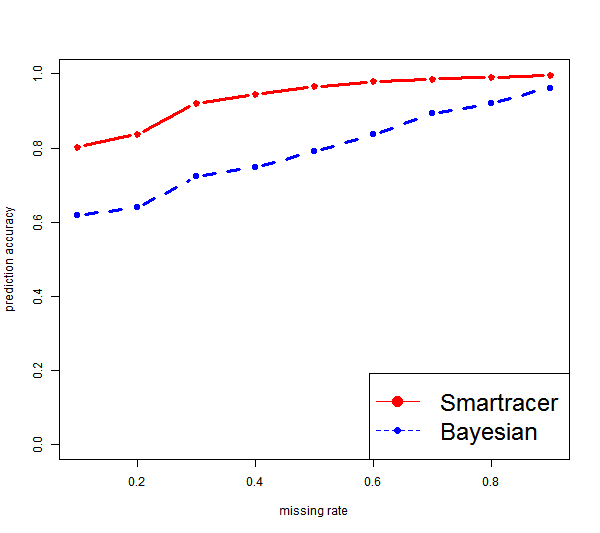
2) In the second part, we show that it is possible to recover a person's whole trace(location sequence) given the condition that only a small portion of the locations are observed or known. To be more specifically, we treat the location series as markov chain, and further a Markov Chain Monte Carlo method is exploited to sample missed entries in the location sequences.
Accomplishments and contributions
- We extract locations from WiFi AP scan result, we further show that these locations are distinguishable and representative enough to detonate places that are frequently visited
- We develop a MCMC sampling method which enables us to recover the missing/unknown locations with very high accuracy given only a small portion of observations as ground truth
What's next for PocketCare: A smart sensing platform
Currently Smartracer is a system only works on data collected on mobile client side, in order to get useful information for public transportation, we need to aggregate such information to a centralized server to analyze traffic pattern for certain locations of interest, such as UB campus or crowded public places. More efforts are needed to work on building models on predicting and simulating large scale transportation patterns.

Log in or sign up for Devpost to join the conversation.