-
-
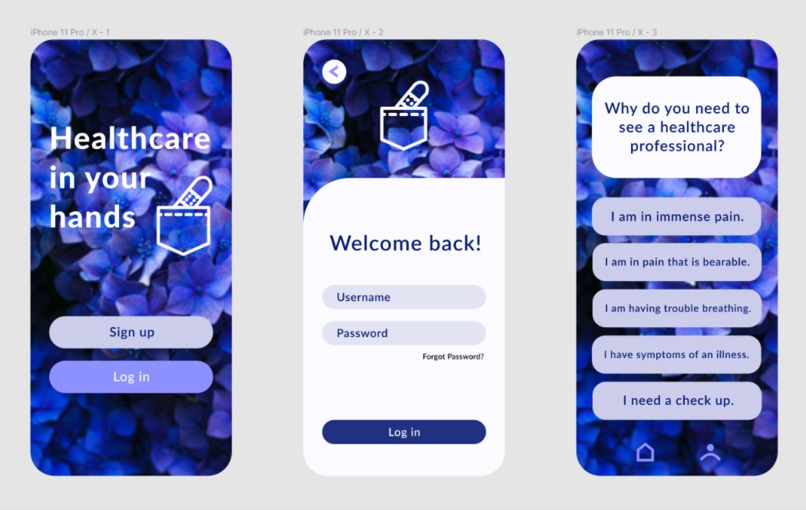
App Mockup
-
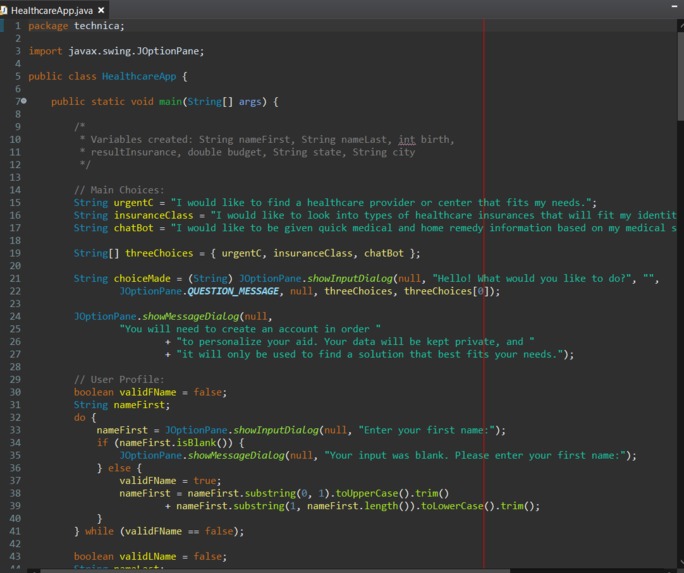
Java Code
-
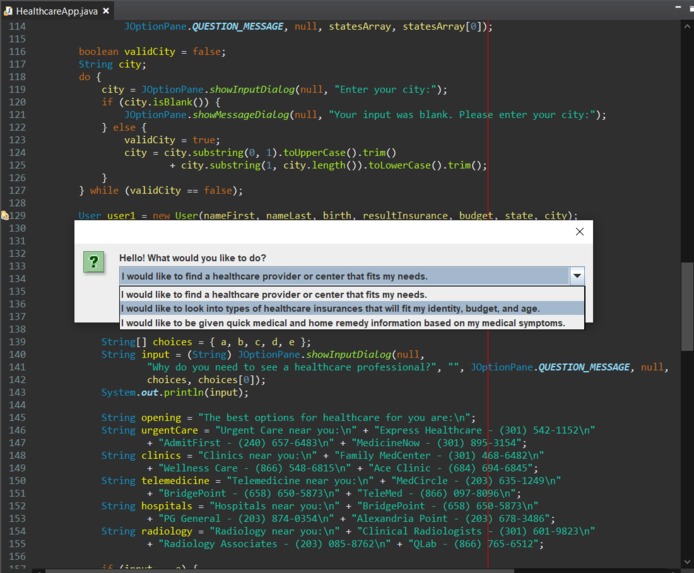
Pop-up Interaction
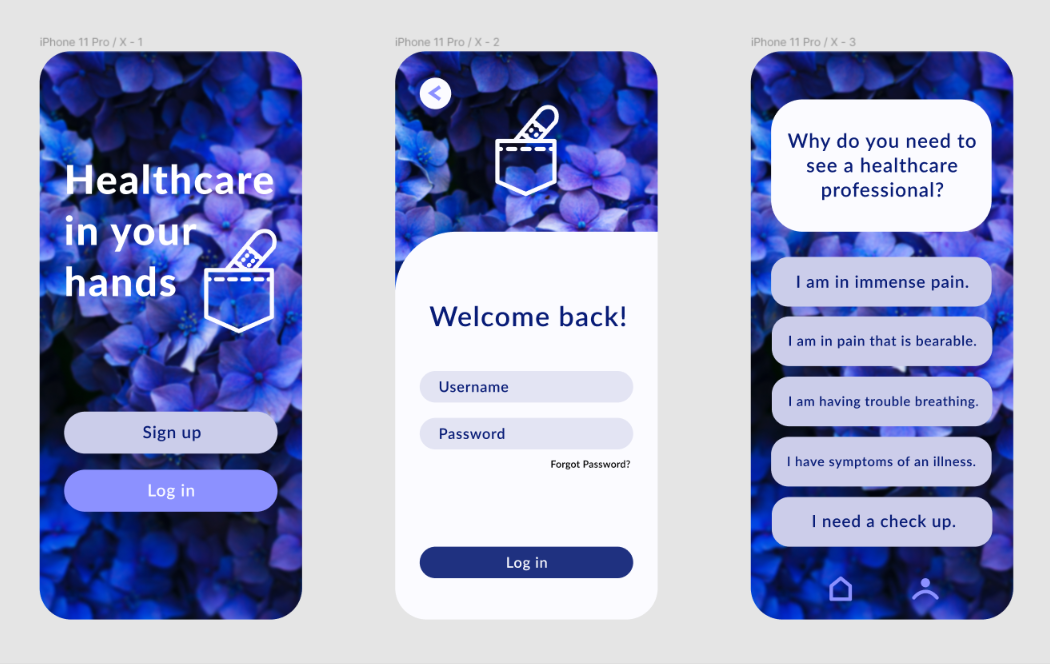
Inspiration
We were inspired by one of our teammate's personal experiences. She told us about how her mother, a nurse practitioner, would come home often dissatisfied because even though she personally had the capability to provide expert health care to patients, many of her patients could not properly access her care due to their lack of resources, whether it be finances, citizenship status, proximity, etc. It is this lack of accessibility that motivated us to create a program that could make healthcare accessible anywhere, anytime.
Many people struggle to find the transportation, financial means, and time to get to the nearest healthcare facility where they can receive proper medical care. Unfortunately, our teammate's mom's position does not enable her to spend adequate time resolving these issues. Sometimes it's too late for her to provide preventative care or allow for the most effective treatments.
What it does
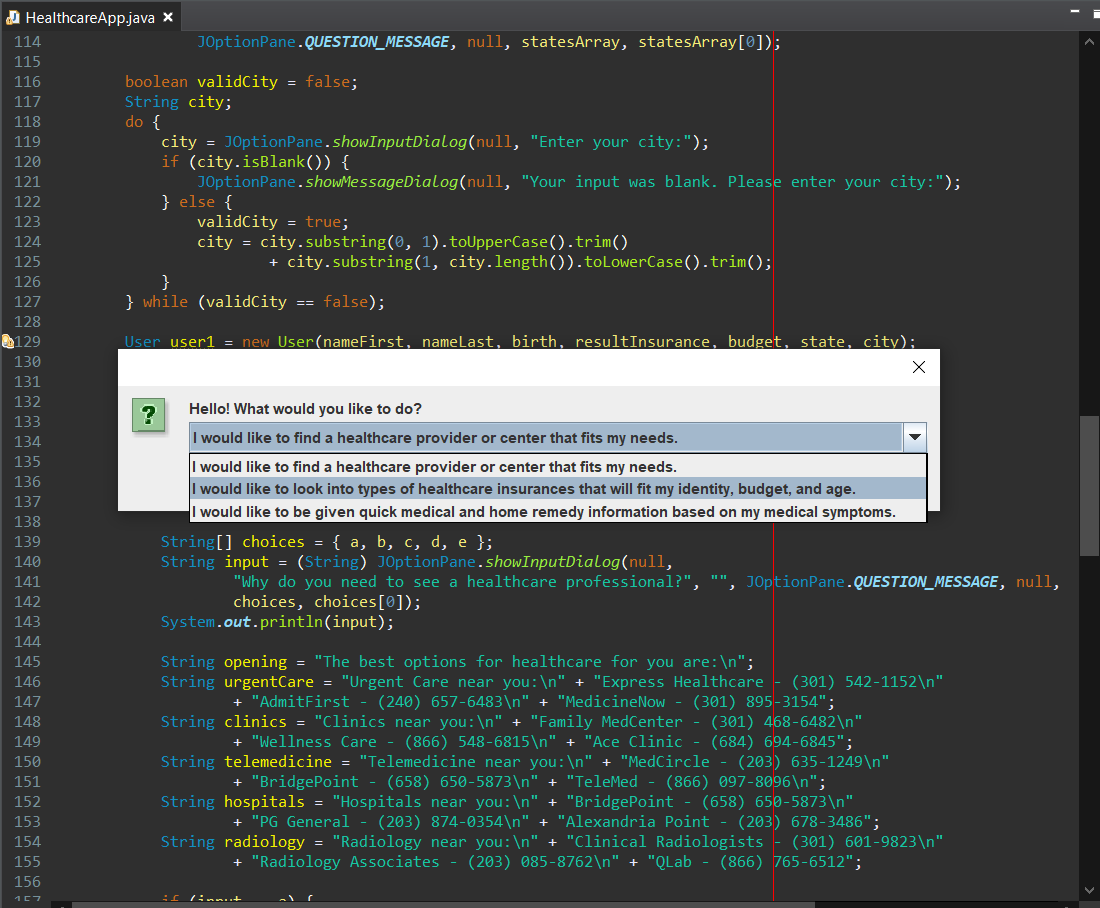
The program takes in user details and directs them to one of our three services based on what they answer on the home page. If the user requests urgent care from their location, our locator service will determine the best local medical care option that will be the most convenient for your current status. If the user requests to explore their options for long-term care, we take in the user's personal information and determine the best healthcare insurance firm that matches their specific needs. If the user is looking for quick advice on their ailments, we provide a chatbot that suggests affordable remedies for the user.
How we built it
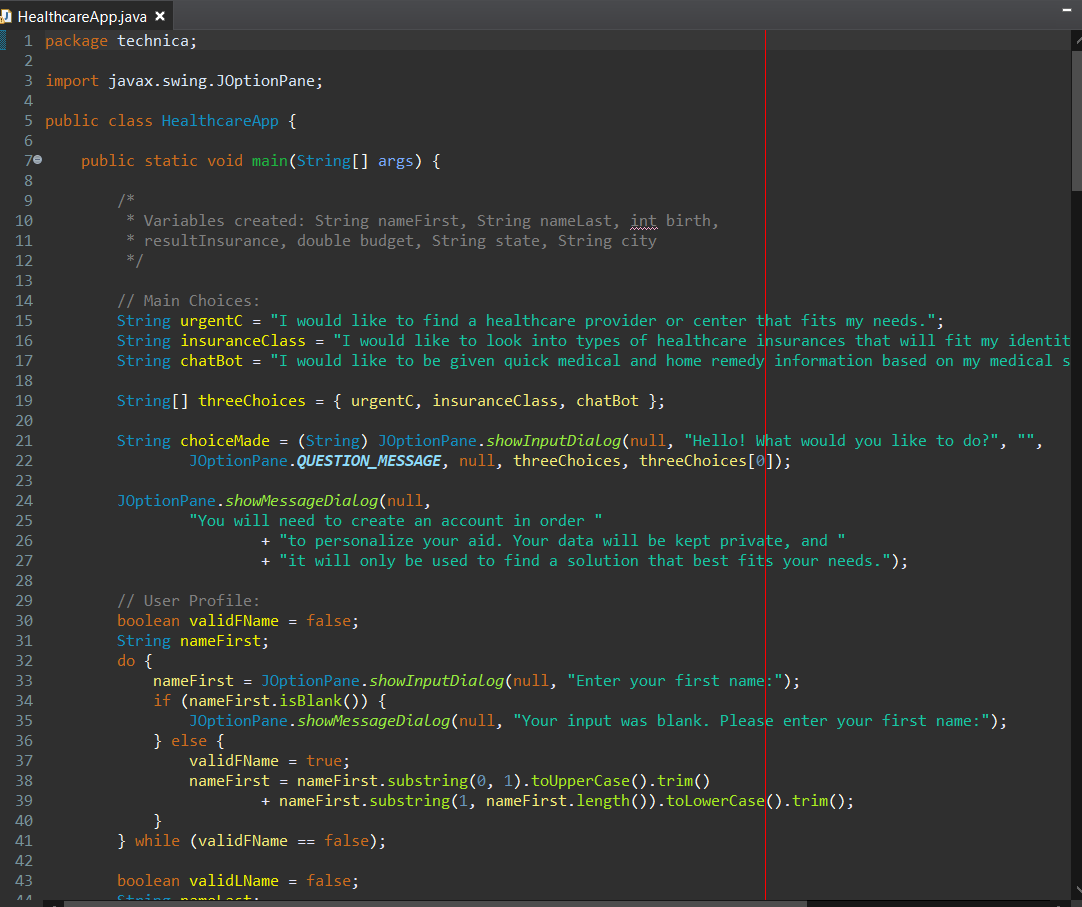
We built our program using Java in Eclipse but we made the model for our app using Figma.
Challenges we ran into
We ran into challenges when it came to finding an efficient method to collaboratively work on our hack through GitHub. In order to surpass this obstacle, we decided to manually create classes individually and merge them together on one of our team member's laptops. We also ran into problems pertaining to logic gaps in our pseudocode, but we were able to fix this by reconvening at a team, revising our pseudocode then reimplementing.
Accomplishments that we're proud of
With three out of our four team members being beginner hackers, we are proud of the fact that we made what we originally set out to make which was a program that ran multiple services to cover as many users as possible and that too within the time limit we had.
What we learned
We learned the following skills from this Hack: (1) Designing a project prompt from scratch which included evaluating our team member's skill sets and choosing a prompt that would be compatible enough to incorporate and challenge our skill sets. (2) Think from the user's perspective while designing a product that would best follow a user's intuitive logic. (3) Exploring different IDEs and platforms to figure out more about collaborative coding, a valuable lesson for future hacks and individual endeavors.
What's next for Pocket Doctor
(1) We hope to expand our current prototype by accounting for more factors a user may want to consider before getting urgent care or insurance. From there we plan on merging our back-end program with our mockup model in order to develop a fully functioning product.


Log in or sign up for Devpost to join the conversation.