Inspiration
As AI continues to advance, the nature of work is changing rapidly. Millions of traditional jobs are being displaced, while digital and technical roles are increasingly becoming the foundation of the future economy.
But the access to those opportunities is uneven. Learning to code–one of the most powerful entry points into building technology–often requires infrastructure that many people don’t have: reliable internet, laptops, and time. As a result, entire communities are locked out before they can even try.
The future shouldn’t just be for people who have the resources. The opportunity to shape the future should belong to anyone.
We built Pocket Code to start bridging that gap today.
What it does
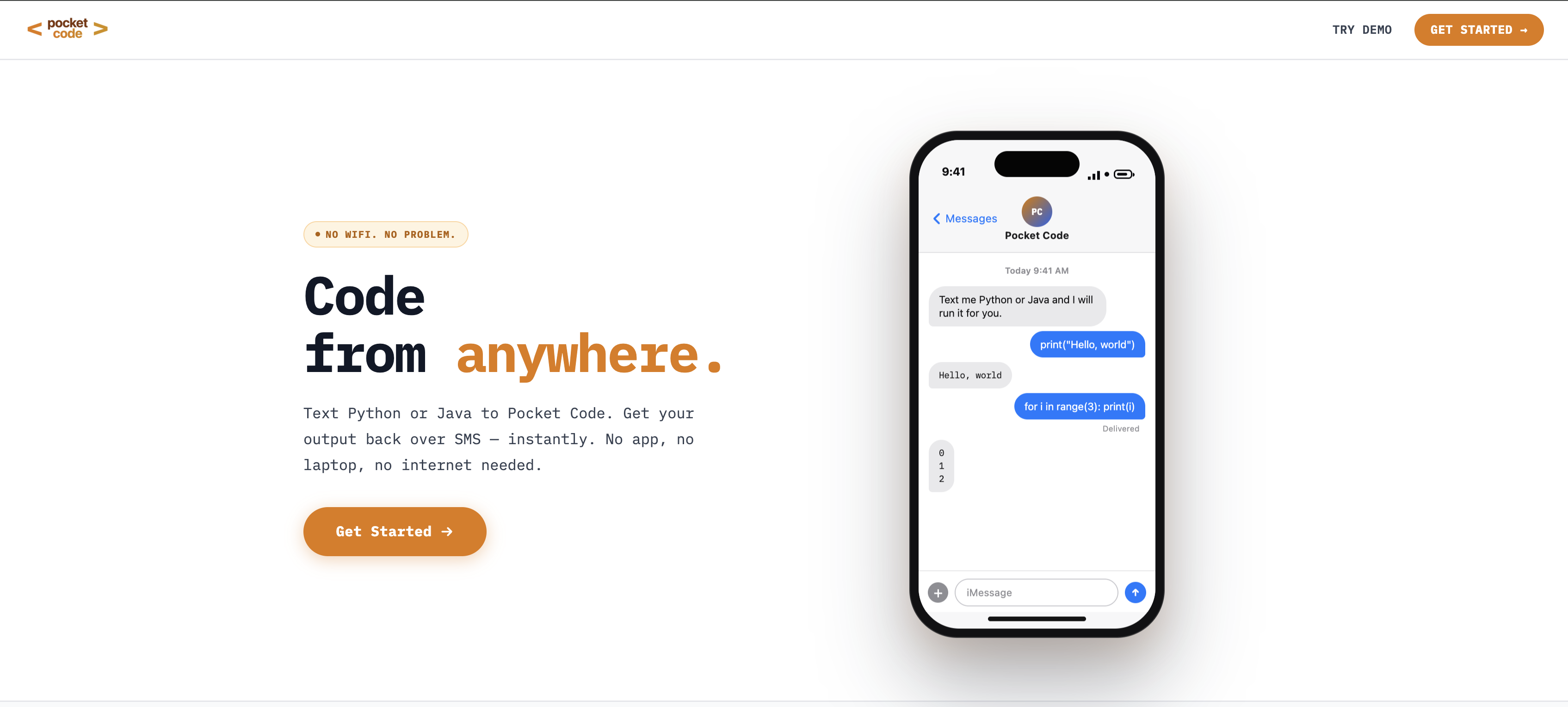
Pocket Code is an SMS-based platform that teaches real programming through text messages.
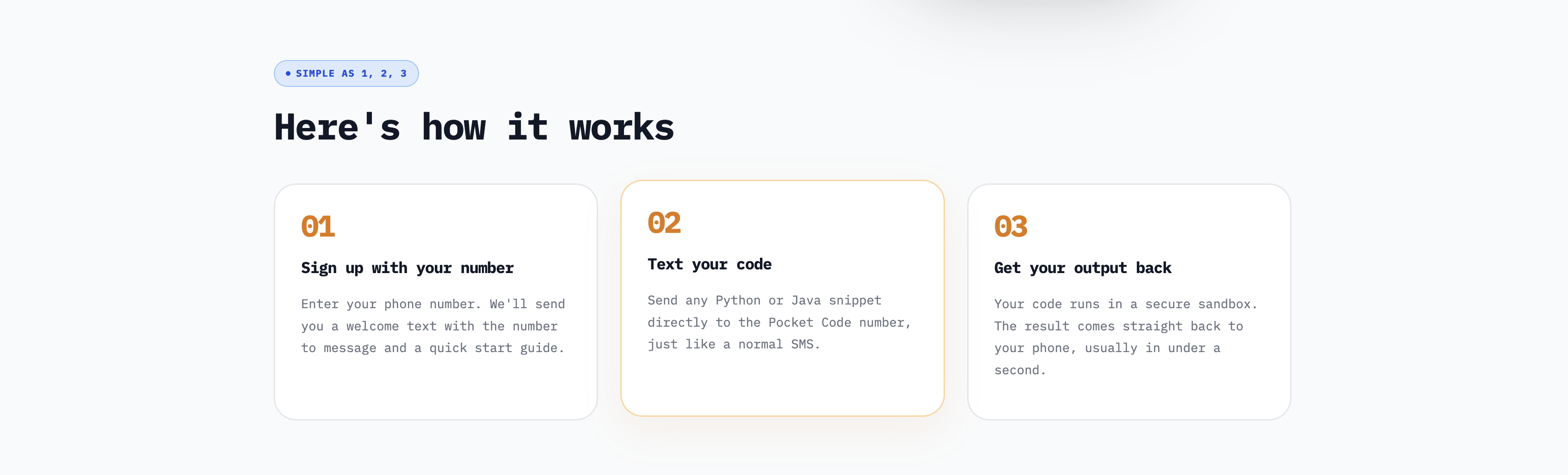
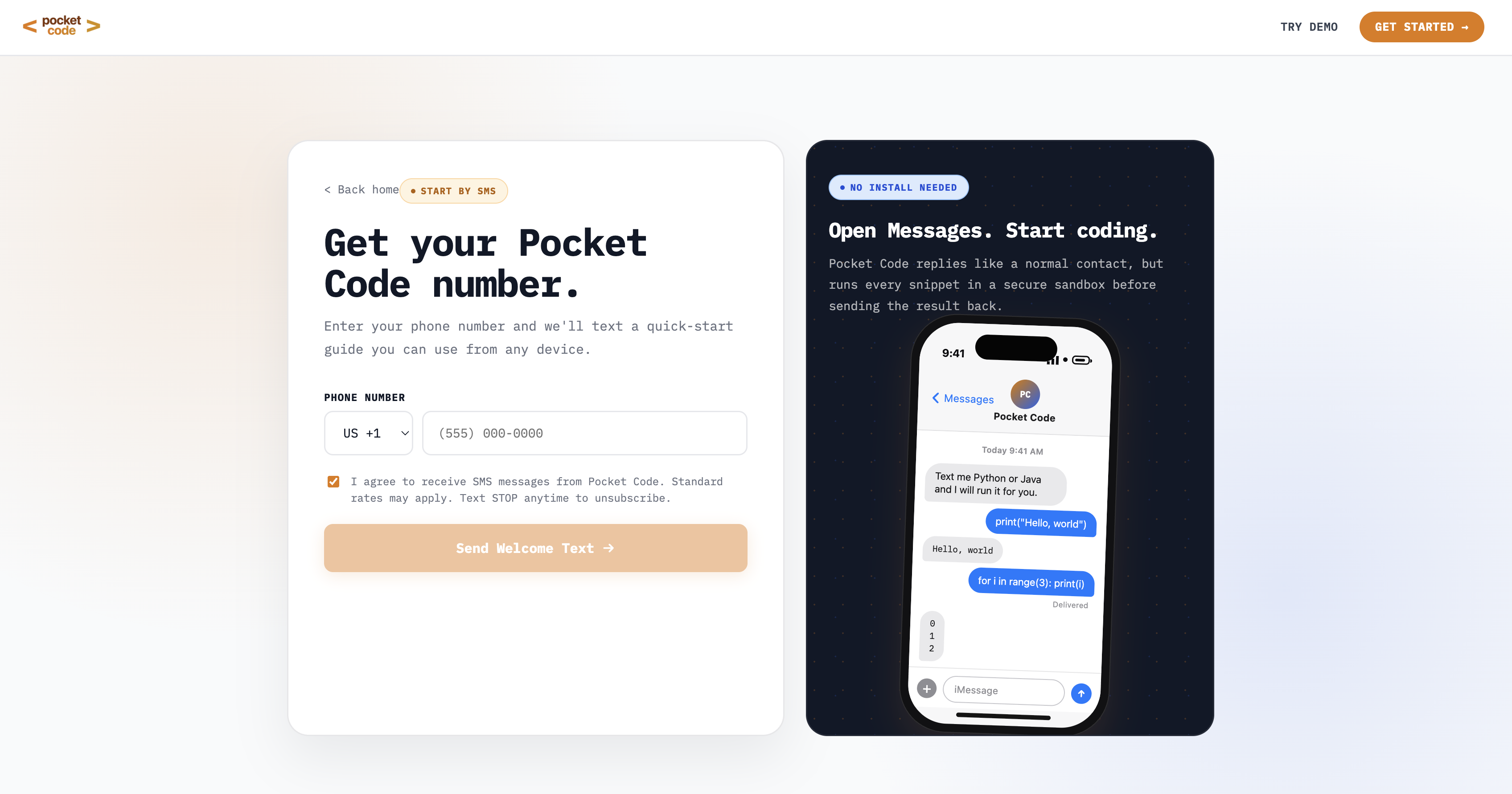
Users text a number to start learning, receive interactive lessons, and write real code directly through SMS. The system responds instantly with feedback and next steps with no apps, no downloads, no internet required.
How we built it
Pocketcode was built as a TanStack Start app deployed on Cloudflare Workers, with SMS8 handling inbound and outbound SMS. When a user texts Python, the app normalizes the message, stores the request in Neon Postgres through Drizzle, runs the code inside a Cloudflare Sandbox container, and sends the output back over SMS. Better Auth powers the admin side for inspecting messages, users, quotas, and execution jobs.
Challenges we ran into
The biggest challenges were coordinating several edge-runtime services at once: SMS webhooks, database persistence, sandboxed code execution, and Cloudflare deployment constraints. We also had to make code execution safe and predictable by enforcing timeouts, output limits, isolated containers, and durable tracking of each execution so failures, retries, and message delivery states could be debugged reliably.
Accomplishments that we're proud of
A major accomplishment for our team was building and deploying an SMS-based system despite having no prior experience working with SMS infrastructure. Within a short timeframe, we were able to integrate messaging, handle user input, and deliver a working, end-to-end product.
More importantly, we built something that we believe can actually move someone. Not just teach syntax, but make coding feel approachable. Learning to code can be intimidating, and Pocket Code feels like a product that we would have genuinely enjoyed using when we were starting out. It's very rewarding and fulfilling to build a product that lowers that barrier and gives more people the chance to begin.
What we learned
Integrating SMS into a production web application introduced a unique set of challenges. SMS is a highly constrained interface that has limited message length, no formatting, and minimal state. We had to design around these limitations. We also learned to pivot some of our ideas. We were unable to get a working phone number from our original technology stack, but we were able to find another API. We also learned how to use cloudflare sandbox to simulate the code.
What's next for Pocket Code
We plan to expand Pocket Code into full programming tracks, including languages like Python and JavaScript, allowing users to progress from basic concepts to more advanced skills entirely through SMS.
To broaden our reach, we will introduce multi-language support to reach global users and reach as many underserved communities as possible.
Beyond the product itself, we would love to partner with schools and organizations in underserved communities to bring Pocket Code directly to those who would benefit most.
Built With
- cloudflare
- neon
- tanstack

Log in or sign up for Devpost to join the conversation.