Pluto
Real problems. Guided learning. Proof that lasts.
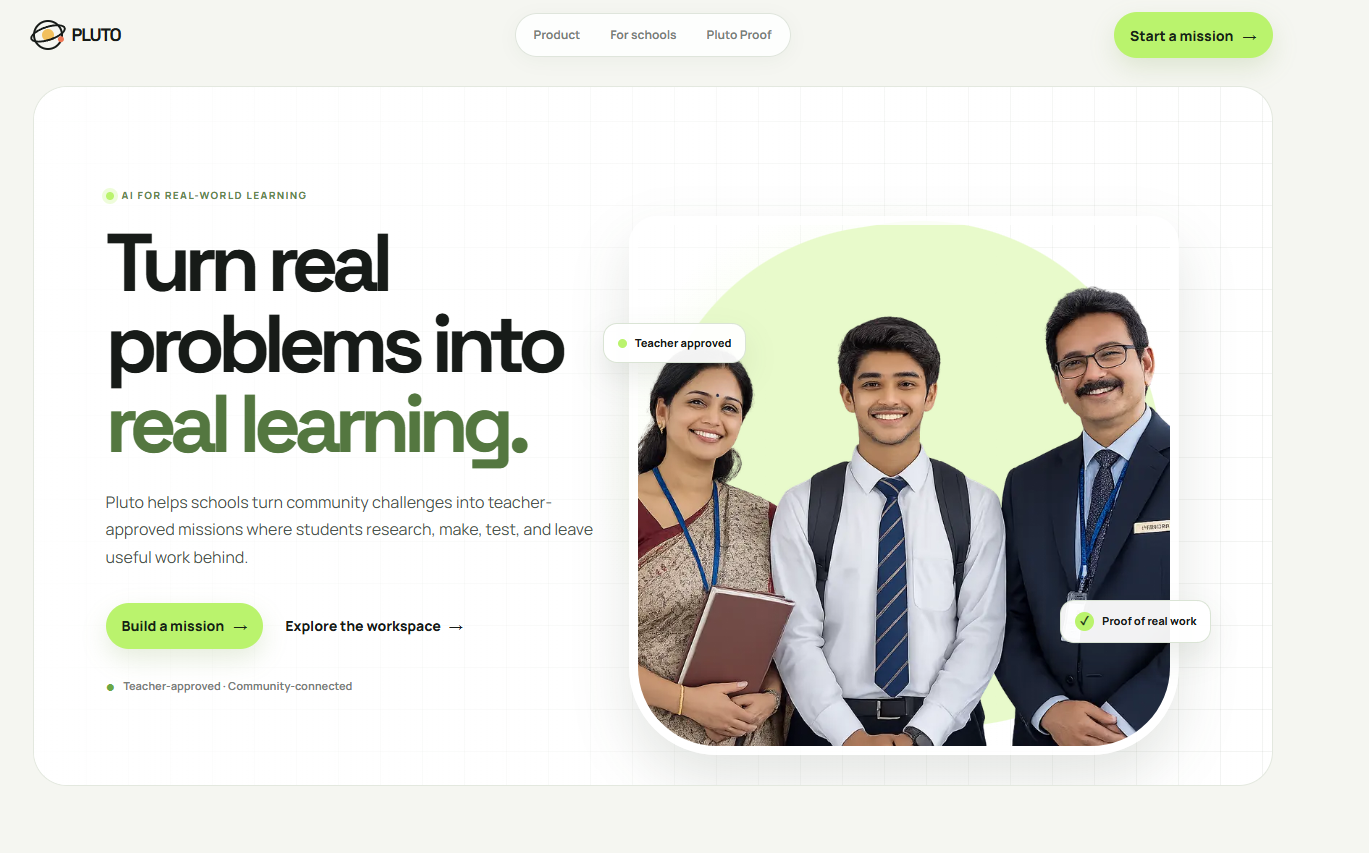
Pluto is a teacher-controlled learning workspace that connects schools with local community organisations.
A partner brings a real challenge. Pluto shapes it into a safe learning mission. A teacher reviews the scope and safeguards, proposes balanced student teams, and controls every release. Students research, collaborate, create useful work, and document their contribution. The partner validates the outcome. Pluto brings the mission, evidence, assessment, consent, and community response together in a shareable Pluto Proof record.
Why Pluto
Schools want learning to feel useful beyond the classroom. Community organisations have meaningful local problems but rarely have a safe, structured way to work with students. Existing AI tools can generate content quickly, but they do not automatically understand school policy, student identity, evidence quality, or who should be allowed to make a decision.
Pluto is built around a different contract:
- AI helps structure complex work, but it does not silently decide what is true, who is assigned, or how a student is graded.
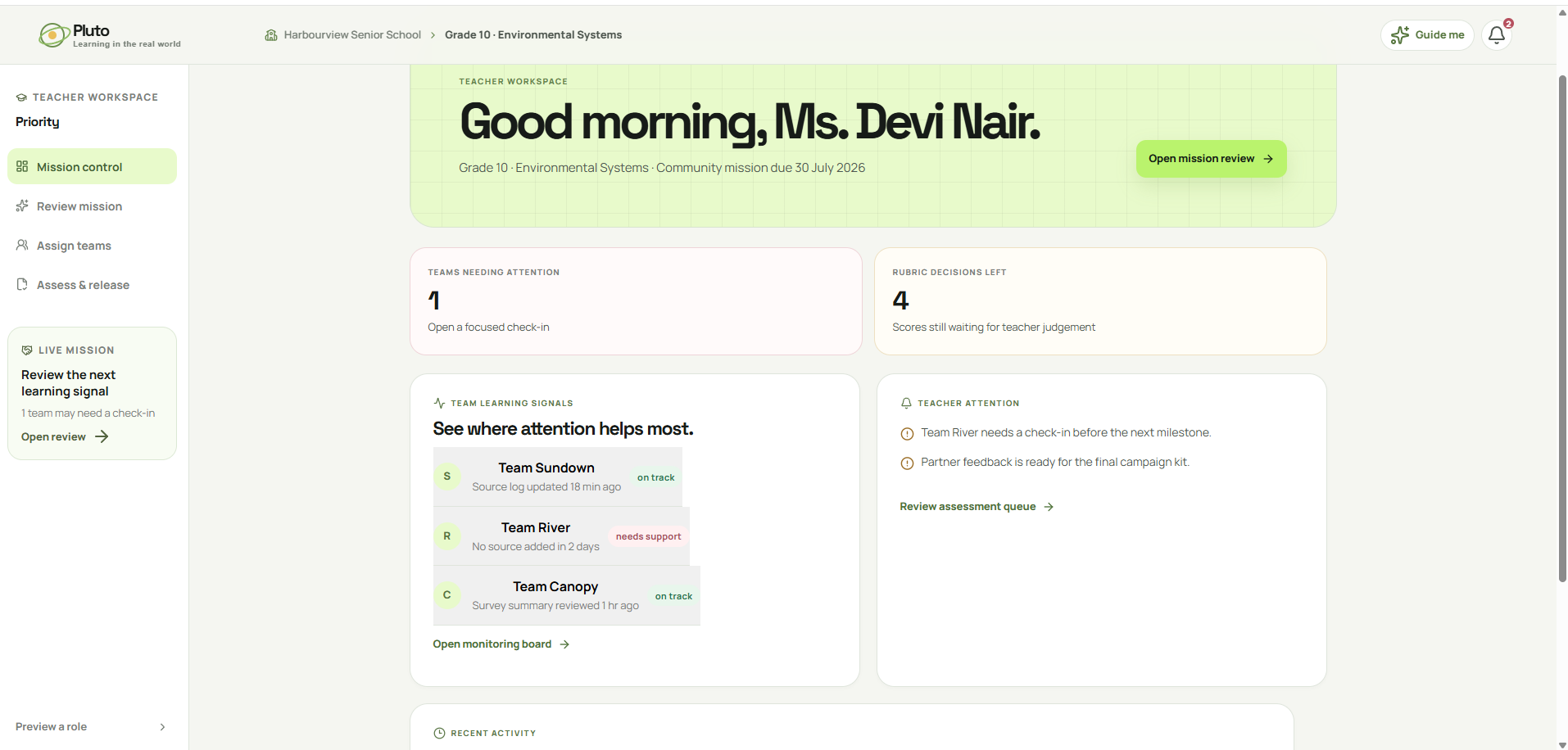
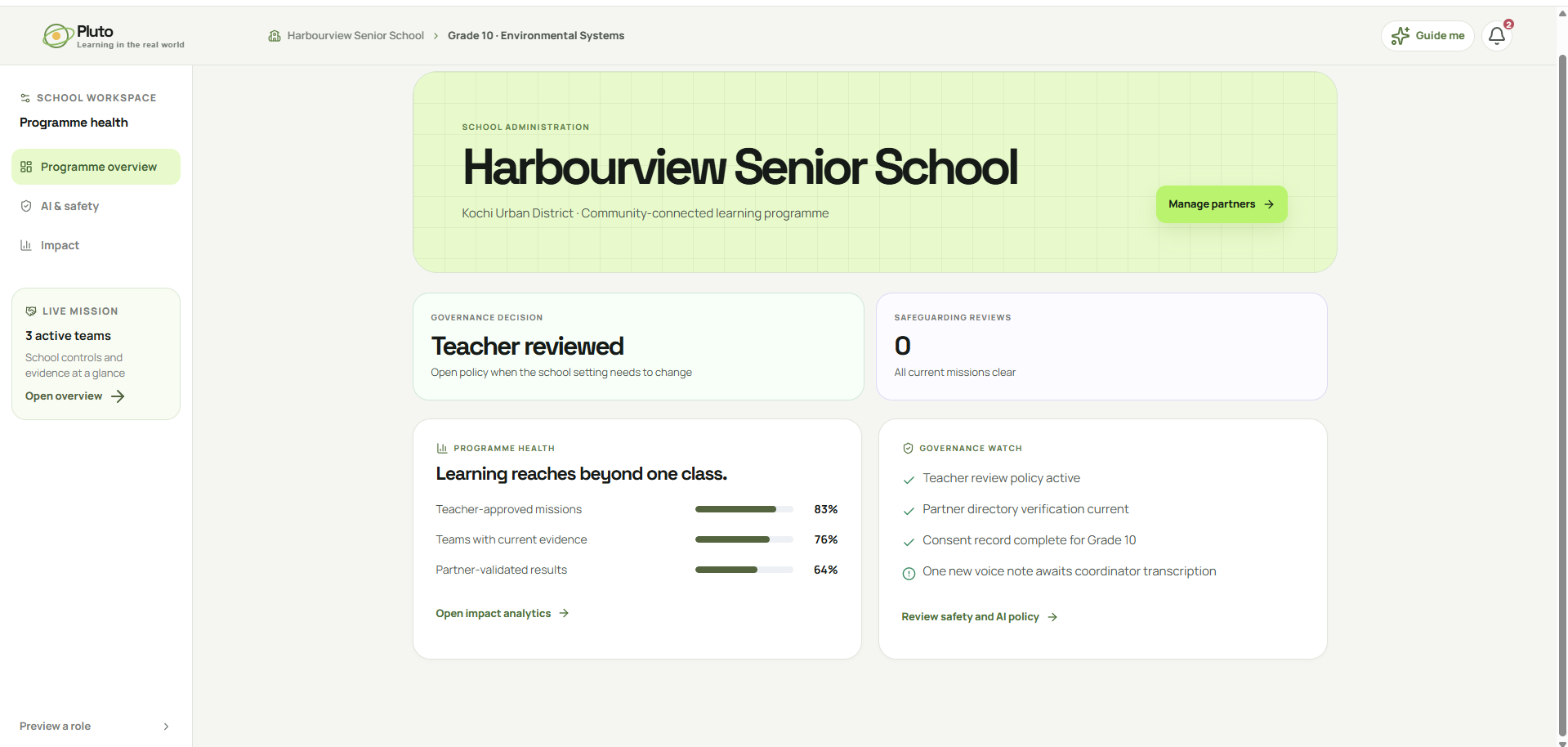
- Teachers remain responsible for mission approval, student access, assessment, and publication.
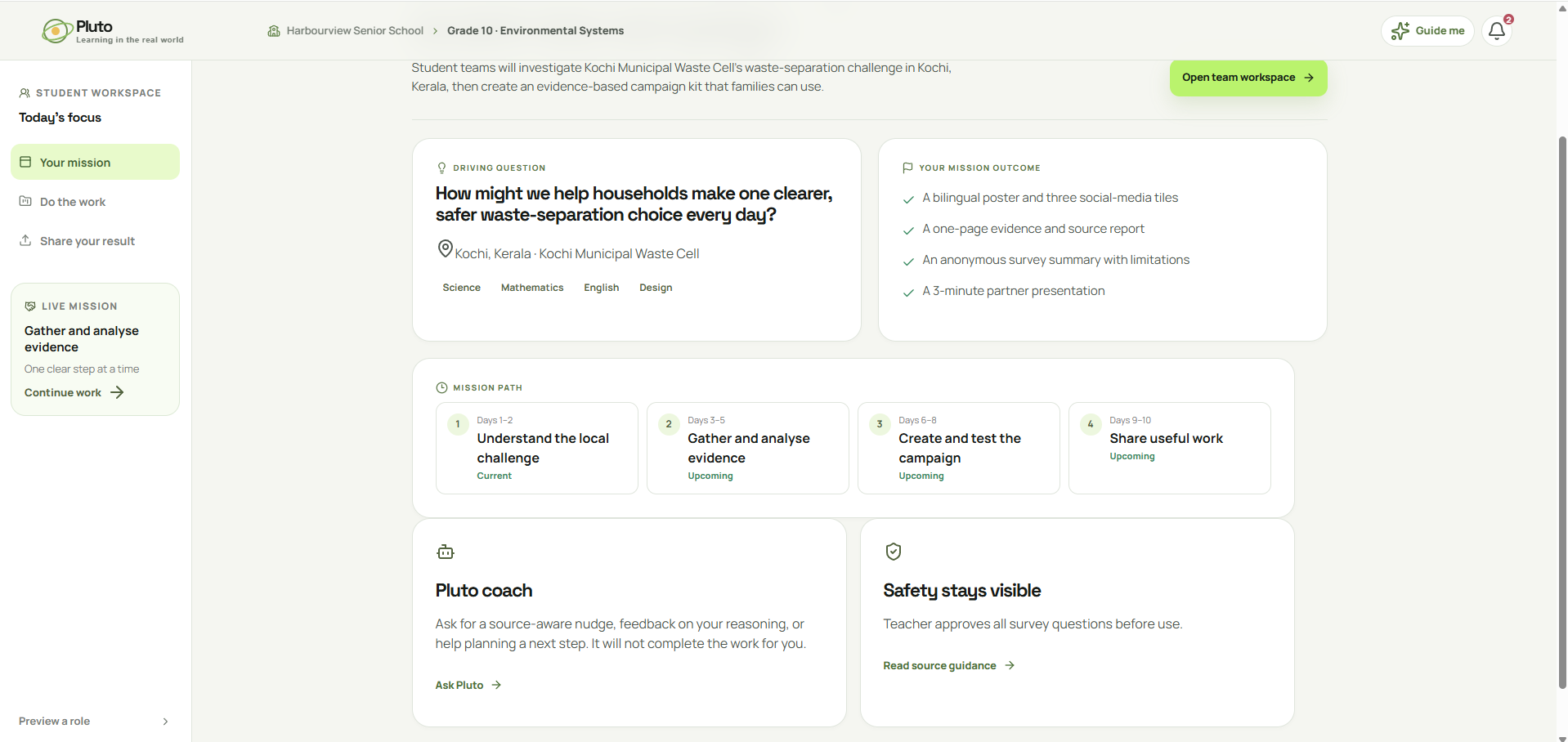
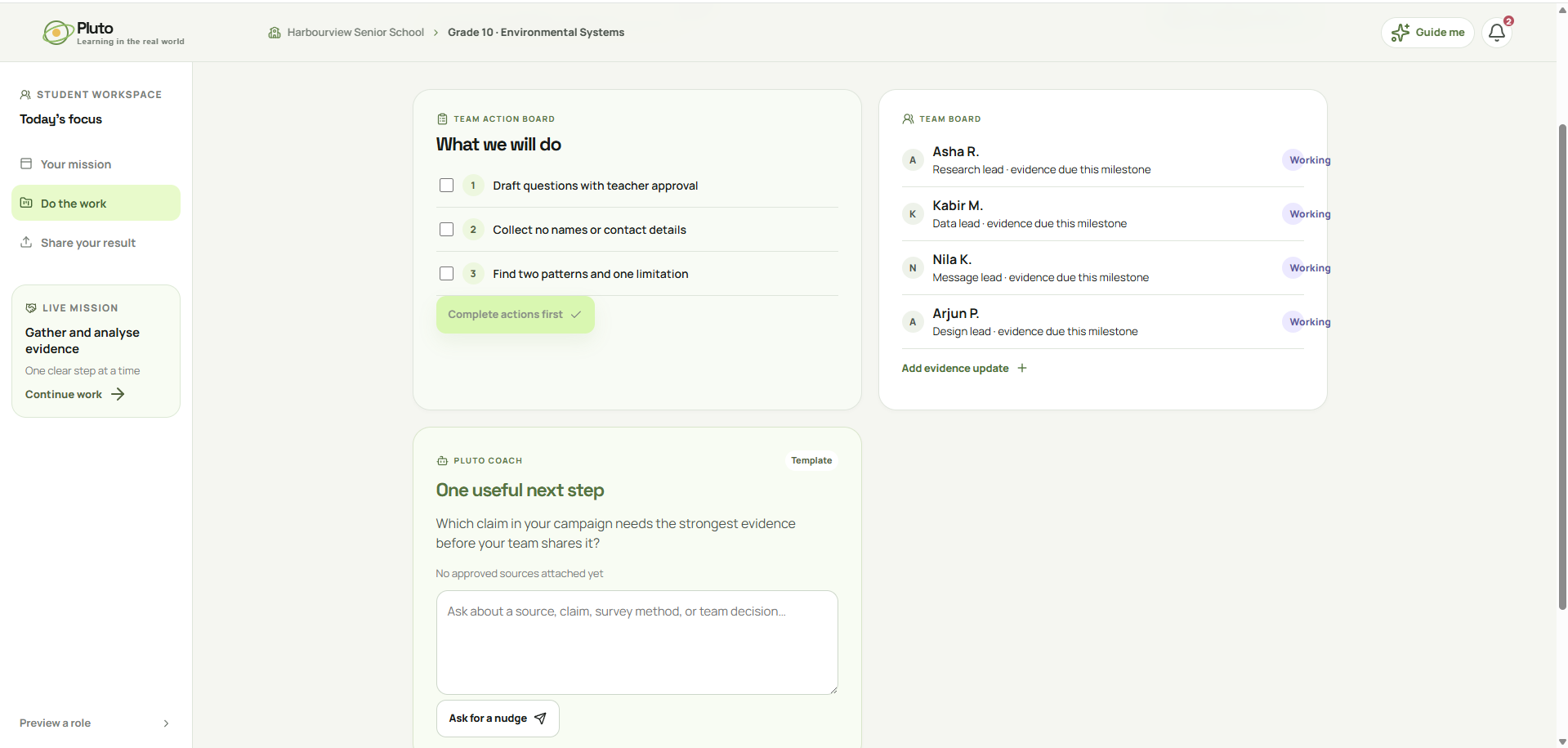
- Students see clear next steps, grounded sources, and an honest explanation of what the coach can and cannot do.
- Partners validate usefulness, never individual student grades.
How it works
- A partner submits a local challenge by text or voice note.
- Pluto drafts a mission with curriculum links, roles, milestones, deliverables, sources, a rubric, and safeguards.
- A teacher reviews and approves the mission before students can access it.
- The teacher imports the roster and reviews editable, balanced team proposals.
- Students work through checkpoints, research sources, attach evidence, collaborate, and reflect.
- The teacher assesses individual contribution.
- The partner validates whether the result is useful.
- Pluto creates a consent-aware Pluto Proof snapshot.
Honest AI
Pluto clearly labels every AI state:
- Live AI uses the configured OpenAI model.
- Template mode uses deterministic local structures when live generation is unavailable.
- Restricted policy is enforced server-side and limits the coach to safety and reflection prompts.
The coach receives approved evidence only. It cites that evidence when possible and says when the available material is insufficient. AI mode, policy, model, and evidence provenance are recorded in the audit path.
The assignment engine
Pluto does not make a black-box student assignment. It proposes balanced, editable teams using:
- interests and strengths
- preferred roles
- availability and availability windows
- accessibility needs and accommodations
- team size and role coverage
- distribution of strong role matches
The teacher approves the final assignment, with approval history and undo.
What is implemented
- Partner challenge intake and delivery validation
- Teacher mission review and safety gate
- Roster import and assignment proposals
- Student mission, workspace, research, artefacts, reflection, and submission flows
- Source checks, evidence linking, consent, publication controls, and audit history
- Per-student assessment and gradebook export
- Pluto Proof verification record
- Responsive product design for partners, teachers, students, and administrators
- Template, Live AI, and Restricted policy states
Built with
Next.js, React, TypeScript, OpenAI, Codex, SQLite, Zod, Vercel, and GitHub Actions.
How Codex and GPT-5.6 were used
Codex was used throughout the build to consolidate duplicated interface layers, implement the teacher approval and assignment workflows, enforce AI-policy boundaries, connect approved evidence to coaching, fix deployment issues, refine the design system, and run typecheck, lint, tests, and production builds.
GPT-5.6 powers the live mission-generation and coaching path when configured. The product remains usable in Template mode when a live model is unavailable, and Restricted mode prevents the server from returning live coaching where school policy does not allow it.
Try the pilot
The public repository includes a seeded Kochi waste-separation mission so judges can explore every role without real school data.
Pilot password for every account: pluto-demo
- Partner:
[email protected] - Teacher:
[email protected] - Student:
[email protected] - School admin:
[email protected]
Production boundary
This is an open pilot foundation, not an approved production system for real student data. Before school-wide deployment, Pluto still needs managed identity, managed relational and object storage, retention and deletion controls, malware scanning, monitoring, accessibility validation, localisation, LMS/SIS integrations, and operational support.
OpenAI Build Week
Pluto is submitted to the Education category. The project demonstrates a working product, a coherent design system, a specific education problem, accountable AI, and a non-trivial implementation with server-side authorization, migrations, evidence handling, and assignment constraints.
Built With
- codex
- github-actions
- next.js
- openai
- react
- sqlite
- typescript
- vercel
- zod

Log in or sign up for Devpost to join the conversation.