-
-
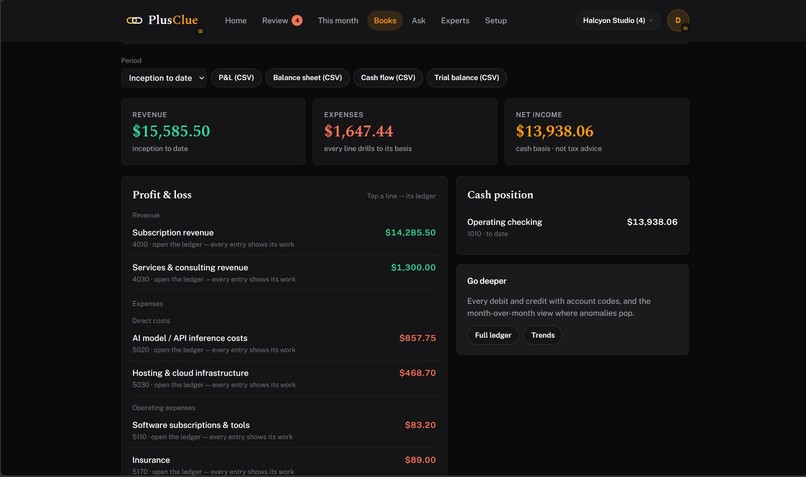
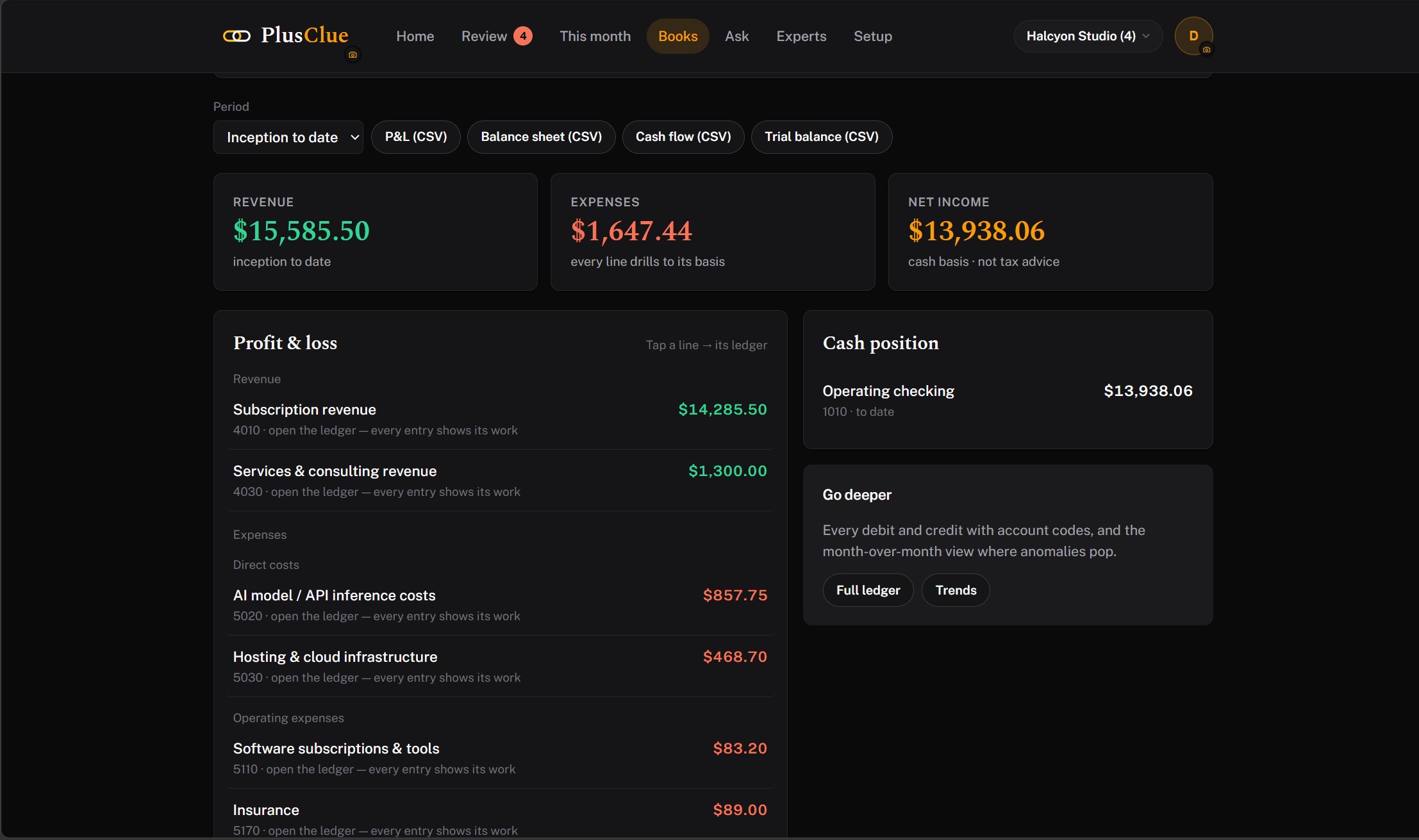
Demo Books at a glance
-

Demo Setup glossary
-

Demo - Asking the Subscriber
-
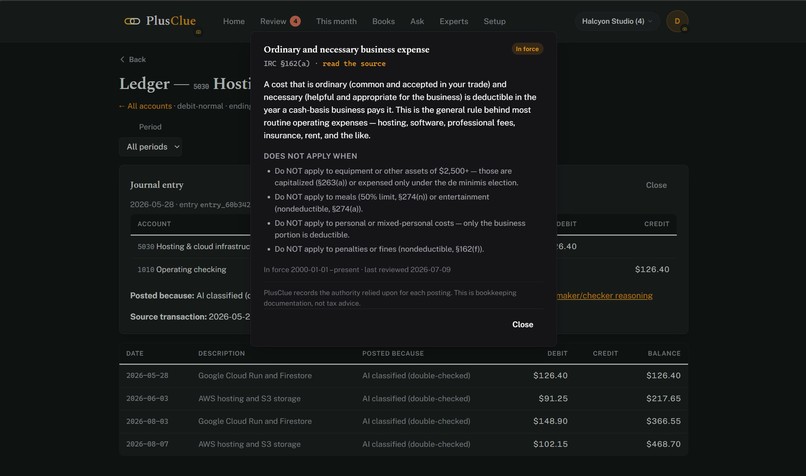
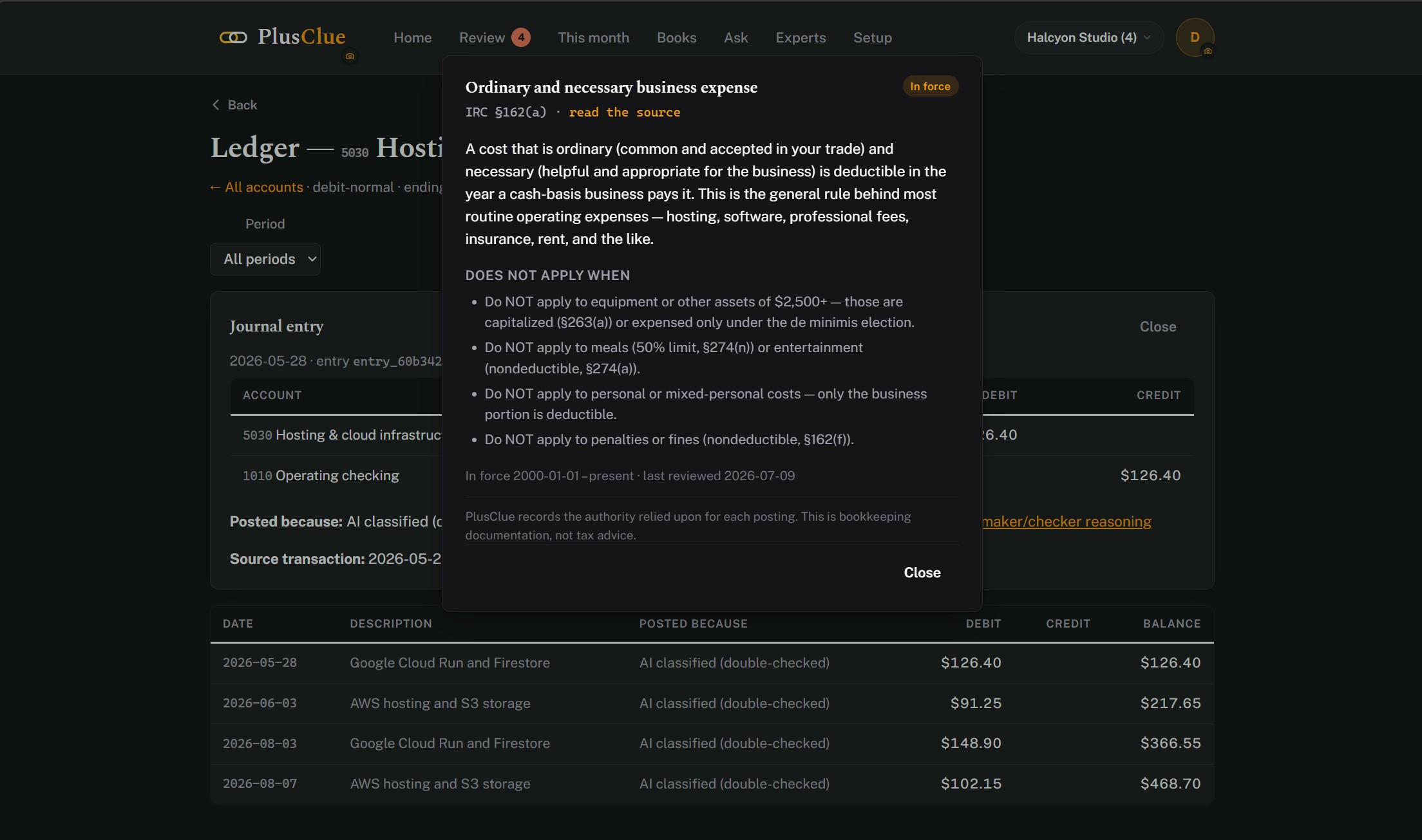
Demo - The IRC §162(a) authority card, "In force" badge, the "records the authority relied upon for each posting" disclaimer
-
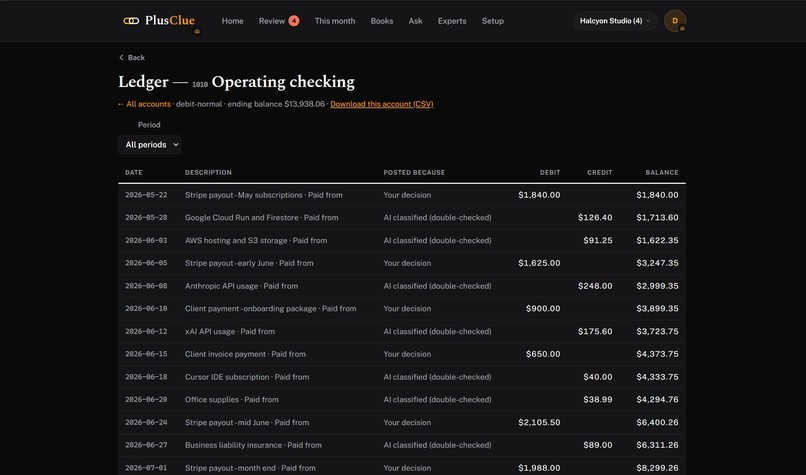
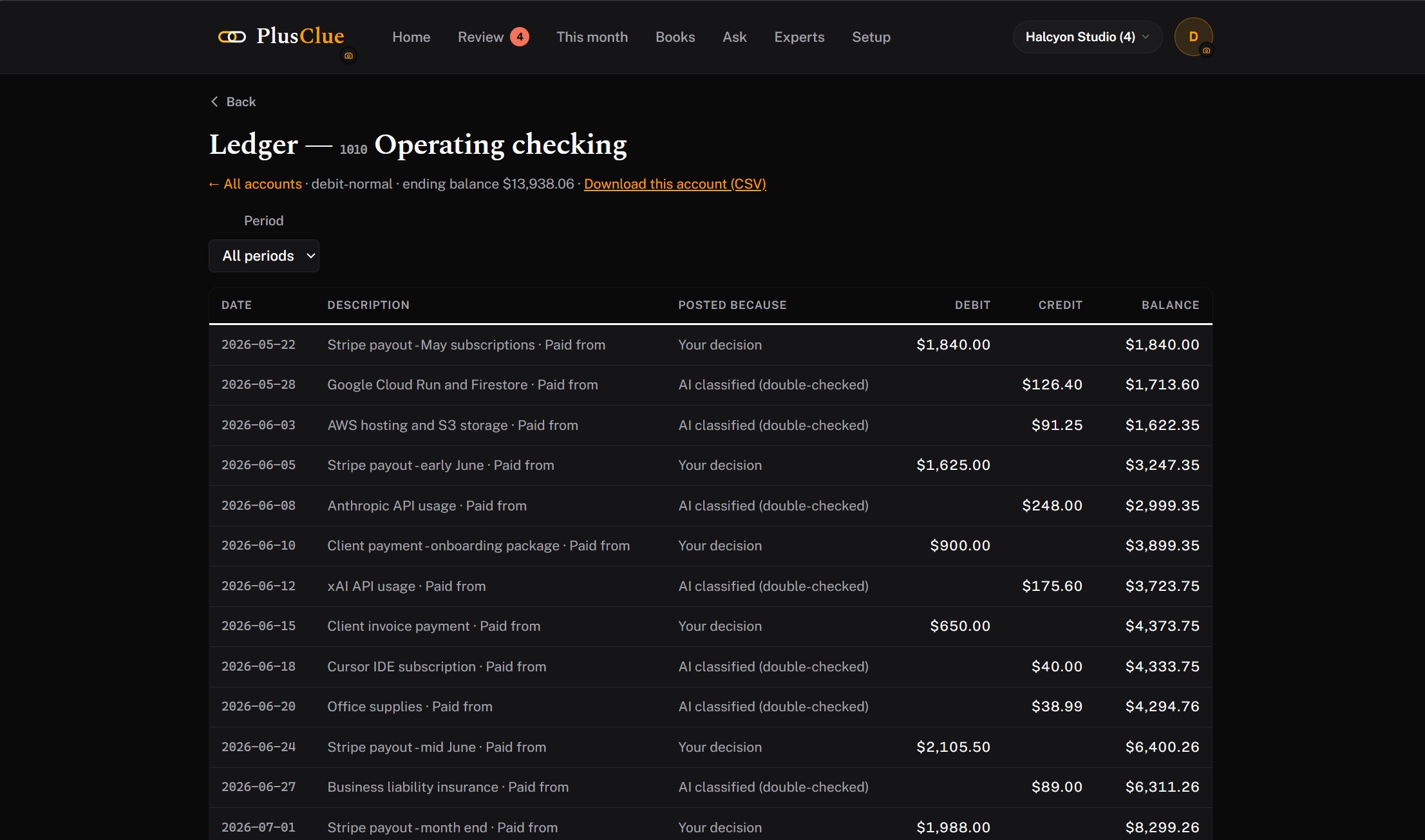
Demo - Ledger drill down - Your Decision, AI Classified
-
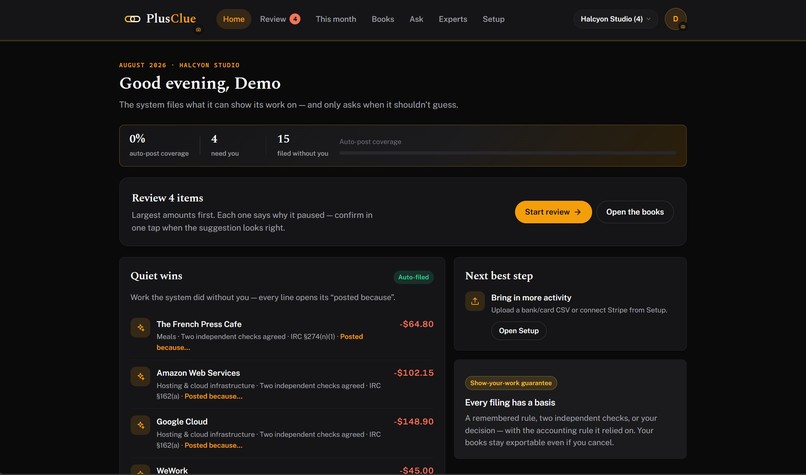
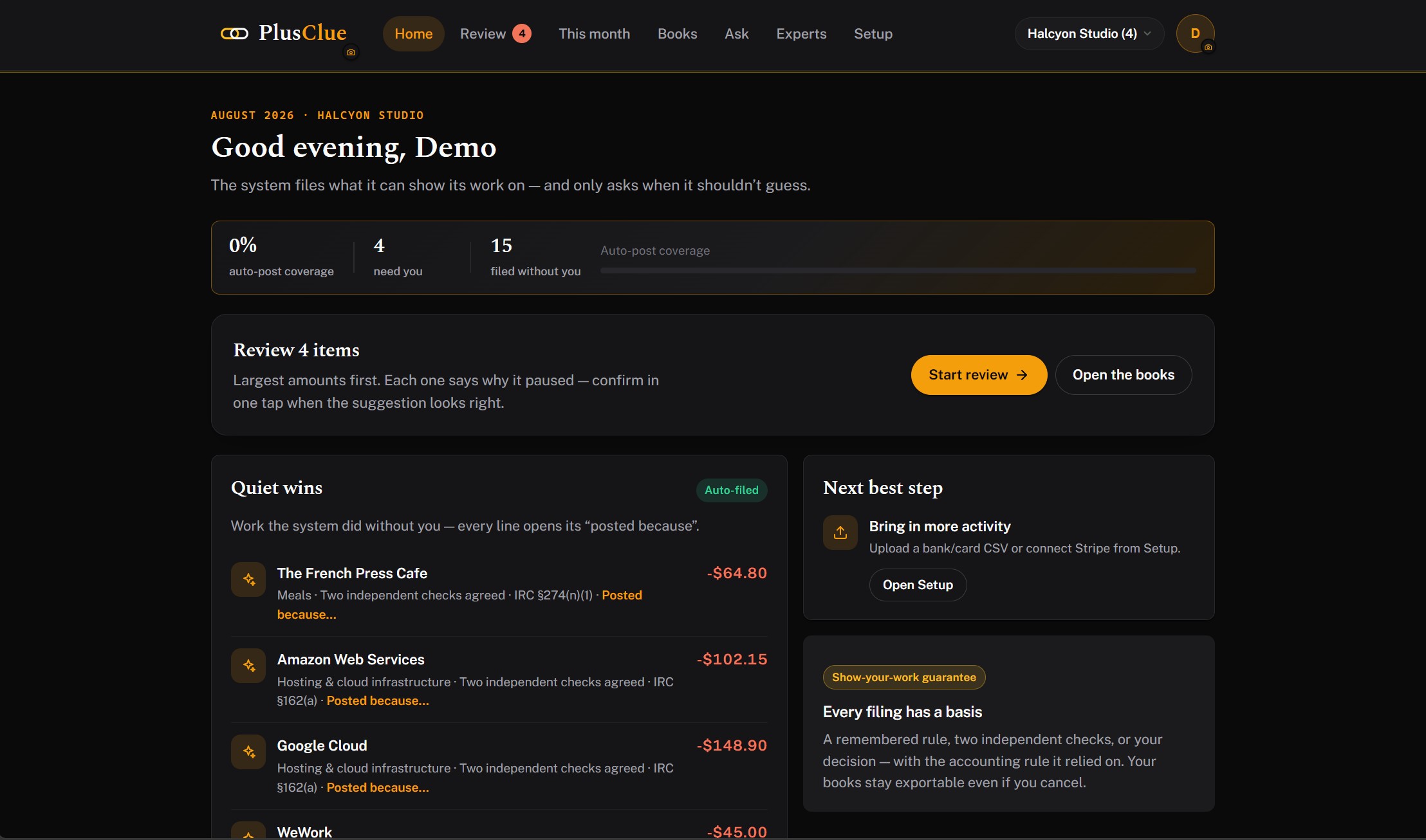
Demo - App Home Page
-
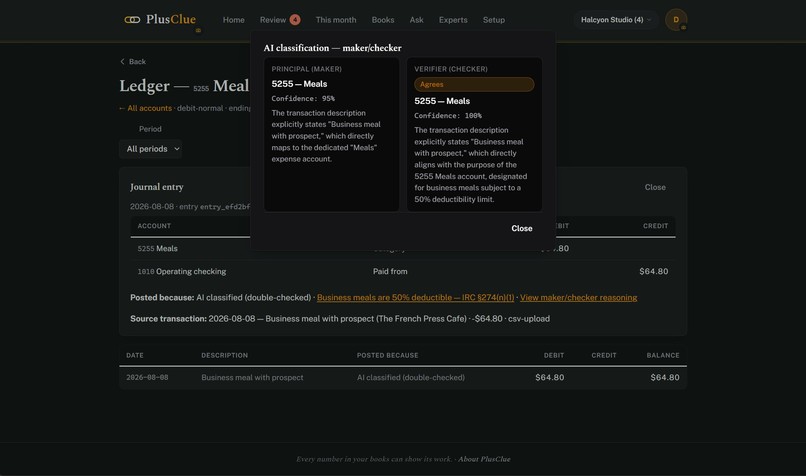
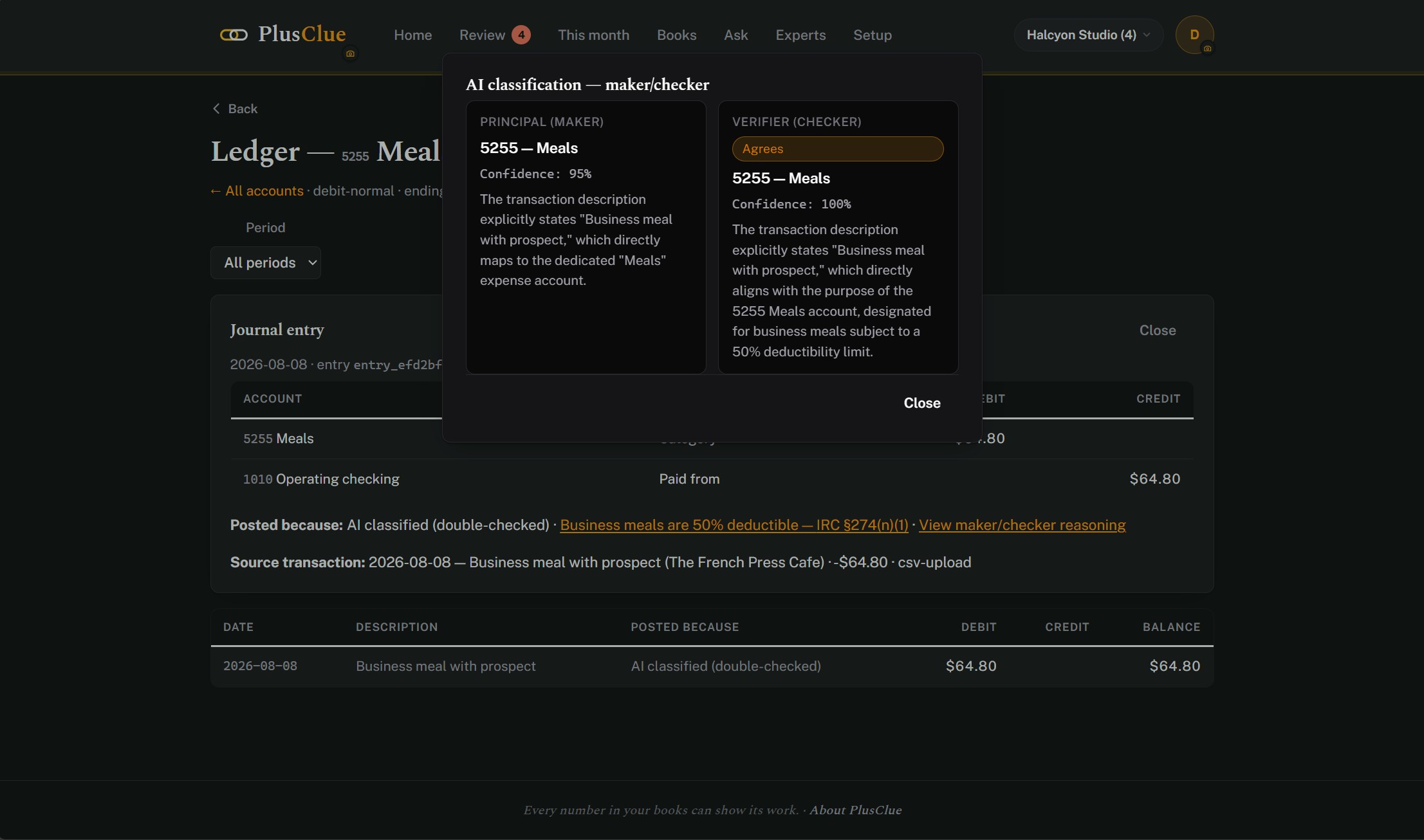
Demo - Maker Checker


Inspiration
Bench Accounting raised \$113M and collapsed overnight — 12,000 businesses lost access to their own books. Its automation rested on hidden human labor; when the labor stopped, so did the books. The failure was not the automation. It was that nobody could see it failing.
Thirty-three million U.S. small businesses need bookkeeping. Most cannot afford a bookkeeper and do not want to become one. Every AI bookkeeper asks you to trust it, and none answers the question a bank or the IRS eventually asks: how would anyone know if it were wrong?
I spent my career on that question — Big Four, then nineteen years at a media company including management audit. Ledgers never depended on perfect bookkeepers. The audit profession's answer to fallible workers has always been controls, not supervision: assume the worker errs, and design the system to catch it. Nobody had applied that to AI agents.
What it does
Autonomous cash-basis bookkeeping. Data arrives from bank feeds, Stripe, CSV uploads, and receipts. Every transaction passes a maker-checker before anything posts.
A principal model classifies transaction $t$, producing $c_P(t)$. An independent verifier, blind to that answer, produces $c_V(t)$. It posts automatically only when
$$ \operatorname{post}(t)\iff c_P(t)=c_V(t)\;\wedge\;\lvert a(t)\rvert<m $$
where $m$ is the owner's materiality threshold. Anything else — disagreement, low confidence, an unidentified deposit, a large amount — queues for the owner with a plain-language explanation of what only they would know. It never guesses.
Open any entry and it shows which model concluded what, at what confidence, under which authority, and whether a human or agent decided. Books close monthly against the bank statement, to the cent, or they do not close.
See it: read-only demo at app.plusclue.com — [email protected] /
anchor-margin-8120. Writes are disabled; reads stay open by design.
How we built it
AI is not a feature here; it executes the core decision.
Gemini 3.1 Pro is the verifier — the independent second classification on the critical path. Nothing posts without Gemini agreeing, and it is a different model from a different provider than the principal, so the check is genuinely independent rather than a second opinion from the same mind. Gemini also powers the in-app assistant, which answers only from the owner's own records under a schema that makes an uncited claim unrepresentable, and reads receipts multimodally. A third auditor model, from a third provider, re-performs posted work blind.
Running on Google Cloud (Cloud Run, Firestore). Correctness is structural rather than prompt discipline: schema-constrained output makes an invented account unrepresentable; a machine-checked gate lets a model cite only authorities whose preconditions the transaction satisfies; every model call passes one logged choke point; the store is append-only; and every entry carries exactly one basis $b(e)$.
So when a basis is later found wrong, the affected population is exactly
$$ E_b={\,e\;:\;b(e)=b\,} $$
Blast radius is a query, not an estimate.
Challenges we ran into
Independence is harder than it sounds — a verifier that sees the principal's answer is an echo, not a check. A model bake-off settled the lineup: cheaper models were competitive at classifying but measurably weaker at checking, so the checker seat went to Gemini 3.1 Pro.
"Never guess" has to survive the boring failures. Quota exhaustion mid-run raises a typed error that queues the transaction; it never degrades into a lower-confidence guess.
Truth-in-credentials meant showing less than we could. A professional's license reads "as attested" until a human checks the issuing board's lookup. The Experts directory ships with no star ratings, and trust metrics render nulls rather than placeholders that look like measurements.
Accomplishments that we're proud of
PlusClue is live in production on Google Cloud, selling a \$199/month flagship plan through Stripe. On traction I will be blunt: every account on the platform is mine or a family member's, so independent sales are zero. A product whose entire premise is claim exactly what is true does not get to round its own numbers up.
What I would rather be judged on: PlusClue is the reference implementation of the Autonomous Operations Control Framework (AOCF), a criteria-form control standard we authored for operations where AI agents execute core decisions. ISO/IEC 42001 certifies that AI management processes exist; SOC 2 attests to infrastructure; evaluations test models. None asks whether the operation is trustworthy.
And a practitioner can issue a report a business hands its bank, carrying a public verification URL where the bank checks the record itself — issuer, verified license, procedures, tamper-evident hash. Documents get forged; verifiable records do not.
What we learned
Where you spend model quality matters more than how much you spend. Cheap models make fine makers and poor checkers; the strongest model belongs in the checker seat.
Controls scale where supervision does not. Pairing every agent with a human reviewer — the industry's current answer — caps automation at human throughput and human price points. Materiality thresholds put humans at judgment instead of in review of everything, which is what makes small-business pricing possible.
What's next for PlusClue
I entered this competition to fund the next stage. An award — and the raise it seeds — pays for the things standing between this and customers: an attorney pass over the Terms of Service, Privacy Policy, and marketplace claims; an independent code review by a professional engineer, since this was built solo; a commercial agreement with Plaid for production bank data; and beta testing at a scale that produces real trust numbers instead of nulls.
Bookkeeping is the first vertical, not the last. The near path is the accountant channel: every professional who receives a report or a year-end package meets the platform.
The far path is the framework. AOCF is written as examination criteria, so independent practitioners can certify other autonomous operations against it. Texas's RAIGA statute already makes adherence to a recognized AI risk framework an affirmative defense. Claims processing, procurement, fund administration — every category of autonomous operation will need an answer to how would anyone know?
PlusClue exists to prove that answer works, in the least forgiving domain there is: other people's money, reconciled to the cent, published monthly.
Built With
- anthropic
- artifact-registry
- cloud-build
- cloud-run
- cloud-storage
- express.js
- firestore
- gemini
- google-cloud
- node.js
- plaid
- react
- react-router
- resend
- secret-manager
- stripe
- typescript
- vite
- xai

Log in or sign up for Devpost to join the conversation.