-
-
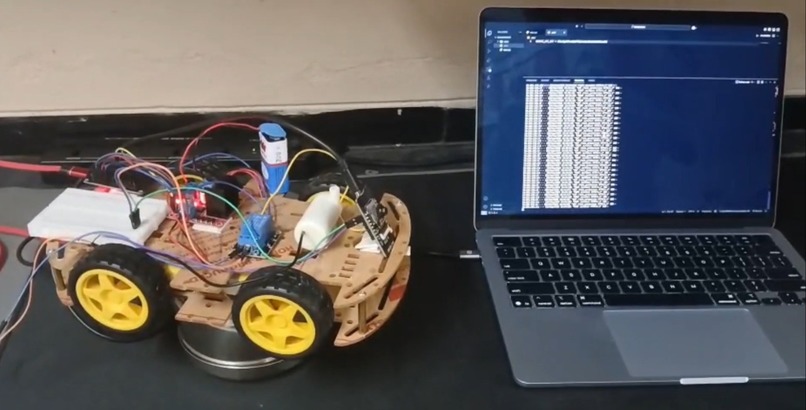
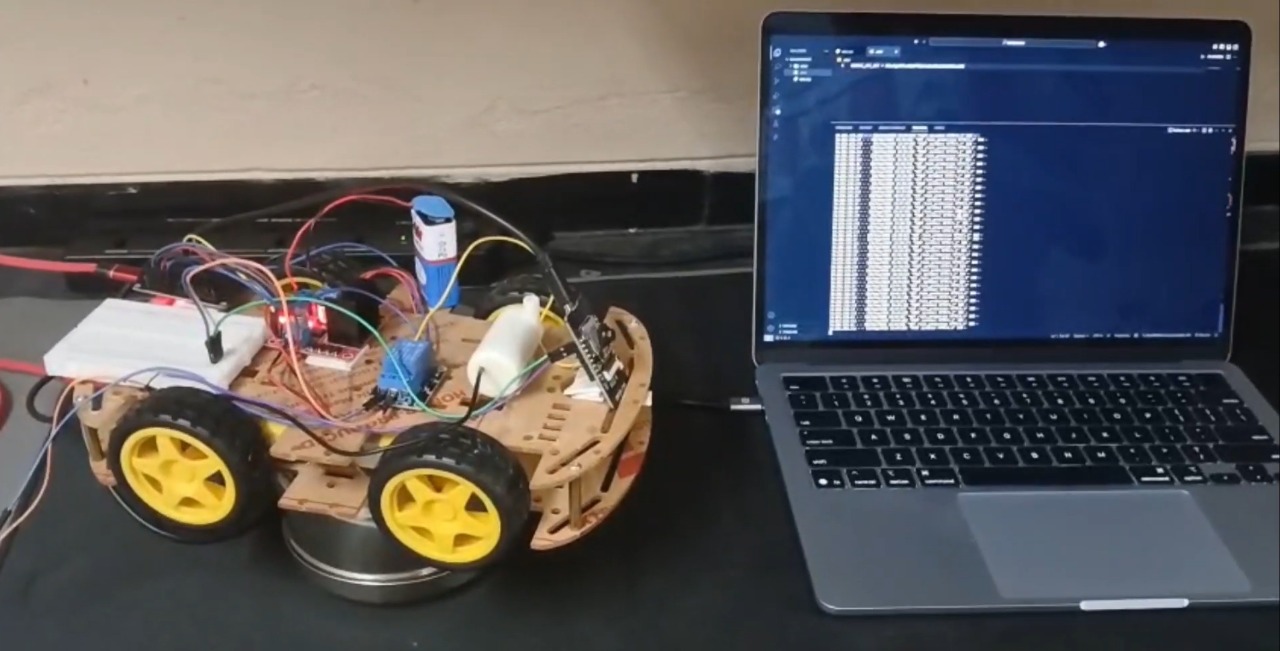
This is our AgriBot's "Prototype".
Agriculture still depends heavily on manual inspection and blanket pesticide spraying, which wastes chemicals, harms soil health, and increases farmer expense. I wanted to create a system that could intelligently detect pests and spray only where needed, combining robotics, AI, and mapping into a real-world solution.
I was inspired by: Precision agriculture robots Computer-vision-based disease detection Autonomous navigation challenges in unstructured farm environments Helping farmers reduce costs and chemical exposure This became a personal mission to build something genuinely useful.
AgriBot is an autonomous ground robot that: Navigates through farms using SLAM, GPS, IMU, and encoders Scans crops using camera + AI pest detection Automatically identifies pest-infected areas Precisely sprays pesticide only where required Logs pest detections and spray events to a backend server Maps the farm and shows pest hotspots on a dashboard Covers entire fields with a planned zig-zag (boustrophedon) pattern
How we built it
We divided AgriBot into three major layers:
Perception Layer Sensors collect raw data: Camera → pest detection images LiDAR/ToF → obstacle detection GPS → global positioning IMU → orientation Wheel encoders → odometry
Computational Layer (Raspberry Pi 5)
This acts as the robot’s brain: Runs SLAM to build a dynamic farm map Fuses IMU + Encoders + GPS + LiDAR using EKF Runs a model to detect pests every meter Executes path planning Decides when/where to spray Sends commands to motor/sprayer controllers
Actuation Layer Motor driver → robot locomotion (linear + angular velocity) Pump + solenoid valve → precision spray actuation
Backend Server Built using Node.js + Firebase : Stores pest detections, GPS logs, spray usage Visualizes farm maps and hotspots Allows OTA updates and model improvements
This multi-layer system allowed AgriBot to behave like a “neural network” of sensing, thinking, and acting.
Challenges we ran into
2D LiDAR gaps in farms Leaves create height gaps that LiDAR can’t detect → solved using: ToF depth sensing Vision-based obstacle detection
Running AI on Raspberry Pi models were slow → optimized using: Reduced inference resolution
Odometry errors on soil Uneven terrain caused wheel slip → fixed with: IMU fusion GPS corrections
Precision spray alignment Synchronizing camera detection point → spray nozzle position required calibration & coordinate transforms.
Power management Pump + motors caused current spikes → added: Separate power rails Voltage regulators
Accomplishments that we're proud of
Built a fully autonomous navigation system using SLAM + IMU + GPS fusion Designed an AI system that detects pests in real time on a Pi Achieved precision spraying, reducing chemical usage dramatically Created a full-stack system: bot → edge processing → cloud → dashboard Proved that low-cost hardware can deliver real-world agricultural automation This is one of the few student projects combining robotics, AI, actuation, and cloud into a complete working solution.
What we learned
We learned how to integrate robotics, AI, and backend engineering into one coherent system. Robotics Kinematics, odometry, control loops SLAM fundamentals and sensor fusion Path planning algorithms AI & Vision Dataset collection & training TFLite/TensorRT optimizations Running neural inference on embedded hardware Systems Engineering Building a 3-layer robotics architecture Designing real-time decision systems
Logging + cloud analytics
What's next for AgriBot
Integrating multispectral cameras for early disease detection Adding solar charging for long autonomous missions Implementing RTK-GPS for centimeter-level precision Deploying multiple robots working as a fleet Adding AI that predicts future pest outbreaks Sharing the platform as an open-source project for farmers and researchers AgriBot is just the beginning — the future is scalable, intelligent, autonomous agriculture.

Log in or sign up for Devpost to join the conversation.