-
-
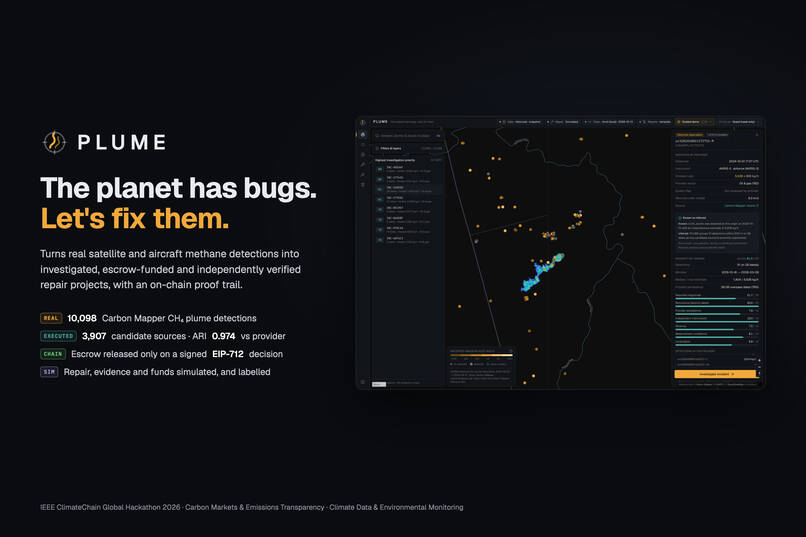
Cover Picture
-
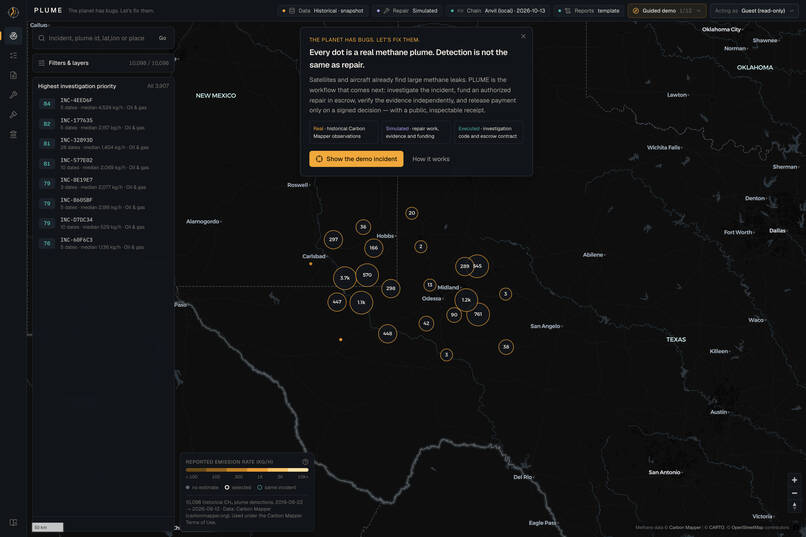
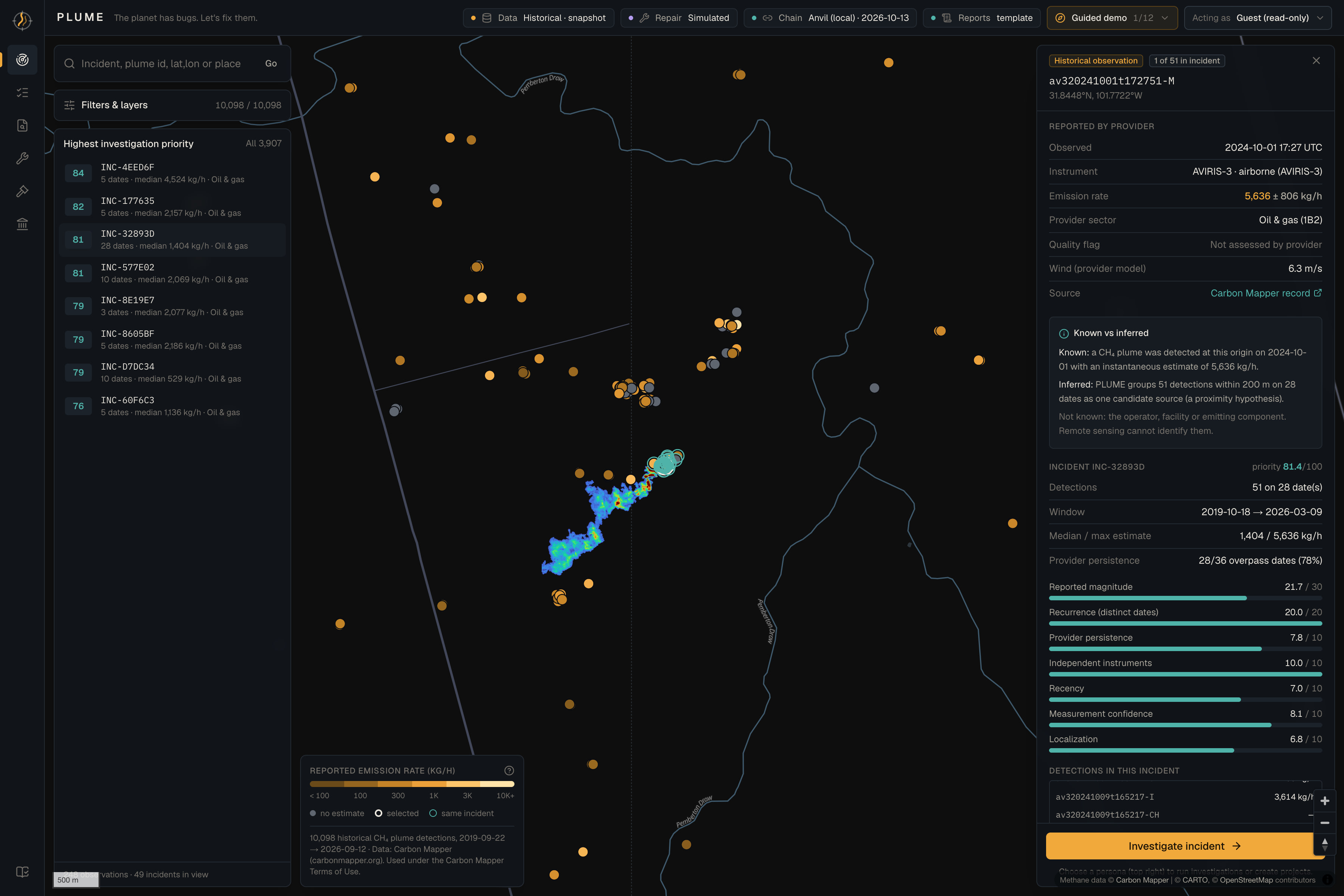
Mission Control
-
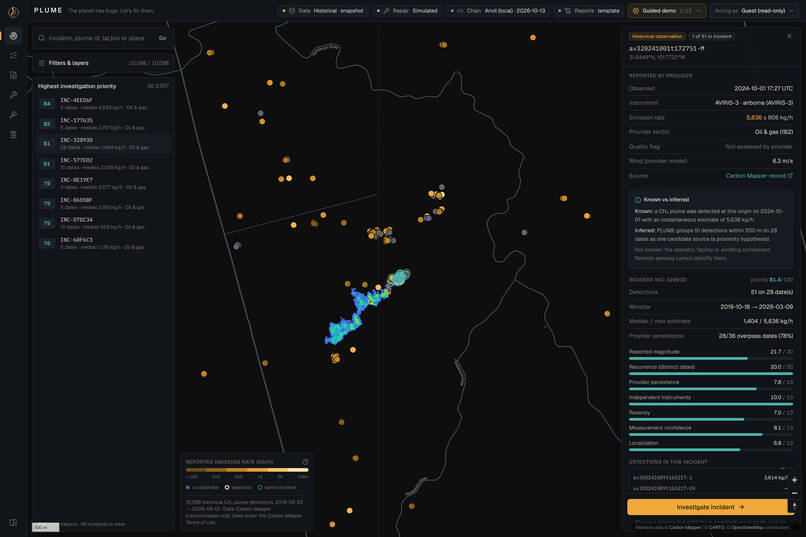
Plume Detection
-
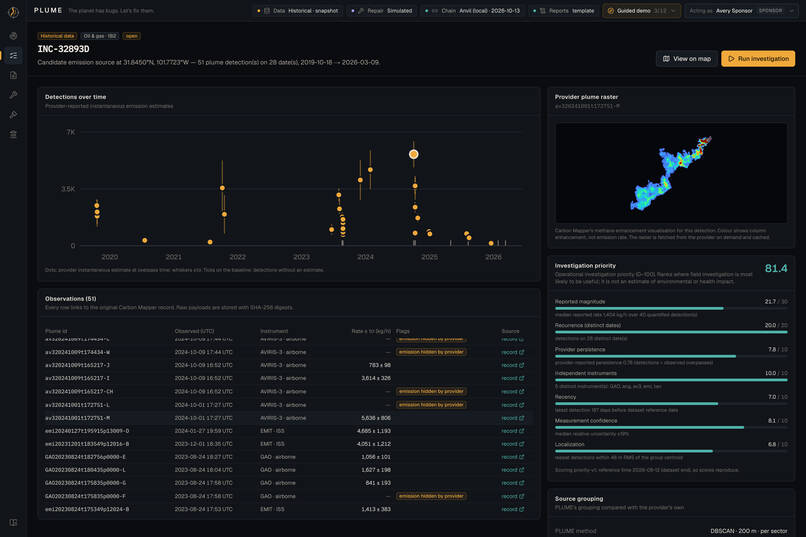
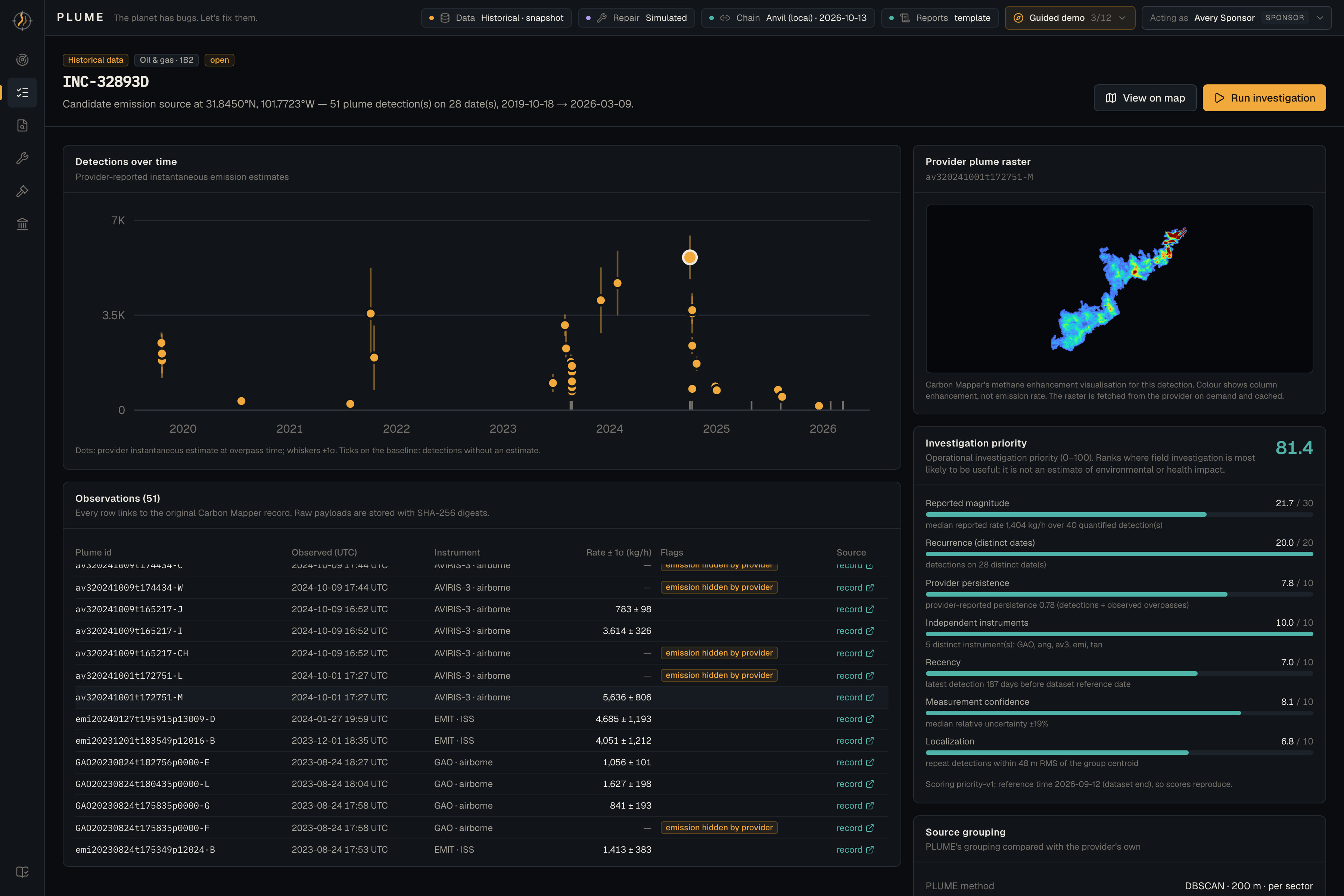
Incident Priority
-
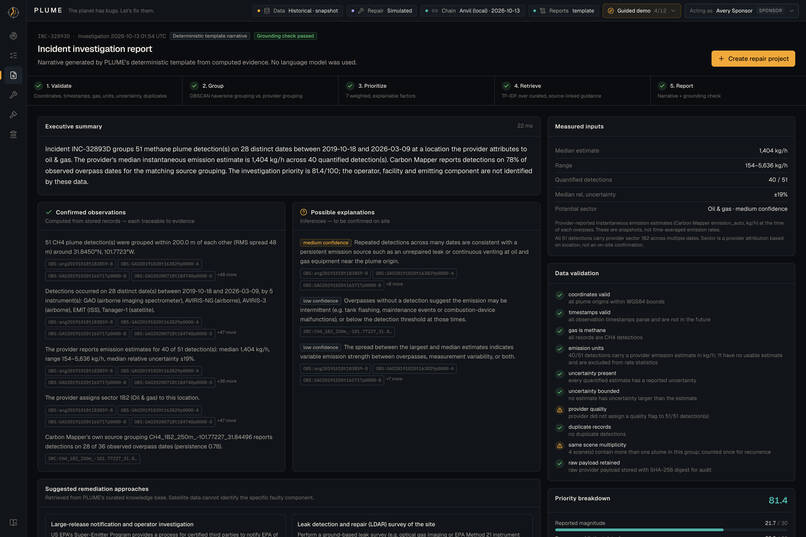
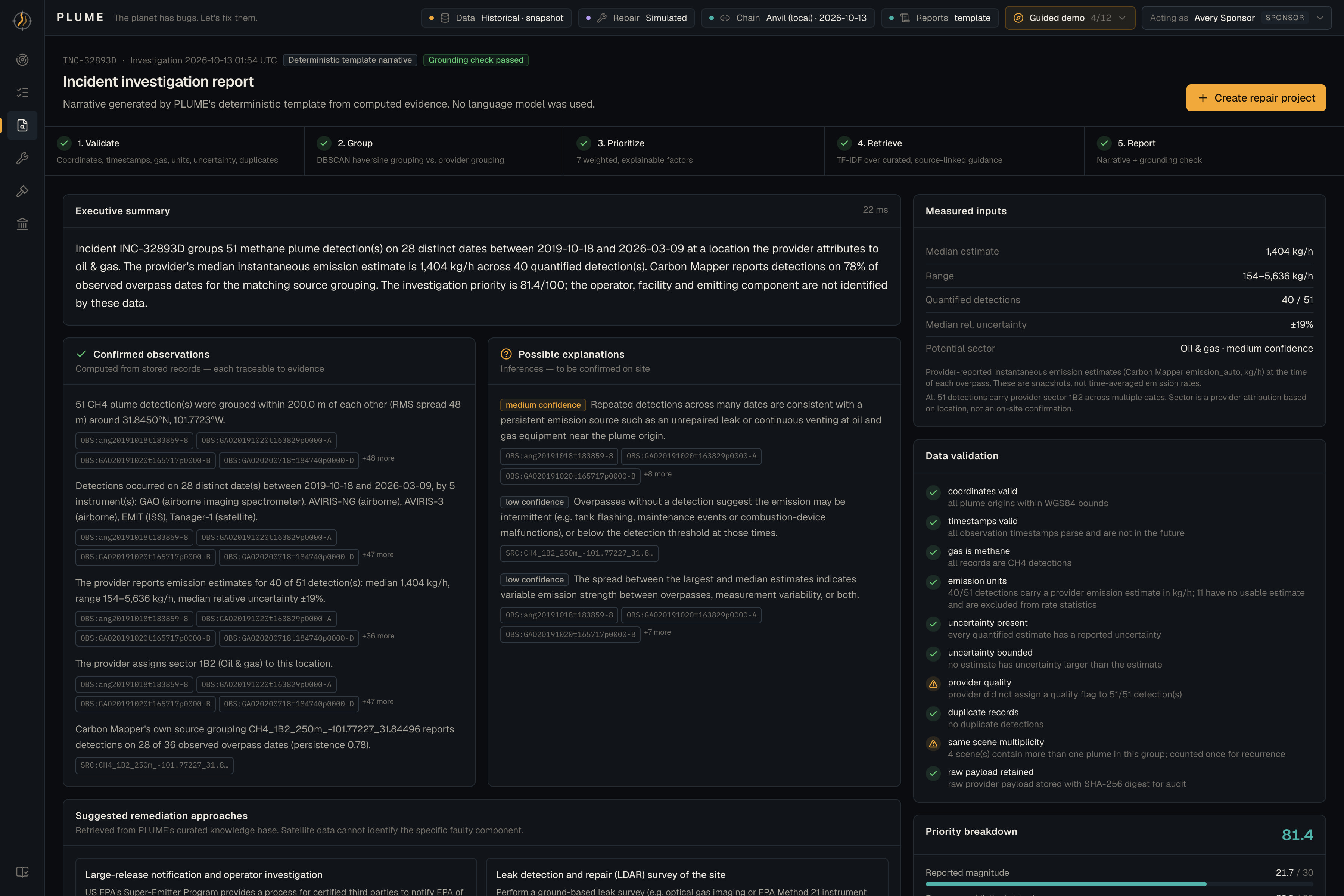
Investigative Report
-
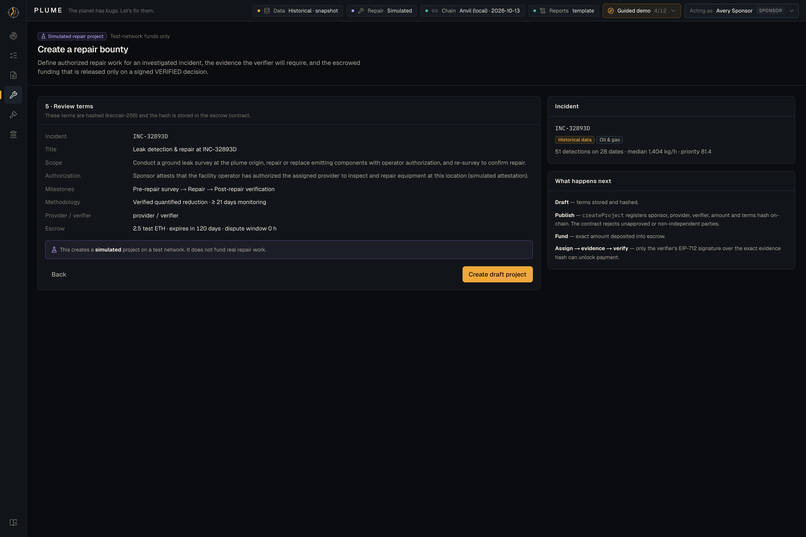
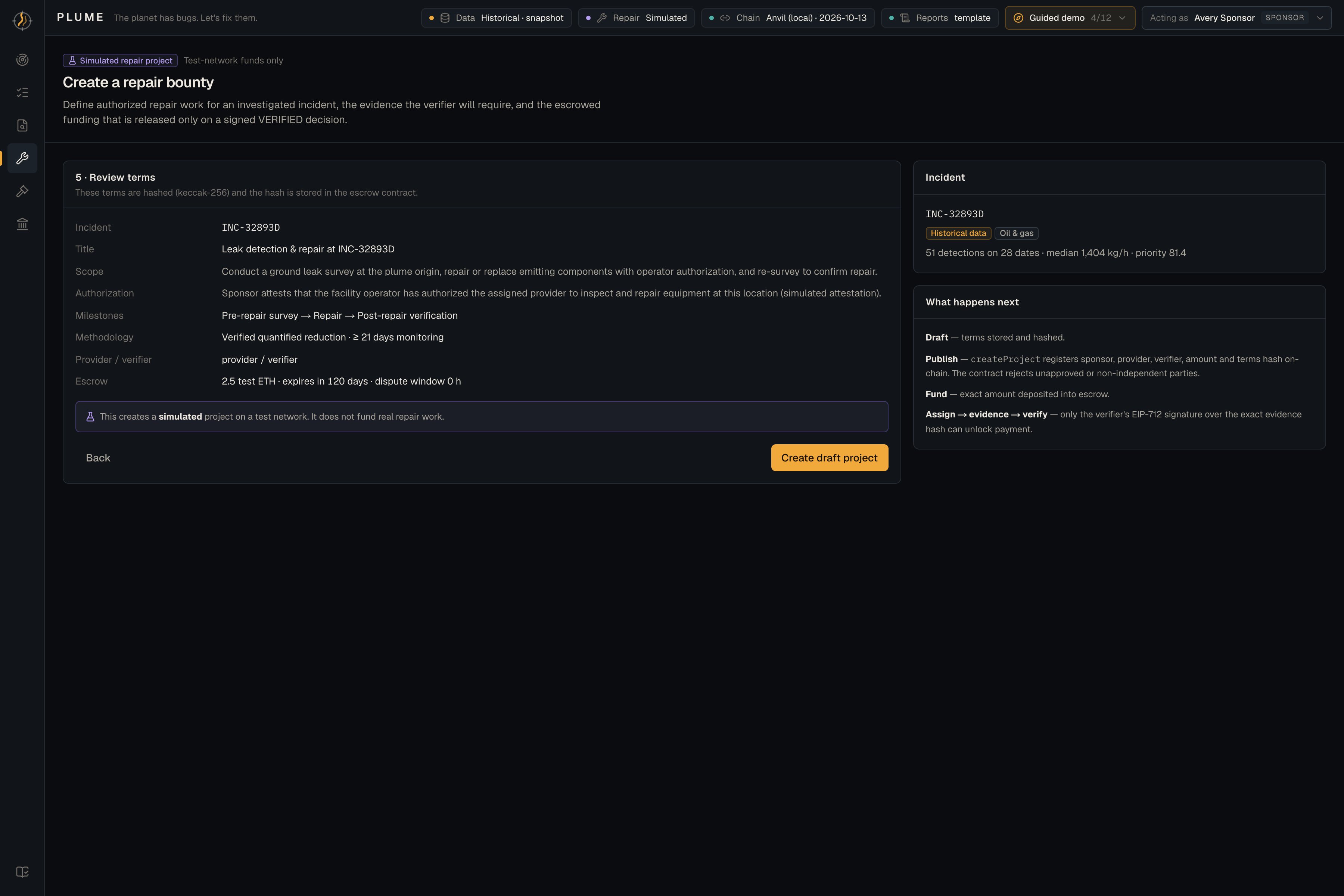
Repair Bounty
-
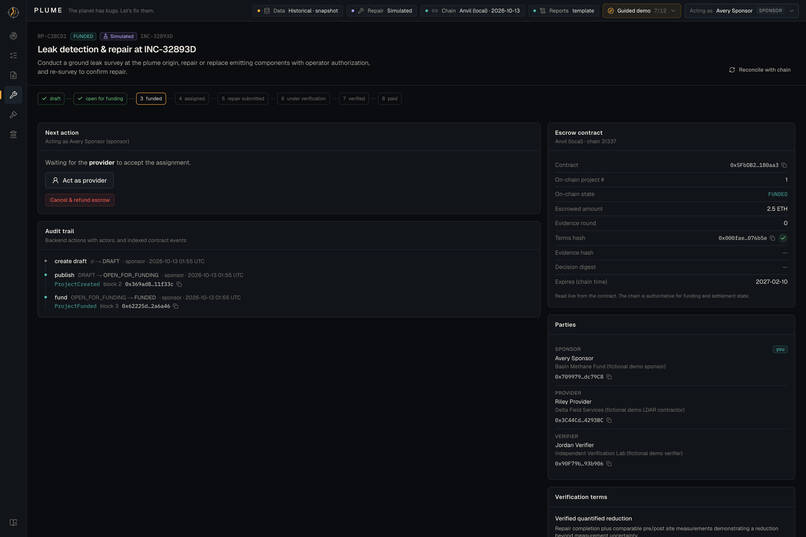
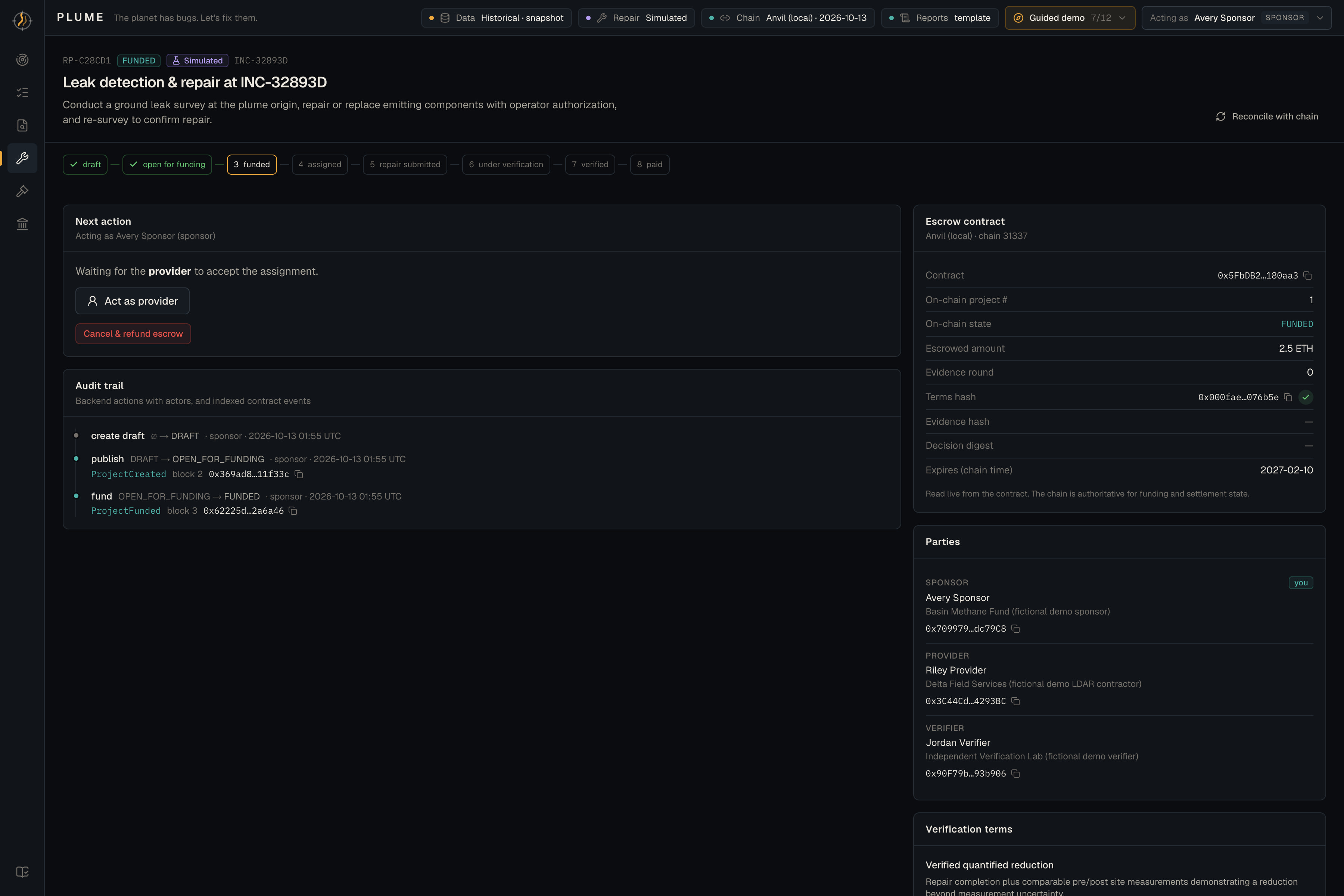
Escrow Funded
-
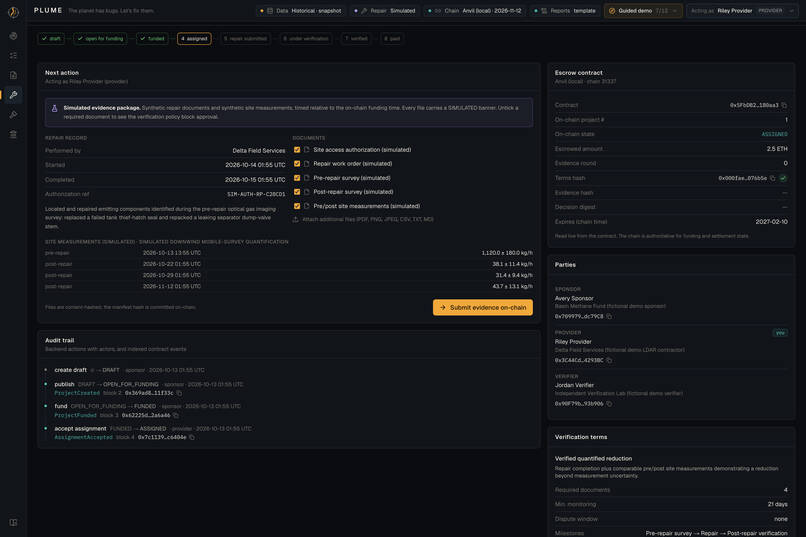
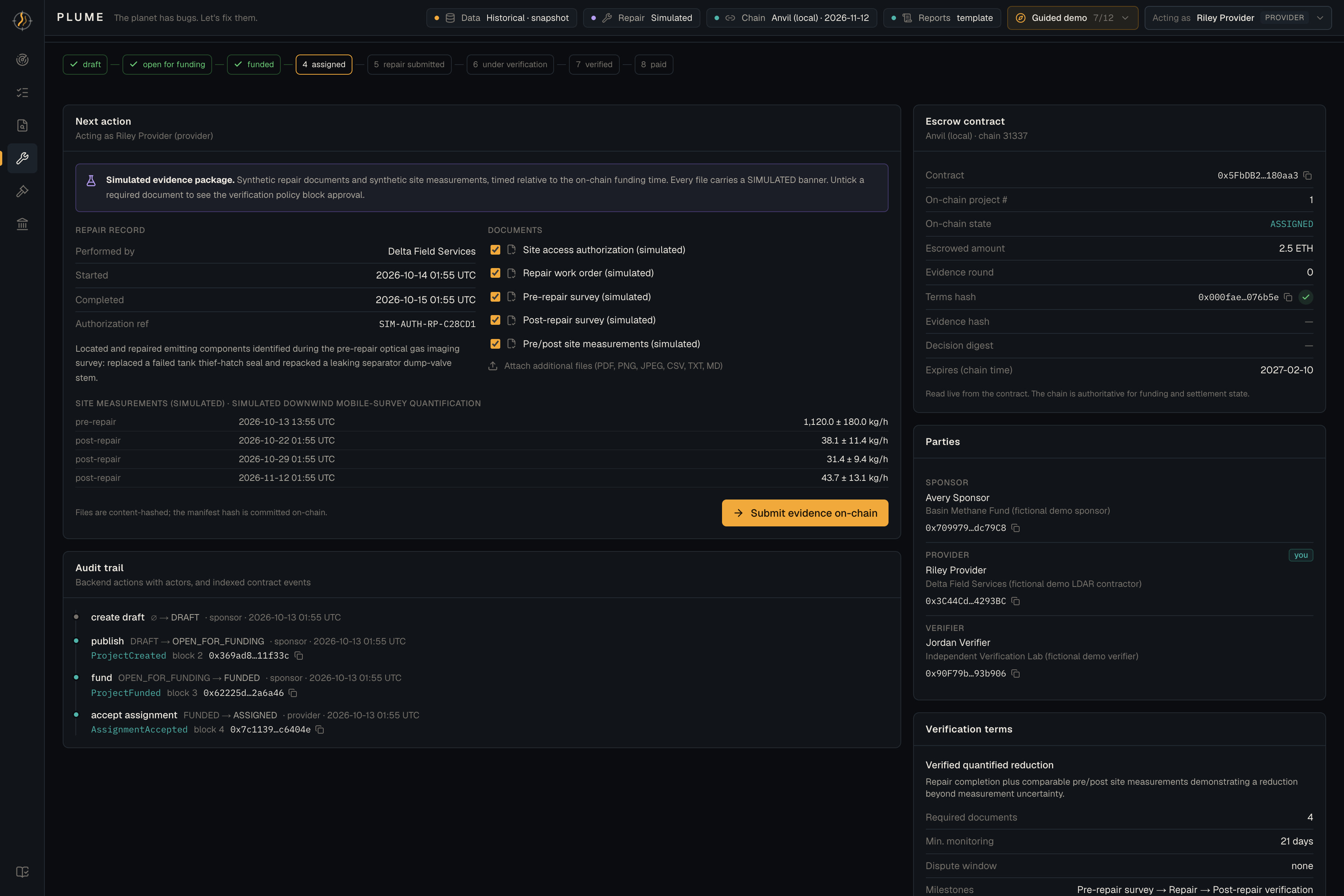
Provider Evidence
-
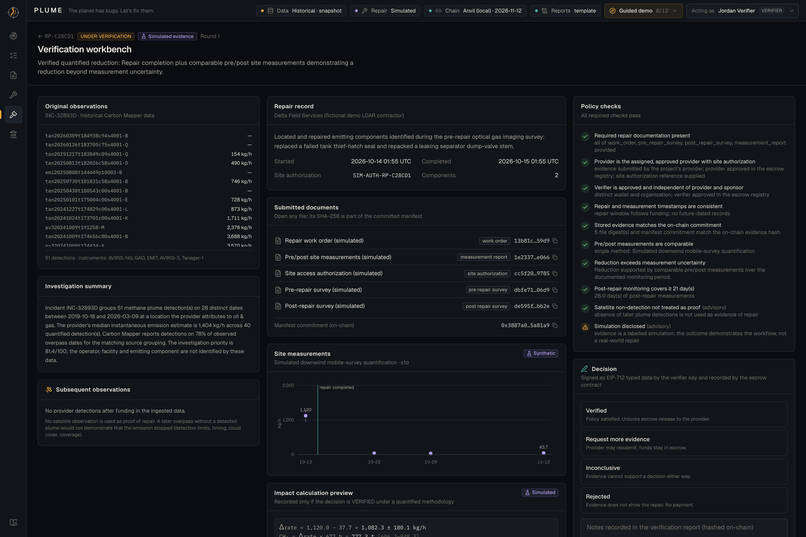
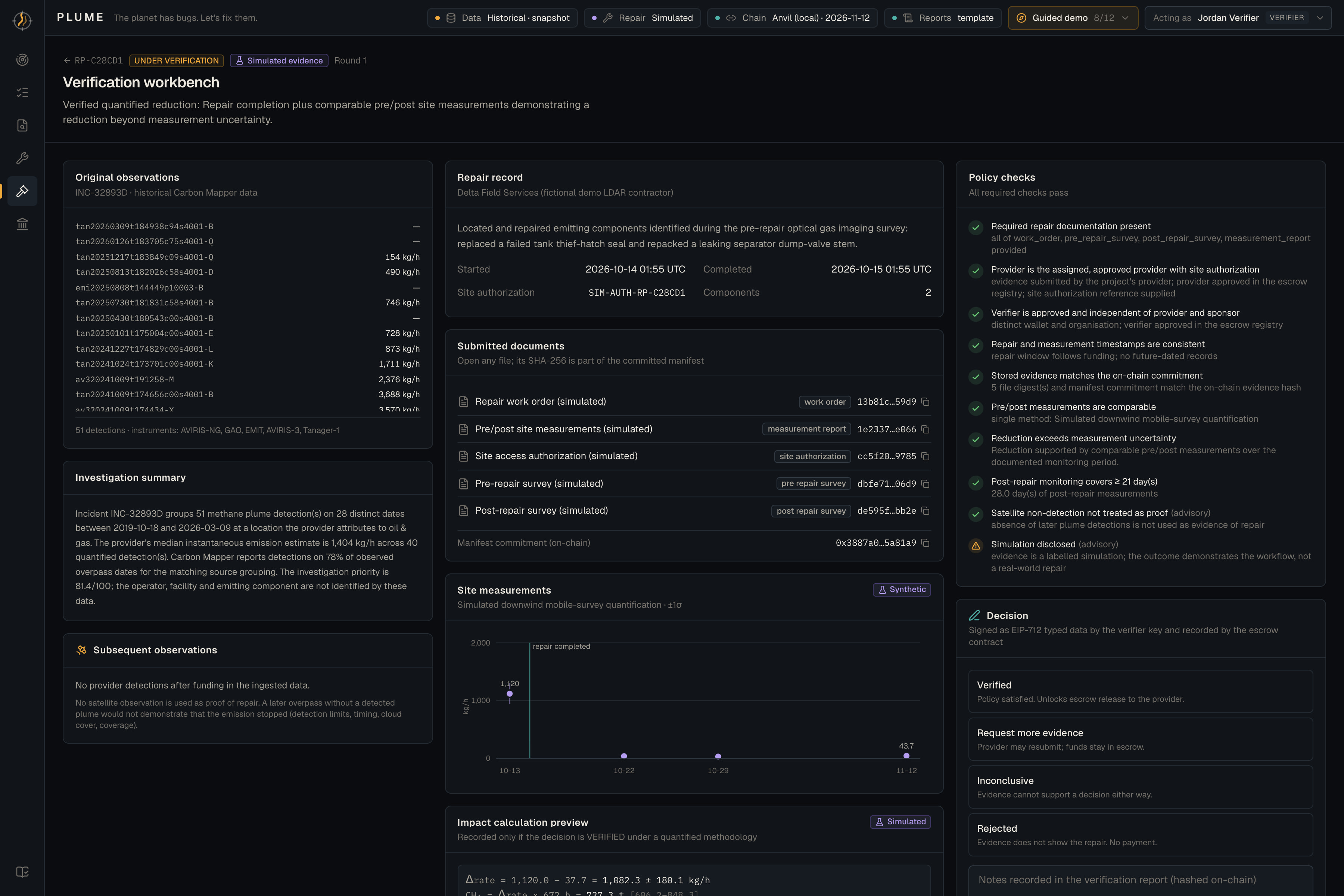
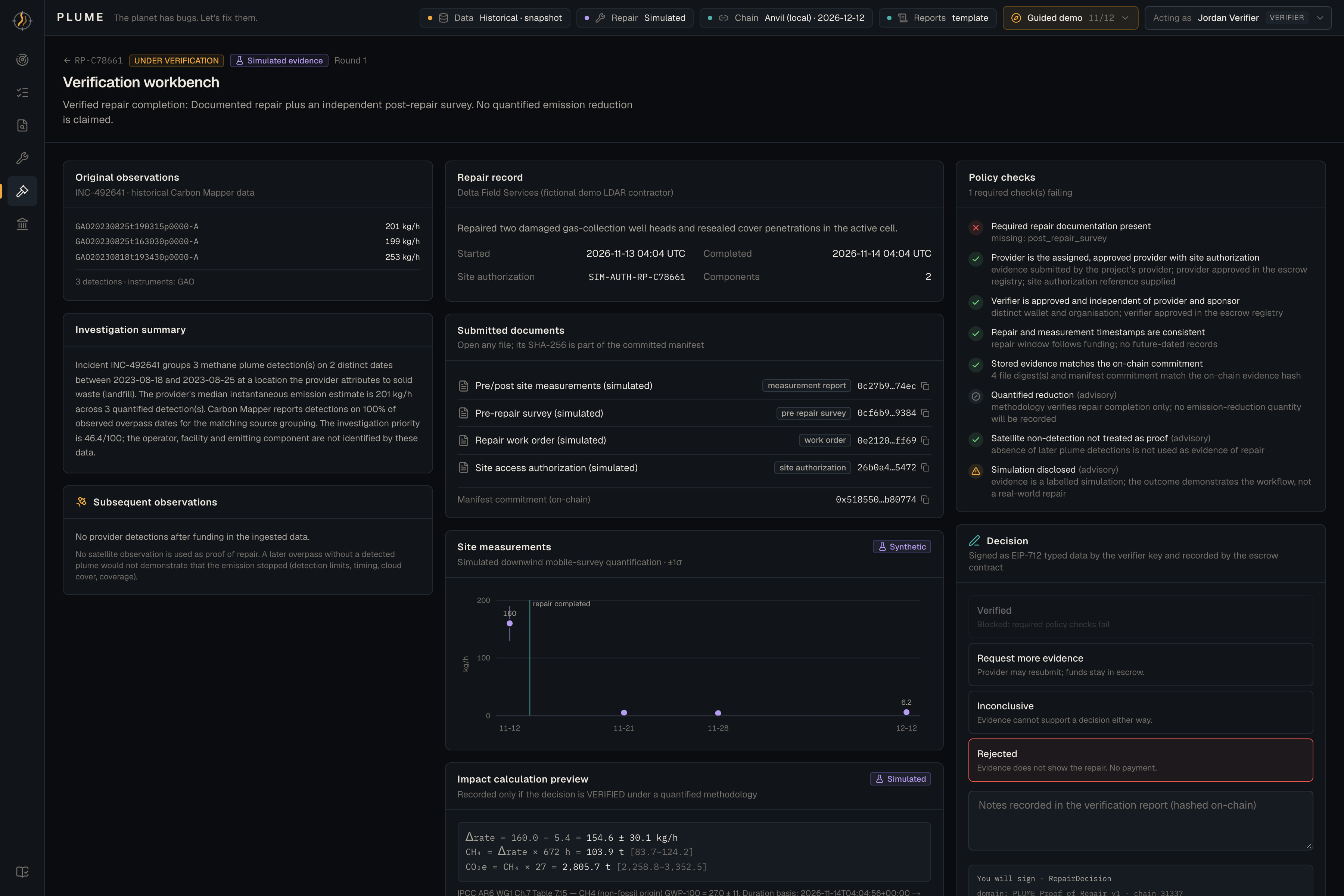
Workbench Verification
-
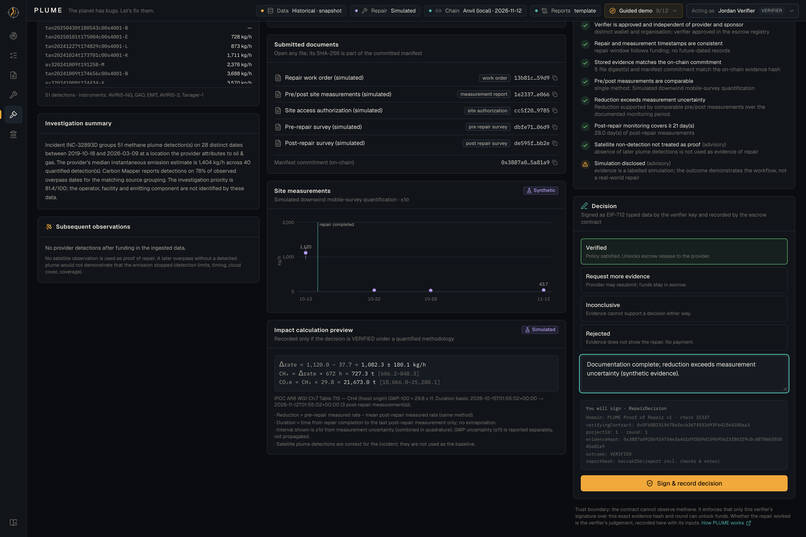
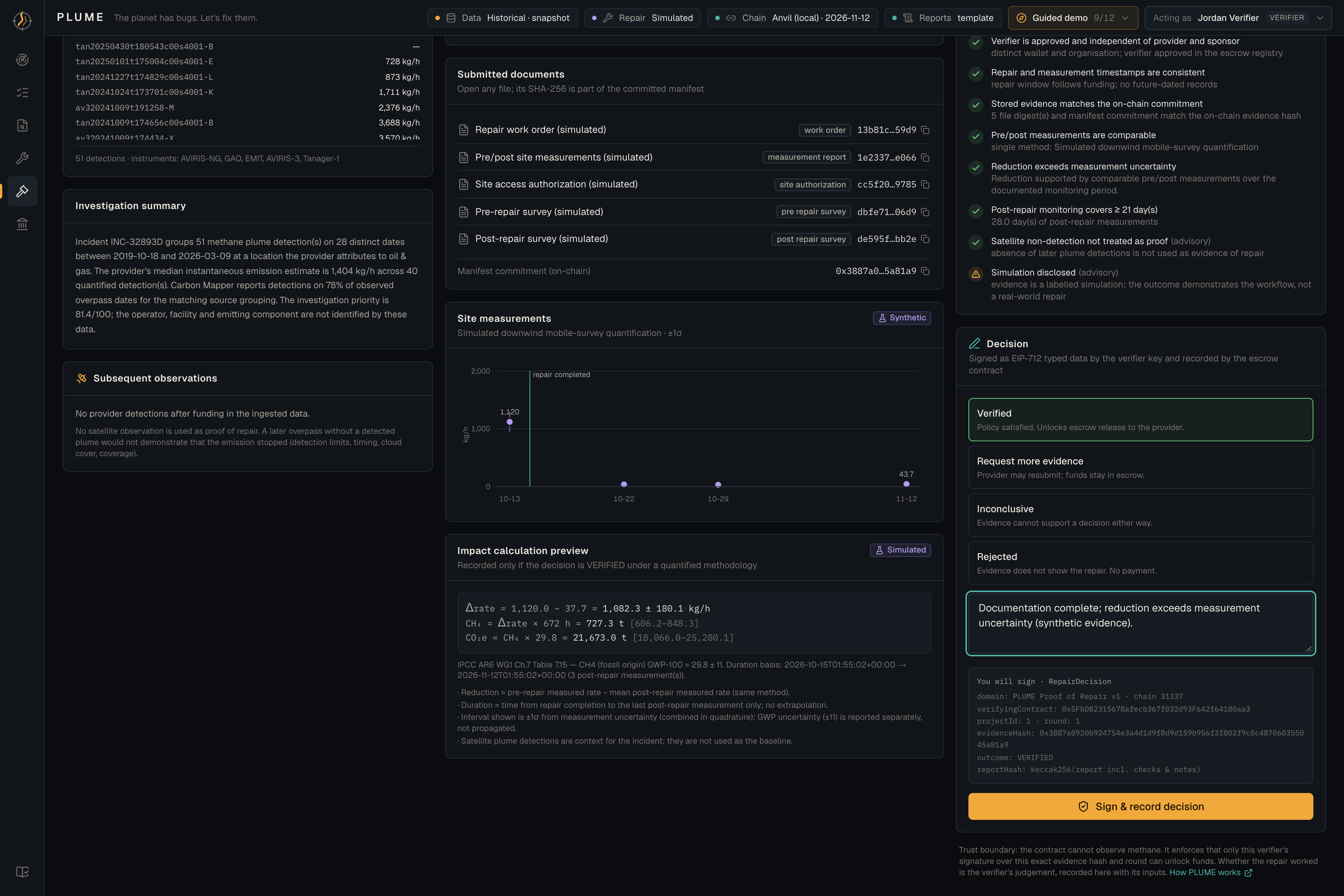
Sign Decision
-
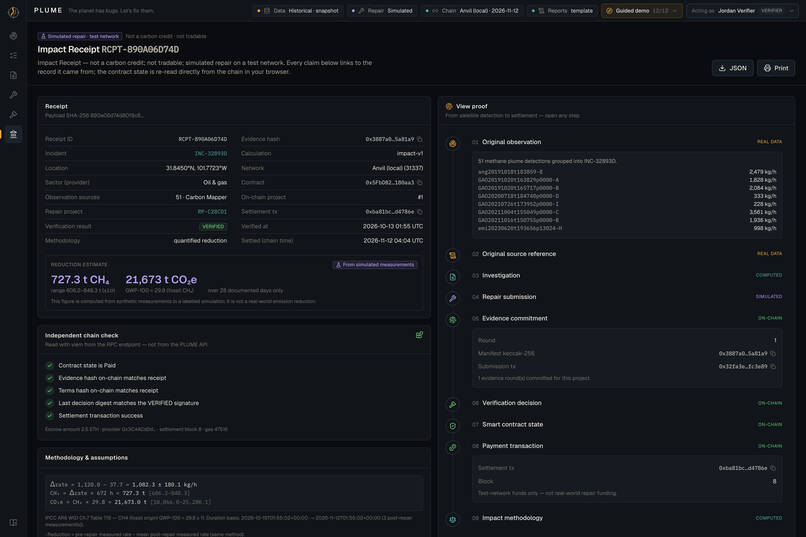
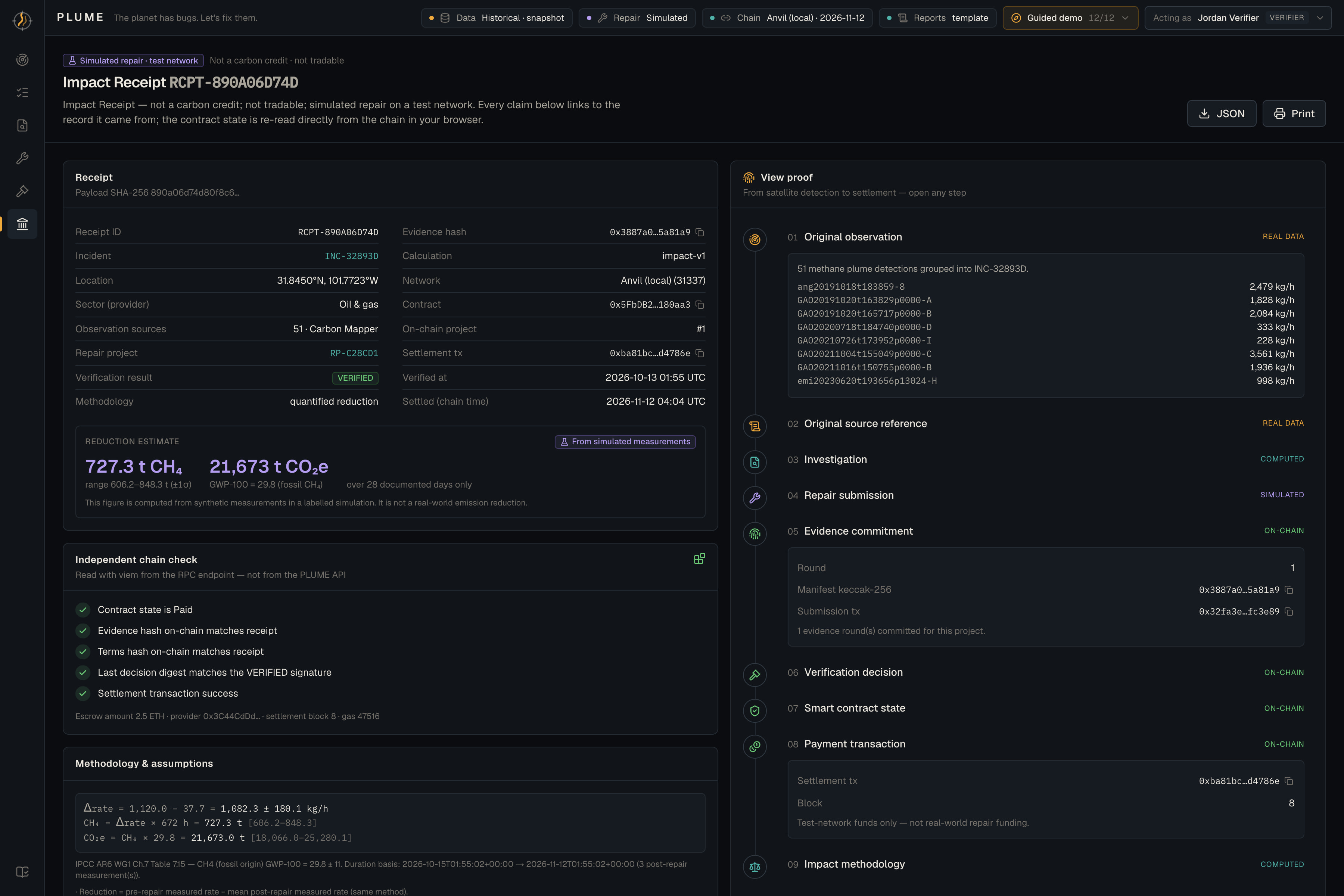
Impact Receipt
-
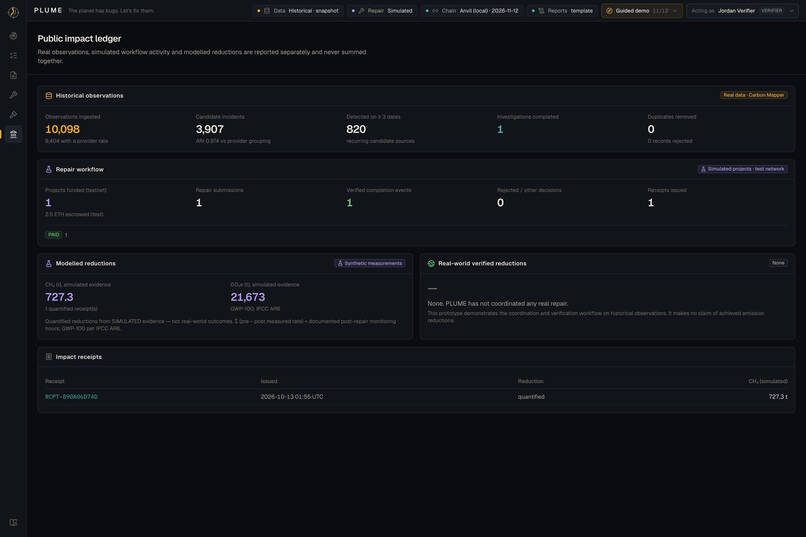
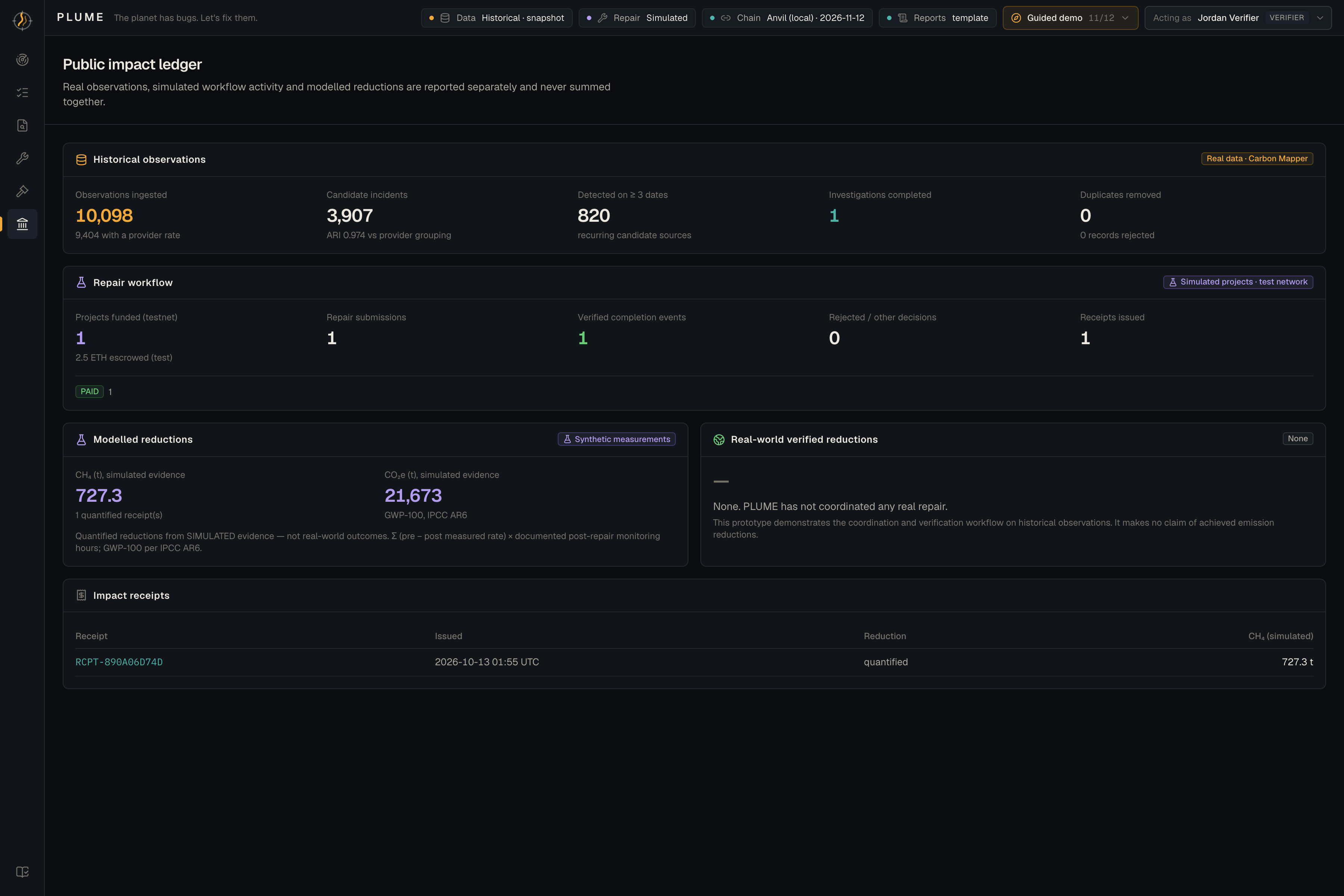
Impact Ledger
-
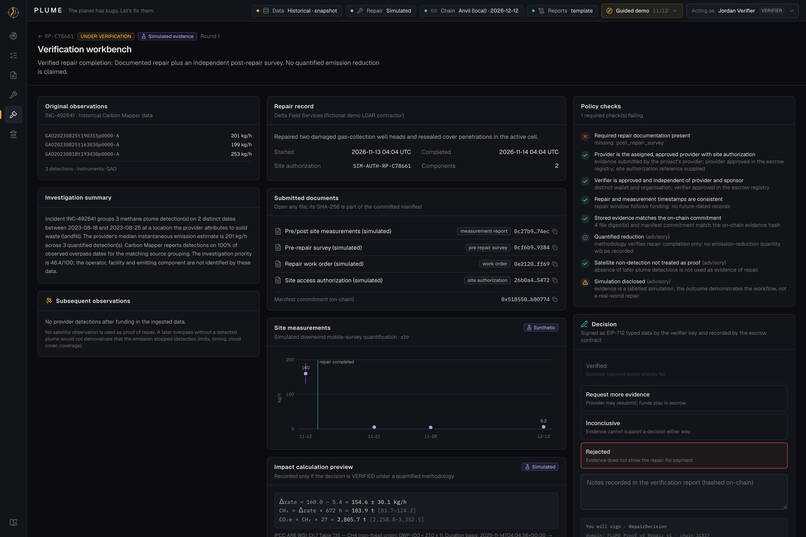
Policy Blocks Approval
-
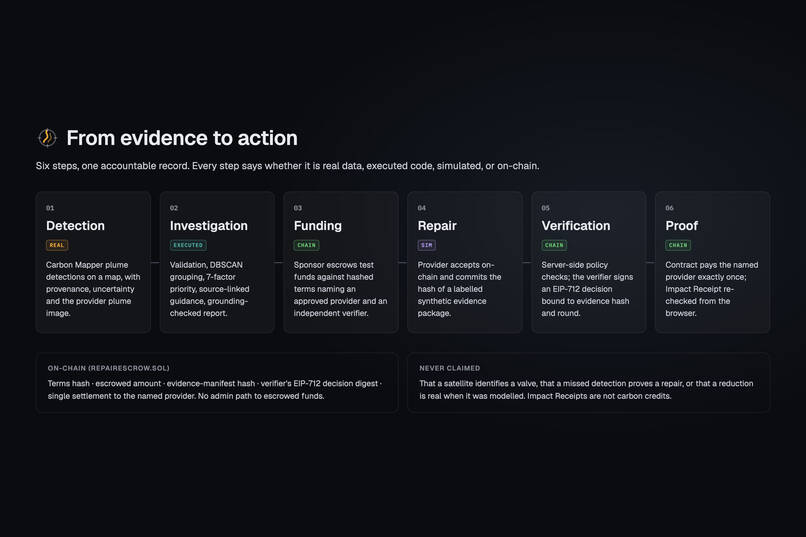
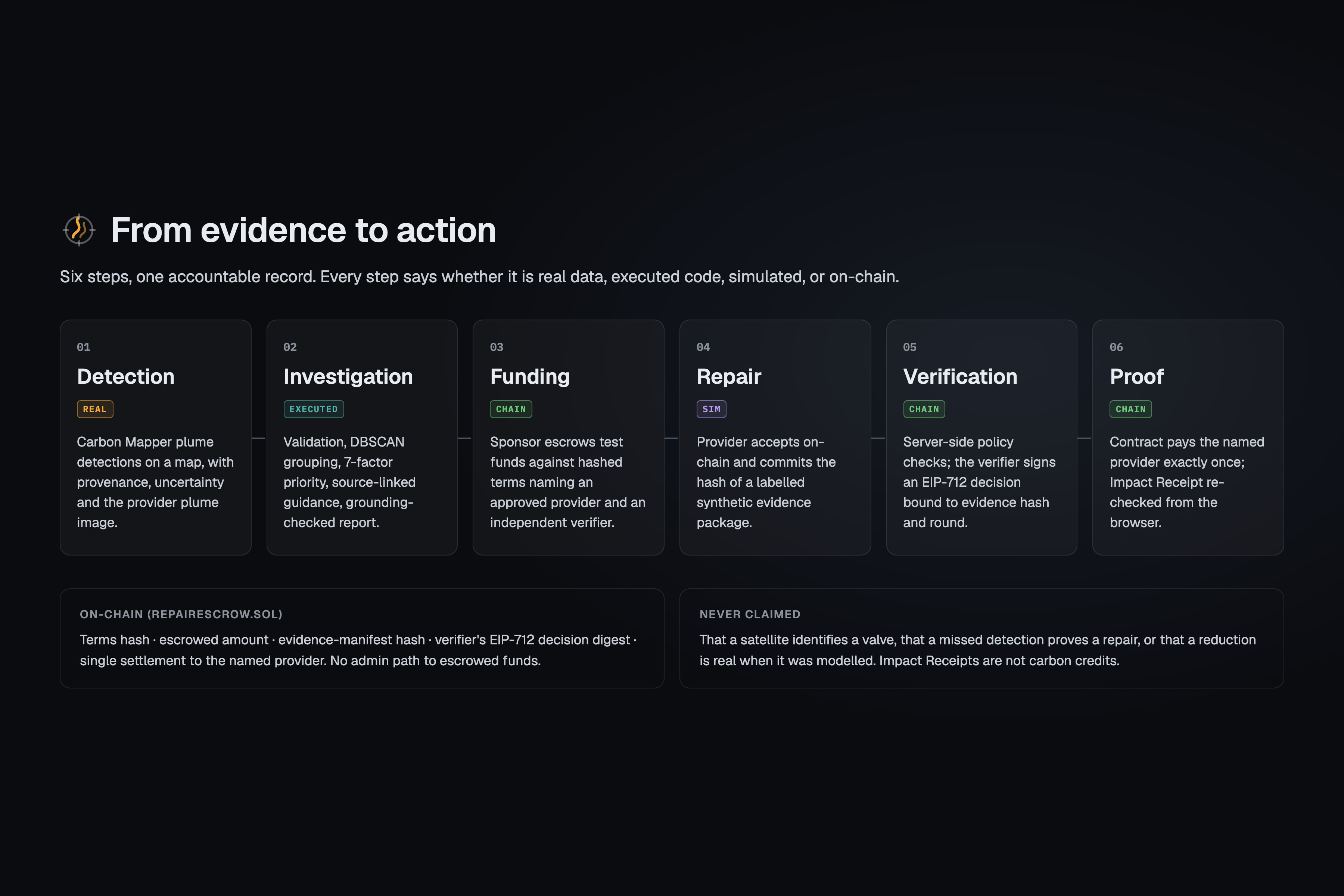
End to End Workflow
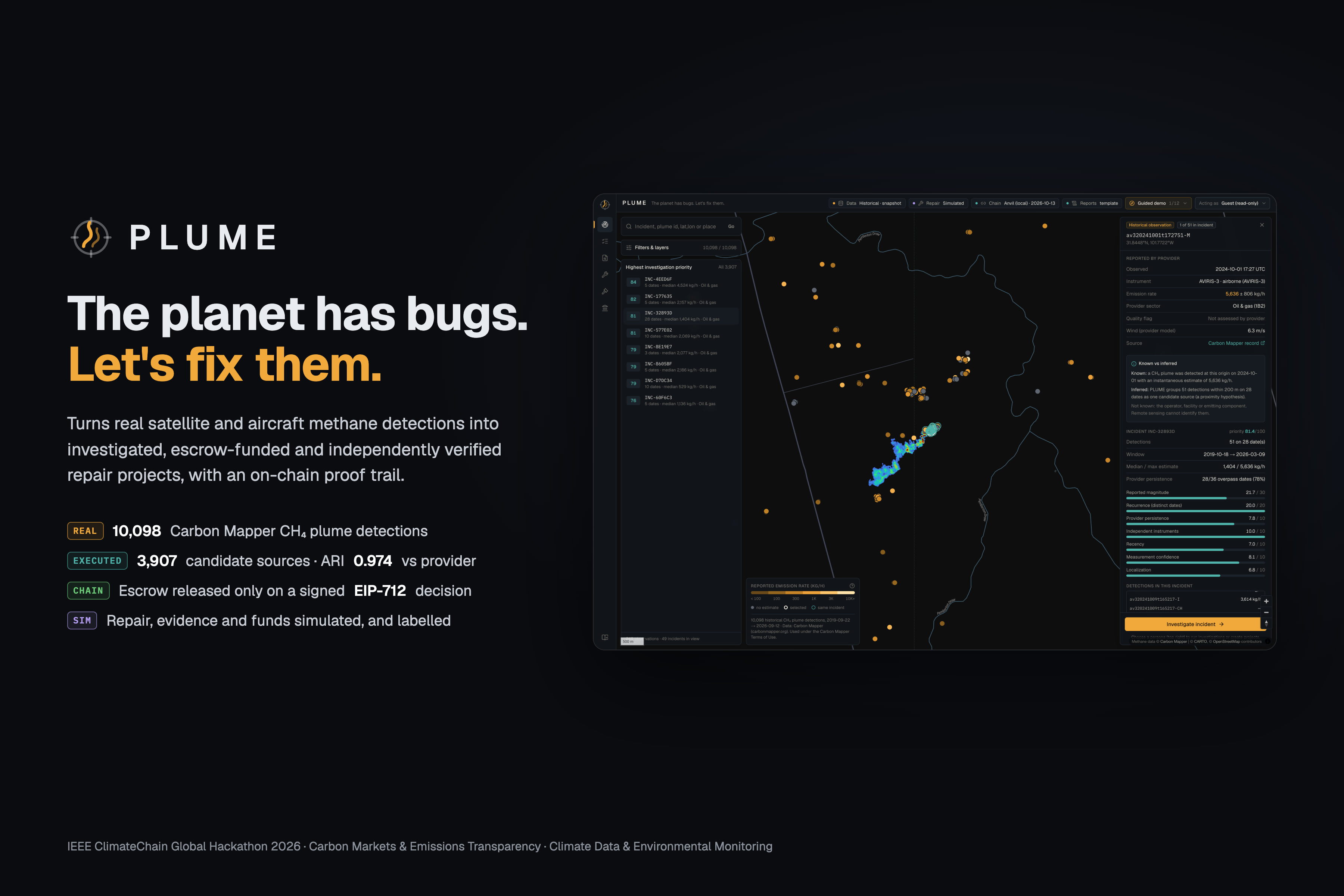
PLUME: The Planet Has Bugs. Let's Fix Them.
Inspiration
We can now detect methane leaks from space. Satellites and aircraft identify emissions across oil fields, industrial facilities, and other infrastructure, sometimes revealing leaks that would otherwise go unnoticed.
But detecting a problem isn't the same as solving it.
Thousands of methane plumes have been documented across regions like the Permian Basin. The data exists, but turning an observation into an actual repair still requires someone to investigate it, take responsibility, fund the intervention, and verify that it worked.
That gap inspired me to build PLUME.
I started with a simple question: What if fixing climate problems worked like fixing software bugs?
In software engineering, an issue can be reported, investigated, assigned, resolved, and closed with evidence. I wanted to bring that same accountability to environmental problems, with financial incentives and independently verifiable outcomes.
PLUME turns satellite-detected methane emissions into actionable repair opportunities, combining AI-powered investigations with blockchain-backed funding and verification.
The planet has bugs. Let's fix them.
What It Does
PLUME is an end-to-end climate intervention platform built around six steps:
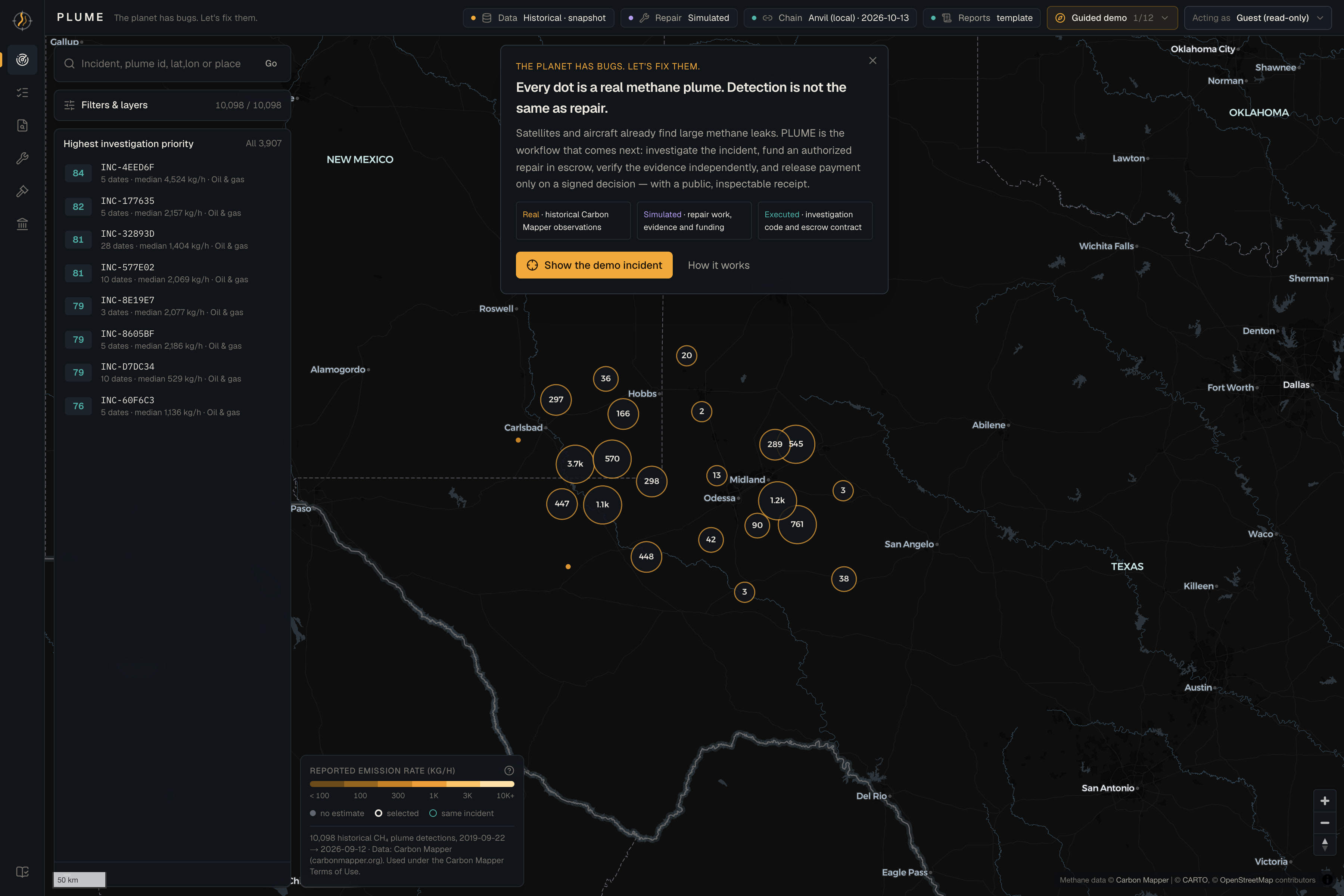
- Detect: Visualize real methane plume observations from publicly available environmental datasets on an interactive map.
- Investigate: Analyze emission observations using geospatial processing, incident grouping, prioritization, and AI-assisted reporting.
- Fund: Create repair projects backed by blockchain smart contracts that hold funding in escrow.
- Repair: Allow authorized participants to submit evidence of completed interventions.
- Verify: Evaluate submitted evidence against verification requirements before approving a repair.
- Prove: Release funding when the required conditions are met and generate an auditable record of the intervention.
The key difference is that PLUME doesn't stop at showing where emissions occur. It demonstrates how environmental observations can lead to funded, accountable action.
How I Built It
I designed PLUME as an integrated system with three primary components.
1. Geospatial Intelligence and AI
I built a data-processing pipeline around real methane observations published by Carbon Mapper.
The backend processes environmental records, groups related observations, calculates investigation priorities, and generates reports that help users understand which incidents may warrant attention.
I developed an interactive geographic interface where users can explore documented methane plumes, examine individual incidents, and initiate investigations.
Rather than treating AI as a black box that declares a facility responsible, I focused on connecting generated explanations to observable evidence.
2. Blockchain-Powered Repair Funding
I implemented a smart-contract-based repair workflow using Solidity and a local Anvil blockchain.
Repair projects have defined funding and verification conditions. The blockchain provides an auditable history of commitments, decisions, and settlements.
I incorporated evidence hashing and EIP-712 typed-data signatures to connect off-chain verification decisions with on-chain contract execution.
I wanted blockchain to serve a real purpose: ensuring that funding follows explicit verification rules instead of relying solely on a centralized application's status field.
3. Verification and Proof
The final component connects the environmental investigation, repair workflow, verification decision, and blockchain transaction.
I designed the system so users can examine the evidence associated with a repair project, review its verification outcome, and inspect the resulting transaction records.
I built a complete demonstration of this process, from identifying a documented methane plume to executing a simulated repair settlement.
My goal was to build more than a monitoring dashboard. I wanted a working prototype of the infrastructure needed to connect climate intelligence with accountable intervention.
Challenges I Faced
Connecting satellite observations to real-world action.
One of the biggest challenges was recognizing that an environmental detection doesn't automatically tell me which piece of infrastructure is responsible, whether a leak is continuous, or how much a repair would reduce emissions. I had to design the investigation pipeline to distinguish measured observations from inferred conclusions.
Making blockchain genuinely useful.
It would have been easy to tokenize emissions or store arbitrary records on-chain. Instead, I focused on a narrower problem where smart contracts offer a concrete benefit: enforcing agreed funding and verification conditions across participants.
Bridging on-chain and off-chain verification.
A smart contract cannot inspect a methane plume or determine whether a physical repair occurred. I had to connect external evidence, cryptographic hashes, signed verifier decisions, contract state transitions, and payment execution into a coherent workflow.
Building a credible demonstration.
Real methane observations are publicly available, but real repairs take time, money, authorized personnel, and independent measurements. I separated historical environmental data from simulated intervention inputs while ensuring that the data-processing and blockchain operations execute real code.
What I Learned
My biggest takeaway was that climate technology needs more than accurate measurements. It needs systems that turn information into decisions and decisions into accountable action.
I also learned that AI and blockchain are most effective when they solve different parts of a problem.
AI can help interpret complex environmental observations, organize evidence, and support investigations. Blockchain can preserve commitments, enforce settlement conditions, and provide transparent transaction records.
Neither technology can independently prove that an environmental problem has been solved. Reliable outcomes still depend on good measurements, sound verification methods, and responsible human oversight.
That realization shaped how I designed PLUME.
Accomplishments I'm Proud Of
- Integrating real historical methane observations into an interactive climate intelligence platform.
- Building an investigation workflow that groups, prioritizes, and reports on environmental incidents.
- Implementing real smart contract transactions instead of presenting blockchain as a visual mockup.
- Connecting evidence hashing, cryptographic signatures, verification policies, and contract settlement into one workflow.
- Demonstrating the complete journey from methane detection to an auditable repair-payment record.
- Preserving a clear distinction between real environmental observations and simulated interventions.
What's Next
My next goal is to take PLUME beyond a prototype by exploring how it could support organizations responsible for actual methane mitigation projects.
Potential early adopters include municipalities, landfill operators, environmental organizations, and infrastructure owners.
I want to integrate verified ground-level sensor measurements, expand satellite data coverage, enable authorized field contractors, and support independent third-party verification.
In the longer term, I envision PLUME becoming an open coordination layer connecting environmental monitoring systems with the organizations capable of acting on their findings.
I started with methane because its emissions can be measured and many sources can be mitigated using existing technology.
But I believe the underlying concept can go much further.
Climate action shouldn't end when we detect a problem. That's where it should begin.
Built With
- ai
- anvil
- blockchain
- carbon-mapper
- deck.gl
- docker
- eip-712
- ethereum
- fastapi
- foundry
- geopandas
- machine-learning
- maplibre-gl-js
- next.js
- openzeppelin
- postgis
- postgresql
- python
- react
- scikit-learn
- smart-contracts
- solidity
- tailwind-css
- typescript
- viem

Log in or sign up for Devpost to join the conversation.