-
-
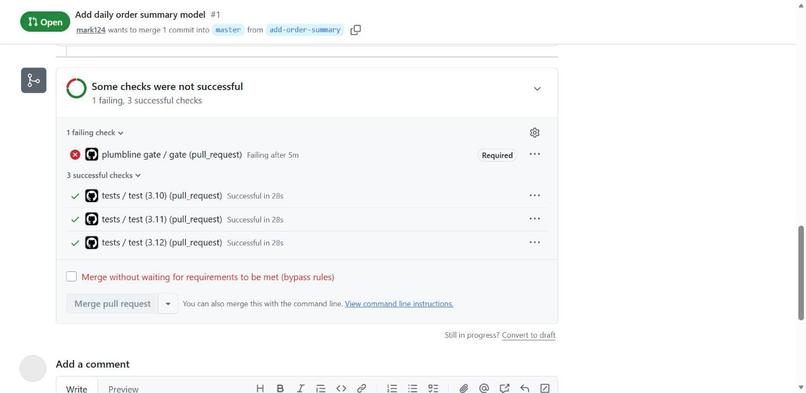
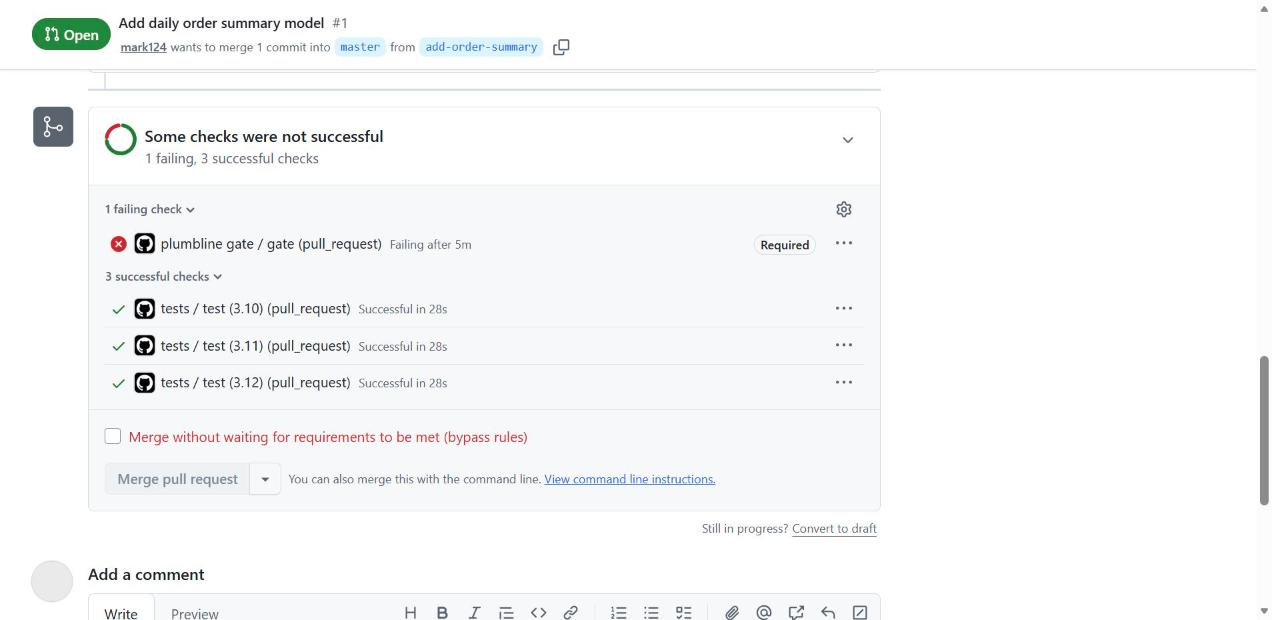
Catalog gate required and red, unit tests green, merge button disabled. A failing reference stops the merge.
-
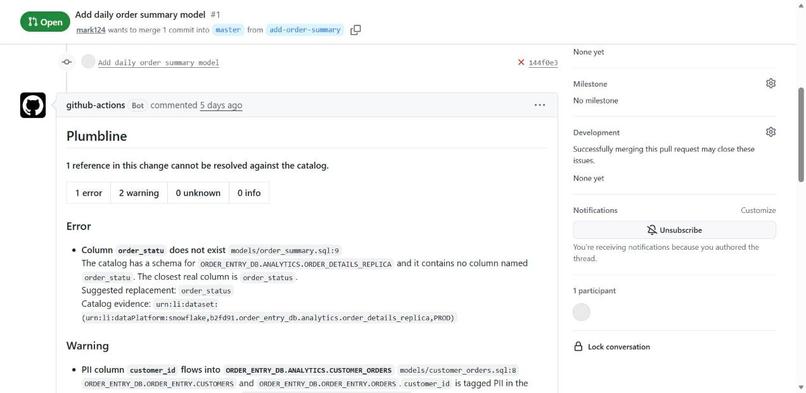
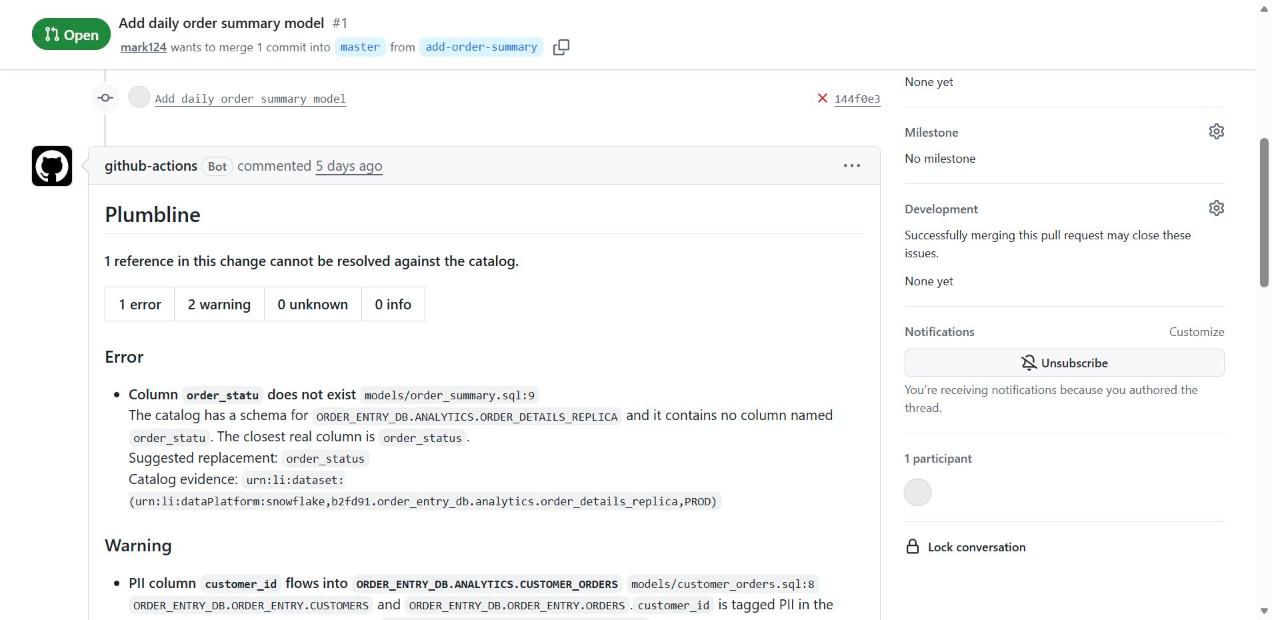
The bot comment on a real pull request: the bad column, the file and line, the real column, and the catalog URN that proves it.
-
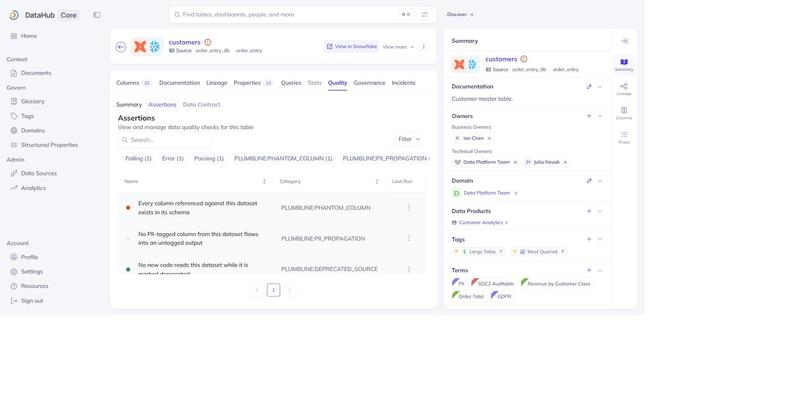
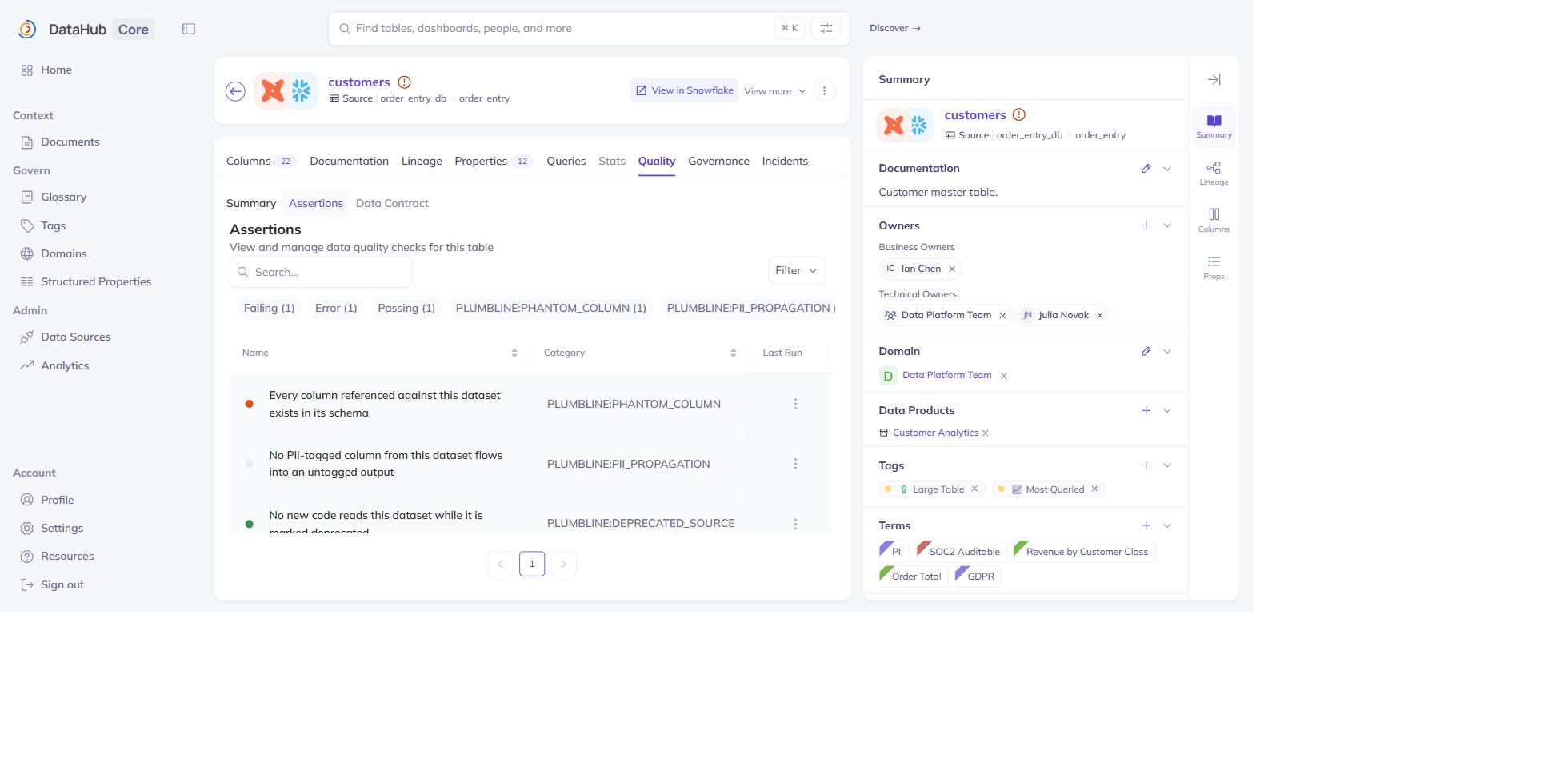
Failing, Error and Passing. Each check is a claim in plain English; clean datasets get a passing assertion, not silence.
-
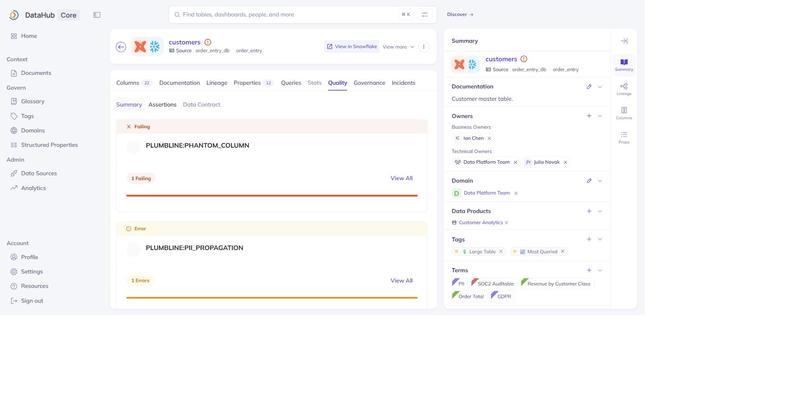
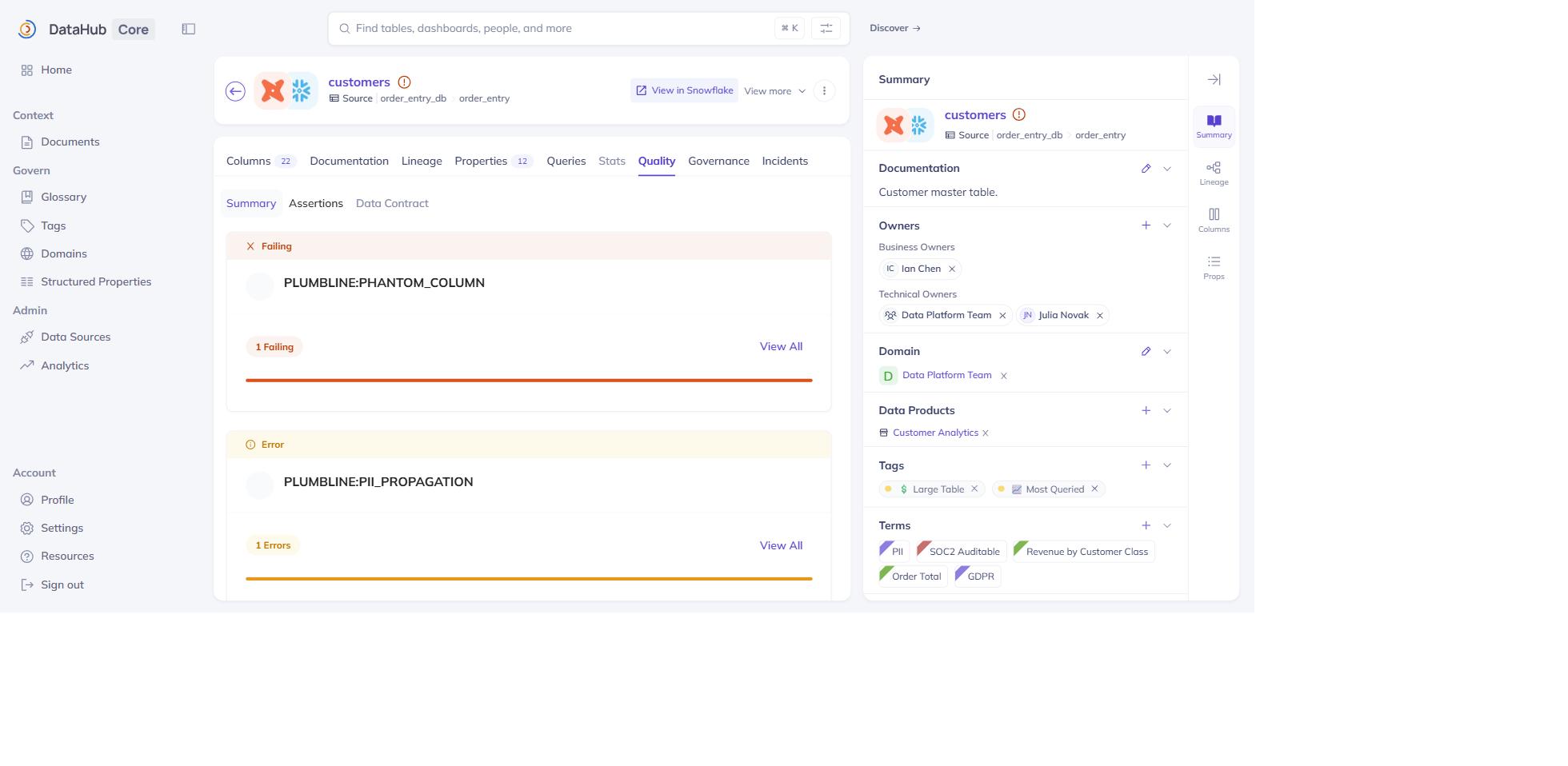
The verdict written back to DataHub. Plumbline's findings sit on the dataset's Quality tab beside its owners, domain and glossary terms.
Inspiration
A coding agent writes a dbt model. It compiles, it reads well, it passes review, and it references order_ttl on a table where the column is order_total. It joins on a key pair nobody in the company has ever joined on. It pulls a PII-tagged column into an output table that carries no such tag. It rewrites a table that thirty-four dashboards depend on.
None of that is visible in the diff. All of it is already written down in your catalog.
The gap is not that the model is careless. It is that the model is writing against its guess about your warehouse rather than against your warehouse. So the fix is not a better prompt. It is ground truth, applied before the merge button.
A plumb line is a carpenter's instrument: it finds true vertical by reference to gravity, which is external and not a matter of opinion. That is the whole design. The catalog is the gravity.
What it does
Plumbline resolves every table and column in a SQL file against DataHub and reports what the catalog can disprove. It runs as a CLI, a GitHub Action, and a pull request gate, and it exits nonzero so CI can stop a merge.
Six checks:
| Check | What it catches | Severity |
|---|---|---|
| Phantom column | Column referenced on a table whose schema says otherwise | Error |
| Phantom table | Table the catalog has never heard of | Unknown, or Error on a near miss |
| Deprecated source | Reading from an asset marked deprecated | Warning |
| PII propagation | PII-tagged column flowing into an untagged output | Warning |
| Unvetted join | Join key pair seen in no observed production query | Warning |
| Blast radius | Who consumes the asset this statement rewrites | Info |
The rule that makes it usable: severity reflects the strength of the evidence, not how alarming the problem would be if it were real.
A missing column on a table whose schema we have is an error, because the catalog can prove it, and it blocks the merge. A table the catalog has never heard of is an unknown. That is not evidence of a defect; it may simply not be ingested. It never blocks. Promoting the second to the first is how catalog tools get switched off in week one.
When a reference is provably wrong, an agent can propose the repair. It reaches DataHub only through the official MCP server, with mutation tools forced off, so it can read the catalog and cannot change it. Every proposal is re-parsed and re-checked by the deterministic layer before a human sees it. Unverified repairs are discarded and reported as "no verified fix".
And it writes back. With --publish, each dataset the run reached a conclusion about gets a DataHub assertion carrying that conclusion, with run history, on the dataset's Quality tab. The next agent inherits what this run proved instead of rediscovering it.
How we built it
Two layers, and the split is the entire idea.
Layer 1 is deterministic: parse with sqlglot, resolve every reference through DataHub's schema resolver and GraphQL, compare, report. There is no model in this layer and there must never be one. A checker that can hallucinate is not a checker. We do not fight hallucination with more hallucination.
Layer 2 is agentic, because Layer 1 can prove a reference is wrong but cannot know what the author meant. That needs judgment and open-ended investigation of the catalog, which is exactly what a model with tools is for. It runs on Claude via the DataHub MCP server over stdio.
The rule binding them: the agent proposes, the deterministic core disposes.
The same asymmetry governs writing to the catalog. Only the deterministic layer may publish; the agent is never handed a publishing path. The one component allowed to change the graph is the one that cannot hallucinate. A model that can invent a column must not be able to record a judgment about one.
How it uses DataHub. The context graph for ground truth: schemas, column-level tags, glossary terms, deprecation aspects, lineage, and query history. The MCP server for the agent layer, because choosing what to look up is that layer's whole job. Assertions for the return leg. Layer 1 deliberately does not use MCP: it asks a fixed set of questions and gets facts back, and there is no model in it to do the choosing.
Challenges we ran into
Our own verification gate accepted nine hostile rewrites out of nine.
Everything had been tested on whether the checker finds bad SQL. Nobody had asked what a rewrite could get past it. When we finally asked, the gate accepted SELECT 1, accepted DROP TABLE orders, and accepted a correct fix with ; DROP TABLE orders appended, because the parser reads the first statement and silently discards the rest.
The gate was not broken. It was answering a weaker question than the word "verified" implied: re-running the catalog checks proves a rewrite is grounded, not that it is the same query. SELECT 1 resolves perfectly against any catalog. The gate now compares shape as well as references: one statement only, same statement kind, same source tables, same output column count, no dropped filter, with every rule stepping aside for the identifier under repair.
The benchmark was not reproducible, twice. It selected tables using hash(template_name), and Python salts string hashing per process, so the fixed seed was doing nothing and two runs of identical code scored 100% and 98.4%. After fixing that we ran it three times, compared the headline numbers, and called it reproducible. It was not: column order still came from the catalog into a seeded sampler, so when a rebuild reordered the search index the defect mix moved while every total stood still. Two runs agreeing is not evidence about an axis you did not vary. The property is now asserted rather than inferred, by shuffling the inputs and demanding a byte-identical case set.
A DataHub outage made every real table look invented. The SDK swallows transport errors and reports the table as unresolved, which is indistinguishable from "this table does not exist". Left alone, an outage would emit a phantom-table finding for every real table in the file and the run would look like a successful check. Plumbline now confirms the catalog is answering before it believes any negative, and if it is not, produces no report at all.
Publishing put a red mark on an innocent dataset. A phantom table has no URN of its own, so the finding cites the suggested table as evidence. Writing that back marked a healthy ORDERS as failing because ORDRS was mistyped somewhere else entirely. The invariant now enforced: publish a passing assertion only for a check whose failures can be attributed to that same dataset.
Accomplishments that we're proud of
It does not cry wolf. Zero false positives on 66 queries built from the catalog's own schemas and valid by construction, and zero blocking errors on 6 real view definitions taken out of the catalog that this project did not write. That is the number that decides whether a team keeps a checker installed past week one.
It says "I don't know" out loud. An uningested table is reported as unknown, does not block, and says its columns were not checked. A check that cannot run reports that it did not run rather than passing silently. When the catalog is unreachable, there is no report at all rather than a confident wrong one.
Thirty-two defects found in our own work, across nine rounds of deliberately different exercise, plus two more in the benchmark that measures it. Not one came from repeating a round that already passed, which is the only honest reason to believe the count is not finished.
It runs against a real DataHub inside a GitHub runner. The pull request gate stands the platform up from scratch in about five minutes, loads the catalog, checks the diff, and comments with the bad column, the real column, and the URN that proves it. No hosted instance, nothing mocked.
What we learned
Repeating a passing test suite finds nothing. Every defect we found came from a new kind of exercise: installing from a clean clone, pointing it at production SQL, attacking the gate, varying file encodings, hostile identifiers, malformed catalog responses. Not one came from running an existing suite again. "All tests pass" is a statement about the angles you already tried.
Test the thing that judges, not only the thing being judged. The costliest bug was in the component whose entire job was to catch bugs.
Grounded and correct are different claims. Only one of them deserves the word verified, and the gap between them is wide enough to drive a DROP TABLE through.
A number you cannot reproduce is not a measurement, whichever direction it errs in, and comparing headline figures does not prove reproducibility.
What's next for Plumbline
Rendering dbt Jinja so uncompiled models can be checked in place. Following PII through multi-hop lineage rather than one statement at a time. Catching a bad column introduced in a second CTE hop, which is currently a deliberate miss because convicting an unqualified name with a computed source in scope is how false positives start. Demonstrating the unvetted-join check against a catalog with real query history rather than seeded queries.
Try it in thirty seconds, without a catalog
git clone https://github.com/mark124/plumbline
cd plumbline
pip install -e .
plumbline check examples --demo
--demo reads a snapshot of the public showcase-ecommerce catalog that ships with the repository. Same checker, same six checks, same report; only the source of the facts changes. Nothing is simulated, and every run states that the catalog is frozen.
See it block a real pull request: https://github.com/mark124/plumbline/pull/1
Open-source contributions to DataHub
Three pull requests, all open and under review. None merged, none reviewed yet, stated plainly rather than optimistically.
- datahub#18634:
datahub datapack loadis unusable on Windows.get_path_schemaparses the path withurlparse, soC:\...yields the scheme"c"and the filesystem registry lookup raisesKeyError. Fix plus tests. - datahub#18635:
datahub datapack --helpraisesFileNotFoundErrorbecause the package ships withoutcli/datapack/resources/DATAPACK_AGENT_CONTEXT.md. Verified by removing and restoring the file. - datahub-skills#57: a new
datahub-sql-reviewSkill. It teaches a coding agent to check its own SQL against the catalog before proposing it: resolve every table and column, read column-level tags and deprecation, and say plainly when the catalog cannot answer instead of guessing. It is Plumbline's central idea packaged to work inside any agent using DataHub Skills, with no need to install Plumbline at all.

Log in or sign up for Devpost to join the conversation.