What it does
Plumb is a GitLab Duo Agent Platform flow that takes over when a main pipeline goes red, and walks away only when main is green again or a person has a precise issue to read. A Pipeline events trigger starts the flow on the failed pipeline; nobody mentions it or clicks anything, and nobody merges: CI proves the fix with 50 runs and its merge-gate job merges it, as it did for all 11 fix merge requests that merged. It is a Path A project at the Hands-off autonomy level: a person sets the rules in CI and walks away.
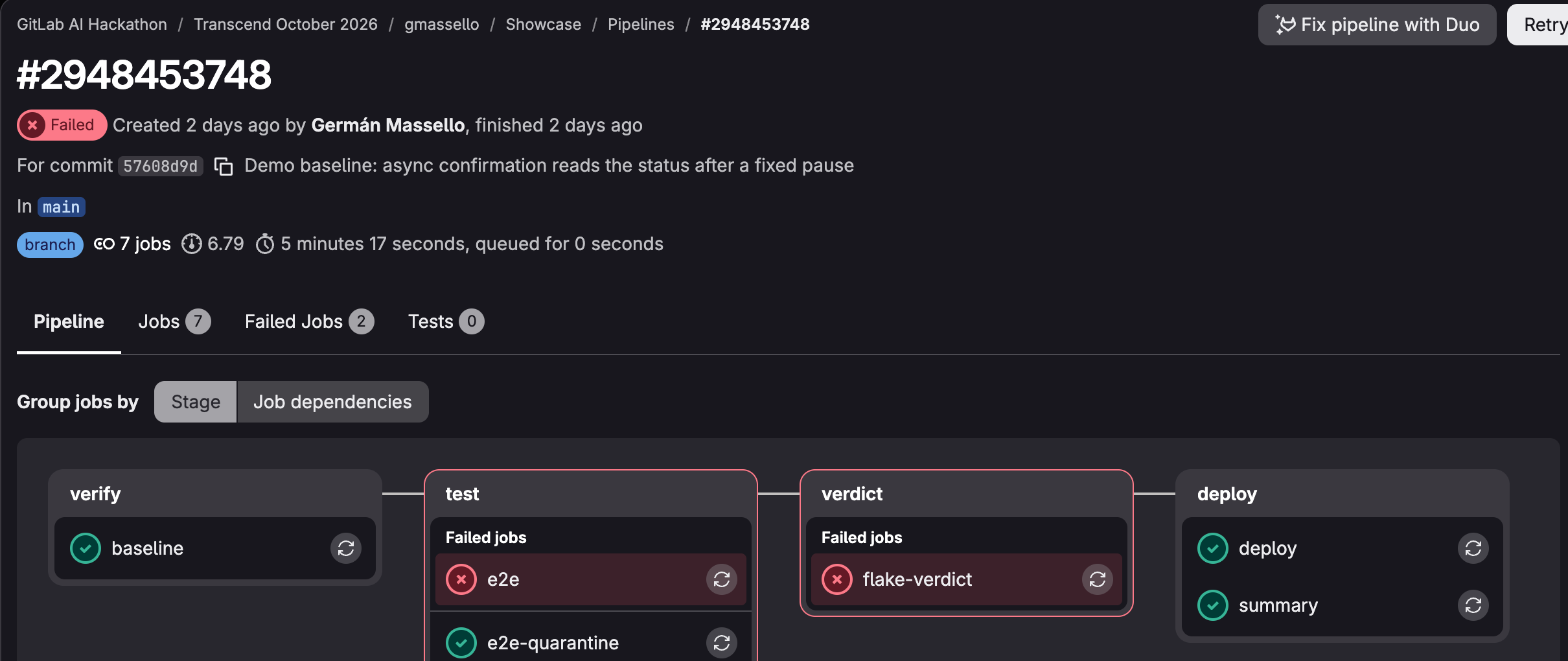
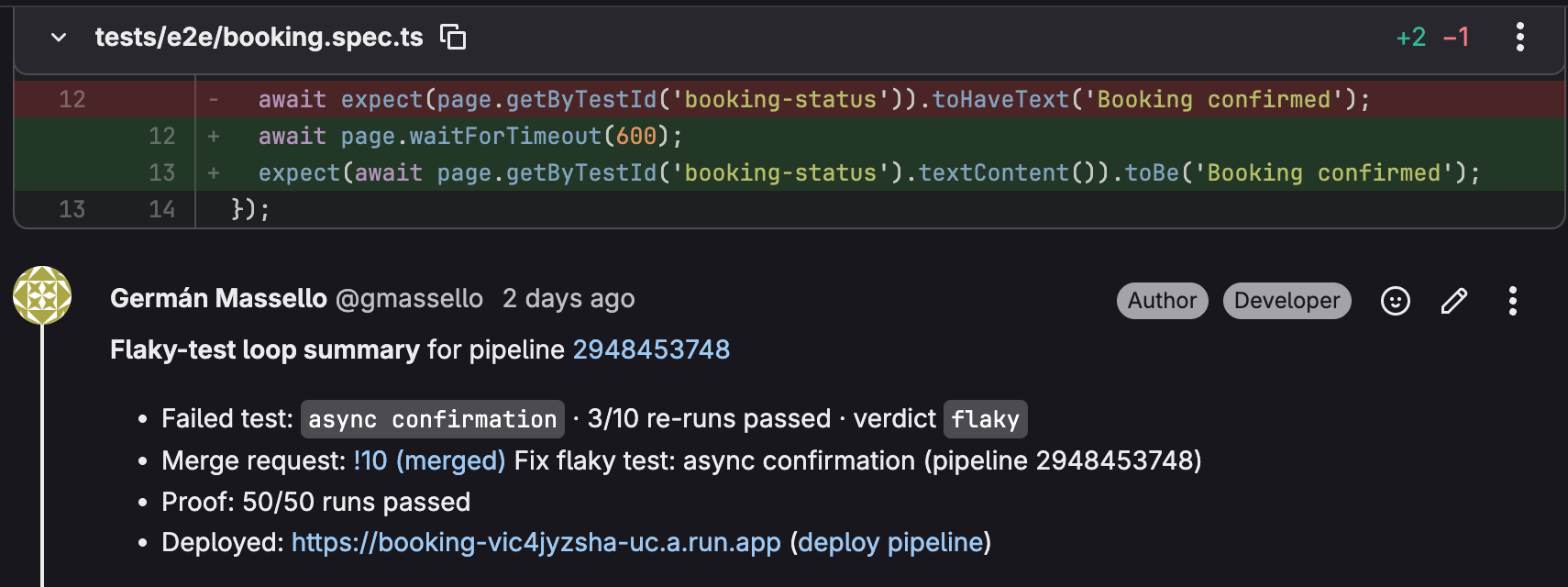
Before the flow starts, CI decides what kind of failure it is. flake-verdict re-runs each failed test 10 times on the same commit and writes verdict.json. Any pass makes the test flaky. A test file that fails to load counts as a real failure without re-runs. A test that fails all 10 also runs 3 times on the parent commit, so the verdict says whether this commit broke it or it was already broken. The verdict also records order effects (state left by earlier runs, or a test that only fails inside the full suite), infrastructure failures that need no code change, and the test's history in the project.
The flow then acts on that verdict:
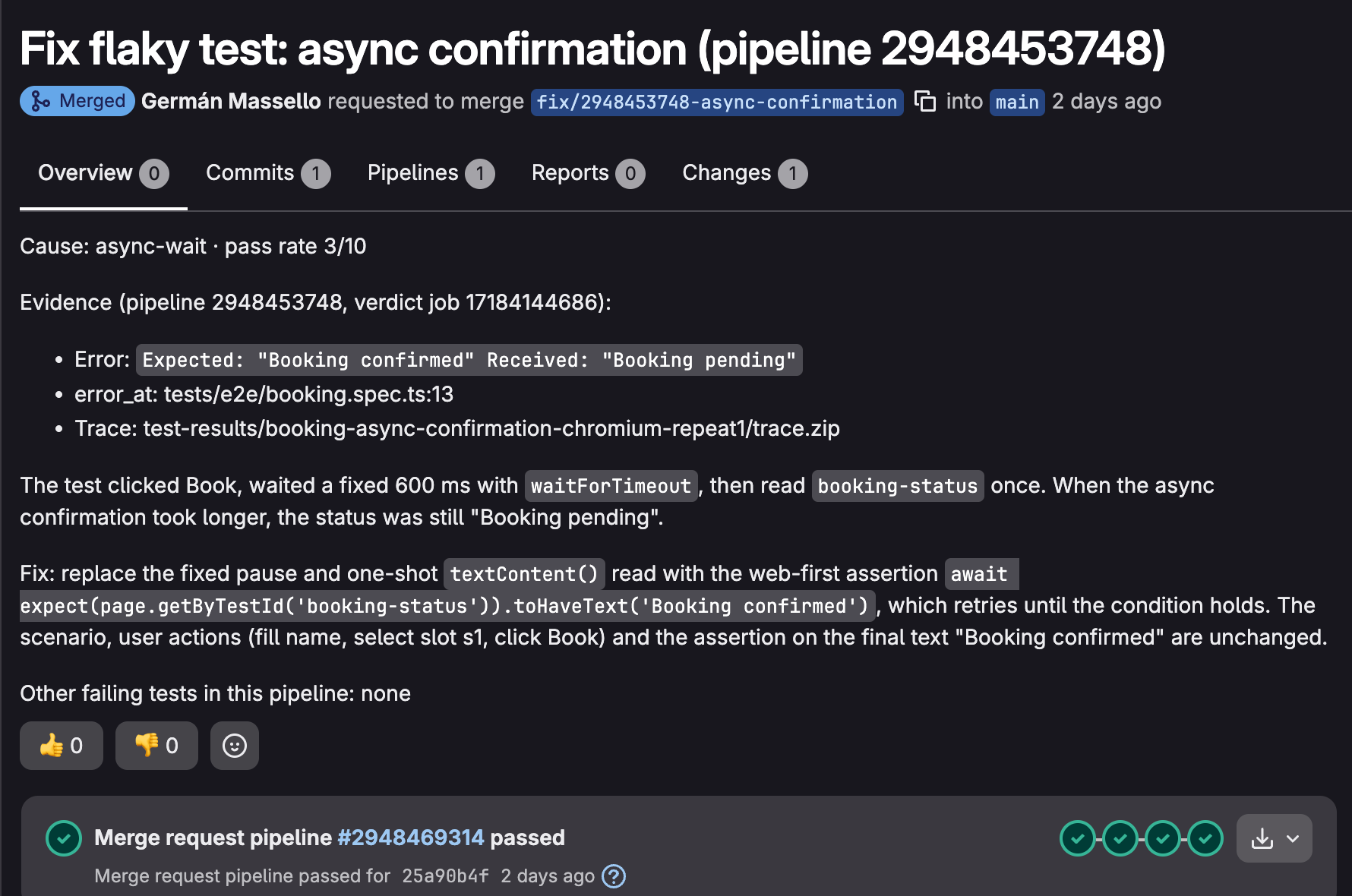
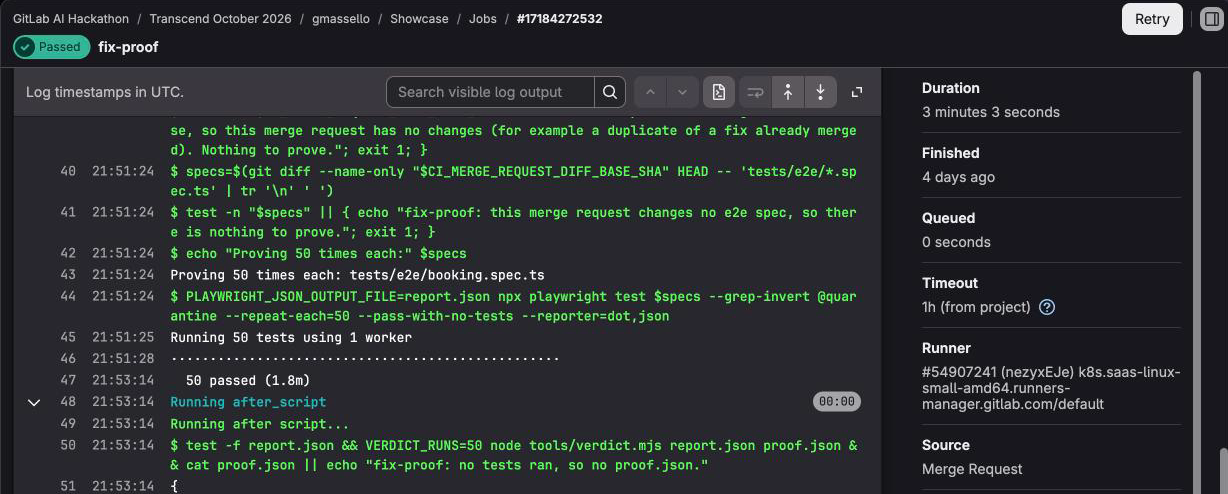
- Flaky: it finds the cause (async wait, concurrency, animation, time zone, shared state), commits a fix on a
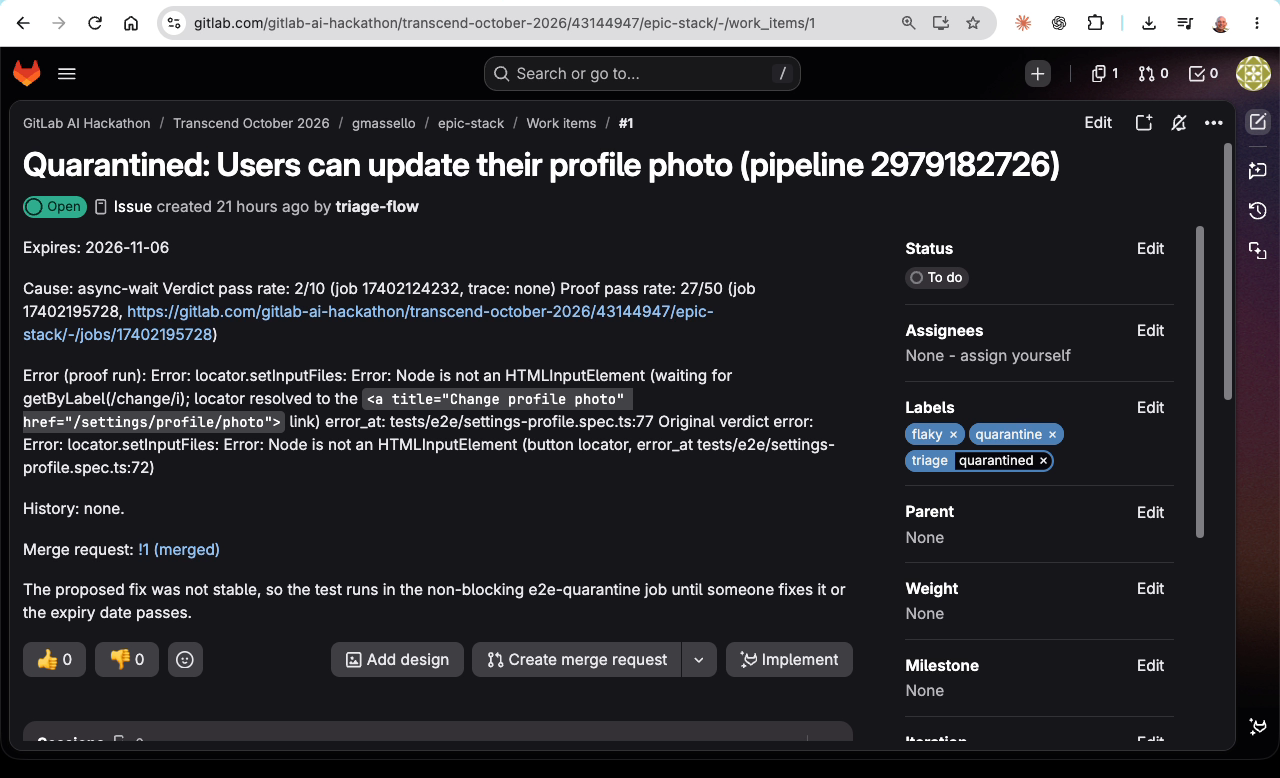
fix/branch and opens a merge request. In that MRfix-proofruns the test 50 times, andmerge-gatemerges only if all 50 pass and the MR changes nothing but e2e specs; a fix that touches the app waits for a human. If the proof fails, the flow replaces the fix with a quarantine tag and opens an issue that expires in 14 days. - Real failure: it reads the commit message and diff and picks a cause. A regression gets an issue that quotes the diff. An intended app change gets an
update/MR that always waits for a human. A CI setting change gets anenvironmentissue. Missing test data gets afix/MR. - Recurring: a test already fixed 2 times is not fixed a third time; it goes straight to quarantine with its history quoted (!13).
After the merge, deploy ships the app to Google Cloud Run, live-checks runs the API contract against the live URL, and summary posts one note on the commit that failed, linking the verdict, the MR, the proof and the live app.
Inspiration
At Google, about 84% of the transitions from pass to fail involve a flaky test, not a real regression. So the developer on CI duty who opens a red main pipeline is usually chasing noise, and pays twice: the time to read the log, and the habit everyone learns of pressing retry. Retrying hides the flake; skipping it hides the bug.
The usual answers are to retry the failed test, or to quarantine it and file an issue for someone to fix later; GitLab's own testing guide does both. Plumb writes the fix, proves it with 50 runs, and quarantines only when the proof fails. Another flaky-test entry in this hackathon classifies the failure and opens a quarantine MR for a person to merge; Plumb writes the fix, proves it with 50 of 50 runs and merges it without one. We wanted an agent that does the boring part end to end, without trusting a language model to decide what is safe to merge.
How we built it
The design rule is "CI decides, Duo fixes" (ADR 0001): the model picks the cause and writes the fix, and code decides everything else, as the table in the README shows row by row. Everything that decides is deterministic: the re-run counts, the 50-run proof, the merge, the quarantine cap and the recurrence threshold live in .gitlab-ci.yml and small Node scripts with unit tests. The Duo flow (.gitlab/duo/triage-flow.yml, public in the AI Catalog as triage-flow) reads verdict.json, picks the cause, writes the fix and opens the MR or issue. flow-drift fails the pipeline if the published flow differs from the one in the repo, so the flow that runs is the one that was reviewed.
The subject under test is a small booking app (Node, no framework) with a Playwright suite whose flakiness is natural, not injected: a random confirmation delay, a gap between checking and booking a slot, an animated modal, time zones. It deploys to Cloud Run through Workload Identity Federation, so no Google key is stored anywhere.
Plumb touches all 9 DevSecOps lifecycle stages: plan (the issues it opens), create (the fix commit), verify (flake-verdict, fix-proof), package (Cloud Run builds the container image from the Dockerfile), secure (SAST and Secret Detection on every pipeline), release (merge-gate), configure (the CI and the flow are YAML in the repo), monitor (live-checks after each deploy, and a health check every 6 hours) and govern (scoped bot token, quarantine expiry, at most 2 quarantined tests).
Challenges we ran into
A flaky test does not fail on demand, so every scenario had to be measured before it could be demoed. A fix that looks right can still be flaky: the concurrency fix in !9 passed only 33 of 50 runs, so it was never merged and the flow quarantined the test instead. That negative control is why the proof exists.
Accomplishments that we're proud of
- From the red job to the summary note in 9 min 47 s, with no human action, on pipeline 2948453748.
- One incident, measured end to end (pipeline 2958940993 → !14, merged): 6.2 min of CI jobs on the red pipeline, 1.9 of them the verdict re-runs; 5.2 min on the MR pipeline, 2.0 of them the 50-run proof; and a flow session of 4 min 10 s.
- All 11
fix/merge requests that merged were merged by themerge-gateCI job, 3 to 48 s after it finished. GitLab names the author on those merges because the job calls the merge API with the author's token; the fix commits are signedtriage-flow. - Every path of the flow ran on a real pipeline, with public links: flaky fixed, flaky not fixable, flaky by order, regression, intended app change, environment, test data, recurring.
- The same published flow ran on an app it was not built for: a copy of epic-stack, Kent C. Dodds' MIT starter, which includes Plumb's CI jobs with one
include: project. Of its 3 red pipelines, a flaky test the app already had (2/10) and a seeded one (6/10) each got a fix that the 50-run proof rejected (27/50 and 30/50). The flow quarantined both, andmerge-gatemerged the quarantines with no person. A seeded regression got a "Real regression" issue, with the parent commit at 3/3. - The cause of always-failing tests was right in 12 of 12 runs across four seeded scenarios, and no
update/MR was ever merged automatically.
What we learned
A language model is good at reading a diff and writing a three-line fix, and the wrong judge of whether that fix is safe. Keeping the judgement in CI made the agent trustworthy enough to merge on its own.
What's next
- Handle every failing test in a pipeline, not only the first.
- Take a test out of quarantine automatically when its expiry date passes and it is green again.
What we chose not to build
- Other test frameworks (Cypress, Jest, Appium): one framework done end to end beats four done halfway.
- Infrastructure flakiness (a runner that dies, a registry outage): it needs a retry, not a code change, so the verdict records it and the flow does not touch code.
- A dashboard of its own: the record lives where the team already looks, in GitLab merge requests, issues and comments.
Known limitations
- Outside its own booking app, the flow has run on one project: a copy of epic-stack. There, neither flaky test got a fix that held. The proof rejected both, and for the seeded one the model named the wrong cause: it called a test-data flake (a random title longer than the field's 100-character limit) an async wait.
- The flow fixes one test per pipeline; the others are listed in the MR, not fixed.
- The cause of an always-failing test is the model's call. The merge is not: only
merge-gatemerges, after 50 of 50, and only MRs that change nothing but e2e specs. - An expired quarantine turns the pipeline yellow, but nothing removes the tag. At most 2 tests can be quarantined; a third fails the pipeline.
- History is matched by exact test title, so a renamed test starts with none.
- 50 of 50 catches a fix that still fails often, not one that fails rarely: a test that fails 10% of runs passes the proof 0.5% of the time, one that fails 5% passes it 7.7% of the time, and one that fails 1% passes it 60.5% of the time.
- The Duo credits a session uses are not visible to the participant's Developer role (GraphQL
creditsUsedreturns null), so the cost above counts CI minutes and session time only. - The demo app keeps bookings in memory, and its API has no authentication; only the test reset endpoint needs a token.

Log in or sign up for Devpost to join the conversation.