
Inspiration
Every team has architecture rules — "the UI never touches the database directly," "the domain layer has no framework imports," "no cyclic dependencies," "all DB access goes through the repository." They're the load-bearing decisions of a codebase, yet they live nowhere but in senior engineers' heads and stale wiki pages. Linters check style; type checkers check types; nothing checks architecture — so codebases erode silently, one merge request at a time. GitLab Orbit turns a codebase into a queryable graph — exactly what you need to make architecture checkable.
What it does
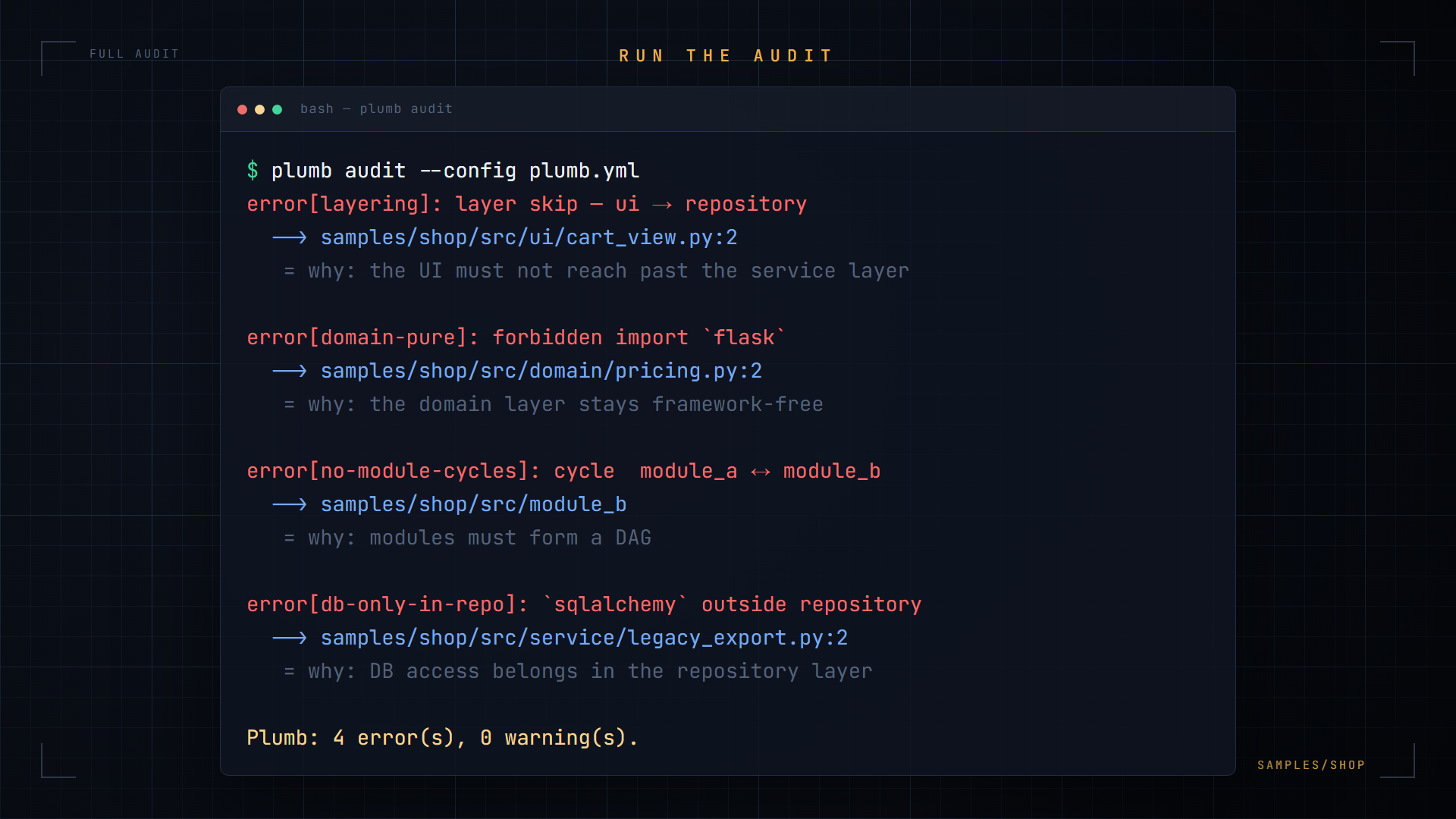
Plumb makes architectural rules executable and enforced. You declare invariants in a small rules file; Plumb compiles each into structural queries over the GitLab Orbit code graph, finds the exact dependency edges that break them, and reports every violation with its file:line, the rule's intent, and a concrete fix.
Five rule types: layering (ordered layers, no skips/upward edges), forbidden-import, no-cycles (dependency cycles), placement (where a capability may live), and boundary (enter a zone only through its gateway).
Two modes:
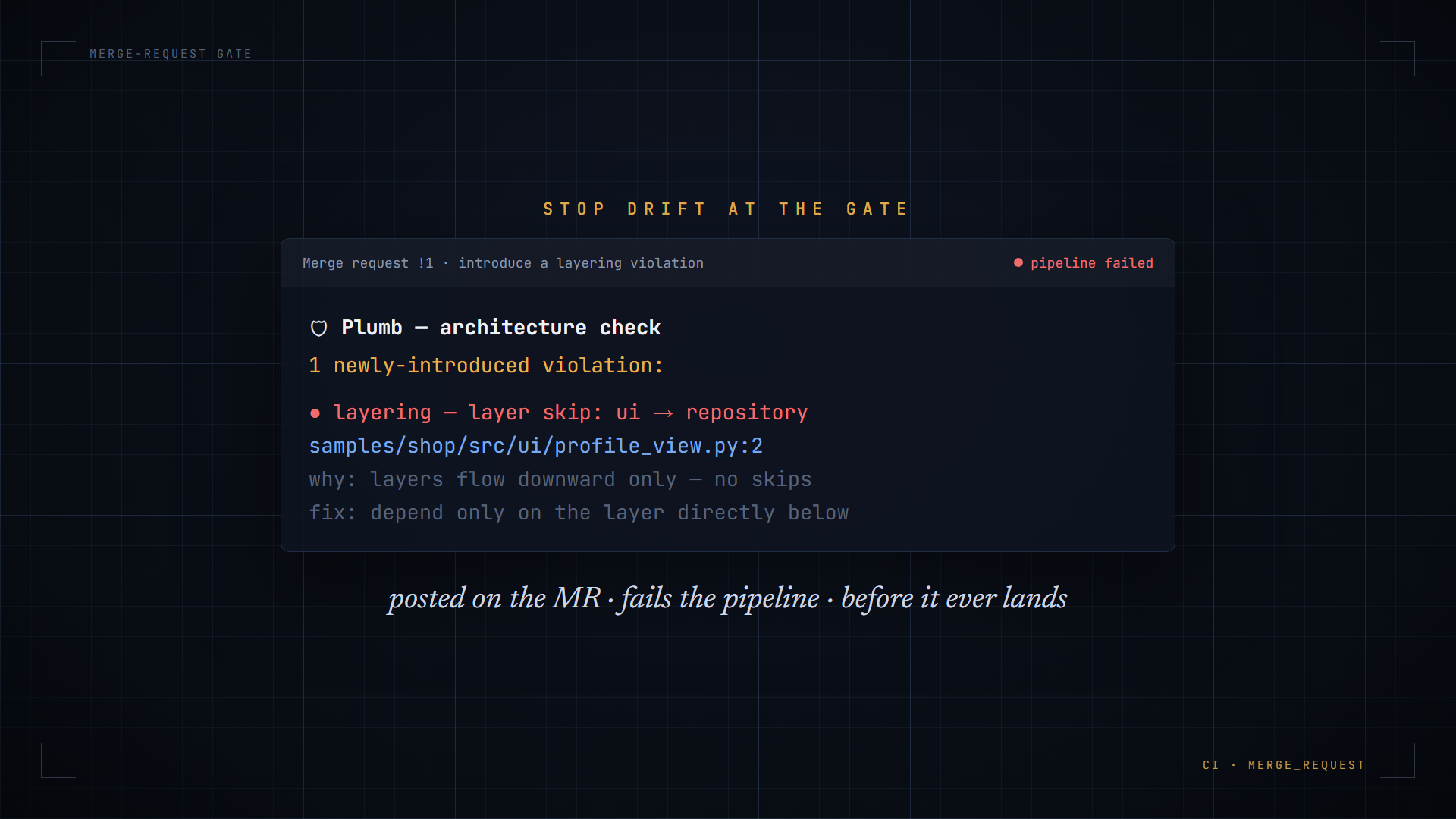
plumb audit— a full architectural health report plus a drift metric (an erosion score over time).plumb check --base <ref>— reports only the violations a merge request introduces, posts them as an MR comment, and fails the pipeline. Drift prevention at the gate.
How we built it
- GitLab Orbit is the load-bearing core. Plumb queries Orbit's DuckDB code graph (
gl_file,gl_imported_symbol,gl_definition,gl_edge) viaorbit sql --format json, resolves imports to internal files, and builds a normalized in-memory graph.plumb explain <rule>prints the literal Orbit queries each rule runs — the integration is real, not a wrapper. - A Rust engine — a rules DSL, selector compiler, and five evaluators running as deterministic predicates and graph algorithms (cycles via Tarjan SCC). 24 unit tests plus a gated end-to-end golden test against a live Orbit index.
- Shipped as a GitLab Duo skill, plus an AI Catalog agent and flow, each wired to the Orbit graph tools (
query_graph,get_graph_schema). - AI-native split: detection is deterministic and trustworthy; the explanation and fix are AI-native via Duo. A GitLab CI template gates merge requests live.
Challenges we ran into
- Orbit has no edge linking an import to its target file, so Plumb resolves imports itself (exact-stem-first, deterministic suffix fallback).
- Orbit's Rust indexer emits Windows-style backslash paths while the Python indexer uses forward slashes — Plumb normalizes separators so selectors compare consistently (a candidate upstream Orbit fix).
What we learned
A queryable code graph changes what's possible: rules that were tribal knowledge become a versioned, enforced, explainable artifact. The hard part of "executable architecture" isn't the rules engine — it's having a trustworthy structural representation of the code, which is exactly what Orbit provides.
What's next
- First-class import resolution for Rust/TypeScript module systems, to unlock layering & cycles on more languages.
- Orbit Remote mode: gate MRs using the full SDLC graph server-side.
- Auto-suggested starter rules inferred from a codebase's existing structure.
Built With
- clap
- duckdb
- gitlab-ci/cd
- gitlab-duo-agent-platform
- gitlab-orbit
- petgraph
- rust
- serde

Log in or sign up for Devpost to join the conversation.