-
-
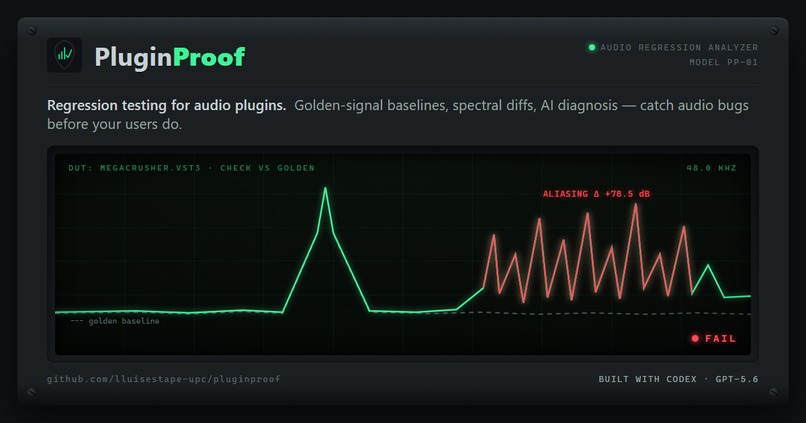
Banner
-
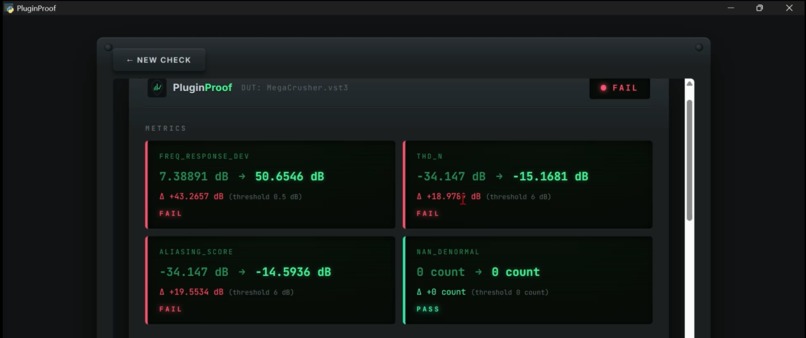
Fail Test
-
Title
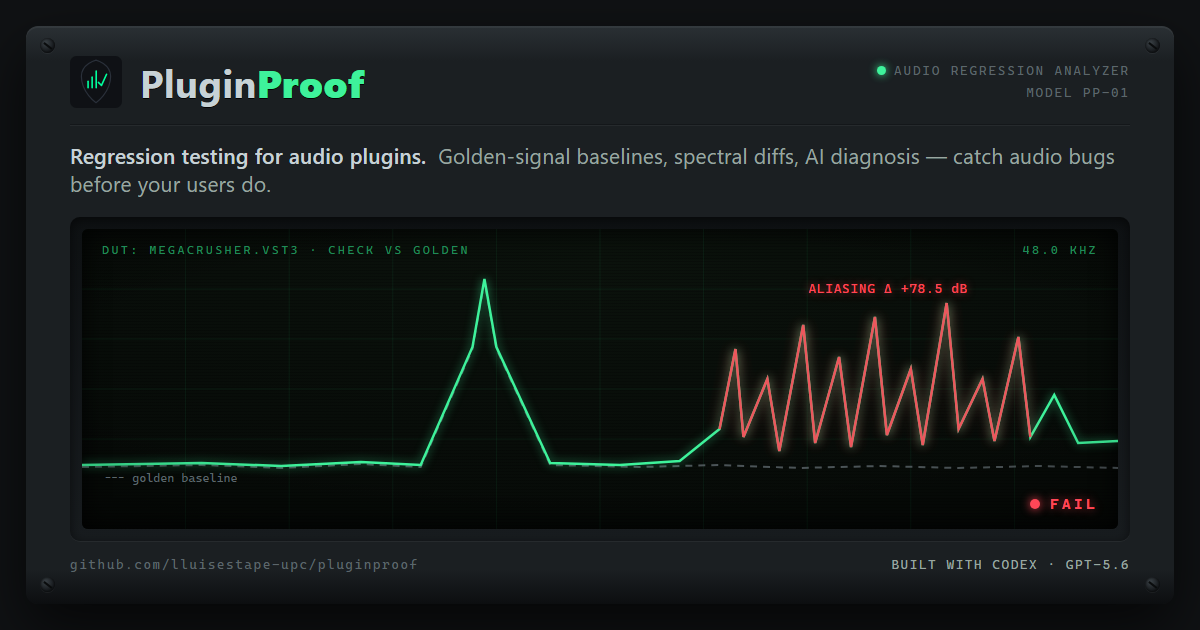
Inspiration
I develop audio plugins (guitar effects — including a distortion called MegaCrusher). Every release is tested the way the whole industry does it: by ear. But ears don't diff. A refactor that compiles cleanly can invert a parameter mapping, bypass an oversampler, or introduce denormals — and you find out from a 1-star review. Web developers have Jest snapshots and visual regression testing; audio developers have nothing. PluginProof is the missing pytest for sound.
What it does
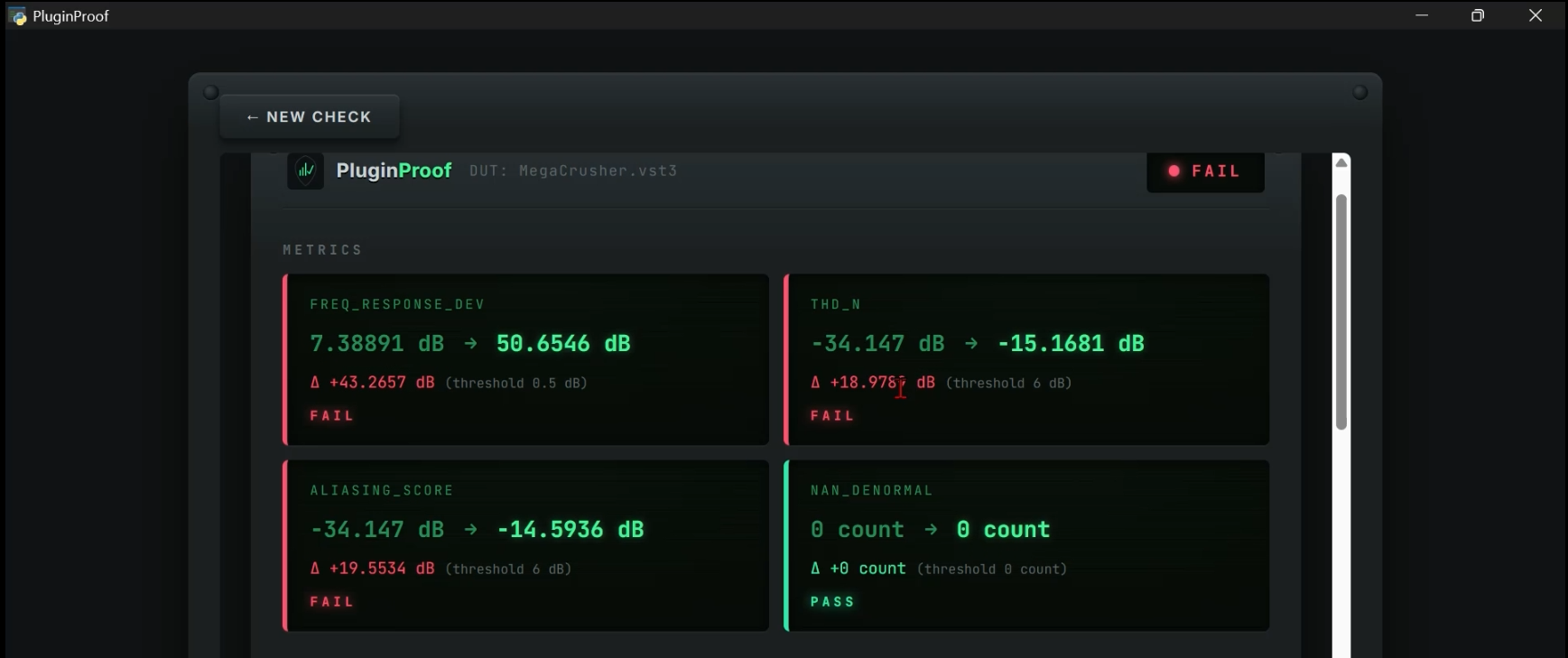
PluginProof measures a VST3 plugin like a lab instrument — frequency response, THD+N, aliasing, and NaN/denormal stability — through the real plugin binary, and snapshots a golden baseline. After every build, one click (or one CI job) re-measures and diffs against the golden with per-metric thresholds: PASS / WARN / FAIL, spectrum overlays, and exit codes 0/1/2.
Then the part numbers can't do: the metric diffs go to an AI that answers like a DSP engineer — "severe aliasing above 15 kHz, check your oversampling stage." It ships with GPT-5.6 as the default engine, and it's bring-your-own-key: Anthropic works, and Ollama runs it 100% local and free (perfect for CI). A rule-based offline fallback means the tool never breaks, and every report honestly labels which engine produced the diagnosis.
It's a real product, not a PoC: a windowed desktop app (drag a .vst3 onto a phosphor CRT screen — the whole UI is a bench-instrument faceplate), a single-file Windows exe on the GitHub release, a typer CLI, and a GitHub Actions gate that blocks PRs that regress audio in under two minutes.
How we built it
The core was built in a Codex session with GPT-5.6 (Session ID submitted): the pywebview desktop app — including root-causing from library source why dropped-file paths only exist in pywebview's Python-side DOM events — the re-measure-on-check flow, the multi-provider BYOK diagnosis layer (one OpenAI-compatible code path for three providers), real-world VST3 hardening (stereo adaptation, single-thread affinity for pedalboard renders), PyInstaller packaging, and the CI workflow.
The measurement engine is numpy/scipy: Welch H1 transfer functions, least-squares sine fitting for THD (with frequency refinement — FFT interpolation alone de-phased the fit), and an aliasing score that counts only non-harmonic image energy. Spotify's pedalboard hosts the VST3, which avoided writing a C++ headless host. Claude Code agents scaffolded specs and tests in parallel lanes against a shared data contract, and the brand started from a Gemini pass.
Challenges we ran into
Measuring "does it sound the same" without false positives: the whole pipeline is deterministic (seeded phases, fixed stimuli), so an unchanged plugin diffs to exactly zero. THD via naive FFT interpolation read −31 dB on a clean signal — a 0.02 Hz frequency error de-phases the sine fit — fixed with a bounded refinement step. And pywebview drag-and-drop silently never exposes file paths to in-page JavaScript — Codex root-caused it from the library source.
Accomplishments that we're proud of
A real bug demo: a one-line "branchless" refactor of MegaCrusher's bit crusher that compiles clean and quantizes audio to 4 levels — caught with a triple FAIL (+43 dB freq response, +19 dB THD, +19.6 dB aliasing) and an AI explanation. Both plugin builds and the golden baseline are in the repo, so judges can reproduce the catch in 60 seconds without compiling anything. There's also a live blocked PR in the repo showing the CI gate catching a different bug class (a filter-coefficient typo that only breaks frequency response).
What we learned
Domain moats matter: the hard part wasn't the app, it was knowing what to measure and what makes a measurement trustworthy. Deterministic beats statistical for CI gates. And honest engine labelling (GPT-5.6 / local / rule-based) is a feature, not a disclaimer.
What's next for PluginProof
More formats (AU, CLAP), parameter-sweep baselines (measure at N parameter snapshots, not just defaults), latency/CPU regression tracking, and a hosted dashboard for teams.


Log in or sign up for Devpost to join the conversation.