-
-
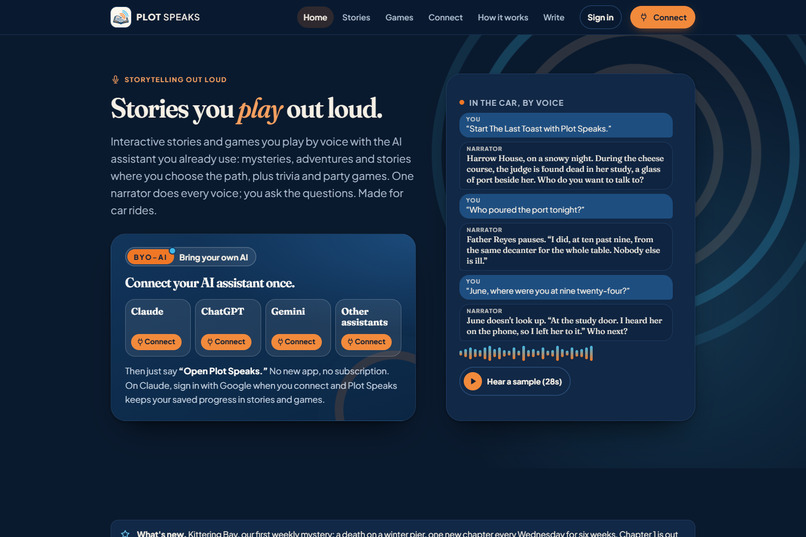
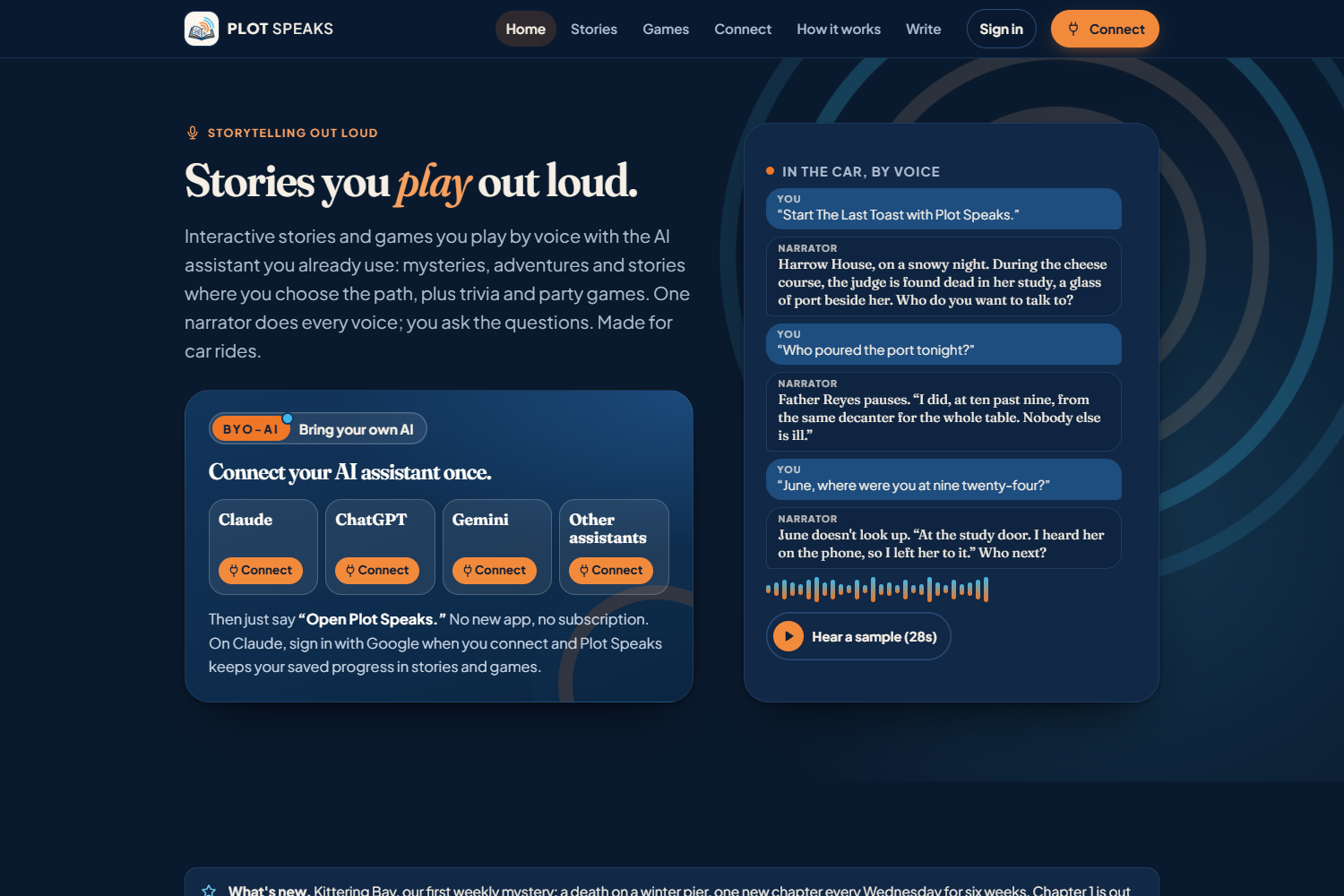
home page with the BYO-AI badge and the sample conversation
-
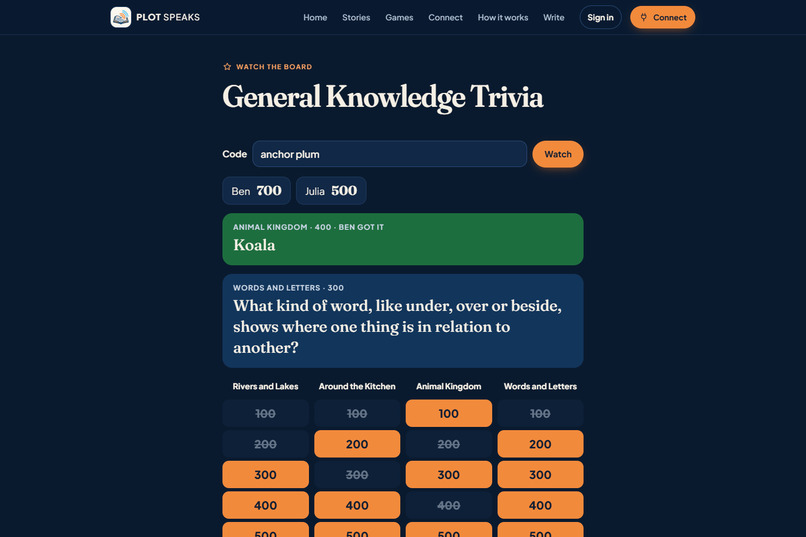
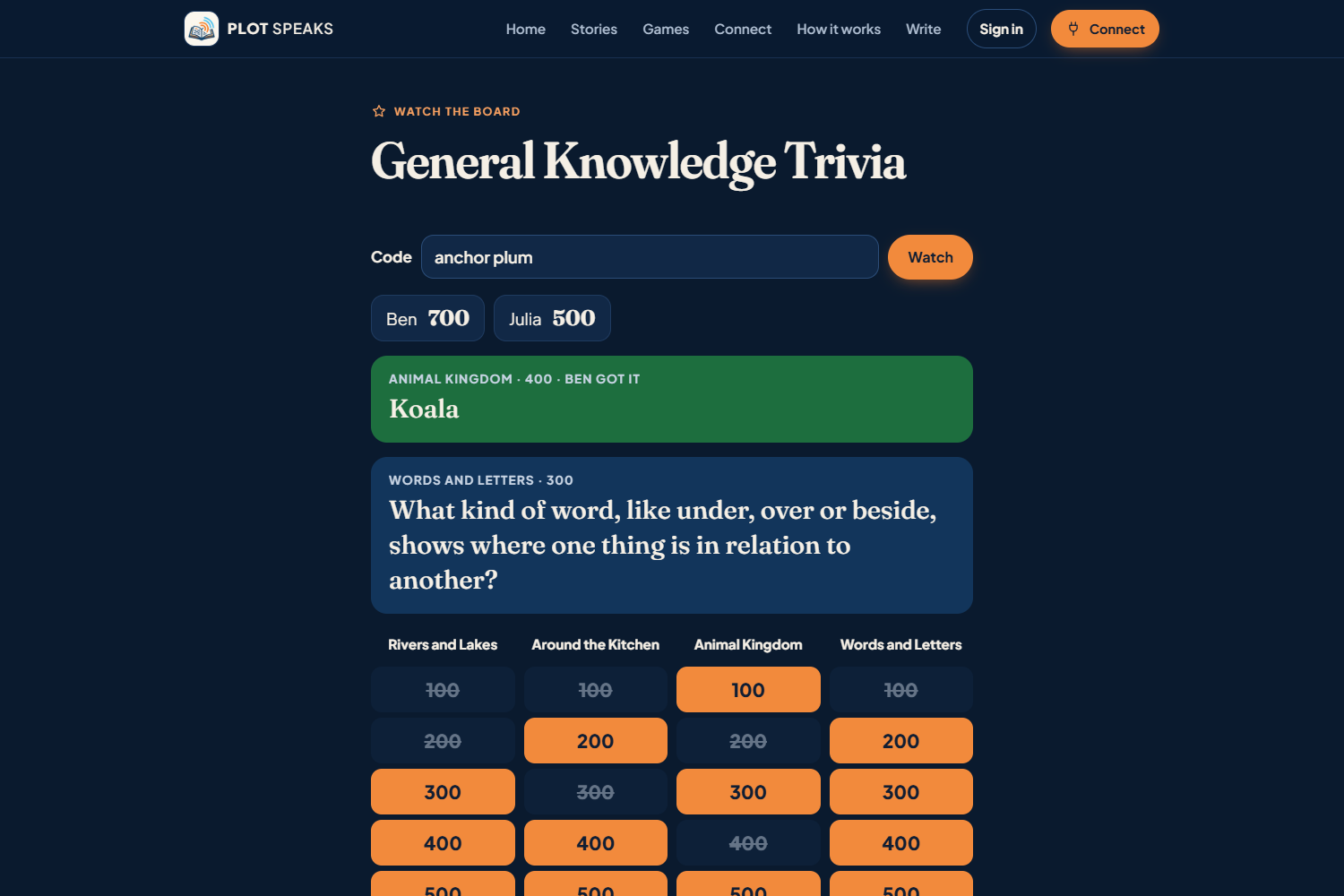
a live trivia board on the watch page (Ben 700, Julia 500, Koala just answered, a clue open)
-
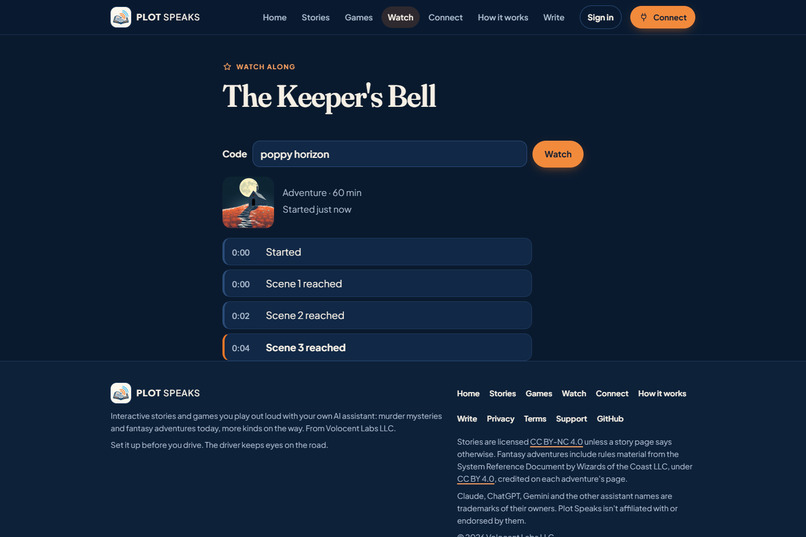
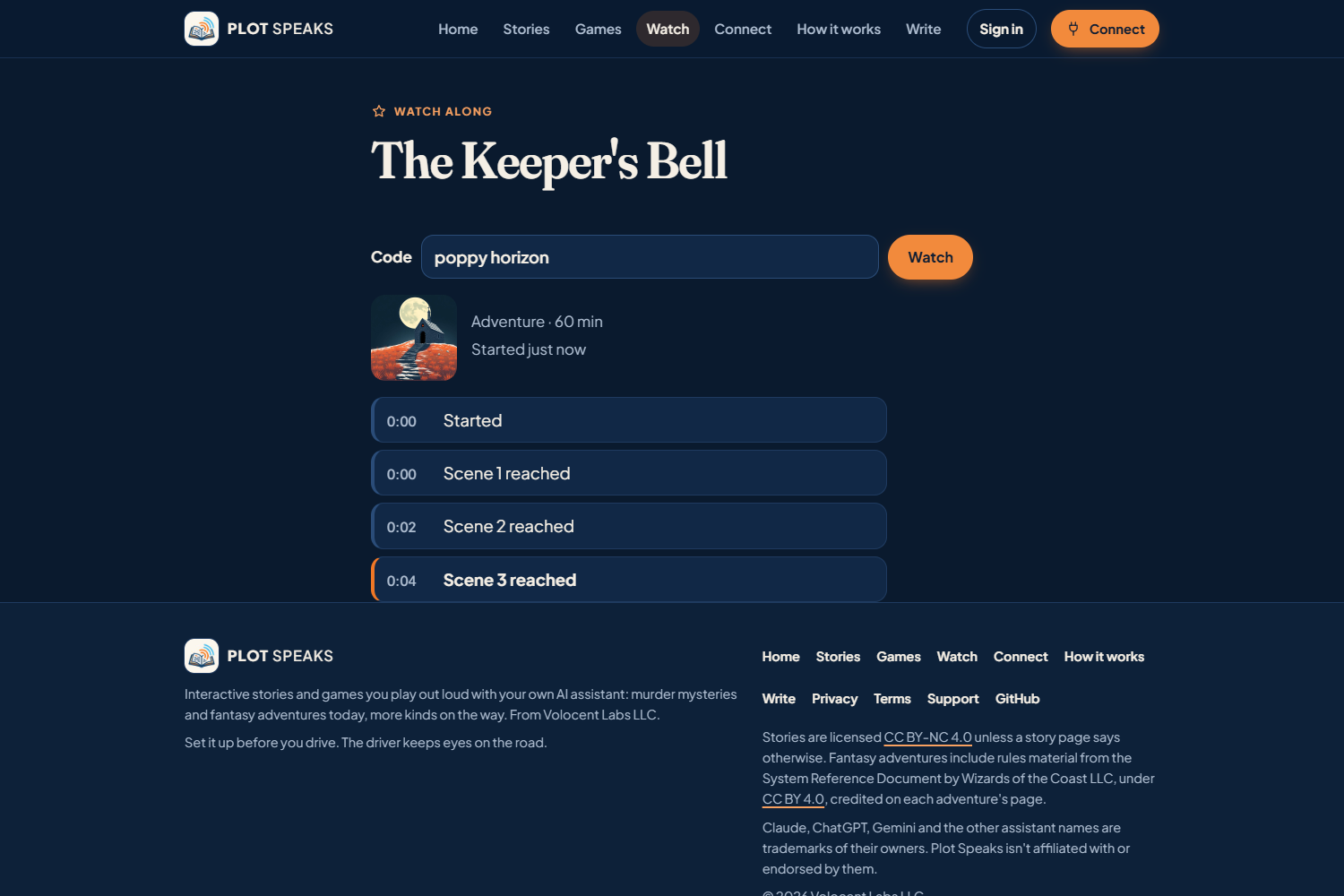
a live murder mystery on the watch page
-
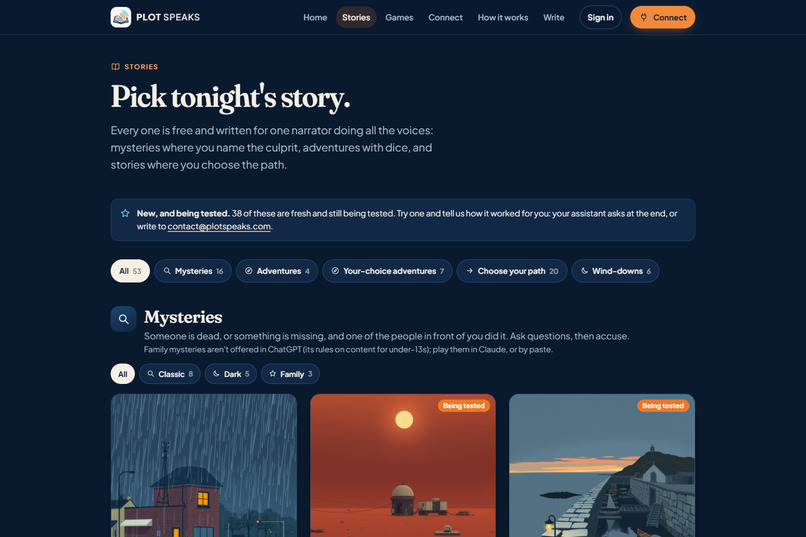
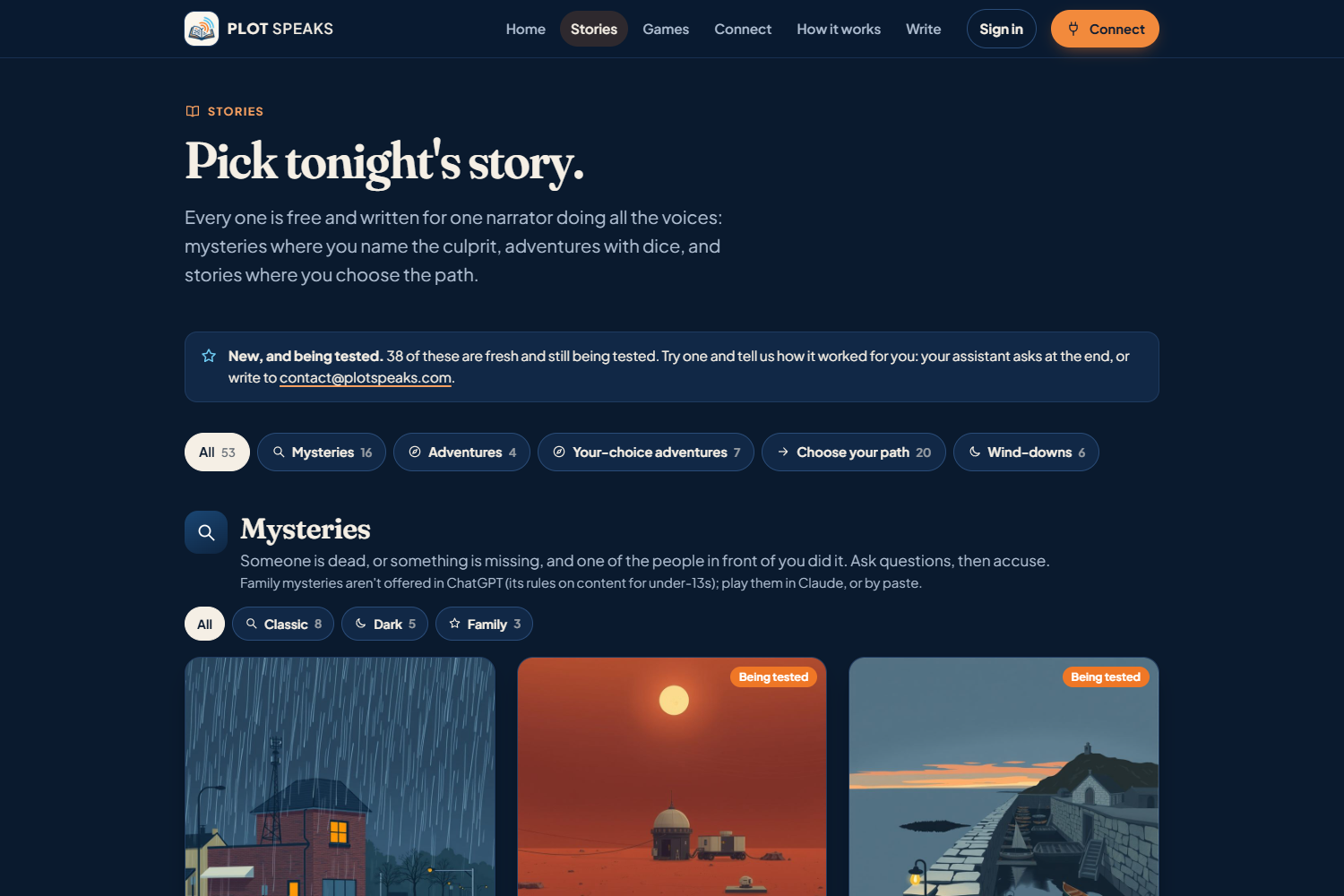
the stories library with cover art
-
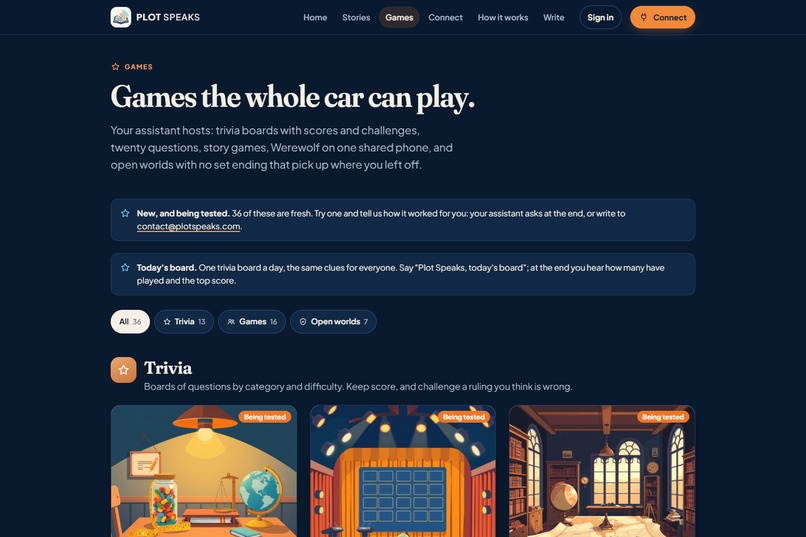
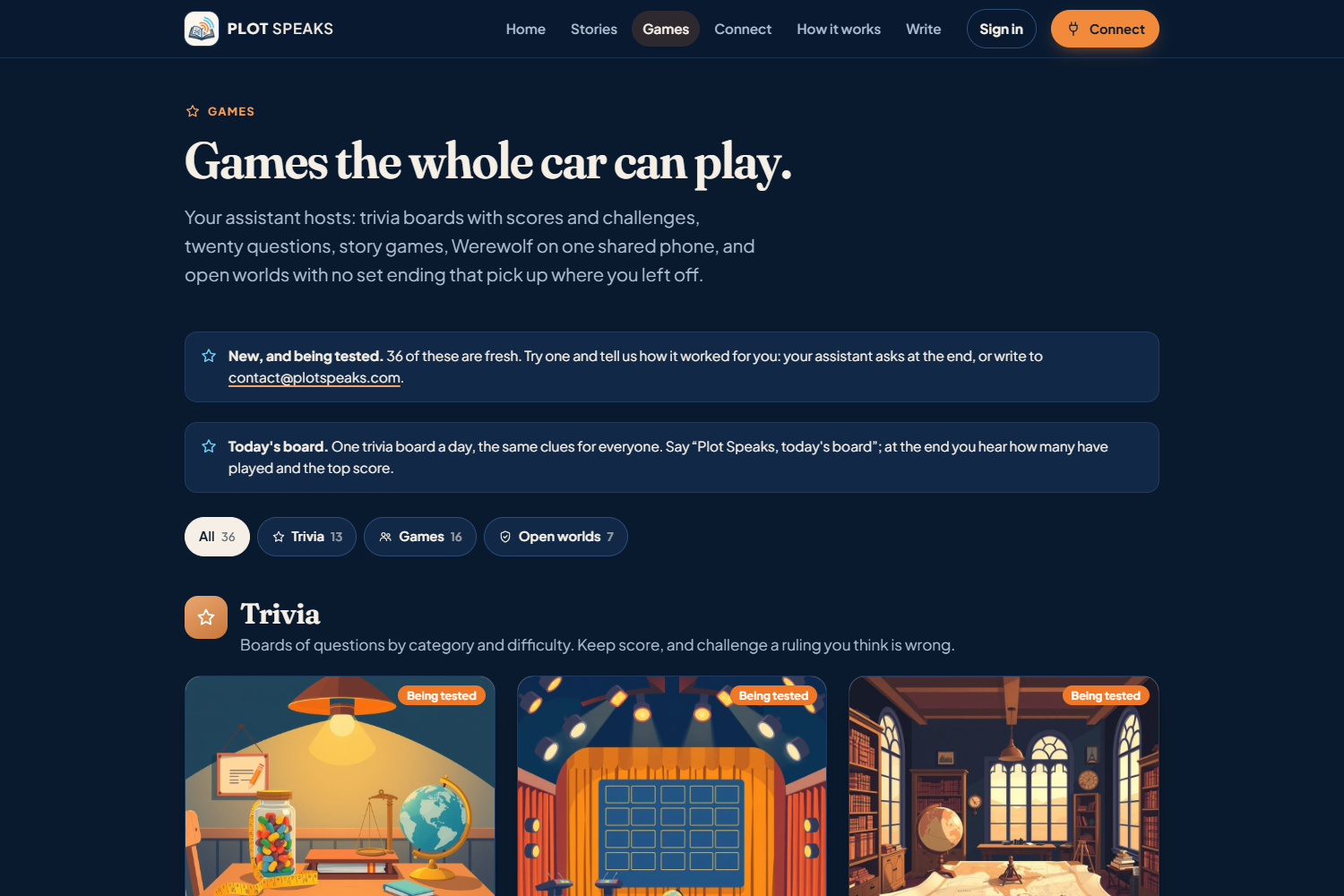
games library (today's board strip)
-
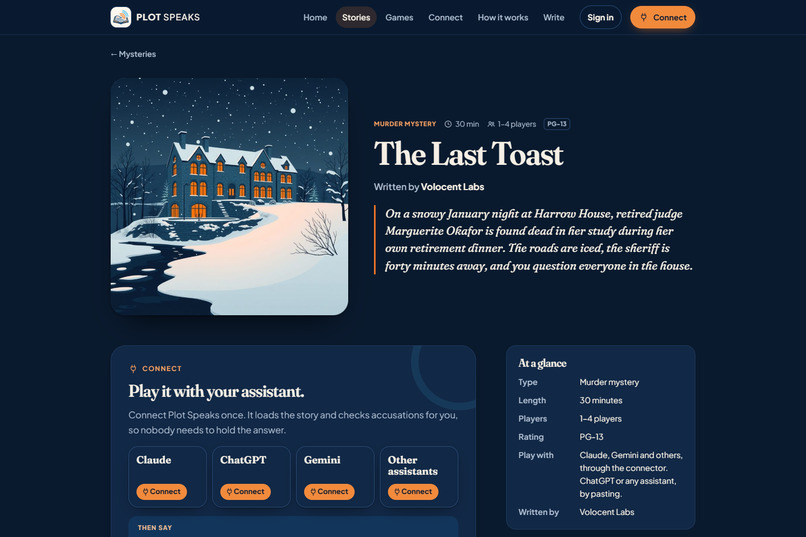
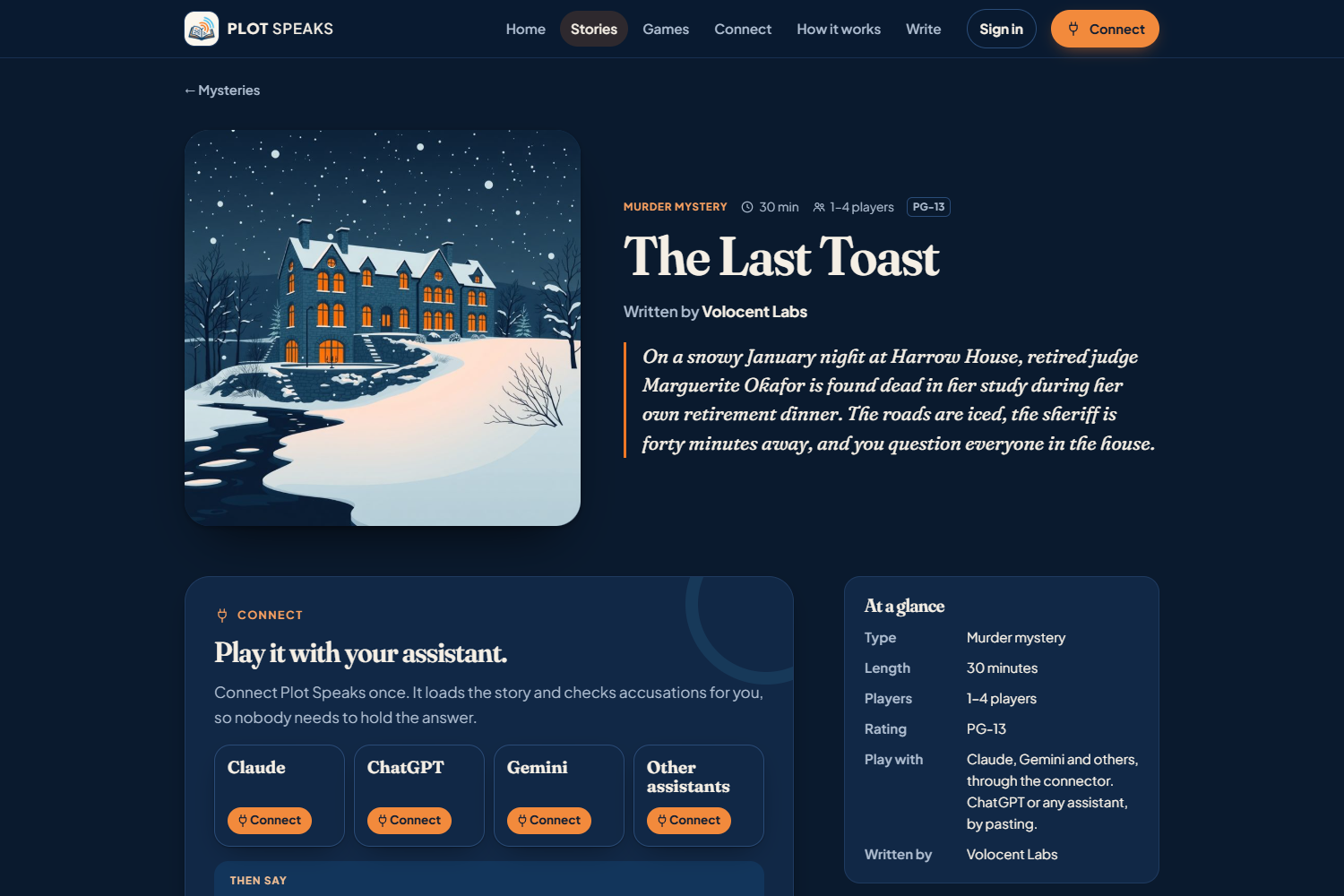
The Last Toast story page (cover, blurb, connect panel)
-
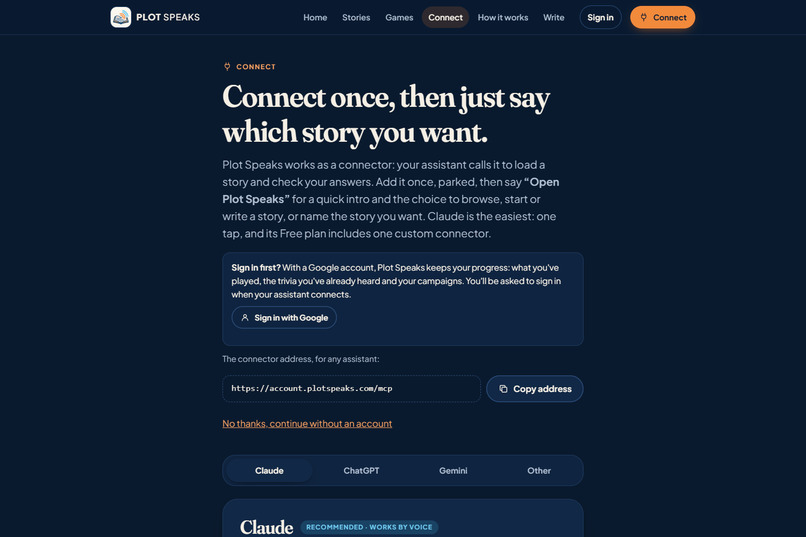
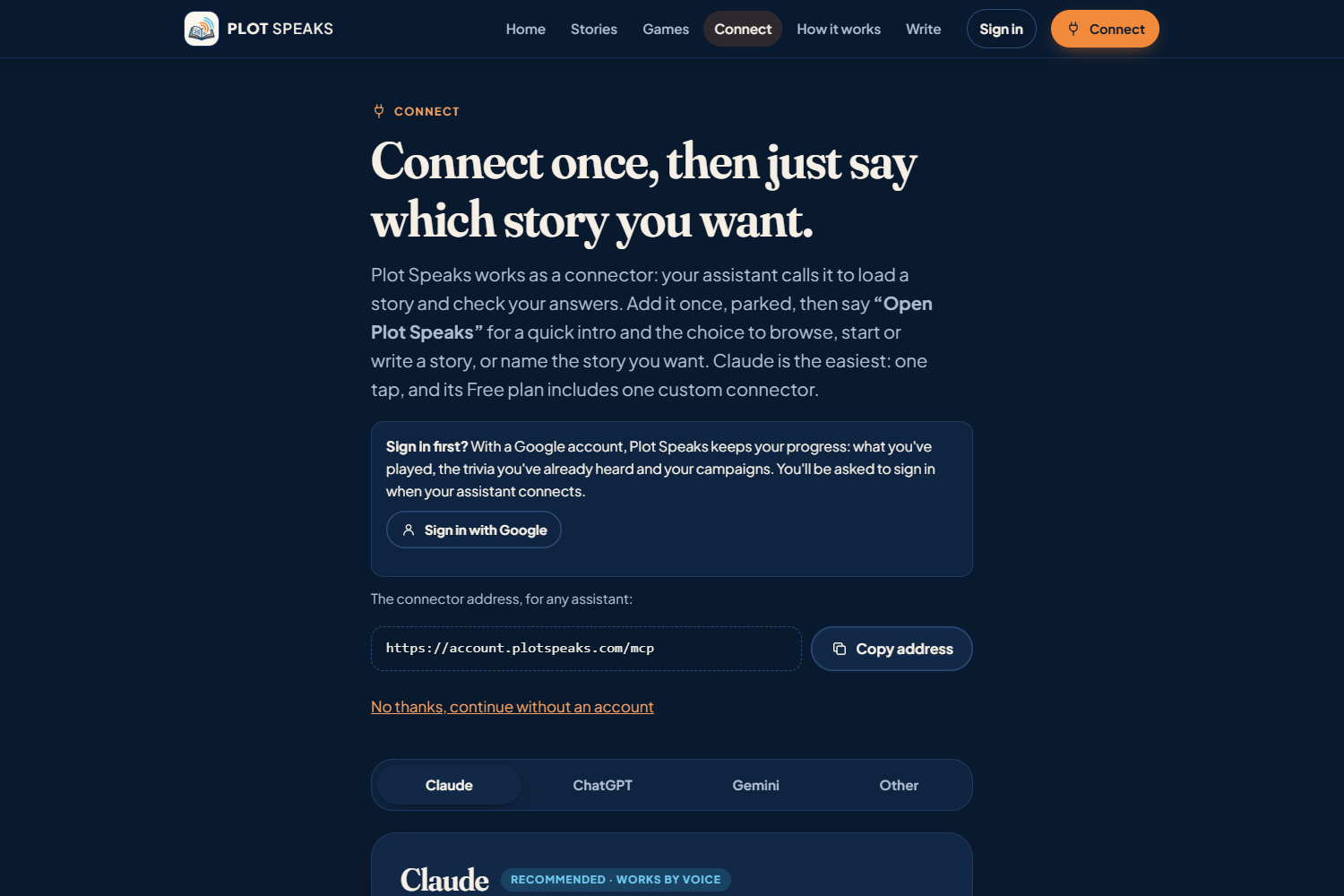
connect page with Google sign-in and the account address
-
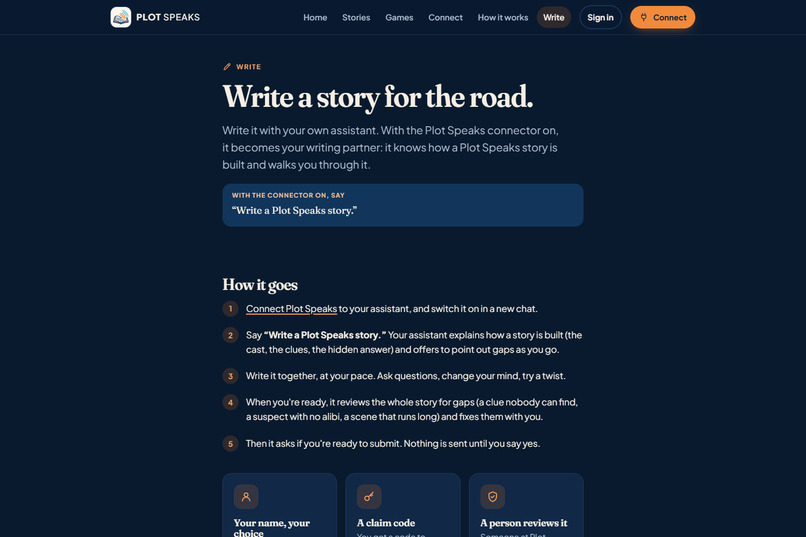
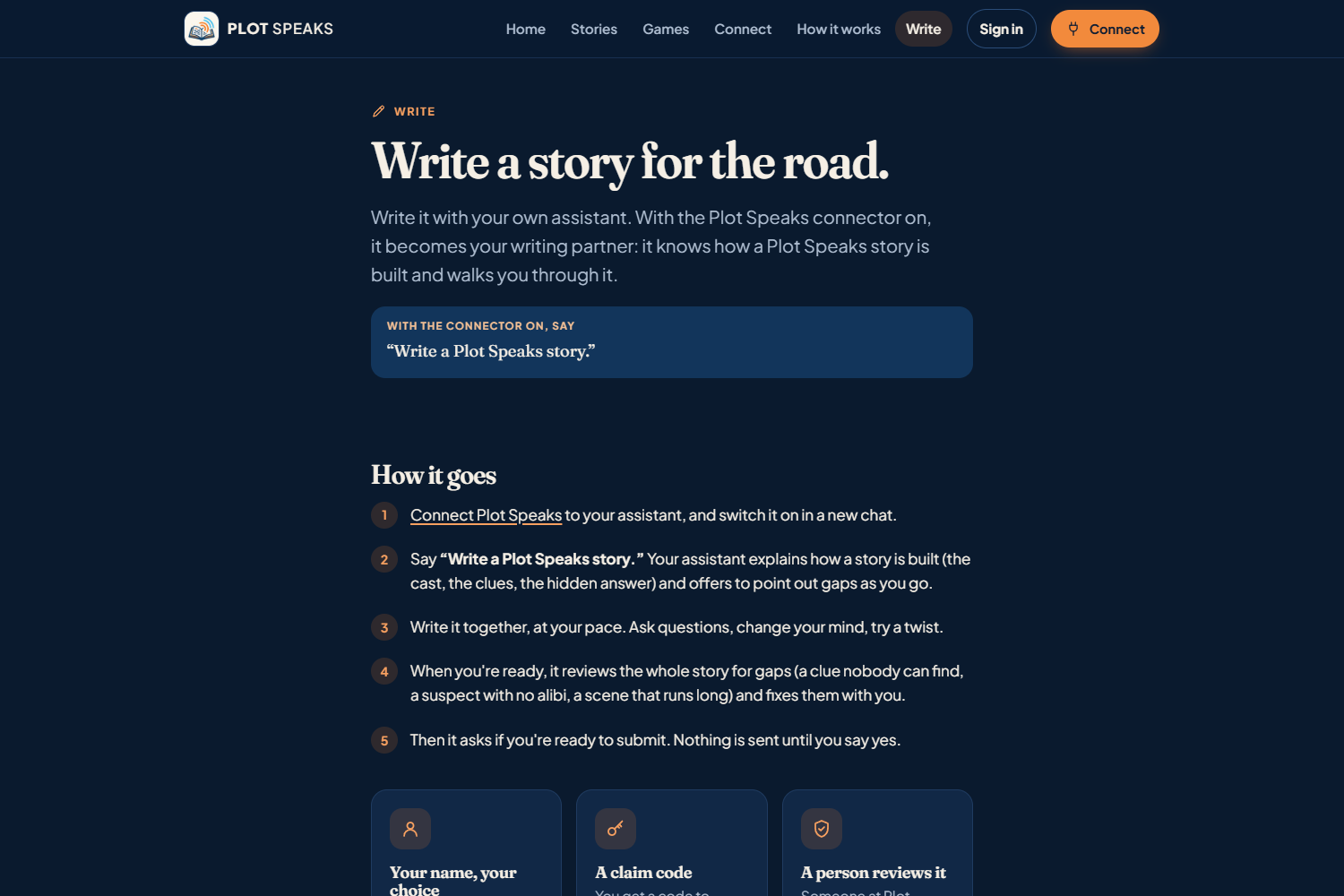
Story Studio (community writing)
-
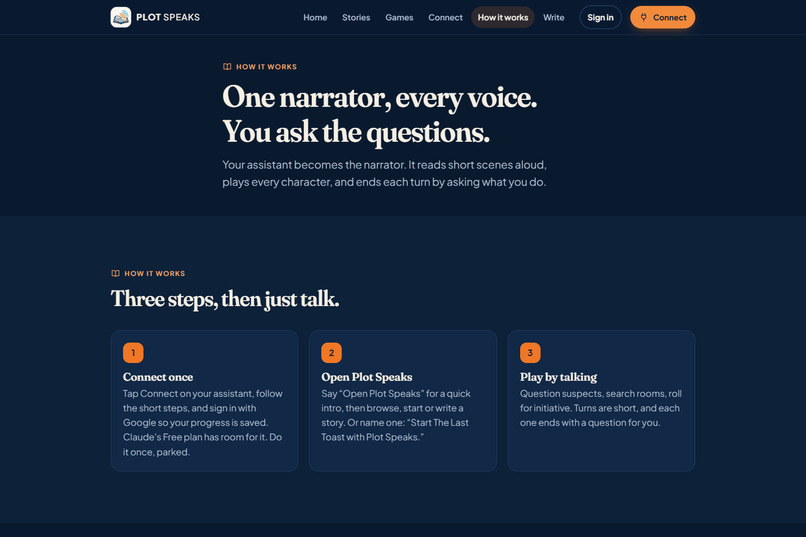
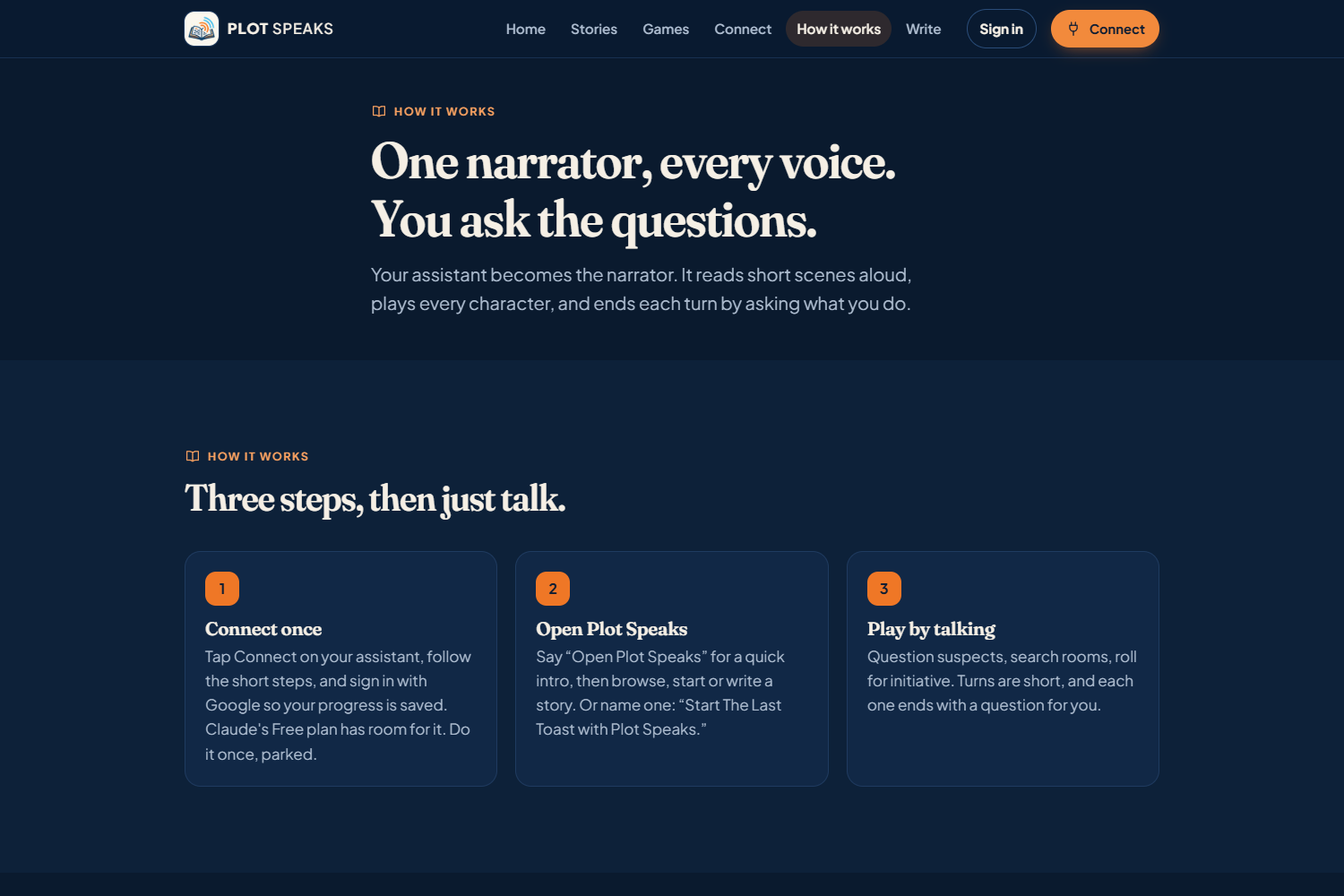
how to - three steps
-
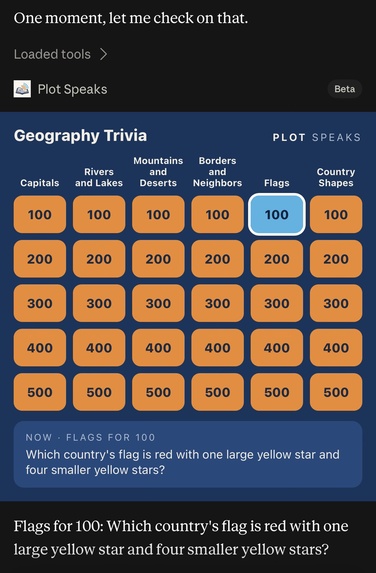
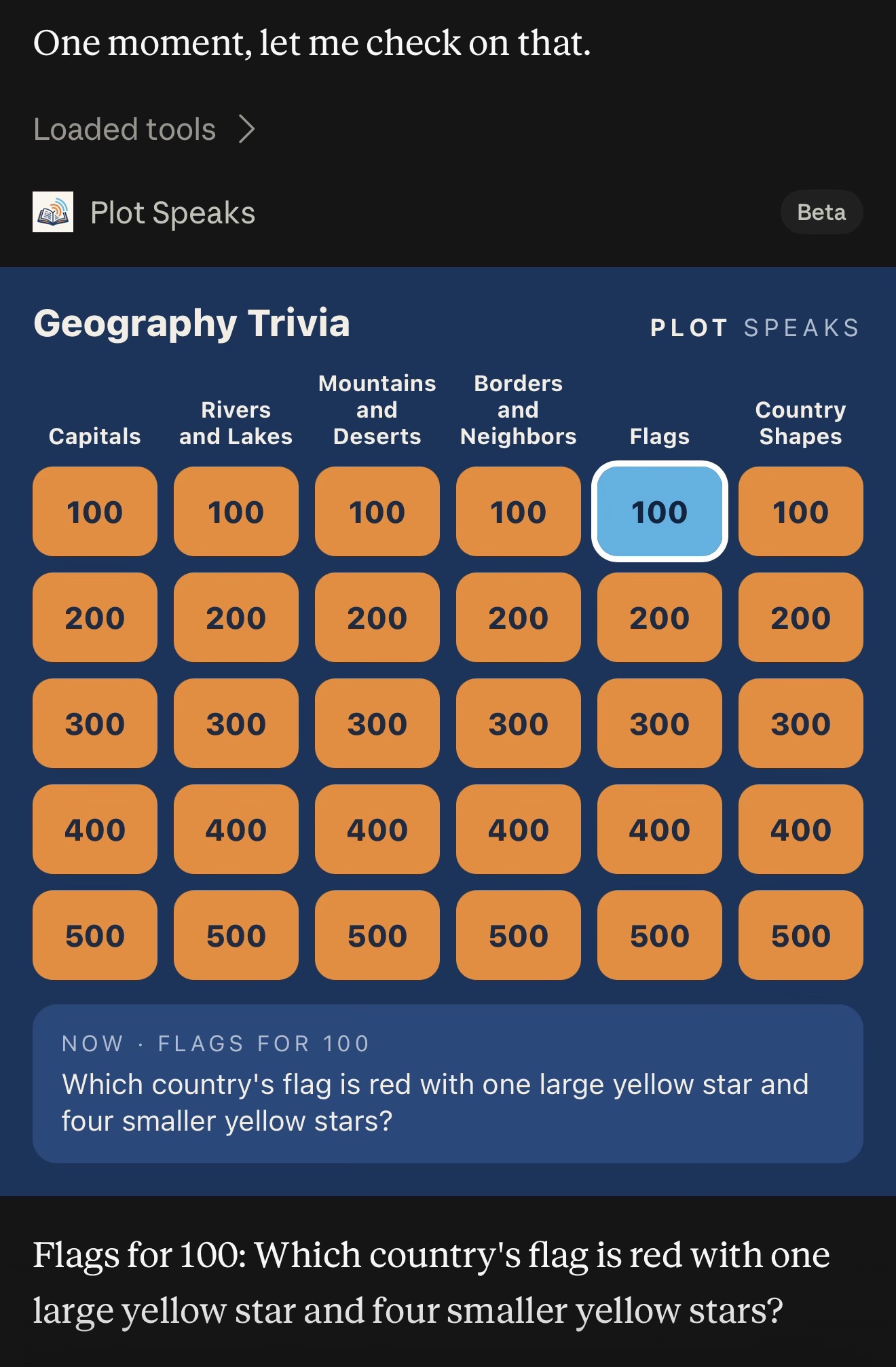
MCP App showing the game board on Claude
-
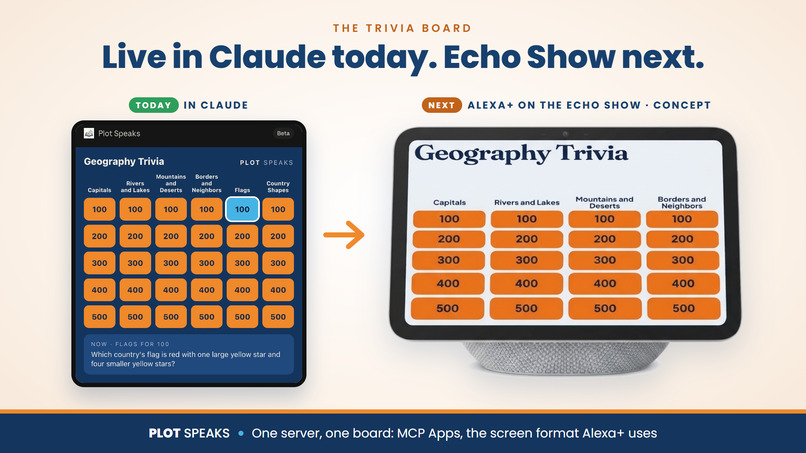
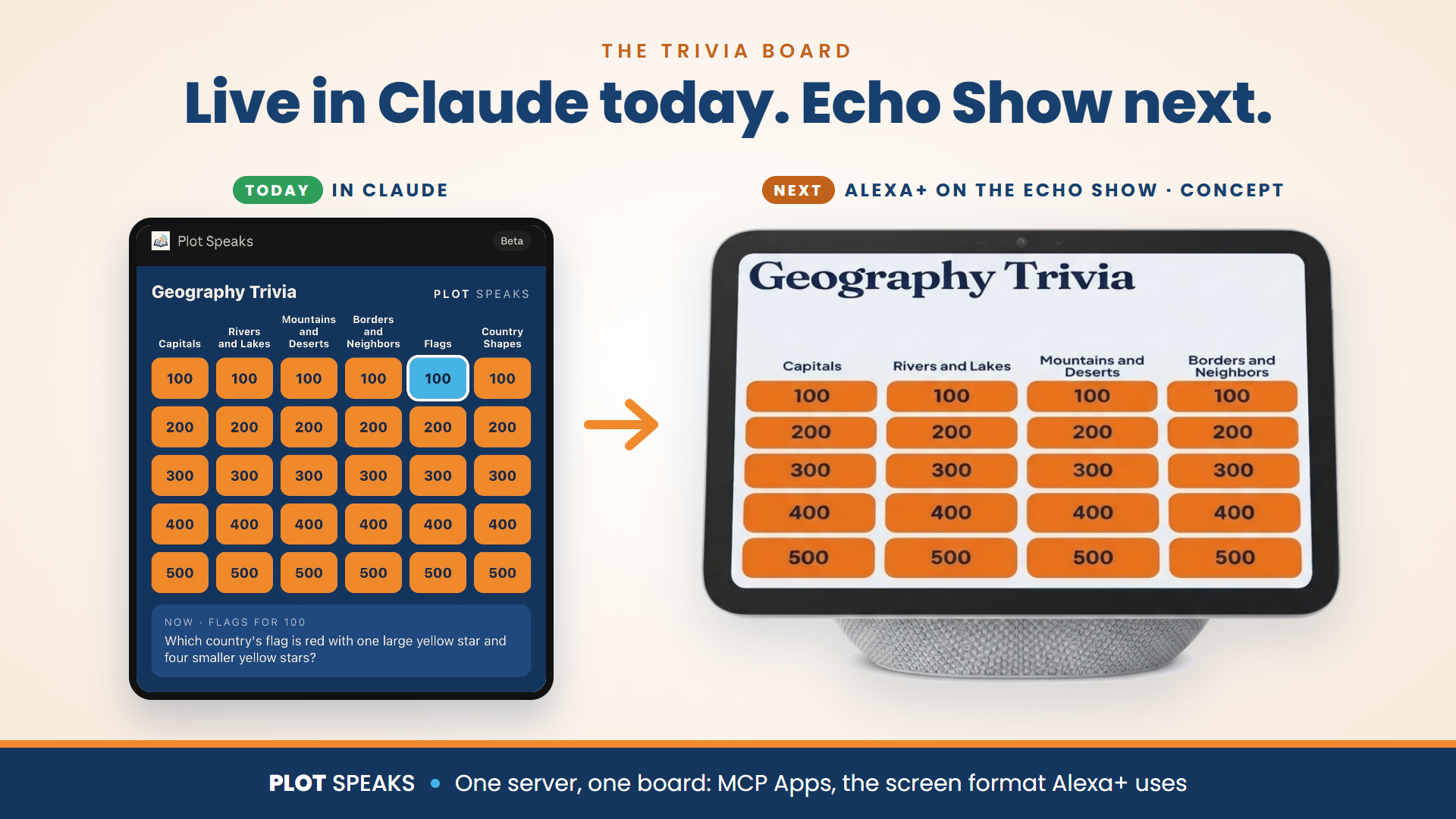
echo show concept
-
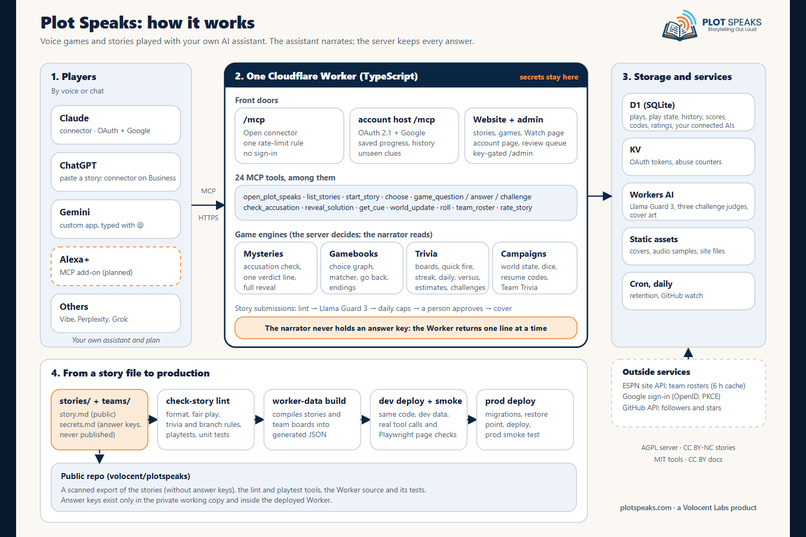
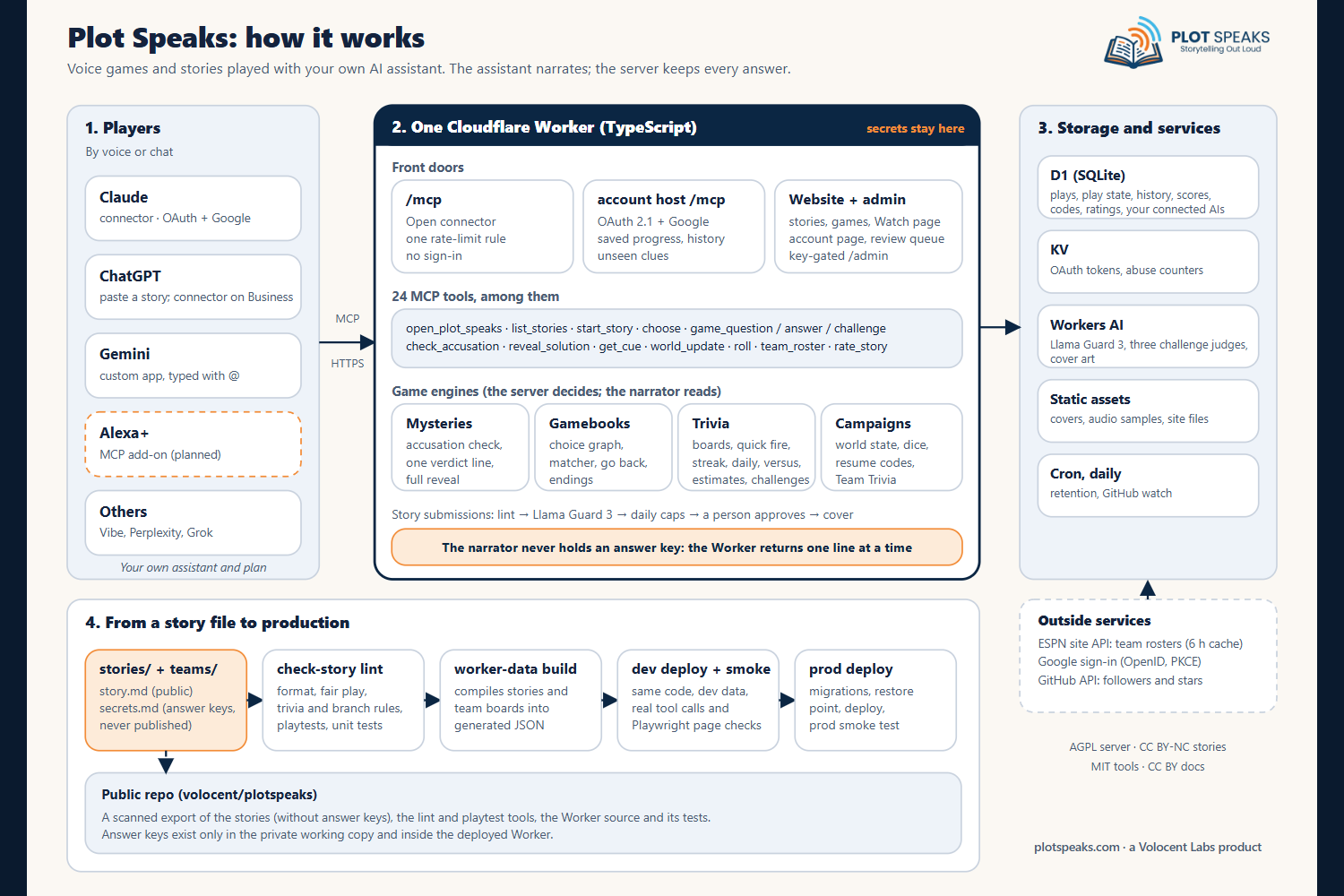
the technical design diagram
Inspiration
Plot Speaks is bring-your-own-AI (BYO-AI). You don't download a new assistant to play; you connect the one you already use (Claude today, Gemini today, Alexa+ as soon as the preview opens) to the Plot Speaks MCP server, and your assistant becomes the narrator, the quizmaster and the game host. Sign in with Google once and your progress, ratings and badges follow you across assistants.
The reason it has to be a server and not a prompt: voice assistants are good narrators and terrible secret-keepers. Ask one to run a murder mystery and it will, right up until it blurts out the killer, invents a clue, or lets you talk it into the answer. So the assistant does the voices while the server holds the truth: every answer key, every trivia board and every rule lives on Plot Speaks, which gives up exactly one line at a time, only when the player has earned it.
What it does
A library of stories and games on plotspeaks.com, each with AI-generated cover art, a description, a running time and its community rating. Pick one on the site or just ask your assistant for it by name.
- Murder mysteries (16 of them): question suspects, search rooms, then accuse. The server rules on the accusation with a single line and reveals the solution only after a correct accusation or when you give up. Kittering Bay is a six-chapter season, one chapter released every Wednesday.
- Choose-your-path adventures (27 of them), where every choice is yours: gamebook adventures, escape rooms, a heist, two courtroom trials, longer sci-fi and mystery dramas, gentle bedtime stories for kids, and two Spanish-practice stories. All have "go back", and a shareable path code so a friend can follow your choices.
- Trivia: ten general boards (1,800+ clues), Team Trivia for 356 teams across MLB, NBA, NHL, college football and soccer with today's roster from ESPN, Ballpark (estimate the number), a seasonal Halloween board, and a daily board everyone plays with the same deal. Modes: board, quick fire, streak, or "I've got ten minutes" and it sizes the game. A disputed ruling goes to three independent AI judges; an upheld challenge teaches the board for everyone after you.
- Games and worlds: Werewolf run by the narrator, Twenty Questions, open worlds that remember you across sessions, and six quiet wind-downs for the end of the day.
- Around the play: head-to-head by code, a Watch page (plotspeaks.com/watch) so a second screen can follow any play, the trivia board live or a mystery's, gamebook's or campaign's timeline, with every secret kept server-side; tester badges and public profiles.
- On screen in Claude: Plot Speaks is an MCP App, so assistants that can show a screen draw the game beside the conversation: each story's cover, the menu as covers, the live trivia board with pictures for flag and country-shape clues, a mystery's timeline of accusations and verdicts, dice the players hear, and tap-to-rate stars at the end. It's the same format Alexa+ uses on the Echo Show.
The community writes too. Story Studio lets anyone write a story or a game by voice, with the assistant as co-author, and submit it. Every submission is screened for copyright, malicious and explicit content (Llama Guard plus our own checks), then human-reviewed before it is listed. Listed stories sit in the same marketplace as ours, with the same reviews.
Every play ends with a rating. When a story or game finishes, the assistant asks for one to five stars and anything you'd like to say, or you tap the stars on screen. Ratings show on the site once a story has at least one, and the review text goes back to the writer. Trivia rulings feed each clue's real difficulty the same way.
How we built it
One TypeScript Worker on Cloudflare exposes 24 MCP tools over Streamable HTTP (spec 2025-11-25). D1 holds plays, ratings and game state, KV the OAuth grants, Workers AI runs the three trivia judges, the submission screening (Llama Guard 3) and the cover art (FLUX). There are two front doors: an open server anyone can connect, and an OAuth 2.1 host (PKCE, RFC 9728 metadata, dynamic client registration, Google sign-in) that keeps your progress. The screen is one MCP App view (ui://plotspeaks/screen): tools carry what to draw in their result metadata, built from the same no-spoiler views as the Watch page, so it can never show an unplayed answer or a hidden roll.
Stories are Markdown with a private answer key. A lint enforces fair play: no clue may give itself away, every mystery must be solvable from what a player can find, read-aloud beats stay short enough to say in one breath. Before a story ships, simulated playtests run a narrator model, a player model and a judge model against it to catch leaks and invented facts.
The whole thing was built inside the hackathon window: first commit on October 15, 2026, 200+ commits, everything above in production.
Challenges we ran into
- Getting into Alexa+. The Alexa+ track asks for a self-hosted MCP server, and that is what we built. But connecting it to Alexa+ itself needs the Alexa+ for Builders toolkit, which is in a phased preview for selected partners. We did every documented setup step (developer account, AWS account, IAM user with the published policy, Ubuntu, Node, the AWS CLI), and the final AssumeRole is refused because our AWS account is not yet on the role's trust list. Amazon's support team confirmed this is expected in the current phase and recorded our interest, and the hackathon's organizers said on the forum that participants won't get the toolkit and aren't expected to use it. So the server meets Alexa+'s core add-on requirements (MCP over Streamable HTTP on spec 2025-11-25, OAuth 2.1 with PKCE), and the trivia board already runs as an MCP App in Claude, the format Alexa+ uses to draw on the Echo Show. Two pieces wait for access because they need Amazon's side: Alexa's pre-registered sign-in client and its service token. We couldn't demo it inside Alexa+ itself, so the demo shows it in Claude, and it runs in Gemini too.
- Secret-keeping on a small model. The narrator is often a fast, light model. We moved every verdict, every clue and every answer server-side, wrote the tool replies as instructions a small model follows ("read the ruling, then this clue, don't ask"), and measured: a full trivia board went from 110+ turns to 41 by letting the server hand the host the next clue with each ruling.
- Screening what strangers write. A community library is only as safe as its gate. Submissions pass an AI screen for copyright, malicious and explicit content, a two-of-three vote so one flaky verdict doesn't block a good story, and a human review, before anyone else can play them.
- Speech, not text. "Czechia" for "Czech Republic", "nineteen sixty eight", "about 1.5 million", "door 3": the answer matcher grew a spoken-number parser, name aliases, and a three-judge challenge for the cases we couldn't foresee.
Accomplishments we're proud of
A live, public product in eight days that works with the assistant you already have; a fair-play mystery format that a narrator can't spoil; a community studio with real screening; ratings and reviews on every story; a six-chapter weekly season with a working release calendar; a public repository that runs end to end. A game screen that already runs inside Claude in the format Alexa+ uses.
What we learned
Bring-your-own-AI is the right shape for voice play: keep the client dumb and the server honest, and the same library works on every assistant without a line of client code. Most of the value was in what the server says back to the narrator, not in the tools themselves. And the voice surface changes everything: a 40-second cold open is too long, "yes" must be a complete answer, and the player only knows what they have heard.
What's next
- Alexa+ the moment the preview opens: the server already meets Alexa's core add-on requirements, and the screen already runs in Claude, so the Echo Show gets the same board, covers and timeline unchanged. Alexa's sign-in client and service token are the remaining pieces, and both need Amazon's side.
- Paying the writers. The long-term plan is a creator marketplace: writers list stories and games, players pay for premium ones or tip the ones they loved, and the writer keeps most of it. Ratings and reviews already decide what rises. Putting money behind the best writers is what will make the stories and games genuinely good, and it is the engine we want to build on top of Alexa+, Claude and Gemini alike.
- More weekly seasons, and real-play difficulty feeding the trivia deal.
Built With
- cloudflare-d1
- cloudflare-workers
- cloudflare-workers-ai
- espn
- google-sign-in
- mcp-apps
- model-context-protocol
- node.js
- oauth
- playwright
- sqlite
- typescript


Log in or sign up for Devpost to join the conversation.