-
-
app
-
landing
Inspiration
I write novels from time to time, and I often run into the same problem: keeping everything consistent. Worldbuilding notes get scattered, characters change over time, and small continuity errors pile up. I started wondering: What if something could help me manage all the settings, characters, plot arcs, and narrative logic automatically?
That idea became Plot Engine --- an assistant that follows my story as I write and keeps the entire novel coherent.
What It Does
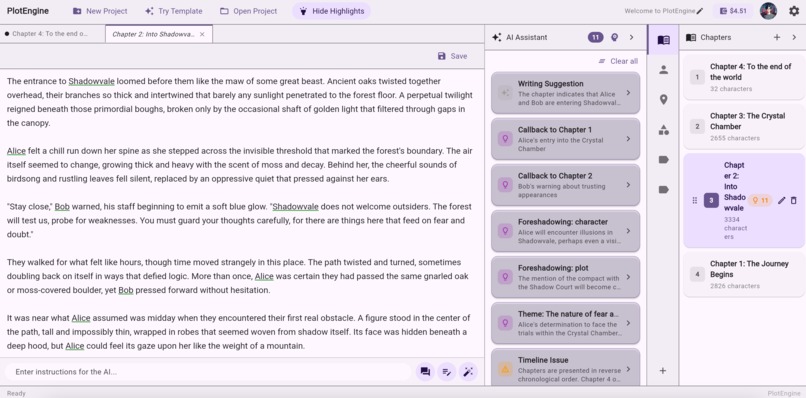
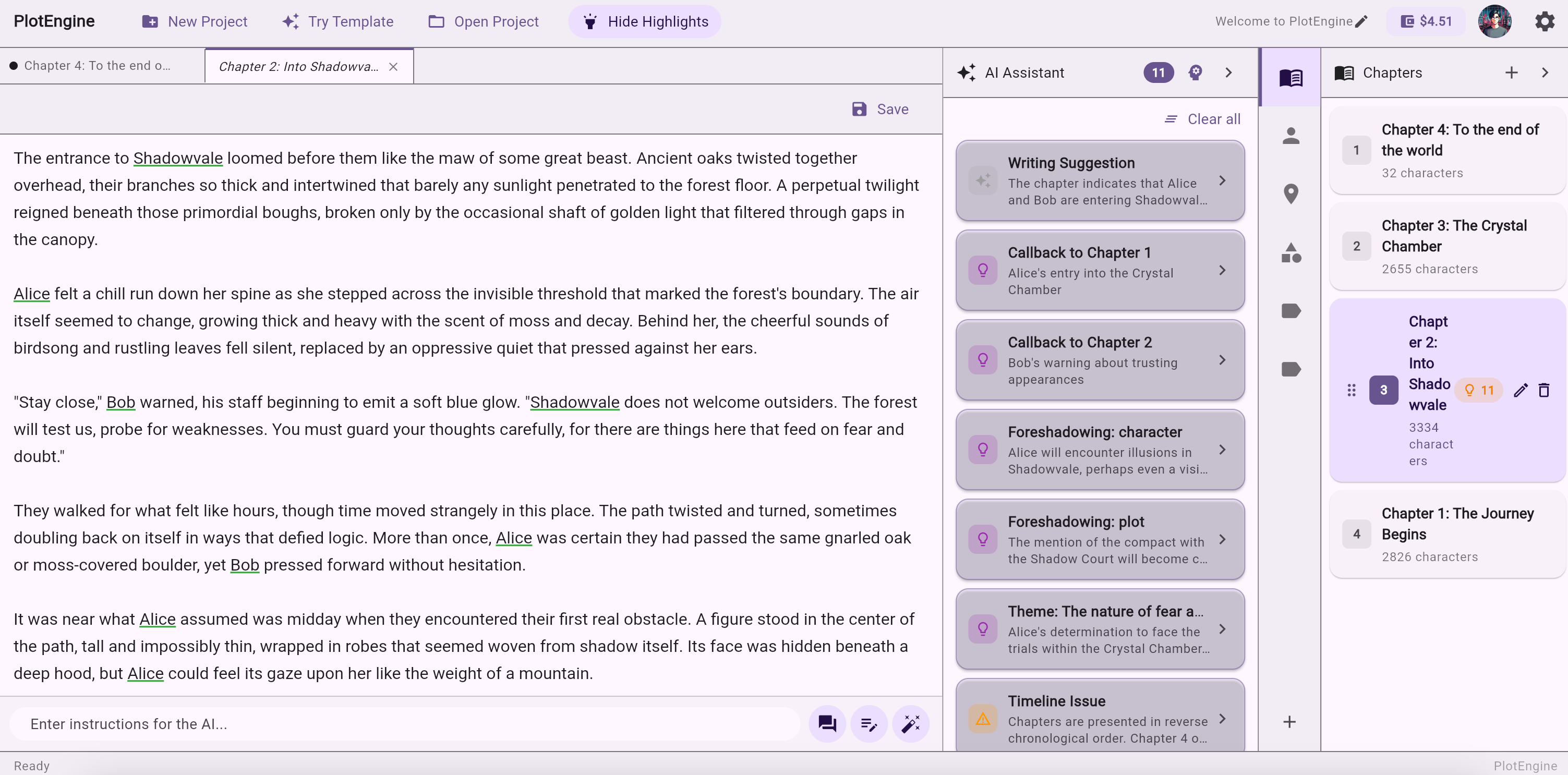
Plot Engine is an AI-powered writing companion built specifically for novelists.
It provides:
Storyline enhancement\ Suggestions for stronger narrative beats, pacing improvements, and plot alternatives.
Background AI consistency checks
- Timeline verification\
- Character consistency\
- Foreshadowing detection\
- Logic and event coherence\
- Tone and style monitoring\
- Entity extraction & relationship mapping
Ask-anything interface\ Writers can ask:\ "Does Chapter 4 contradict anything earlier?"\ "When did Character A first appear?"\ "Are there any unresolved foreshadowing hints?"
Automatic knowledge graph\ Characters, locations, items, and events are extracted and updated as you write.
How We Built It
To allow writers to use Plot Engine anywhere --- web, desktop, or mobile --- we chose Flutter as the core tech stack.
Tech highlights:
- Flutter for cross-platform UI\
- Dart isolates for background AI analysis without blocking the editor\
- Custom writing editor widget with real-time AI notifications\
- Backend AI pipeline for entity extraction, consistency checks, and story-logic validation\
- Local-first architecture for privacy and speed
Challenges We Ran Into
1. Real-time AI analysis without slowing the writer down
Running entity extraction, timeline checks, and logic validation on every update required careful optimization. We had to ensure: - fast performance\
- accurate results\
- non-intrusive UI behavior
2. Designing a flexible story knowledge graph
Every novel is structured differently. We struggled with: - merging similar entities\
- tracking evolving character traits\
- understanding non-linear timelines\
- representing relationships dynamically
3. Cross-platform UI complexity
Supporting desktop, web, and mobile from one codebase introduced issues like: - different text selection behavior\
- different layout needs\
- custom editor styling\
- differing keyboard shortcuts
4. Avoiding false positives from the AI
We needed to tune the system so it wouldn't: - flag intentional story ambiguity\
- rewrite the user's writing style\
- misinterpret metaphors or symbolic descriptions
Accomplishments That We're Proud Of
- AI analysis & recommendation system that detects timeline issues, continuity problems, and logical gaps.
- Entity extraction engine that builds a live database of characters, locations, items, and events.
- Major time savings because writers no longer need separate notes files or constant backtracking.
- True cross-platform support so users can write anywhere.
What We Learned
- AI needs structure to analyze stories effectively.\
- Writers prefer gentle guidance over aggressive rewriting.\
- Cross-platform apps require distinct UX considerations.\
- Building for real writers exposed many story-specific edge cases.\
- Kiro highlighted how emotional pacing matters just as much as plot structure.
What's Next for Plot Engine
Marketing
The current writing-tool market lacks real-time AI logic and consistency checking. We believe: - frustrated writers will switch,\
- new creators will join the market,\
- and overall demand for creative tools will grow in the AI era.
Technical Roadmap
- deeper narrative understanding\
- improved styling in the editor\
- offline AI inference\
- EPUB/DOCX exporting\
- collaboration tools\
- further platform optimization
Built With
- flutter
- kiro

Log in or sign up for Devpost to join the conversation.