Inspiration
Two things that didn't fit together kept bothering me.
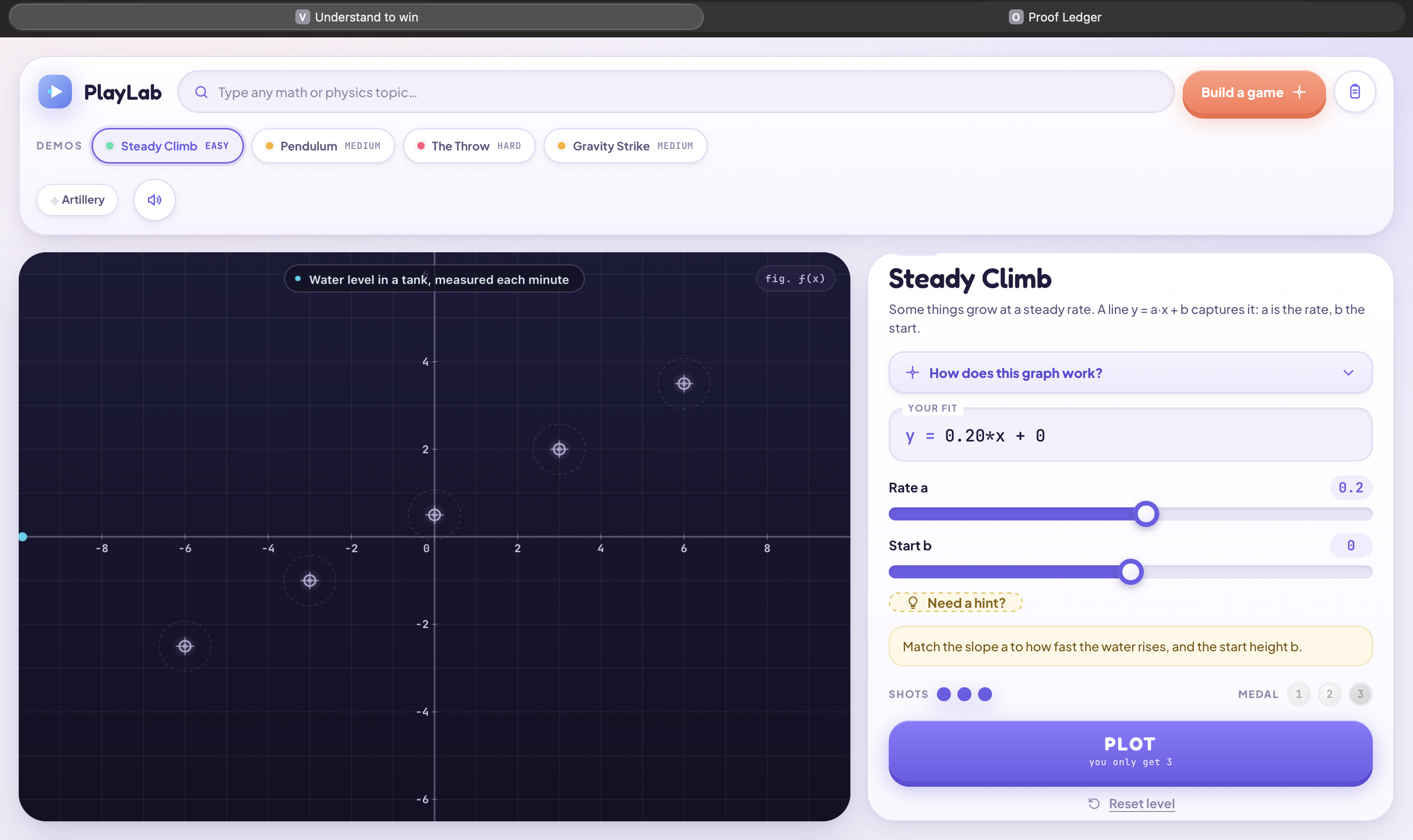
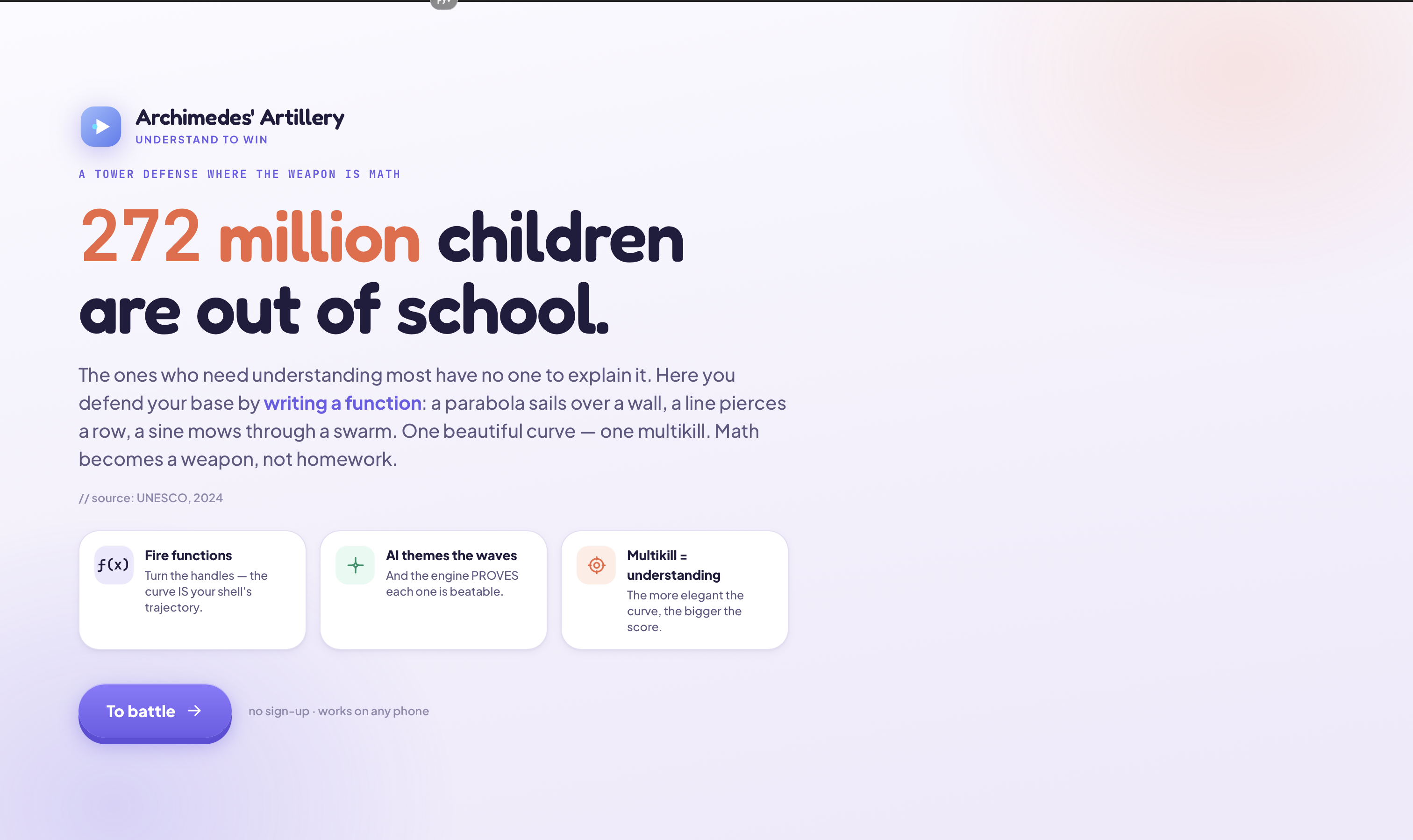
First: 272 million children are out of school (UNESCO). Even in classrooms, math is taught as symbol-pushing, a student can solve ( a\sin(bx) ) on paper but cannot tell you what it looks like in the world.
Second: everyone is rushing to generate education with LLMs, and nobody talks about the obvious failure mode. A hallucinated level is an unbeatable level. A kid who loses to a broken level doesn't learn math — they learn to quit.
I wanted the AI's creativity, but I never wanted to hand it the truth. Archimedes defended Syracuse with mathematics. That felt like the right hero.
What it does
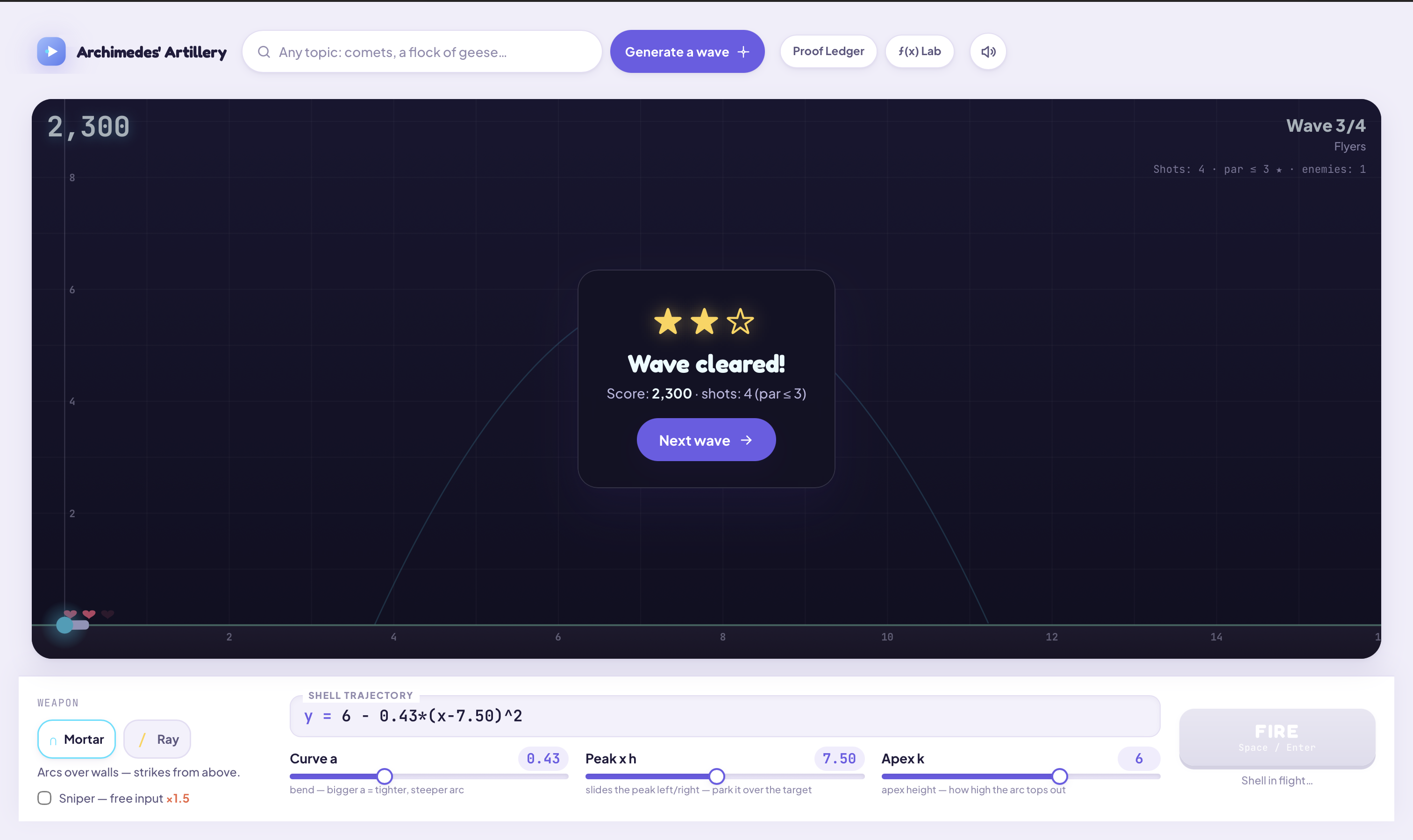
It's a tower defense where the cannon has no aim button. You write the function, and the shell flies along your graph. Shape a curve with sliders or type a formula like ( 0.5 - 0.05(x-6)^2 ), and the trajectory is the function. One parabola can solve three enemies at once.
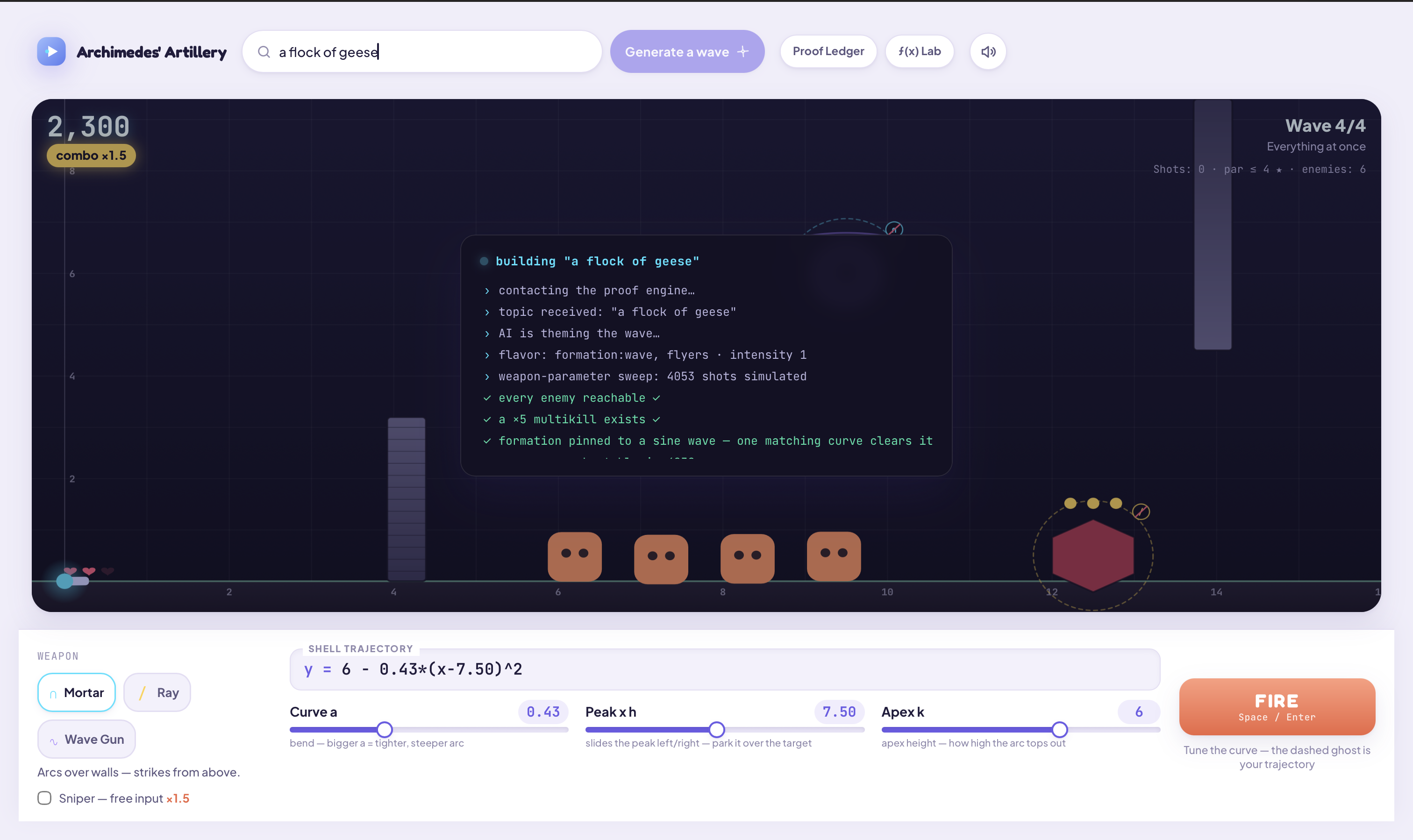
Enemies move along curves drawn from real phenomena. To hit a flock of geese pinned to a sine wave, you have to understand a sine wave. Understanding is the win condition.
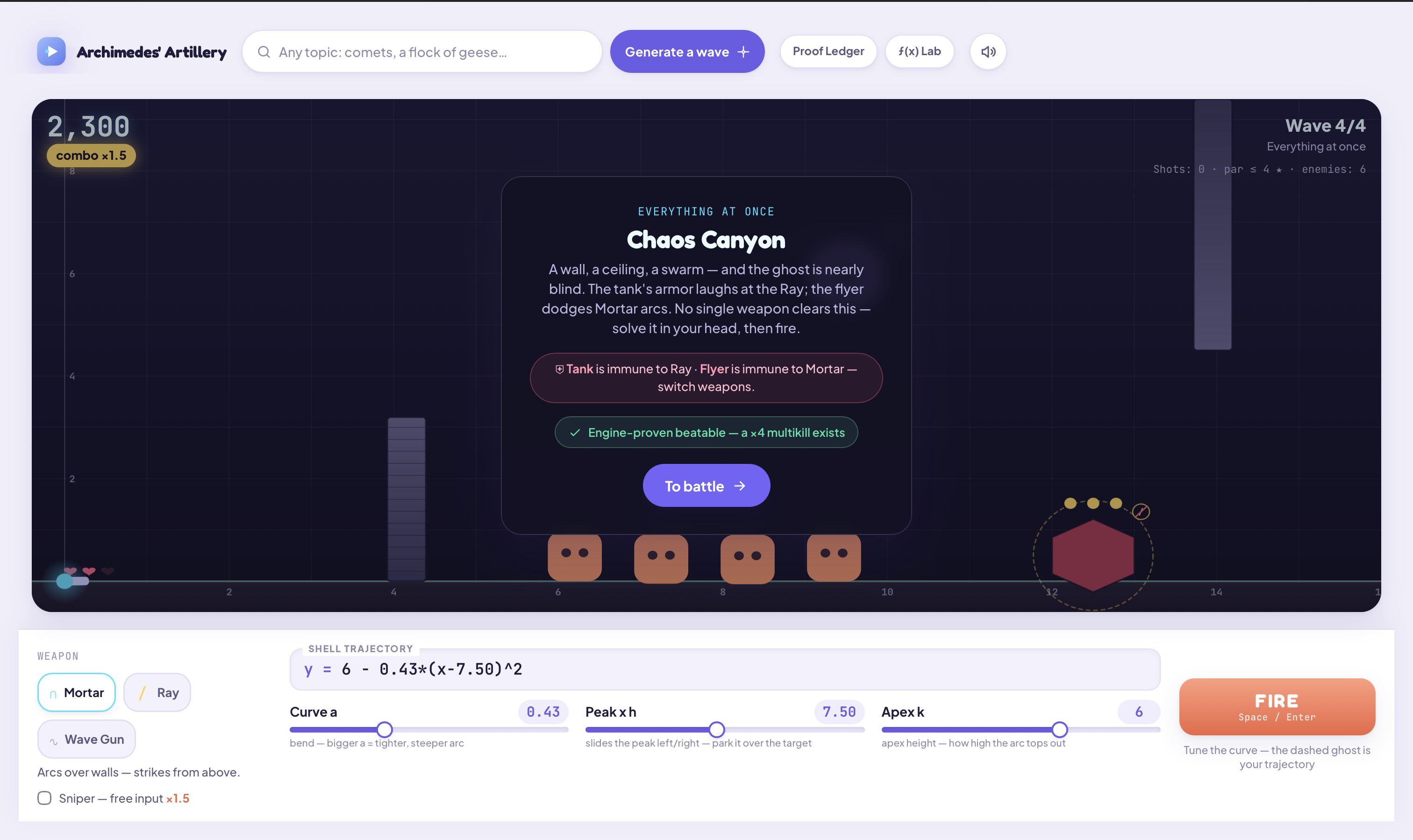
Type any topic and an LLM themes the next wave around it. But before a wave reaches you, a deterministic verifier, the same engine that runs in your browser, simulates thousands of shots and proves at least one function beats it. Failed generations are rejected and retried; non-phenomena like my homework deadline get an honest refusal. Every verify and reject is written to a public Proof Ledger you can watch live.
How we built it
Solo, in vanilla JavaScript with HTML5 Canvas — ES modules, no framework, no build step.
The key decision was one shared engine. The same curve-sampling, physics, and collision code runs the game in the browser and the verifier on a Node backend. There is exactly one definition of "this shot hits", so the proof on the server is a proof about the real game, not about a model of it.
Math input goes through my own safe expression compiler : tokenizer → recursive-descent parser → closure tree, no eval. It doubles as the gate for LLM output: anything the parser rejects never reaches a player.
Frontend on Vercel, verifier backend on Render. Works on a phone, no sign-up.
Challenges we ran into
The biggest one became the thesis of the whole project.
I started by asking the LLM to generate full levels: coordinates, parameters, win conditions. It failed almost every time. Small models are confident and wrong about geometry, and nearly every generated level was unbeatable or degenerate.
Instead of reaching for a bigger model and hoping, I inverted the architecture. The LLM only proposes the theme and the law a phenomenon follows; my deterministic code computes everything that must be correct; the verifier has the final word. The flaw stopped being a bug and became the design.
A smaller but real one: a free-tier backend that falls asleep. I had to make generation so a cold start never blocks the gameplay loop, if the server is slow or down, the client falls back to offline generation running the same proof.
Accomplishments that we're proud of
- No unbeatable level can ever reach a player, by construction, not by hope. The Proof Ledger shows this publicly, including the rejections.
- The same prompt box that makes geese also says, honestly, "this is not a
phenomenon I can model", and I think the refusal demos better than the
success.
- One engine, two jobs, zero drift between what is verified and what is played.
- It's live, it runs on a phone, and a stranger can play it in ten seconds with no account.
What we learned
The right question for AI in education is not "how good is the model" — it's "what is the model allowed to decide". The moment I limited the LLM to creative choices and gave deterministic code authority over correctness, a 7B model became reliable enough to ship.
Also: building the verifier first made every other feature cheaper. I could let the AI be wild because the gate was strict.
What's next for PlayLab
Hyperbolas and damped sines as weapons. Intercept missions where you solve ( f(x) = g(x) ). Shielded enemies keyed to slope is a quiet way into derivatives. And a classroom mode where one topic builds the same verified wave for a whole class, turning the understanding map into a live picture of what the room is confused about.
Built With
- canvas
- es-modules
- featherless-ai
- html5
- javascript
- node.js
- qwen2.5
- render
- vercel


Log in or sign up for Devpost to join the conversation.